
 Ask ChatGPT
 Ask Perplexity
 Ask Claude
 Prefer us on Google
Introduction
If you write your own sales emails, you already know the uncomfortable truth: most of them don't get a reply on the first try. That's not a sign your email failed. It's the default. The gap between people who follow up and people who don't is one of the more reliably measurable things in outbound sales.
Campaigns that include follow-ups average an 8.3% reply rate. Campaigns that send one email and stop average 4.1% (Woodpecker, 2026). In a separate, larger study of 12 million outreach emails, adding a single follow-up lifted total replies by 65.8% over sending the initial email alone (Backlinko, in partnership with Pitchbox, 2019). The follow-up isn't a backup plan. For most senders, it's where the majority of replies actually come from.
Key takeaways
- Follow-ups work: campaigns with 3-5 follow-up steps average an 8.3% reply rate versus 4.1% for single-touch outreach, and adding one follow-up alone can lift total replies by 65.8% (Woodpecker, 2026; Backlinko/Pitchbox, 2019).
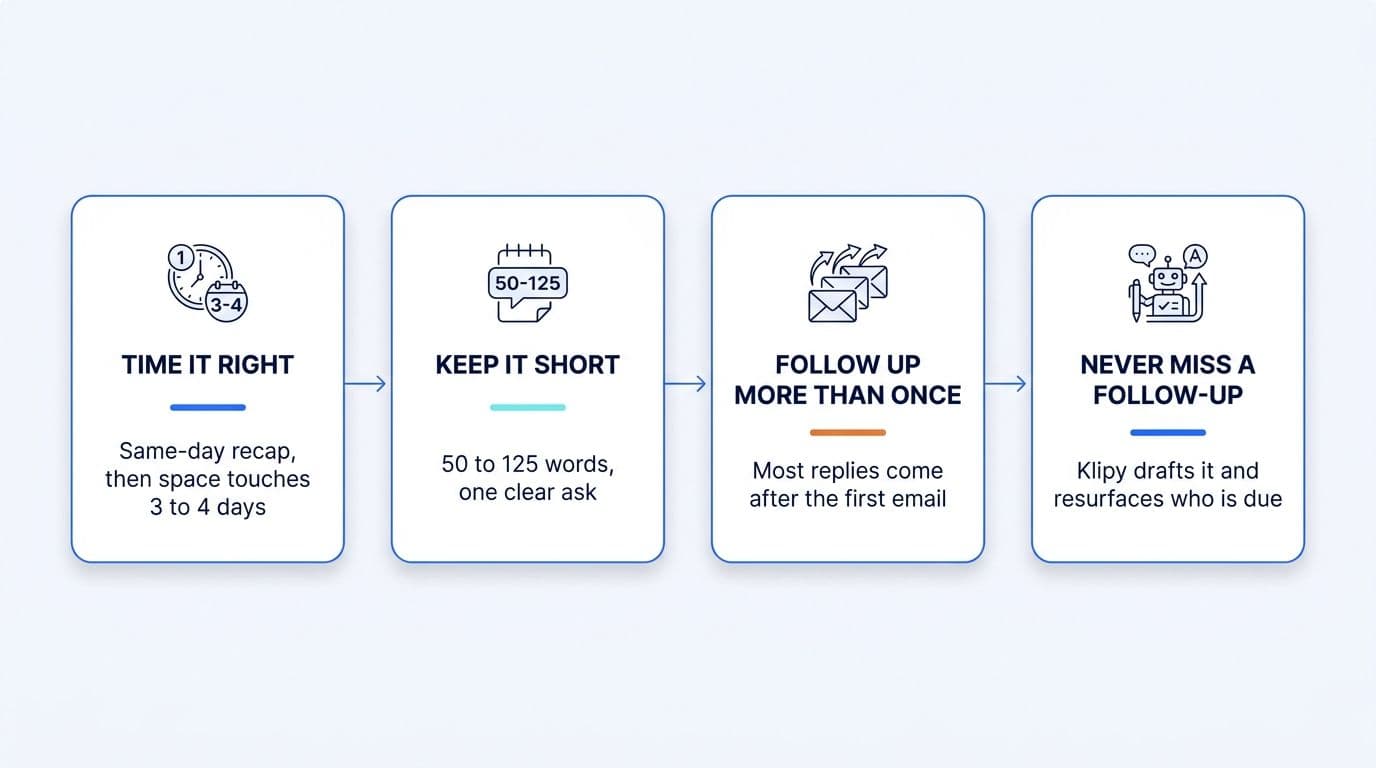
- Wait 2-3 business days before the first cold follow-up, but respond within minutes if a prospect replies to you first; response speed has an outsized effect on whether a lead converts.
- Plan for 4-7 total touchpoints and stop after about 4 follow-ups: spam-complaint and unsubscribe risk roughly triples past that point (Woodpecker, 2026).
- Keep follow-ups to 50-125 words with 1-3 specific questions; that combination gets meaningfully higher reply rates than longer, question-free emails (Boomerang, 2016).
- Personalized subject lines beat generic ones by a wide margin, in some datasets more than doubling reply rates (Belkins/Reply.io, 2025; Snov.io, 2026).
- For most owner-sellers, the real bottleneck isn't what to say. It's remembering who's due for a follow-up and drafting it on time between everything else running the business.
Do you need to follow up on a sales email?
Yes, almost always. Sequences with follow-ups roughly double reply rates compared with single-touch outreach: campaigns with no follow-up average a 4.1% reply rate, versus 8.3% for campaigns with 3-5 follow-up steps (Woodpecker, 2026). The 12-million-email Backlinko and Pitchbox study found the same pattern at a larger scale: one follow-up alone increased total replies by 65.8%.
[CHART: Bar chart, reply rate by follow-up count, 4.1% with no follow-up vs. 8.3% with 3-5 follow-up steps, source: Woodpecker, 2026]
Someone running their own pipeline usually isn't skeptical that follow-ups work. The real problem is that tracking who needs one, and when, competes with actually doing the work that pays the bills. That's a real constraint, not a discipline problem. The rest of this guide, plus the automation options in the final section, is built around closing that gap.
How long should you wait before following up?
Wait 2-3 business days after a cold email before sending your first follow-up. That gives a prospect time to see and consider your message without letting it go cold. It's a practical default, not a hard rule: shorten it for time-sensitive offers, extend it slightly for senior or slower-moving buyers.
Once a prospect replies to you, the calculation changes. Respond quickly. Research into inbound lead response (not outbound email cadence, but relevant to the underlying principle) found that the odds of qualifying a lead dropped 21-fold when the first contact attempt slipped from 5 minutes to 30 minutes after the lead came in (InsideSales.com, in partnership with MIT Sloan School of Management, Dr. James Oldroyd, 2007). That study measured phone response to inbound web leads, not email follow-up timing, so treat the exact multiple as directional rather than an email-specific benchmark. The underlying point still holds for email: once someone engages, momentum decays fast, and a same-day or same-hour reply keeps a conversation alive that a next-week reply often can't revive.
Keep those two clocks separate. "Time before your first follow-up" (days) and "time to respond once they reply" (minutes to hours) are different problems with different stakes.
[INTERNAL-LINK: full follow-up timing and cadence breakdown → dedicated spoke on day-by-day cadence for cold, warm, and inbound sequences]
How many follow-ups should you send?
Plan for 4-7 total touchpoints, meaning your initial email plus 3-6 follow-ups. That's the range where reply rates peak: campaigns with 3-5 follow-up steps average an 8.3% reply rate, close to double the 4.1% average for single-touch campaigns (Woodpecker, 2026).
Stop around touch 4 or 5. Beyond about 4 follow-ups, the same Woodpecker analysis found spam-complaint and unsubscribe risk roughly triples. That matters beyond the one prospect who unsubscribes: Google's own Gmail guidance treats any sender of 5,000-plus messages a day to personal Gmail accounts as a "bulk sender" subject to enforcement, and recommends keeping spam-complaint rates under 0.1%, with 0.3% as a hard ceiling above which Google withdraws deliverability support (Google, Gmail Workspace Admin Help, 2024). An owner-seller sending from a personal-feeling inbox has less room for error here than a large sequencing platform does; a handful of spam complaints can do outsized damage to a domain that isn't sending high volume to begin with.
[CHART: Line chart, reply-rate and risk curve by touch number, showing gains through touch 4-5 and rising spam/unsubscribe risk after touch 4, source: Woodpecker, 2026]
| Touch | Typical timing | Goal |
|---|---|---|
| 1 (initial) | Day 0 | Introduce the specific reason you're reaching out |
| 2 | 2-3 business days later | Add one new piece of value or proof |
| 3 | 3-5 business days after touch 2 | Reframe around a likely objection |
| 4 | 4-6 business days after touch 3 | Ask a direct, low-effort question |
| 5 (final) | 5-7 business days after touch 4 | Send a short breakup email and close the loop |
What should a follow-up email actually say?
Keep it short, reference the earlier email in one line, add something new, and ask a specific question. In an analysis of 40 million emails, messages in the 50-125 word range got response rates above 50%, peaking near 51% at 75-100 words; emails that asked 1-3 questions were 50% more likely to get a reply than emails with no questions at all (Boomerang, 2016).
The 3-part structure that works at every stage
- Reference, one line. "Following up on my note from Tuesday about [topic]." Not a resend, and not a recap of the entire original email.
- New value, one addition. A result, a quick answer to a likely concern, or a resource you didn't include the first time. Most follow-ups skip this step, and it's what makes a follow-up read as a new, worthwhile message instead of a nag.
- One question. Specific and easy to answer, ideally yes/no or either/or. "Worth a 15-minute call this week?" beats "Let me know your thoughts."
The pattern to avoid: "just checking in" or "circling back" with nothing new attached. It restates the ask without giving the reader a new reason to respond, which is exactly the version of a follow-up that reads as pressure rather than value.
Follow-up email templates for every stage
Use a different template for each touch. Each one below stays under 125 words and asks one clear question, in line with the word-count and question-count data above.
Touch 2: the new-information follow-up
Subject: Quick add to my last note
Hi [Name],
Following up on my note from [day] about [specific topic]. Since then, [one new detail: a relevant result, a quick stat, or something specific to their business].
Worth 15 minutes this week to see if it's a fit?
[Your name]
Touch 3: the objection-reframe follow-up
Subject: In case [likely objection] is the holdup
Hi [Name],
I know [common concern, e.g. "budget timing" or "switching tools"] is usually the thing that stalls a decision like this. Here's how [specific detail addressing it] tends to play out for teams your size.
Does that change anything, or is the timing just off right now?
[Your name]
The sales-call follow-up
Send this the same day as the call, not the next morning. It opens with a one-line recap, restates the specific next step and who owns it, and links anything you promised. For the full same-day template and why timing matters this much right after a call, see follow-up email after a sales call: the same-day template that gets replies.
The breakup email (final touch)
Subject: Should I close this out?
Hi [Name],
I haven't heard back since [day], so I'll assume now isn't the right time. I'll stop reaching out, but if [specific trigger, e.g. "budget opens up" or "the project restarts"] changes that, just reply and I'll pick it back up.
[Your name]
[INTERNAL-LINK: full template library by industry and deal stage → dedicated spoke with additional follow-up email templates]
What subject line and tone get the most replies?
Personalized subject lines outperform generic ones by a wide margin. In a dataset of 5.5 million B2B emails, personalized subject lines achieved a 46% open rate versus 35% for non-personalized ones, and reply rates more than doubled, from 3% to 7% (Belkins, in partnership with Reply.io, 2025). A separate, larger dataset (10 million-plus emails, including a 44 million-plus-email subset from February-March 2025) found a 20.79% open rate for personalized subject lines versus 14.96% for generic ones (Snov.io, 2026). The exact lift varies by dataset, but the direction doesn't: naming the person, their company, or the original topic beats a generic line like "Following up" every time it's been measured.
[CHART: Grouped bar chart, personalized vs. generic subject line open and reply rates, two datasets labeled separately, sources: Belkins/Reply.io 2025 and Snov.io 2026]
A few formulas that work without sounding like a template:
- "[Topic] + [Name]," for example "Onboarding timeline, Sam"
- "Quick question about [Company]"
- "Following up on [specific thing discussed]"
Tone matters as much as the words. Keep it conversational and specific. Skip false urgency ("last chance," "final notice") in a first or second follow-up; it reads as a sequence, not a person, and undercuts the personalization that's doing the actual work.
Cold vs. warm follow-ups: what changes
Cold follow-ups need more patience and more new value per touch, since there's no relationship to draw on yet. Warm follow-ups, meaning a prospect who has replied once, met you, or came through a referral, can be shorter and more direct, because some trust already exists.
The core mechanics (reference, new value, one question) stay the same either way. What changes is spacing (cold can tolerate longer gaps between touches; warm should move faster while the context is fresh) and how much new value each message needs to carry (cold follow-ups do more convincing per line; warm follow-ups can lean on the existing relationship and get straight to the ask).
[INTERNAL-LINK: cold vs. warm follow-up playbooks → dedicated spoke comparing cadence and copy for each]
How to follow up after no response without sounding needy
Don't repeat the original email, and don't ask "did you see my last email?" Both signal that you have nothing new to say, which is the exact impression a follow-up should avoid. Instead, reference the earlier message in one line, add something new, and end with a specific, easy-to-answer question.
Here's what that looks like in practice:
Subject: Quick follow-up, [Name]
Hi [Name],
Following up on my note from [day] about [specific topic/benefit]. Since then, [new detail: a related result, an answer to a likely question, or a resource link].
Worth a quick 15-minute call this week, or should I check back next quarter?
[Your name]
This version stays short, adds something the reader hasn't seen, and closes with an either/or question that's genuinely easy to answer. That structure is why the 65.8% reply lift from adding a single follow-up shows up in the data (Backlinko/Pitchbox, 2019): the reply comes from following up with something new to say, not simply from following up again.
Common follow-up mistakes that kill replies
- Sending too many touches with no new information. Repetition without new value turns a follow-up into a nag; reply rates come from the new value in the message, not from resending the old one.
- Vague, generic subject lines. Personalized subject lines outperformed generic ones by 20-plus percentage points to more than double in reply rate, across two separate datasets (Belkins/Reply.io, 2025; Snov.io, 2026).
- Waiting too long, or replying too fast, at the wrong moment. A 2-3 business day gap works for a cold first follow-up; once a prospect replies, that window should shrink to minutes, not days.
- Writing long emails with no clear ask. The 50-125 word range with 1-3 questions gets meaningfully higher reply rates than longer, question-free messages (Boomerang, 2016).
- Pushing past 4 follow-ups. Spam-complaint and unsubscribe risk roughly triples beyond that point, which can damage deliverability for every email you send afterward, not just that one thread (Woodpecker, 2026).
Why owner-sellers struggle to follow up, and how to fix it without a sales ops team
For most owner-sellers, knowing what to say is rarely the obstacle. Remembering who's due for a follow-up, when, and what was already sent, on top of delivery work, hiring, and everything else running the business, is the harder part. Sellers already spend only about 40% of their workweek actually selling, with the rest going to admin, data entry, and internal work (Salesforce, State of Sales, based on a survey of 4,050 sales professionals across 22 countries, 2026). For someone running the whole sales process solo, that ratio is even harder to escape, since there's no one else to hand the tracking to.
Sellers are already turning to AI to close that gap: 54% report using AI agents today, and among those who do, agents cut prospect research time by roughly 34% and email drafting time by roughly 36% (Salesforce, State of Sales, 2026).
Klipy handles this specific part of the job. It reads the thread so far, whether that's an email exchange, a call transcript, or a note from a previous touch, and drafts the next follow-up with the right context already in it: what was already said, what's new to add, and when it's due. You review and approve each draft before anything sends. That's the mechanism behind follow-up drafts: it removes the part of this guide that's hardest to do manually, remembering and drafting on time, without taking the actual decision out of your hands. For a broader look at how the same approach extends to prospecting and outreach, see Klipy's AI agent for sales.
Frequently asked questions
How do you write a follow-up email after no response? Reference the original email by date or topic in one line, add one new piece of value you didn't include the first time, and close with a single low-effort question. Don't open with "just checking in" or resend the same email; a study of 12 million outreach emails found that adding one follow-up lifted total replies by 65.8%, but only when it read as a short, new message rather than a nag (Backlinko/Pitchbox, 2019).
How do you send a follow-up email? Reply in the same thread rather than starting a new one, send it 2-3 business days after your first email for cold outreach, keep it to 50-125 words, ask 1-3 questions, and use a personalized subject line. Personalized subject lines lifted open rates from 35% to 46% and reply rates from 3% to 7% in one dataset (Belkins/Reply.io, 2025), and produced a 20.79% open rate versus 14.96% for generic lines in another (Snov.io, 2026).
What is a good cold email follow-up cadence? Plan for 4-7 total touchpoints spaced a few business days apart. Campaigns with 3-5 follow-up steps average an 8.3% reply rate versus 4.1% for single-touch outreach, and stopping after about 4 follow-ups avoids the roughly tripled spam-complaint and unsubscribe risk that follows (Woodpecker, 2026).
What counts as an email follow-up, and when should you send one? Any message sent after an initial email that didn't get a response, meant to re-surface the ask without repeating it verbatim. Send the first one 2-3 business days after a cold email, and respond quickly if a prospect replies to you; response speed has an outsized effect on whether a lead converts, per research into inbound lead response (InsideSales.com/MIT, 2007).
What should a follow-up email template include? A personalized subject line, a one-line reference to the earlier email, one new value-add, and a single specific question, all kept under 125 words. That word range gets the highest reply rates in a 40-million-email analysis (Boomerang, 2016).
How do you write a sales call follow-up email? Send it the same day as the call. Open with a one-line recap of what was discussed and agreed, restate the specific next step and who owns it, and attach anything you promised. See follow-up email after a sales call: the same-day template that gets replies for the full template.
How many follow-up emails should you send after no response before giving up? Plan for 3-5 follow-ups after the initial email (4-7 total touches), then send one final breakup email that closes the loop. Beyond about 4 follow-ups, spam-complaint and unsubscribe risk roughly triples, so better timing and copy beat sheer volume past that point (Woodpecker, 2026).
What does a follow-up email after no response actually look like? Subject: "Quick follow-up, [Name]." Body: reference the earlier note by day and topic, add one new detail, and close with an easy either/or question, such as "worth a quick call this week, or should I check back next quarter?"
The bottom line
Following up doesn't separate good sellers from bad ones so much as it separates the emails that got sent from the ones that got remembered. The mechanics are simple: wait 2-3 business days, keep it short, add something new, ask one question, and stop after about 4 follow-ups. What's hard is doing it consistently while also running the rest of the business.
If tracking who's due, drafting the next message, and remembering what you already said is the part that keeps slipping, that's worth fixing directly rather than adding another manual step to your day. Start with the next email on your list: does it need a follow-up in 2-3 days, and do you know exactly what you'll add when you send it?