
 Ask ChatGPT
 Ask Perplexity
 Ask Claude
 Prefer us on Google
Introduction
How do you ask a happy client for a referral without a formal program?
Ask right after a real trigger, a milestone, an unprompted compliment, a strong NPS score, or a renewal, and frame the request as helping someone in the client's network rather than asking for a favor. No formal referral program is required. What actually breaks the habit for most owner-sellers and solo reps isn't the wording, it's remembering the moment happened and following through on both the ask and the handoff.
Referrals are one of the few sales channels where the seller doesn't have to convince anyone of anything. The client does the convincing. But most owner-sellers and solo reps don't have a referral program, an incentive structure, or a CRM workflow that reminds them to ask. What they have is a happy client, a busy week, and a moment that passes without anyone noticing. This guide is part of our guide to following up on sales emails, and it covers the mechanics of asking well: when to ask, how to phrase it, how often is reasonable, and what to do once a referral actually shows up.
Key takeaways
- A referred client carries a lifetime value at least 16% higher than a similarly-acquired non-referred client, and 92% of people trust a friend's recommendation over any ad, so one good referral ask is worth more than most cold outreach.
- The right moment is a trigger, not a date on the calendar: a milestone, an unprompted compliment, a strong NPS score, or a renewal, asked for while the win is still fresh.
- Reframe the ask as helping someone in the client's network, not as a favor to you: "Do you know anyone dealing with [the problem you just solved] I could help the same way?"
- There's no one-time limit on asking. Tie each new ask to a new moment, acknowledge any past referral, and it won't read as repetitive.
- Without a formal program, the wording is rarely the problem. What actually breaks is remembering that the moment happened, and following through on both the ask and the handoff.
Why a referral from a happy client is worth chasing down
Referred customers are worth more, for longer, than customers acquired almost any other way. A 2011 study published in the Journal of Marketing tracked referred and non-referred customers with matching demographics and acquisition timing at a German bank, and found the average value of a referred customer was at least 16% higher than a comparable non-referred customer (Schmitt, Skiera & Van den Bulte, Journal of Marketing, 2011). Referred customers cost less to acquire, stuck around longer, and spent more once they arrived.
That value gap traces back to trust. Nielsen's global advertising trust survey of more than 28,000 people across 56 countries found that 92% of consumers trust recommendations from friends and family above every other form of advertising (Nielsen, 2012). A referred lead arrives pre-sold on your credibility in a way a cold email or an ad impression never will.
None of that is news to anyone who has closed a deal off a warm intro. The harder question is what stops it from happening more often. Most sellers already know referrals are valuable, so that's not usually the gap. What's missing is a program that forces the ask, which means everything depends on someone remembering to do it at the right moment, in the right words, while also delivering the work that earned the referral in the first place.
When's the right moment to ask a happy client for a referral?
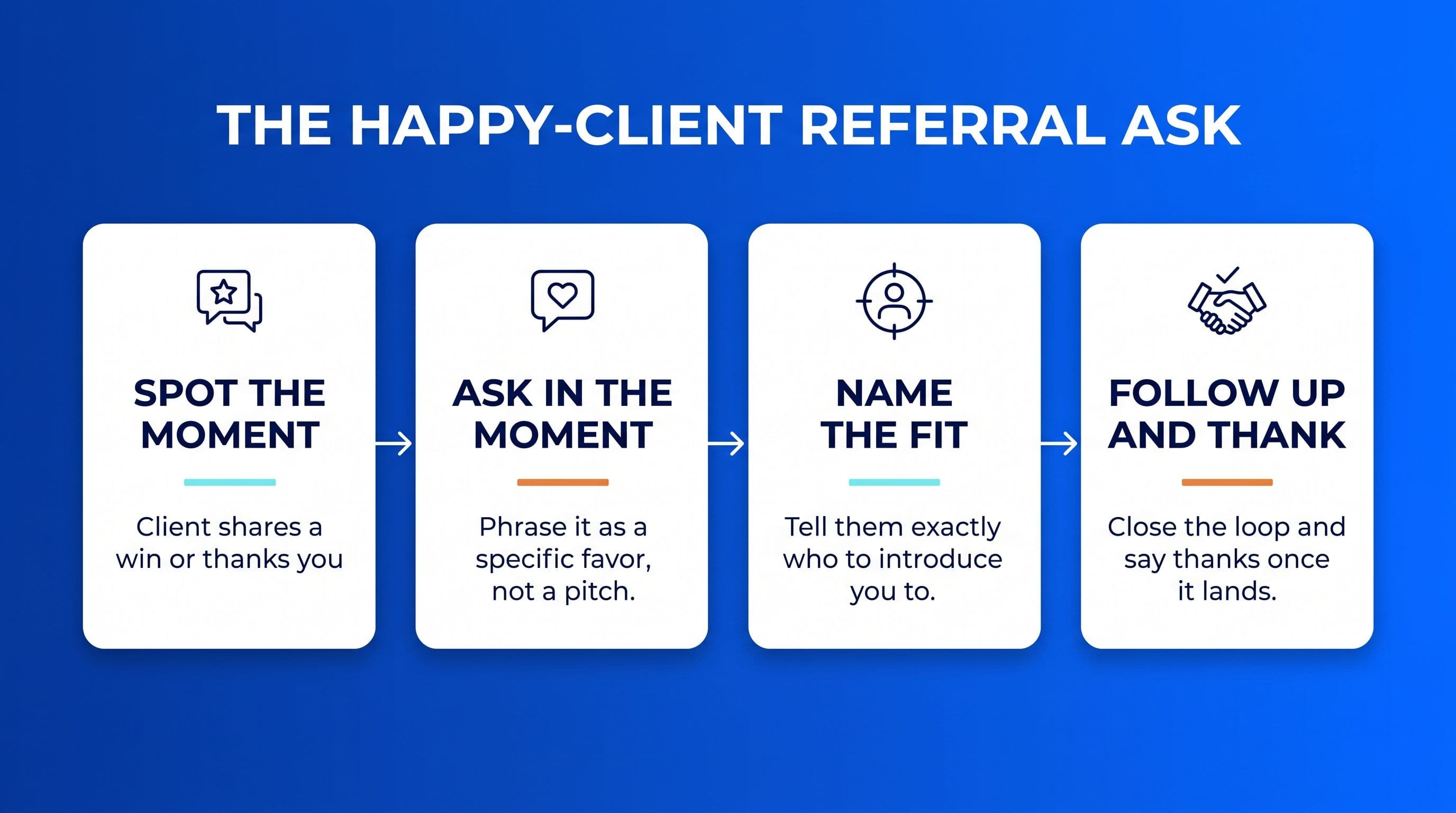
The right moment is a trigger, not a calendar date. Ask right after a client hits a milestone with your work, gives you an unprompted compliment, hands you a strong NPS score, or signs a renewal, while the win is still recent enough that they can describe it in their own words.
HubSpot's guidance for service teams makes the timing condition explicit: wait until the customer is actually seeing value and has experienced strong service before asking, and treat renewal conversations, positive NPS scores, or completed in-product milestones as the signal to make the ask (HubSpot Blog). Fast Company's reporting on solopreneur referral strategy frames the same idea from the other direction: a well-timed request feels natural, and a poorly timed one feels transactional, with past and current clients as the strongest source because they can point to a specific result (Fast Company).
For a solo seller without a scoring system, the practical triggers to watch for are:
- A milestone hit. The client's project launched, their numbers moved, or the outcome you promised actually showed up.
- An unprompted compliment. They said something positive without being asked, in an email, a call, or a Slack message.
- A strong NPS score or a "this is great" moment. ReferralCandy's guidance treats a 9 or 10 NPS response as proof of advocacy worth acting on immediately, and treats a repeat purchase the same way, as a signal the customer trusts you enough to vouch for you (ReferralCandy).
- A renewal. More on this below, because it's the trigger most solo sellers already have a reason to be in touch for.
Freshness matters because recall matters. Buyapowa's proprietary research into referral timing (a vendor study on consumer and e-commerce referrals, not a peer-reviewed B2B study, so treat it as directional) found the optimal window to ask sits between one and three days after a purchase or a positive experience, while sentiment and recall are still high (Buyapowa, "Referral Codebreakers" research). Wait a month and the client has to reconstruct why they were happy in the first place. Ask the same day, and they're still living in the feeling.
What doesn't work: asking on the invoice, asking during onboarding before there's a result to point to, or asking as a generic line at the bottom of every email regardless of what's actually happening in the relationship. Those aren't triggers. They're habits, and clients can tell the difference.
[IMAGE: A person reading a positive text message or email on their phone with a slight smile, warm natural lighting, symbolizing a happy-client moment - search terms: "reading positive message phone smile"]
Renewals are a recurring second chance
A renewal is one of the few referral triggers a solo seller can actually schedule around, because it's already on the calendar. The client has just re-committed, which is itself a vote of confidence, and the renewal conversation is a natural place to ask what's changed in their world since the last one, including who else might be dealing with the problem you originally solved for them.
A same-day template for turning a call into a fast follow-up is useful here too: the referral ask works best inside the same message thread as the renewal confirmation, not as a separate cold ask sent later.
How do you phrase the ask so it doesn't feel transactional?
Reframe the ask as helping someone in the client's network, not as a favor to you. "Is there anyone else you know who's dealing with [the problem you just solved] that I could help the same way?" consistently outperforms a direct, generic ask, because it puts the client in the position of doing someone a favor rather than doing you one.
Compare that to the version most owner-sellers default to. An analysis of insurance agent scripts found that a line like "Hey, do you know anyone who needs insurance?" reads as transactional and is easy to ignore, precisely because it's generic enough to apply to any client at any time (Agility/Enroll Insurance Blog, Brent Veazey). It names no specific result, no specific person, and no specific reason to act now.
The fix is specificity tied to what actually happened. HubSpot's recommended phrasing swaps "I was wondering if you'd give me a referral" for "Do you have anyone in your network who might benefit from [xyz] as well?", anchoring the ask to the exact outcome the client just experienced rather than a generic favor (HubSpot Blog). ReferralRock's version pushes the same reframe further: instead of "Can you refer me?", ask "Who do you think I should be talking to that I could help the same way I helped you?" (ReferralRock). Both versions do the same job: they replace a request for a favor with an offer to extend a result the client already vouched for.
Channel matters here too. A personal message, a call, or a face-to-face moment works better than a mass referral-request email sent to every past client at once, because the ask depends on a real, fresh moment rather than a template blasted out on a schedule. If email is the channel (and for a lot of B2B relationships, it still is), the same specificity rule applies: a referral request email that names the exact result and the exact kind of person you're looking for will get more traction than a generic line asking "if you know anyone."
Two scripts you can adapt
After a milestone or a compliment (in person or by message): "Really glad [specific result] worked out the way it did. Is there anyone else in your world dealing with [the same problem] that I could help the same way?"
In a renewal or check-in email: "Renewing feels like a good moment to ask: is there anyone in your network who's hitting the same wall you were before we started working together? Happy to help them the way I helped you."
Neither script mentions incentives or asks for a formal introduction. Both name the specific result and leave the client in control of who, if anyone, comes to mind.
How many times is it reasonable to ask the same client for a referral?
There's no fixed cadence or one-time limit on asking a happy client for a referral. It's an ongoing, moment-triggered conversation, so it's reasonable to ask again every time a new trigger shows up, not just once, ever. Sales trainer Mark Hunter frames this directly: don't treat referrals as a one-and-done event, make asking for them an ongoing conversation (The Sales Hunter).
The myth that a second ask is automatically pushy comes from confusing repetition with recurrence. Asking the same generic question every quarter is repetitive, and clients notice. Asking again after a new milestone, a new renewal, or a new compliment is a response to fresh evidence that the relationship is still working, not a repeat of the same request.
The real constraint is tracking, not etiquette. A solo seller with a dozen active clients can usually remember who they've asked and when without much trouble. Past thirty or forty relationships, that memory starts failing quietly, not because the seller stopped caring, but because there's no record of who was asked, when, or what came of it. The rule of thumb that solves this without a formal program: acknowledge any past referral before asking again ("thanks again for connecting me with [name], that was a great intro"), and tie every new ask to a new, specific moment rather than repeating the same request verbatim.
What do you do once the referral actually lands?
Treat the referral like a warm handoff, not a new cold lead. Respond within a day, name the person who sent them and what you did for them, and close the loop back to the person who referred them.
Reply within a day of the introduction, even if it's just a short placeholder note, and use the introducer's name in that first message so the new prospect feels the vouching land immediately: "[Name] mentioned you're dealing with [specific problem]. I helped them with exactly that, happy to do the same for you." That single line transfers the trust the client just handed you, and it's the opposite of the blank "thanks for reaching out" a cold lead usually gets.
Close the loop back to the person who referred them too, even if it doesn't turn into anything right away. A short "wanted to let you know I connected with [name], thank you again" costs one sentence and does two things at once: it confirms the referral landed somewhere instead of disappearing into a void, and it makes the client comfortable sending the next one. Referrals that go unacknowledged are the ones that don't repeat, not because the client stopped trusting you, but because they never found out whether the introduction was worth making.
Why does this still fall apart without a formal program?
It's rarely the script that trips people up. The reframed ask above works whether it's said out loud, typed into a message, or written into a renewal email. The real bottleneck is catching the trigger moment and following through on both the ask and the handoff while also running the rest of the business.
Here's what that looks like without a system: a client says something genuinely complimentary on a call, the call ends, the next meeting starts, and by the time there's room to think about it again the moment has cooled. Or the renewal gets signed and the conversation moves straight to onboarding logistics instead of the referral opener that belonged in that same thread. None of this happens because the seller doesn't understand referrals are valuable. It happens because nothing flagged the moment while it still mattered.
Klipy reads every call, email, and renewal date automatically and flags the trigger moments this article describes, a milestone hit, an NPS-worthy compliment, a renewal coming due, then drafts the referral ask in the seller's own voice, tied to the specific result the client just got. The draft waits for approval before it goes anywhere, so the only decision left is whether to send it. Klipy turns every win into the next one, including the referral that's currently living inside a compliment nobody wrote down.
The bottom line
A referral from a happy client converts better than almost anything else a solo seller can chase, and the value gap (at least 16% higher lifetime value, per the Journal of Marketing study cited above) comes from a level of trust a cold lead simply doesn't arrive with. The ask works best tied to a real trigger: a milestone, a compliment, an NPS score, a renewal, and phrased as an offer to help someone in the client's network rather than a favor to you. There's no cap on how many times you can ask, as long as each ask is tied to a new moment and any past referral gets acknowledged first. And the handoff after the "yes," a fast, warm introduction plus a loop back to the person who made it, is what earns the next one.