2026 data report
The cost of being the only salesperson: the real price of founder-led sales
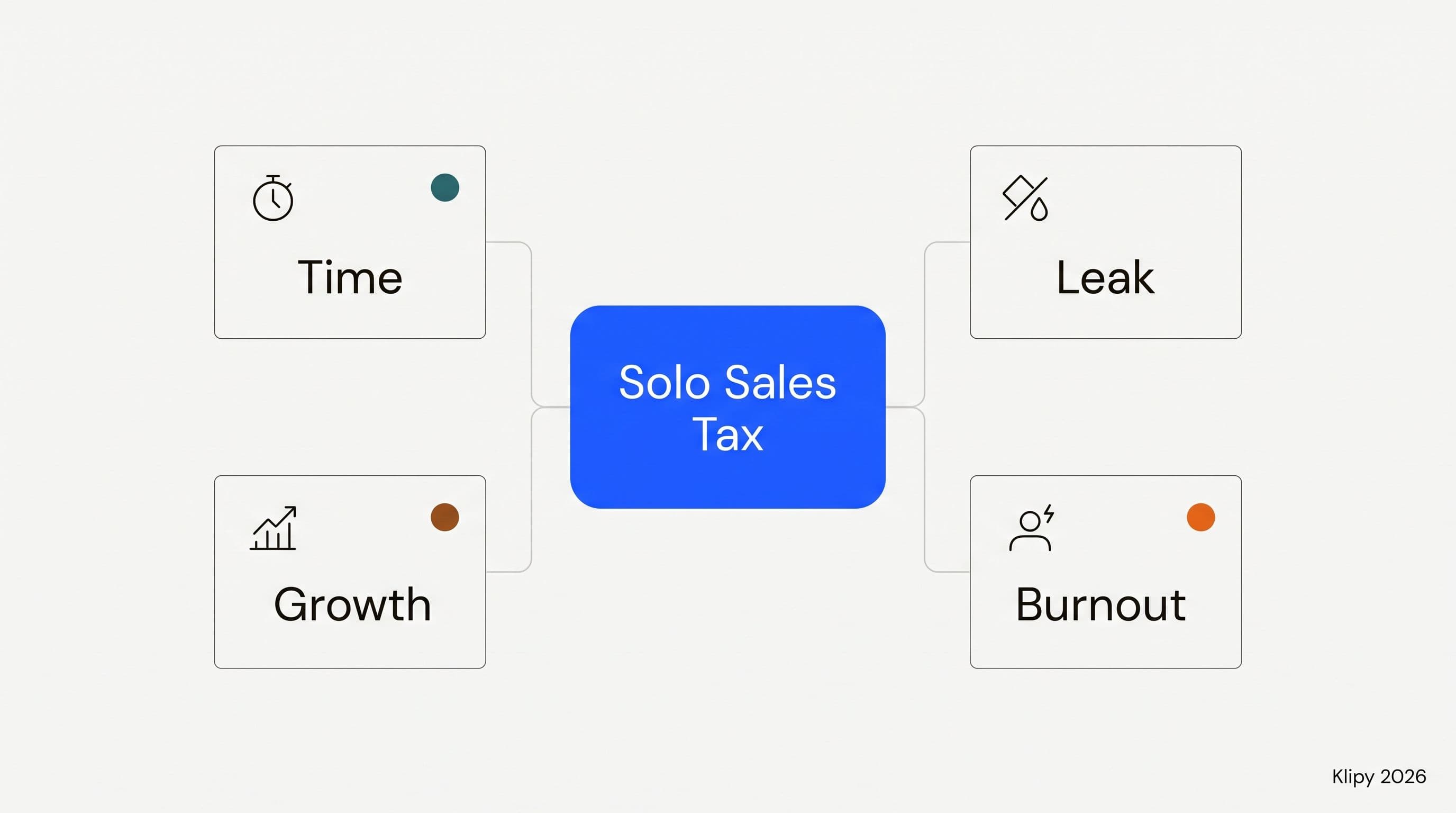
The Solo Sales Tax is the compounding cost a founder pays for being the only salesperson, measured in time lost, deals leaked, growth slowed, and burnout. This 2026 report puts a number on it.
Founder-led sales works early and often works well: the founder knows the product and the buyer better than any hire could, and the first hundred deals frequently close because the founder is in the room. This report is not an argument against that motion. It is an accounting of what the motion costs once demand outgrows one person's hours, and a framework for pricing a bill that never appears on an invoice.
 Jung-Hong KimCo-founder & CEO, KlipyPublished August 9th, 2026
What is inside: the four-driver framework, sourced charts, and an interactive calculator that turns your own inputs into an annual figure.
Executive summary
The paradox at the centre of the data is stark. Founder-led public companies have delivered roughly 2.1 times the total shareholder return of their peers since 2015, and 2.6 times among technology companies (Bain, The Magic of Founder-led Companies, 2026). The same intensity that lifts the company drains the one person running every sales job at once, and that drain shows up in four measurable places. A founder spends selling hours that could build the product. Slow follow-up leaks pipeline that a solo seller cannot recover. Single-channel selling under-serves most of the market. And the human load compounds until it caps the business at one person's capacity.
The single headline finding sets the register for everything that follows: 72% of founders say building the company damaged their mental health (Startup Snapshot, 2023). Sales is one of the heaviest and most relentless loads a founder carries, and for most owner-led businesses it never leaves their desk. This report adds up that load using public, sourced data, names the four drivers, marks the line where selling solo starts to cost more than it saves, and closes with a calculator that turns your own inputs into an annualised figure.
- of founders say building the company damaged their mental health
72%
of founders say building the company damaged their mental health
Startup Snapshot, 2023
- of B2B purchases stall at least once before a decision
91%
of B2B purchases stall at least once before a decision
Forrester, 2024
- of the week is all a rep actually spends selling
28%
of the week is all a rep actually spends selling
Salesforce, 2023
- total shareholder return for founder-led public companies
2.1x
total shareholder return for founder-led public companies
Bain, 2026
Prefer to skip to your own number? Run the numbers on your own business with the Solo Sales Tax calculator.
Market context
Why the one-human-seller model is under pressure now
The moment matters because the buying side has already moved away from the single-seller model, and the selling side is re-tooling around it. Two structural shifts frame why the cost of founder-led sales is worth quantifying in 2026 rather than treating as a timeless founder rite of passage.
61% of B2B buyers now prefer a rep-free buying experience for at least part of the journey (Gartner, 2025).
The first shift: buyers self-qualify before they talk to anyone
The first shift is buyer preference. Buyers research, compare, and self-qualify before they ever speak to a person, which changes what a seller is for. The seller no longer controls the information flow. They arrive late, into a process the buyer has largely run alone, and they win or lose on responsiveness and relevance rather than on gatekeeping. For a lone founder, that means the few moments when a buyer does want a human have to be caught precisely, because there is no second chance and no colleague to cover the gap.
The second shift: buying is slower, more crowded, and stalls
The second shift is that buying has become slower, more crowded, and more prone to stalling. 91% of B2B purchases stall at least once before a decision is reached (Forrester, State of Business Buying, 2024). The same research, drawn from more than 16,000 buyers, found that 81% of buyers were dissatisfied with the provider they eventually chose, and that the typical buying group now involves around 13 people. A purchase is no longer a conversation between a founder and a champion. It is a committee process with multiple stalls built in, and each stall is a point where an under-resourced seller loses momentum they cannot easily rebuild.
The tooling response: pair sellers with software, not headcount
Against both shifts, the tooling response has been to pair sellers with software rather than to add headcount. A large and growing share of sales teams already use or are piloting AI in the workflow (Salesforce, State of Sales, 2024). The direction of travel is clear: the market is re-organising around buyers who self-serve, purchases that stall, and sellers who are augmented. A founder selling entirely alone, with no augmentation and no redundancy, is running against all three currents at once.
The paradox
Founder-led companies win while founder-led sales taxes the founder
Founder-led companies outperform at the company level, and that success is exactly what hides the cost at the selling level. This tension is the spine of the report, so it is worth stating plainly before pricing any driver.
Founder-led public companies have delivered around 2.1 times the total shareholder return of their peers since 2015, and 2.6 times among technology companies (Bain, The Magic of Founder-led Companies, 2026).
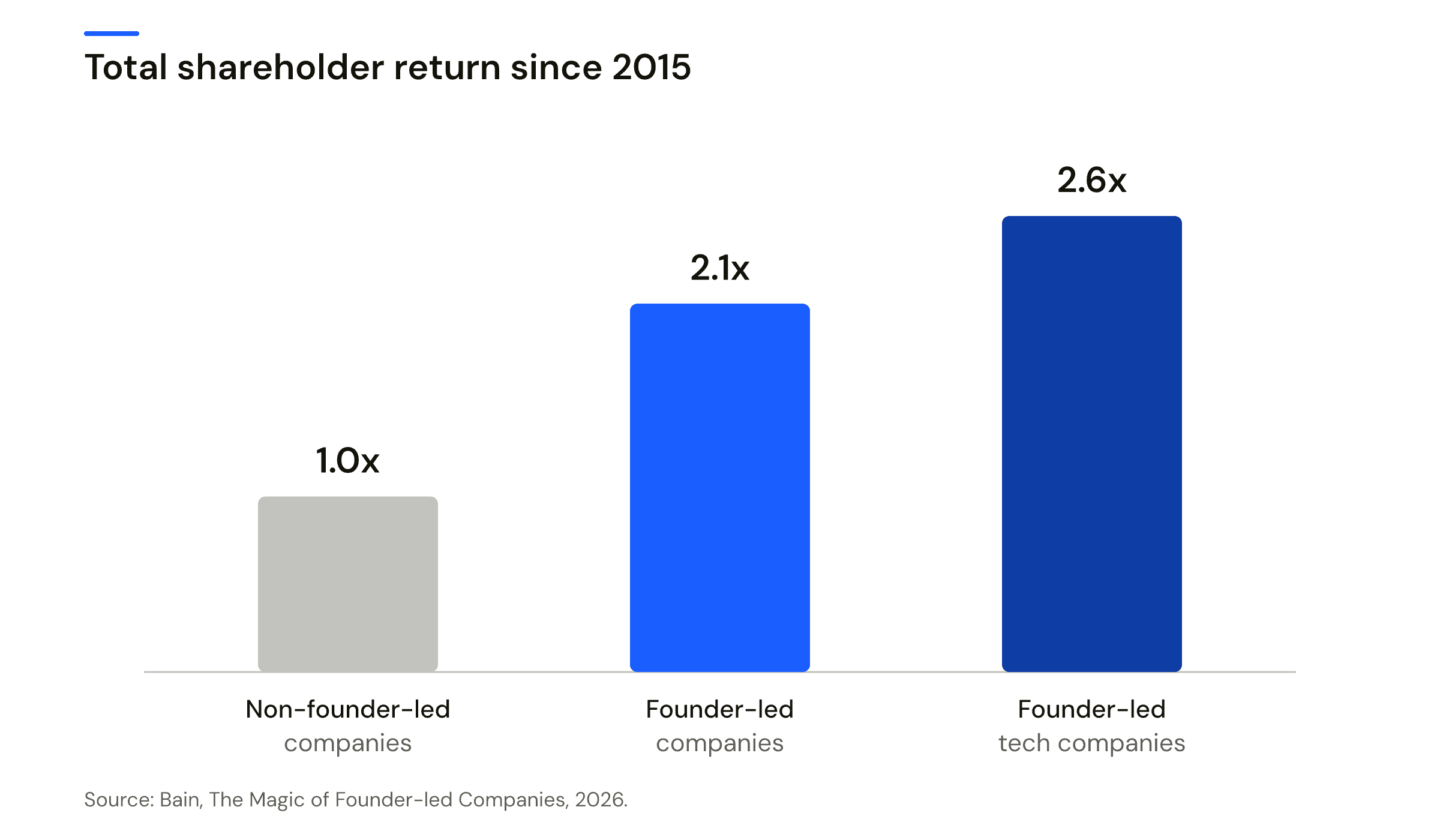
Why founder-led companies outperform
Bain's analysis, built on S&P Capital IQ and Refinitiv data, credits the usual founder virtues: faster decisions, longer conviction, closer proximity to the customer, and a willingness to hold an unpopular strategy through the quarters it takes to work. The founder who personally wins the first hundred deals is often the reason the company exists at all, and the early founder-led sales motion is a large part of how that proximity to the customer is earned.
How the company win hides the cost on one person
The strength of that headline is also the trap. Company outperformance is measured across the entire business: every employee, every product line, every market. The Solo Sales Tax is measured on one person. The same intensity that lifts the company weighs on the individual doing every sales job at once, because that individual cannot be cloned, reassigned, or backfilled overnight. A company can carry a founder's conviction across a thousand people. A pipeline cannot carry a founder's calendar across more than one.
Two readings of the same fact
So the honest answer to "are founder-led companies more successful?" is that many are, and the founder frequently pays for that success in a currency the balance sheet does not track: their own time and health. Outperformance at the top and a hidden tax at the bottom are two readings of the same fact. The rest of this report is about the second reading, which the celebratory version of founder-led sales tends to skip.
A pipeline cannot carry a founder's calendar across more than one.
The framework
What is the Solo Sales Tax? The four-driver framework
The Solo Sales Tax is the total, compounding cost of a founder being the only salesperson, and it breaks into four drivers you can measure.
Reps spend only about 28% to 30% of a working week actually selling, with the rest lost to admin, data entry, and internal meetings (Salesforce, State of Sales, 2023).
Why naming the tax matters
Naming it matters because most owners feel the drag without ever pricing it, and a cost you cannot see is a cost you cannot manage. The tax is not a single event. It is a rate that applies to every week the founder remains the entire sales department, and it compounds because each driver worsens the others.
The time constraint underneath the whole framework
The floor for the whole framework is a time constraint that applies even to people who do nothing but sell. That figure describes professionals whose entire job is sales. A founder splitting attention across product, hiring, delivery, and operations starts from a thinner slice and loses more of it to context-switching. Everything below flows from that squeeze.
The four drivers of the Solo Sales Tax:
Time tax
Founder hours spent selling instead of building or delivering. This is an opportunity cost that never appears on a profit-and-loss statement, because the founder's own time is not booked as an expense.
Leak tax
Pipeline lost to slow or missed follow-up, and to stalls that go unmanaged, when one person cannot cover every lead in time. The leak is invisible because it is made of conversations that never happened.
Growth tax
The scaling penalty of a single seller running a single channel past the point where the motion should be handed off, structurally under-serving the buyers who want a different path.
Burnout tax
The human and continuity cost of a single-point-of-failure pipeline that stalls the moment the founder steps away, and the personal toll of carrying a relentless load alone.
Why the four drivers compound
The drivers compound. A time-starved founder follows up slowly, which widens the leak. A widening leak pushes the founder to work more hours to compensate, which feeds burnout. Burnout narrows the selling window further, which caps growth. No single driver breaks the business. The interaction between them is what caps it at one person's capacity.
Warning signs of a founder sales bottleneck
- Deals stall whenever you are heads-down on product or delivery.
- Leads sit unanswered for a day or more because you were in a meeting or a build.
- You cannot name your follow-up cadence, because there is not one.
- Revenue tracks your personal availability week to week.
- No one else could run a deal end to end if you stopped tomorrow.
Time tax
How much of a founder's week the sale actually gets
Less of the founder's week reaches a prospect than most owners assume, because selling is one of five or six roles competing for the same calendar. The hours that reach a buyer are the hours left over after everything else, and the data on how a working week decomposes shows how thin that residue is.
Reps spend only about 28% of the working week actually selling, with the remainder going to admin, data entry, and internal meetings (Salesforce, State of Sales, 7,775 professionals, 2023).
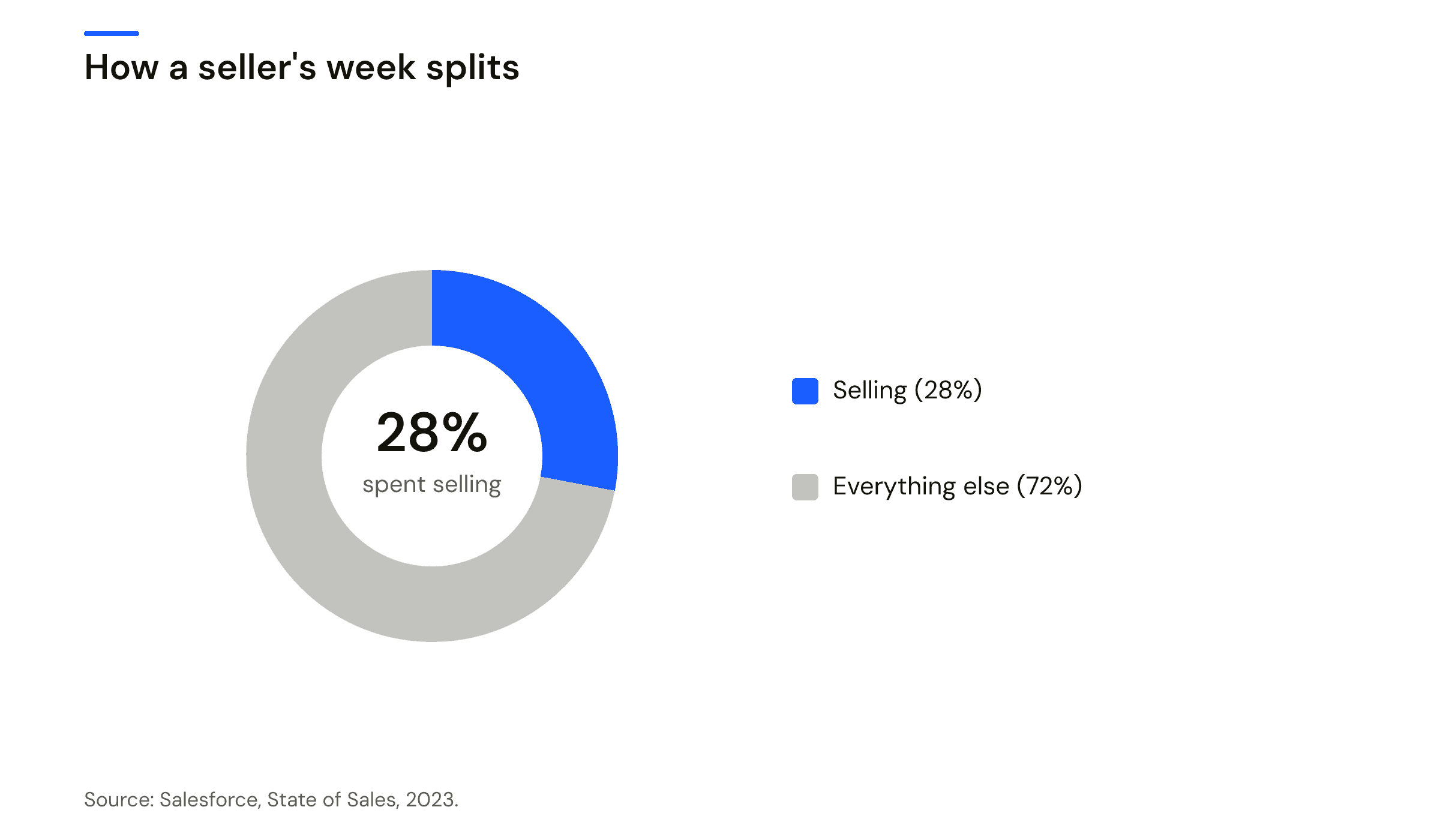
A founder starts from a thinner slice than a rep
That is the benchmark for people whose entire job title is sales. A founder does not start there. A founder starts from a week already claimed by product decisions, hiring, customer delivery, finance, and operations, then tries to fit selling into what remains.
The same squeeze, seen from the buyer's side
Small-business owners work around 54 hours a week on average (CFIB, 2023), and lose an estimated 1.5 hours a day of productivity, including to context-switching between tasks (Salesforce and Slack, 2024). The founder's selling window is not just smaller than a rep's. It is more fragmented, and fragmentation is where selling quality degrades fastest, because a sales conversation resumed cold after an interruption is a weaker conversation.
The cost owners accept but rarely price
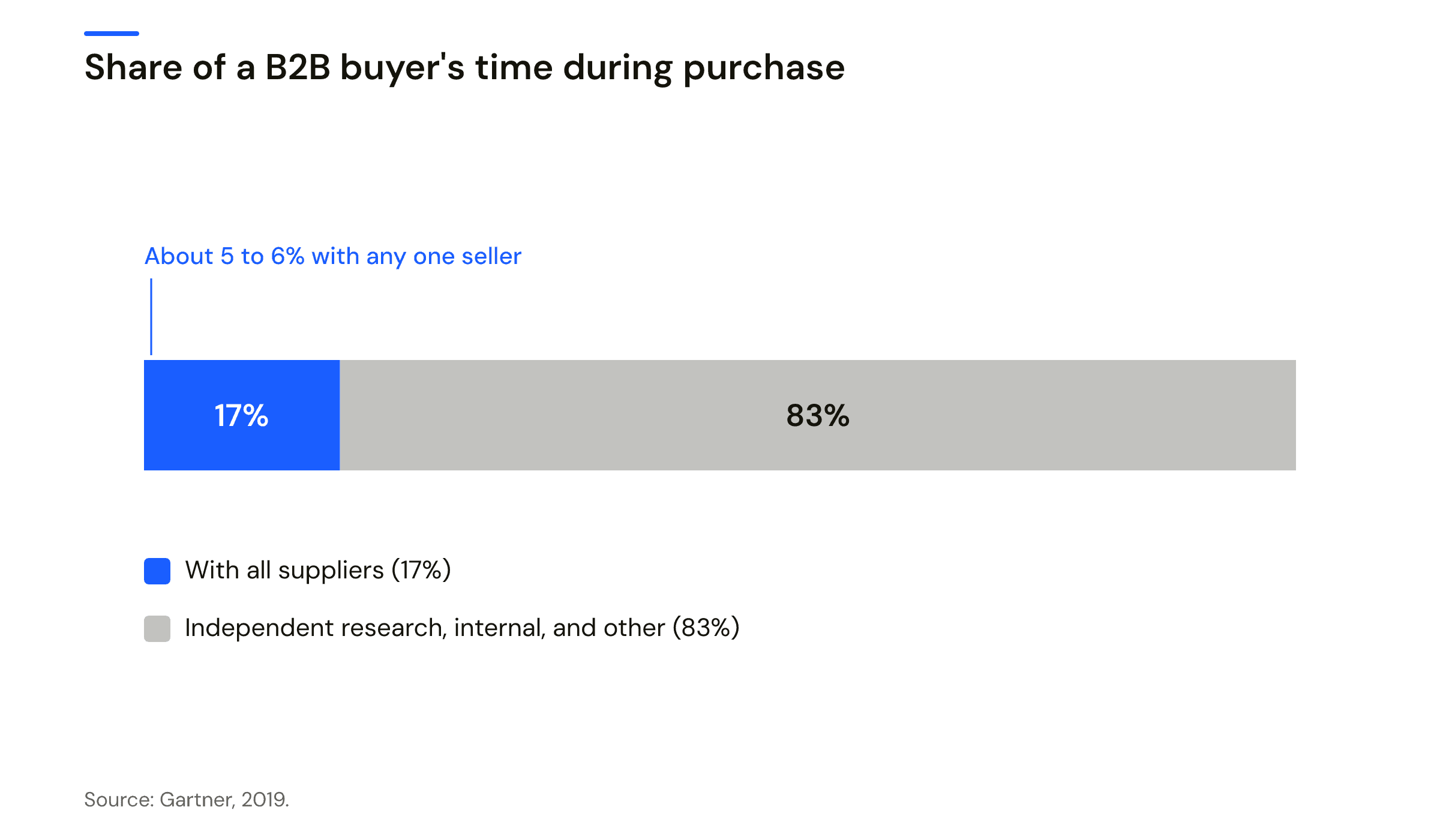
There is a second way to see the same squeeze, from the buyer's side of the table. B2B buyers spend only about 17% of the total buying journey meeting with all potential suppliers combined, which leaves any single seller with roughly 5% to 6% of the buyer's time (Gartner, 2019). The seller does not own the clock.
For owner-led SaaS teams hitting this ceiling, see how B2B SaaS founders hand off the selling motion.
Leak tax
Speed to lead and follow-up when there is no one to catch what you drop
Speed to lead is how fast you respond to an inbound lead, and for a solo founder it is not a team metric. It is a personal accountability metric.
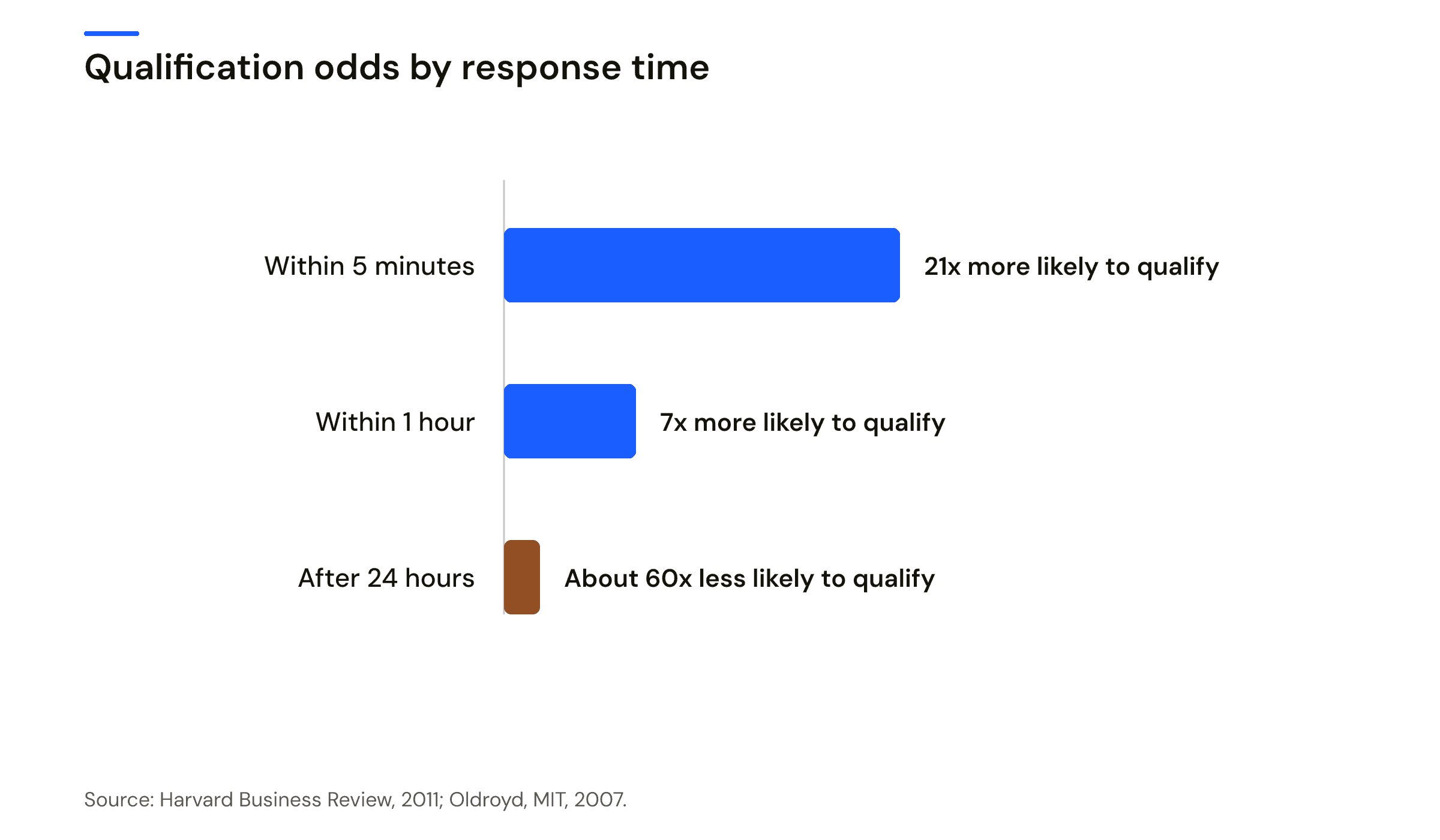
A company that replies to a web lead within one hour is about 7 times more likely to qualify that lead than one that waits an hour longer, and 60 times more likely than one that waits 24 hours or more (Harvard Business Review, The Short Life of Online Sales Leads, analysis of 1.25 million leads across 42 companies, 2011).
A founder cannot dilute a missed lead
A sales team can absorb a slow reply across many reps and many leads, so the cost of any one delay is diluted. A founder cannot dilute anything. When you are the only seller, a missed lead is 100% attributable to you, with no rota to smooth it out and no colleague to catch what you drop. This reframe is the heart of the leak tax, and it is the point where generic speed-to-lead advice, written for a sales-ops manager tuning a team, stops applying to the owner-seller.
Most firms answer slowly, and many never answer
The same study found that the average firm took 42 hours to respond, and that 23% of companies never responded at all. For a founder, that 23% is the clearest single picture of the leak tax: leads that arrived interested and left unanswered because the one person who could reply was on a call, in a build, or asleep.
The decay is steepest in the first minutes
The causal root underneath that finding is even sharper on time. Research on lead-response management found that contacting a web lead within 5 minutes rather than 30 minutes makes it about 21 times more likely to enter a qualifying conversation, and that the odds of qualifying drop by roughly an order of magnitude after the first hour (Oldroyd, MIT lead-response study, 2007). The decay is not linear.
Why the leak is invisible
The leak tax hides because it is made of things that did not happen. A lost deal you fought for and lost leaves a record: a proposal, a call, a "went with someone else" email. A lead that decayed because no one replied in time leaves nothing. It simply never becomes a conversation, so it never enters the pipeline, so it is never counted as a loss. The founder sees the deals they worked. They do not see the deals that quietly expired in an inbox, and the absence of a record is read, wrongly, as an absence of cost.
A rep is watching the inbound queue. A founder is in a product review with notifications silenced.
Leak tax
Follow-up: the second half of the leak
The same invisibility governs follow-up, the second half of the leak.
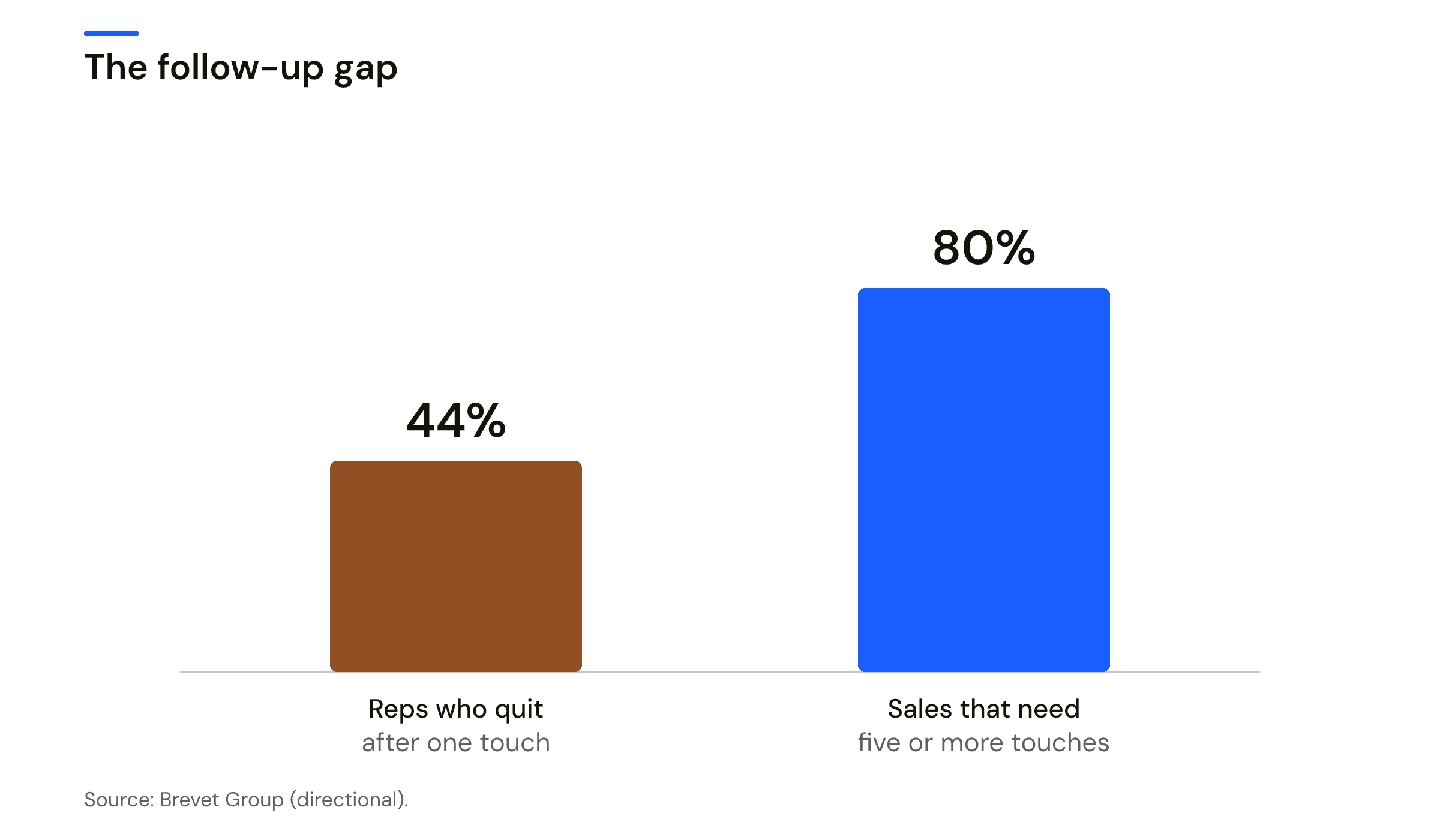
A commonly-cited industry figure holds that roughly 80% of sales require five or more follow-ups, while about 44% of reps give up after a single follow-up (attributed to Brevet Group).
Why follow-up is the work that always slips
The underlying methodology is not published, so this belongs in the report as directional rather than precise, and it is labelled as such. Even discounted heavily, the shape is visible in every solo pipeline: closing takes a cadence of persistent touches, and a founder juggling delivery rarely gets past the second. Follow-up is unscheduled, invisible work, and it always loses to the scheduled, visible work of shipping and delivering. The touch that would have closed the deal becomes the task that slips to next week, then off the list entirely.
What the leak means for the owner-seller specifically
Two clarifications keep this honest. The Harvard Business Review figures come from inbound web leads, so they map best to businesses with real inbound flow rather than pure outbound motions. And the numbers describe qualification odds, not guaranteed revenue: a lead 7 times more likely to qualify is not a lead 7 times more likely to pay.
With both caveats applied, the direction is unambiguous. For a founder, slow is expensive, the decay is fastest in the exact window a founder cannot guard, and there is no second responder to recover what the first one drops. The leak tax is the driver most directly caused by the time tax, and the one most invisible on any dashboard the founder is likely to keep.
Growth tax
Why one seller on one channel under-serves most of the market
Founder-led sales caps growth because one person can run only one selling motion at a time, and one motion structurally under-serves buyers who want a different one. This is the driver that turns a personal time constraint into a market-coverage problem, and it is measurable without resorting to folklore about founders "being in too many calls."
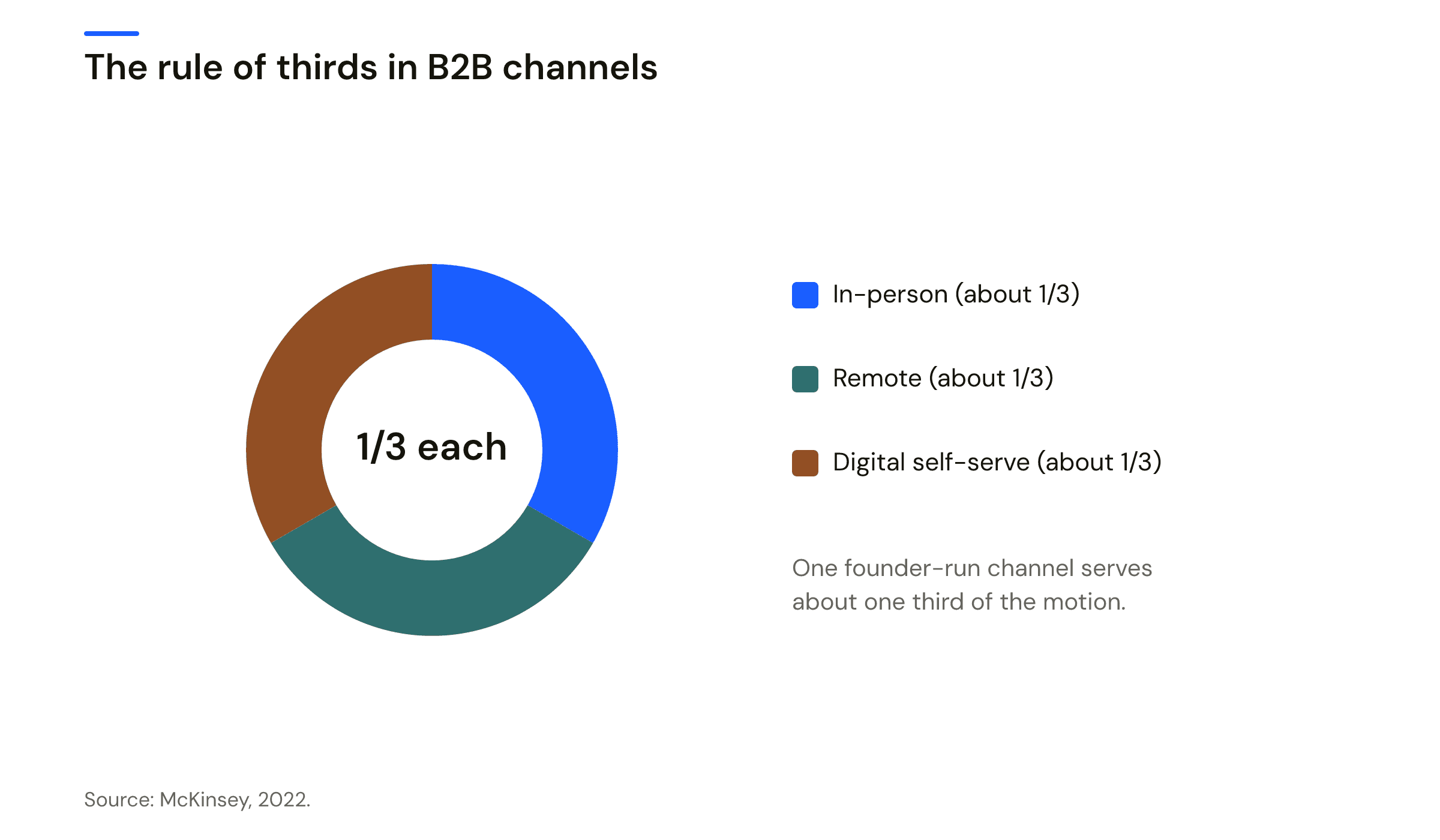
Buyers split roughly into thirds on how they want to buy: about a third prefer in-person interaction, a third prefer remote human contact, and a third prefer digital self-service, and that split holds at every stage of the journey (McKinsey, 2022).
One seller can run only one channel
A lone founder runs one channel, usually the one they are personally good at, which means the founder-led motion is built to serve at most one of those three groups well. The other two-thirds are served poorly or not at all, not because the founder chose to ignore them but because a single person cannot staff three motions at once. The growth ceiling is therefore not only about running out of hours. It is about running out of coverage: even a perfectly efficient founder reaches only the slice of the market that wants to buy the way the founder likes to sell.
The revenue a hybrid model would reach
The revenue consequence of covering more of that split is large. Companies that adopt a hybrid selling model, combining in-person, remote, and self-serve motions, have reported up to 50% more revenue than single-motion peers (McKinsey, 2022 to 2024). A solo founder cannot run a hybrid model, by definition, so the growth tax is partly the value of the revenue that a multi-motion coverage would have reached and a single-channel founder never can. This is a cleaner way to see the scaling penalty than the vague claim that founders are "bottlenecks," because it points to a specific, sourced gap: the two-thirds of buyers the single channel does not fit.
Where the growth tax meets the leak tax
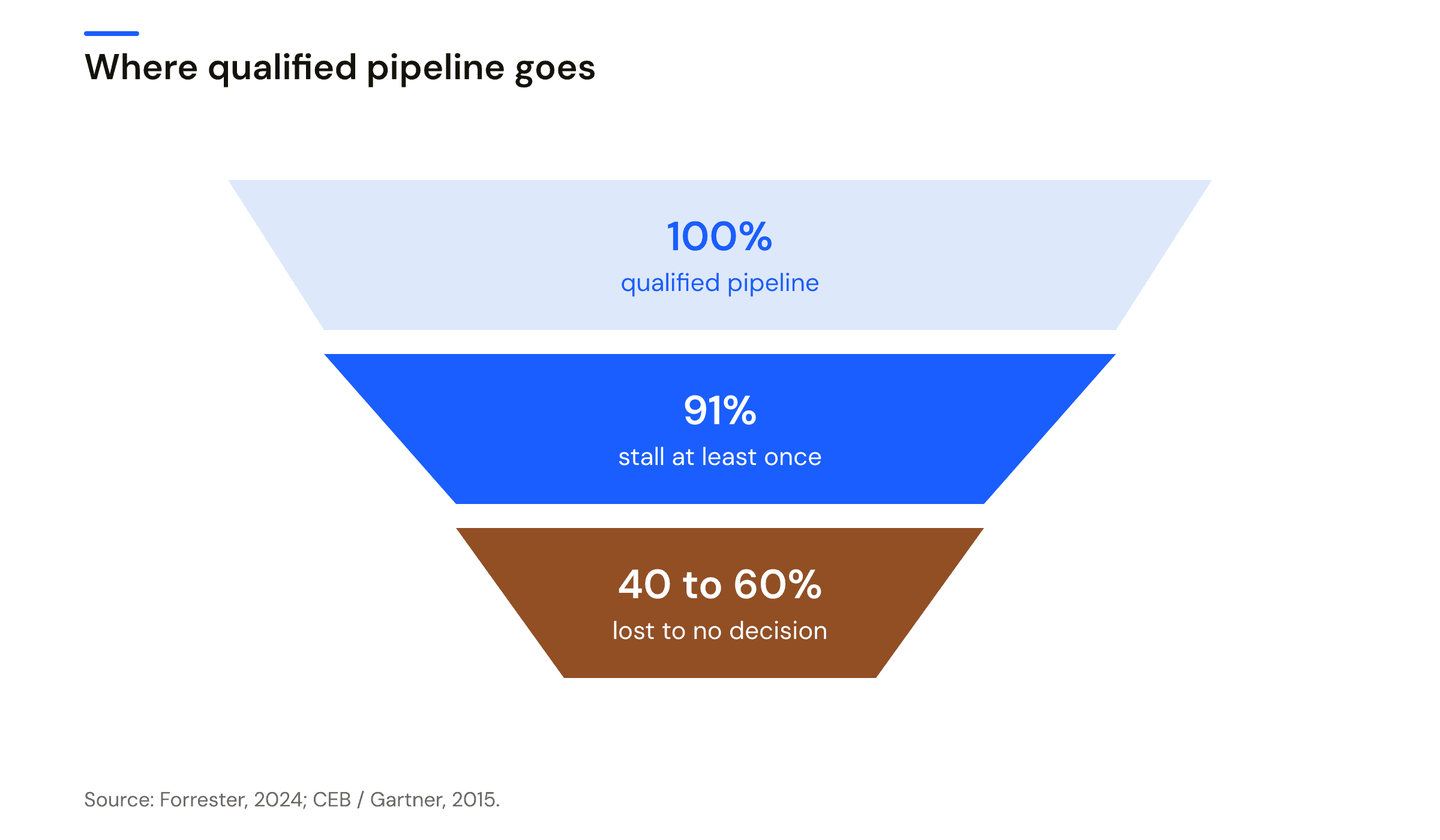
The stall data compounds the coverage gap. 91% of B2B purchases stall at least once before a decision (Forrester, State of Business Buying, 2024), and 40% to 60% of forecasted deals are ultimately lost to "no decision" rather than to a competitor (CEB/Gartner, The Challenger Customer, 2015). Most deals are not lost in a head-to-head. They are lost to inertia, indecision, and a buying committee that never reaches consensus.
Most deals are not lost in a head-to-head. They are lost to inertia, indecision, and a buying committee that never reaches consensus.
Burnout tax
The single-point-of-failure pipeline and the person running it
The last driver is the one owners discount most and pay most heavily, because it is the only driver measured in the founder's own health rather than the company's numbers. When the founder is the entire sales department, the pipeline is a single point of failure, and so is the person running it.
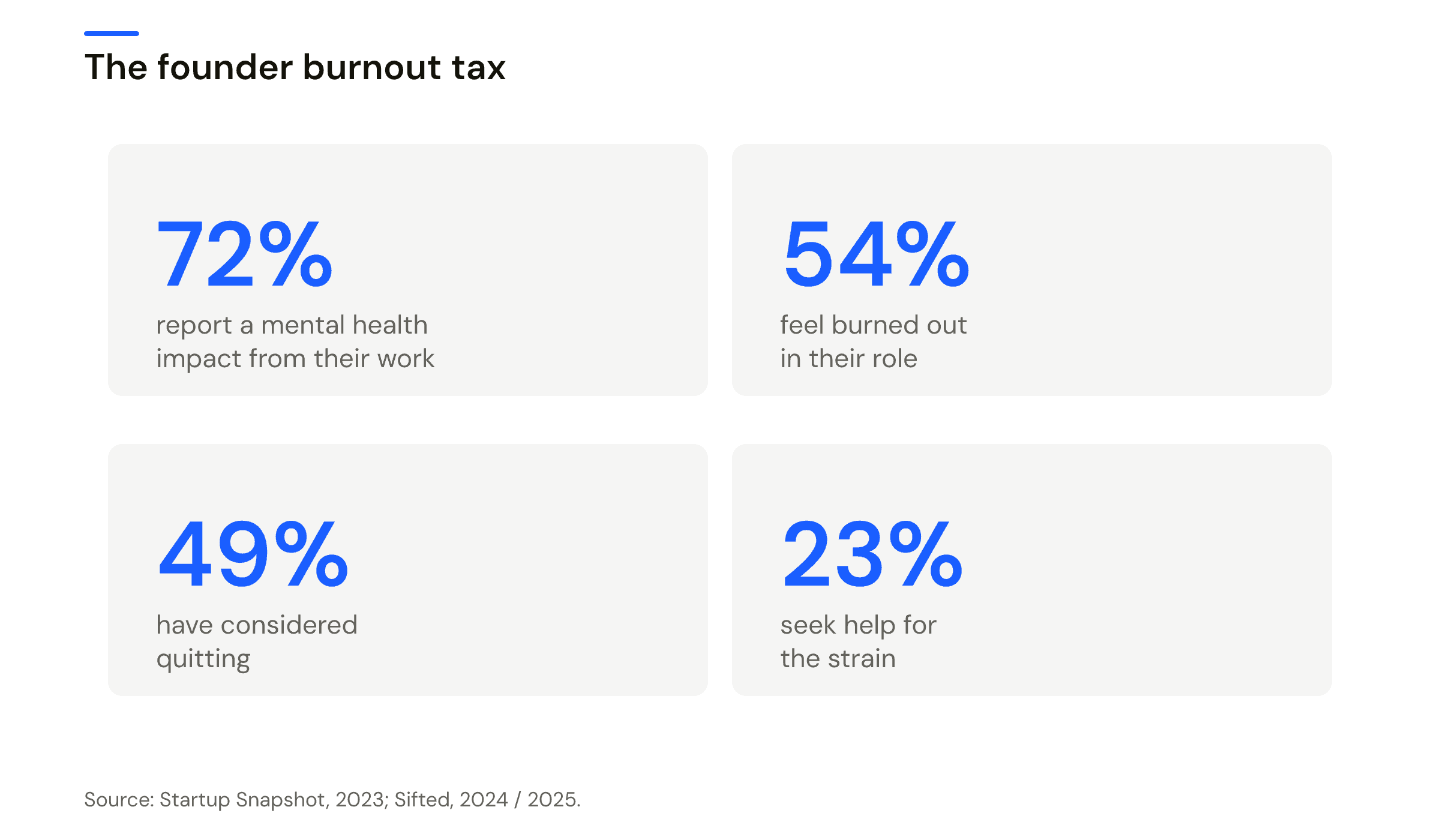
72% of founders say the entrepreneurial journey damaged their mental health, and 54% report burning out in the last 12 months (Startup Snapshot, 2023; Sifted, 2025).
Sales is the load that never ships
The Startup Snapshot research, drawn from more than 400 founders, also found that only 23% seek help, so the load is not just heavy, it is largely carried in silence. There is an academic backbone under the same number: a peer-reviewed study found that 72% of entrepreneurs were affected by mental-health conditions, with markedly higher rates of depression and anxiety than the general population (Freeman et al., University of California San Francisco, 2019). Nearly half of founders have considered quitting in the past year (Sifted, 2024).
The continuity risk is structural
Sales sits at the centre of that load, because it is relentless, personal, and never finished. A product ships and the pressure eases. A pipeline never ships. There is always another lead unanswered, another follow-up overdue, another deal stalling.
A product ships and the pressure eases. A pipeline never ships.
The handoff
When founder-led selling should end and when to make the first hire
Founder-led selling should end when demand outgrows one person's hours and the founder becomes the constraint on every deal, and the data marks that line more precisely than most owners expect. The difficulty is that the exit, hiring a salesperson, has become slower and less certain than it used to be, so the timing of the handoff matters more than the hire itself.
At around $1M ARR, having the CEO in the pitch is "typical and expected," but it does not scale, and the transition from founder-led to sales-led selling runs across the $1M to $10M ARR band (Bessemer, Scaling to $10M ARR, 2023).
Correct early, a liability late
Bessemer's framing is useful because it treats founder-led selling as correct early and a liability late, rather than as a failure at any point. Below roughly $1M the founder in every deal is the right motion. Past it, the founder in every deal is the thing capping the company. The sequencing guidance that follows is consistent across sources: hire the first one or two account executives before hiring a head of sales, and bring in a dedicated sales leader only once there is a repeatable motion for that leader to run (ICONIQ Growth). Hiring a sales leader before there is a repeatable motion to lead is a common and expensive inversion of that order.
Why timing matters more than the hire
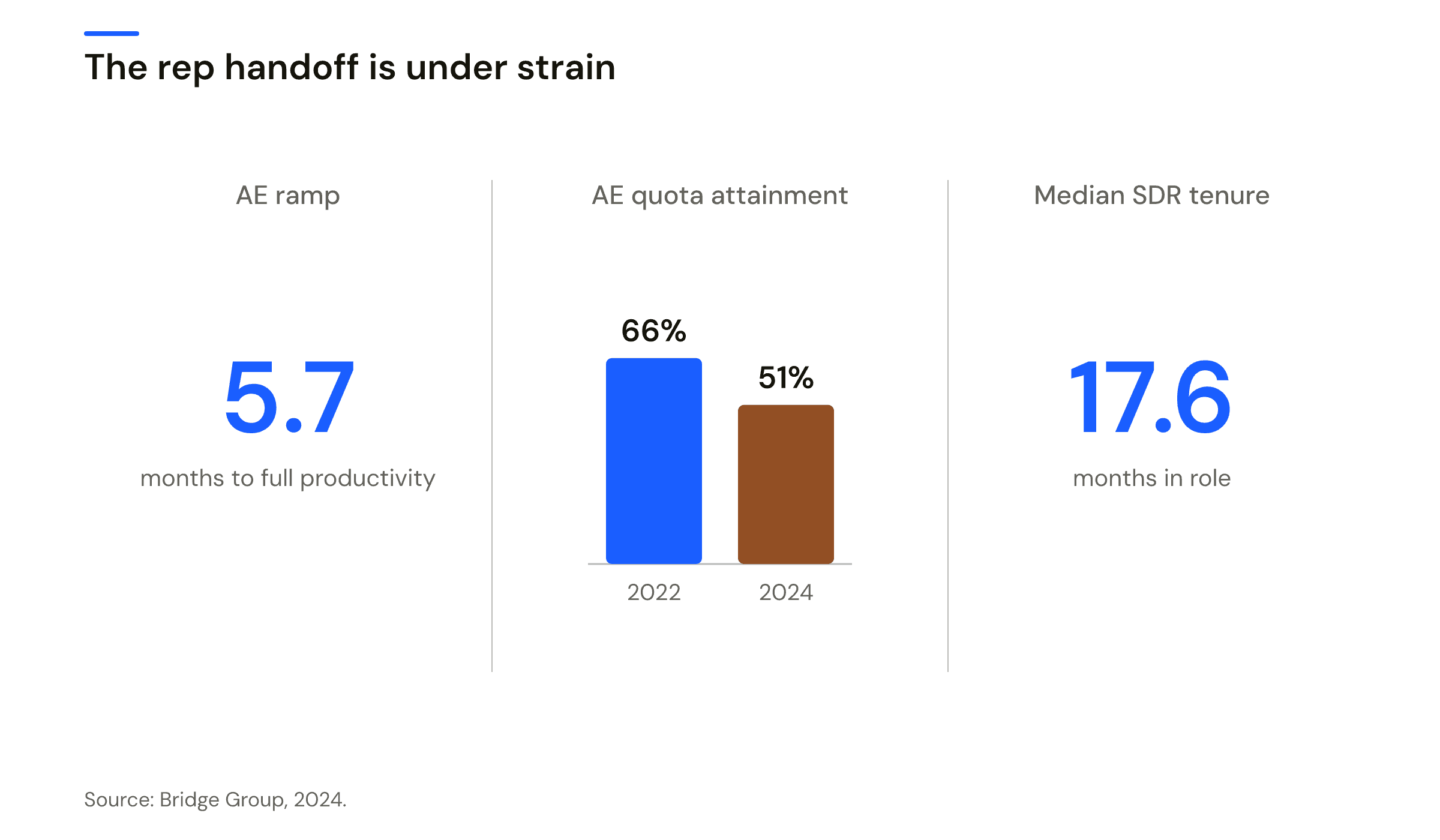
The reason timing matters so much is ramp. Median account-executive ramp to full productivity now runs about 5.7 months, and average AE quota attainment fell from 66% in 2022 to 51% in 2024 (Bridge Group, 2024). In plain terms, fewer hired reps hit their number, and the ones who do take almost half a year to get there.
Signs you have become the bottleneck
- Qualified leads wait on you, and only you, to move forward.
- You are declining or delaying inbound because there are not enough hours in your week.
- Growth has flattened near the $1M ARR ceiling where CEO-in-pitch stops scaling (Bessemer, 2023).
- You cannot take a week off without pipeline stalling.
- The sales process lives in your head, not in a document anyone else could follow.
Prepare the handoff before you are desperate for it
The data-backed guidance is to prepare the handoff before you are desperate for it. Because ramp runs close to six months (Bridge Group, 2024), a hire made at crisis point does not relieve pressure for two quarters, during which the founder is still carrying the full load while also onboarding a new rep, which is the worst of both states.
The founders who scale past the ceiling tend to systematise the motion first, documenting the cadence, the qualification criteria, and the follow-up rhythm, so that whoever takes it over inherits a process rather than a founder's memory. The handoff is less a moment than a project, and it should begin one to two quarters before the ceiling is reached, not after.
The counter-view
When founder-led sales is the right motion
This report would not be credible if it read as a blanket case against founder-led sales, so this section sets out where the motion is correct and where the Solo Sales Tax is a price worth paying rather than a problem to solve.
At around $1M ARR, having the CEO in the pitch is typical and expected, but it does not scale (Bessemer, Scaling to $10M ARR, 2023).
Where founder-led selling is the right motion
Founder-led selling is the right motion early, and the sources this report relies on say so directly. At around $1M ARR, the CEO in the pitch is "typical and expected" (Bessemer, Scaling to $10M ARR, 2023), because early on no one understands the product, the buyer, or the value proposition as well as the founder does, and no hire can shortcut that understanding.
A cost curve, not a verdict
The canonical argument is Paul Graham's: founders should do things that do not scale, and selling personally is the archetype, because the early goal is not efficiency but learning what the market actually wants and building the conviction and the reference customers that a later, scaled motion will stand on (Paul Graham, Do Things That Don't Scale, 2013). Founder authenticity also tends to shorten early sales cycles with small and mid-sized buyers, who often prefer to buy from the person who built the thing, though this effect is directional rather than precisely measured.
The Solo Sales Tax is low precisely when the founder should be selling.
The calculator
Turning four drivers into one number
The four drivers become a single number when you run your own inputs through them, which is what the calculator at the end of this report is for. The abstract cost of being the only salesperson becomes a figure you can weigh against the cost of doing something about it, and a decision framed as a calculation is easier to make than a decision framed as a breaking point.
How the calculator works
What the model takes in and returns
The model takes four inputs: hours per week you personally spend selling, deals per month, average deal size, and your follow-up gap, meaning the share of leads that go without timely follow-up. From those it returns three outputs. The first is the opportunity cost of your selling hours, your time priced at what it would produce if spent on the work only you can do. The second is the estimated pipeline lost to slow or missed follow-up, derived from the response-decay and follow-up benchmarks in this report. The third is the combined annual total, the annualised Solo Sales Tax.
How to read the output
Read the output as directional, not precise. It is built on the sourced benchmarks in this report, applied to your inputs, and it is meant to start a decision rather than settle one. The qualification-odds figures behind the leak estimate describe likelihood, not guaranteed revenue, and the time-cost figure depends on an honest estimate of what your hours are worth elsewhere. Treated as an order-of-magnitude estimate, the number does its job: it moves the cost of founder-led sales from something you feel to something you can see, compare, and act on.
Your estimated Solo Sales Tax
$128,160 / year
- Cost of your selling hours
- $93,600
- Estimated leaked pipeline
- $34,560
How this is estimated. Time cost is your selling hours times your hourly value times 52 working weeks. Leaked pipeline is deals a month times 12 times average deal size times your follow-up gap, then multiplied by an assumed 20% recoverable close rate. It is a directional estimate built on the benchmarks in this report, not a precise audit.
Methodology
Methodology and limitations
Every figure in this report carries a named primary source, a publication year, and where available a link, because the credibility of the data is the point of the report. Statistics were selected against a simple standard: prefer primary research over secondary reporting, prefer published methodology over vendor claims, and label anything that could not be fully traced as directional rather than precise. Figures verified against their primary source are presented without qualification.
Several limitations are worth stating plainly. The Salesforce "28% to 30% selling" figure describes dedicated sales professionals, not founders, so it functions here as a ceiling the founder sits below rather than a direct measurement of founder behaviour. The Harvard Business Review response-time figures come from inbound web leads and describe qualification odds, not guaranteed revenue, so they map best to businesses with real inbound flow. The Brevet Group follow-up figures are commonly cited but lack published methodology and are treated as directional.
Vendor reports, including those from Bridge Group and ICONIQ, are primary to their authors but reflect the segments those firms serve, which skew toward venture-backed software. The buyer-preference and channel-split figures from Gartner and McKinsey describe B2B buying broadly and generalise imperfectly to any single niche.
What we left out
Three widely circulated claims were reviewed and deliberately excluded because they failed source verification, and naming them is part of the standard. The first is a claim that founders present in more than 20% of calls at $5M ARR grow about 30% slower; it traces only to an unpublished industry assertion with no defensible methodology. The second is a claim that an AI SDR generates about 2.6 times less revenue than a human; it rests on a single uncontrolled blog test. The third is a claim that sender reputation drops 38 points in 90 days; it has no locatable primary source. A fourth folk claim, that founders convert two to three times better than early salespeople, was also excluded as methodology-free folklore. None of these appear anywhere in the report, including the charts and the calculator.
Full source list (20)
- Bain & Company. The Magic of Founder-led Companies (2026). Founder-led total shareholder return 2.1x since 2015, 2.6x among technology companies.
- Bessemer Venture Partners. Scaling to $10M ARR / Atlas founder playbook (2023). CEO-in-pitch "typical and expected" at ~$1M ARR; founder-led to sales-led transition across $1M to $10M ARR.
- Bridge Group. SaaS AE Report (2024). AE quota attainment 66% (2022) to 51% (2024); median AE ramp ~5.7 months; median SDR tenure ~17.6 months.
- CEB / Gartner. The Challenger Customer (2015). 40% to 60% of forecasted deals lost to "no decision."
- CFIB (Canadian Federation of Independent Business). Small-business owner hours (2023). Owners work ~54 hours per week.
- Forrester. State of Business Buying (2024), 16,000+ buyers. 91% of B2B purchases stall at least once; 81% of buyers dissatisfied with chosen provider; buying group ~13 people.
- Freeman, M. A., et al. University of California San Francisco. Are Entrepreneurs Touched with Fire? (2019, peer-reviewed). 72% of entrepreneurs affected by mental-health conditions; elevated depression and anxiety vs general population.
- Gartner. B2B buyer time allocation (2019). Buyers spend ~17% of the journey with all suppliers combined.
- Gartner. B2B buyer preference (2025). 61% of buyers prefer a rep-free buying experience for at least part of the journey.
- Harvard Business Review. The Short Life of Online Sales Leads (2011), 1.25 million leads across 42 companies. Reply within 1 hour ~7x more likely to qualify (60x vs 24h); average response 42 hours; 23% never respond.
- ICONIQ Growth. Go-to-market and hiring sequencing benchmarks (2024). First AEs before a head of sales; a dedicated sales leader only once a repeatable motion exists.
- McKinsey & Company. B2B buyer channel preference / "rule of thirds" and hybrid selling (2022 to 2024). Roughly equal thirds prefer in-person, remote, and self-serve; hybrid selling up to 50% more revenue.
- Oldroyd, J. B. Lead Response Management study (2007). Contact within 5 minutes vs 30 minutes ~21x more likely to qualify; odds drop sharply after the first hour.
- Paul Graham. Do Things That Don't Scale (2013). Founders should personally sell early.
- Salesforce. State of Sales (2023), 7,775 professionals. Reps spend ~28% to 30% of the week selling. State of Sales (2024): most teams already use or pilot AI in the workflow.
- Salesforce and Slack. Small-business productivity (2024). SMB owners lose ~1.5 hours per day of productivity, including to task-switching.
- Sifted. Founder mental health (2024, 2025). 54% burned out in the last 12 months; 49% considered quitting in the past year.
- Startup Snapshot. The Untold Toll (2023), 400+ founders. 72% say the journey damaged their mental health; 23% seek help.
- The Alternative Board (TAB). Business owner time use (2023). Entrepreneurs spend ~68% of time working in the business vs on it.
- Brevet Group. Follow-up frequency (commonly cited, methodology unpublished). ~80% of sales need 5+ follow-ups; ~44% of reps quit after one.
Data verified as of August 9th, 2026.
Conclusion
Make the bill visible before it becomes a breaking point
The Solo Sales Tax is the sum of four costs a founder pays for being the only salesperson: time that should build the product, deals leaked to follow-up that never happened, growth capped at one channel and one person's hours, and the human toll of a single-point-of-failure pipeline. None of it appears on an invoice, which is exactly why it goes unmanaged for so long.
The four drivers compound, which is why fixing one in isolation rarely relieves the pressure, and why the honest response is to price the whole rate and decide against it deliberately. Founder-led sales is the right motion early and a liability late; the framework in this report is a way to see which side of that line you are on, and to prepare the handoff before it becomes a breaking point rather than a calculation.
Klipy is the AI CRO that runs your entire sales operation: one agent doing the ten sales jobs, so the owner stops being the entire sales department alone. It drafts the outreach, the replies, and the follow-ups the four drivers describe, so speed to lead and cadence stop depending on the founder's calendar, and leaves the founder the one job only they can do: the relationship. Free forever, no credit card required.
Jung-Hong Kim
Co-founder & CEO, Klipy
Jung-Hong Kim is the co-founder and CEO of Klipy, the AI CRO for owner-led B2B teams. He has spent over 15 years in B2B technology and builds Klipy while running its sales himself, the same owner-seller he builds for who still closes and delivers the work. He writes about sales follow-up, speed-to-lead, and running a founder-led sales motion without an SDR team, grounded in what actually works when the person selling is also the person doing the delivery.
Frequently asked questions
Common questions about founder-led sales, the Solo Sales Tax, and when to hire.
What does founder-led sales mean?
Founder-led sales is when the founder personally runs the company's sales, from first outreach through close, rather than delegating it to a sales team. It is effective early because the founder knows the product and customer best, but it carries a hidden, compounding cost, the Solo Sales Tax, that grows as the company does.
Why does founder-led sales break at scale?
It breaks because demand eventually outgrows one person's available selling hours and one person's single channel. Having the CEO in every pitch is "typical and expected" at around $1M ARR but stops scaling past it (Bessemer, 2023), as follow-up, speed to lead, stalled-deal management, and pipeline volume exceed what a single founder juggling other roles can cover.
Are founder-led companies more successful?
Many founder-led companies do outperform at the company level, with founder-run public companies delivering around 2.1 times peer total shareholder return, and 2.6 times among technology companies (Bain, 2026). That success sits alongside a real cost to the founder, whose time and wellbeing pay for a selling load that never leaves their desk.
What does speed to lead mean, and why does it matter?
Speed to lead is how fast you respond to an inbound lead. Replying within one hour makes a lead about 7 times more likely to qualify than replying an hour later, and 60 times more likely than waiting a day (Harvard Business Review, 2011). For a solo founder it matters more, because a missed lead is 100% attributable to one person with no team to absorb it.
When should a founder hire their first salesperson?
Prepare the hire before growth flattens at the ~$1M ARR ceiling and before you are personally the bottleneck. Because median AE ramp runs about 5.7 months (Bridge Group, 2024), a hire made at crisis point does not relieve pressure for roughly two quarters, so timing and a documented process matter more than the hire itself. Sequence it as first AEs before a head of sales (ICONIQ Growth).
What are the warning signs of a founder sales bottleneck?
The clearest signs are: deals stall when you are heads-down elsewhere, leads sit unanswered for a day or more, you have no defined follow-up cadence, revenue tracks your personal availability, and no one else could run a deal end to end without you.
Go deeper
Where this fits the rest of your workflow
See the product
The ten jobs Klipy runs, from speed to lead to follow-up and CRM updates.
B2B SaaS
How owner-led SaaS teams hand the selling motion to a supervised agent.
Compare alternatives
How Klipy stacks up against the point tools owner-led teams shop most.
Pricing
Free forever, paid plans from $39 a seat a month. The cost of not.
See what founder-led sales is costing you
Run your own numbers through the Solo Sales Tax calculator, then let Klipy run the outreach, replies, and follow-ups the four drivers describe. Free forever, no credit card required.
Founder-led sales: the real cost (2026 data report)
The Solo Sales Tax is the compounding cost a founder pays for being the only salesperson, measured in time lost, deals leaked, growth slowed, and burnout. This 2026 report puts a number on it.
The cost of being the only salesperson is a 2026 data report on Klipy.ai about founder-led sales. It defines the Solo Sales Tax as the compounding cost a founder pays for being the only salesperson, across four drivers: a time tax (founder hours spent selling instead of building), a leak tax (pipeline lost to slow speed to lead and missed follow-up), a growth tax (one seller on one channel under-serving most of the market), and a burnout tax (the human and continuity cost of a single-point-of-failure pipeline). Key sourced figures: founder-led public companies deliver about 2.1 times peer total shareholder return, 2.6 times among tech (Bain, 2026); reps spend about 28% to 30% of the week actually selling (Salesforce, 2023); buyers spend only about 17% of the buying journey with all suppliers combined (Gartner, 2019); replying to a web lead within one hour makes it about 7 times more likely to qualify, 60 times more likely than waiting a day, and 23% of leads never get a response (HBR, 2011); about 80% of sales need five or more follow-ups while 44% of reps quit after one (Brevet, commonly cited); 91% of B2B purchases stall at least once and 40% to 60% of forecasted deals are lost to no decision (Forrester, 2024; CEB/Gartner, 2015); buyers split into rough thirds across in-person, remote, and self-serve channels (McKinsey, 2022); AE quota attainment fell from 66% in 2022 to 51% in 2024 with a 5.7-month median ramp (Bridge Group, 2024); founder-led selling is typical and expected at about $1M ARR but does not scale past it (Bessemer, 2023); 72% of founders say building the company damaged their mental health, 54% report burning out, and 49% have considered quitting (Startup Snapshot, 2023; Sifted, 2024 and 2025). The report includes an interactive calculator that turns hours, deals, average deal size, and follow-up gap into an annualised Solo Sales Tax. Klipy is the AI CRO that runs the outreach, replies, speed to lead, and follow-up so an owner stops being the entire sales department alone.
What does founder-led sales mean?
Founder-led sales is when the founder personally runs the company's sales, from first outreach through close, rather than delegating it to a sales team. It is effective early because the founder knows the product and customer best, but it carries a hidden, compounding cost, the Solo Sales Tax, that grows as the company does.
Why does founder-led sales break at scale?
It breaks because demand eventually outgrows one person's available selling hours and one person's single channel. Having the CEO in every pitch is "typical and expected" at around $1M ARR but stops scaling past it (Bessemer, 2023), as follow-up, speed to lead, stalled-deal management, and pipeline volume exceed what a single founder juggling other roles can cover.
Are founder-led companies more successful?
Many founder-led companies do outperform at the company level, with founder-run public companies delivering around 2.1 times peer total shareholder return, and 2.6 times among technology companies (Bain, 2026). That success sits alongside a real cost to the founder, whose time and wellbeing pay for a selling load that never leaves their desk.
What does speed to lead mean, and why does it matter?
Speed to lead is how fast you respond to an inbound lead. Replying within one hour makes a lead about 7 times more likely to qualify than replying an hour later, and 60 times more likely than waiting a day (Harvard Business Review, 2011). For a solo founder it matters more, because a missed lead is 100% attributable to one person with no team to absorb it.
When should a founder hire their first salesperson?
Prepare the hire before growth flattens at the ~$1M ARR ceiling and before you are personally the bottleneck. Because median AE ramp runs about 5.7 months (Bridge Group, 2024), a hire made at crisis point does not relieve pressure for roughly two quarters, so timing and a documented process matter more than the hire itself. Sequence it as first AEs before a head of sales (ICONIQ Growth).
What are the warning signs of a founder sales bottleneck?
The clearest signs are: deals stall when you are heads-down elsewhere, leads sit unanswered for a day or more, you have no defined follow-up cadence, revenue tracks your personal availability, and no one else could run a deal end to end without you.
Website: https://klipy.ai/reports/founder-led-sales-cost