
 Ask ChatGPT
 Ask Perplexity
 Ask Claude
 Prefer us on Google
Introduction
Most sales calls end fine and then die in the inbox. The call goes well, both people nod along, and then nothing happens, because the follow-up email either never gets sent or gets sent badly: vague, late, or indistinguishable from every other "just checking in" message a prospect has ever ignored.
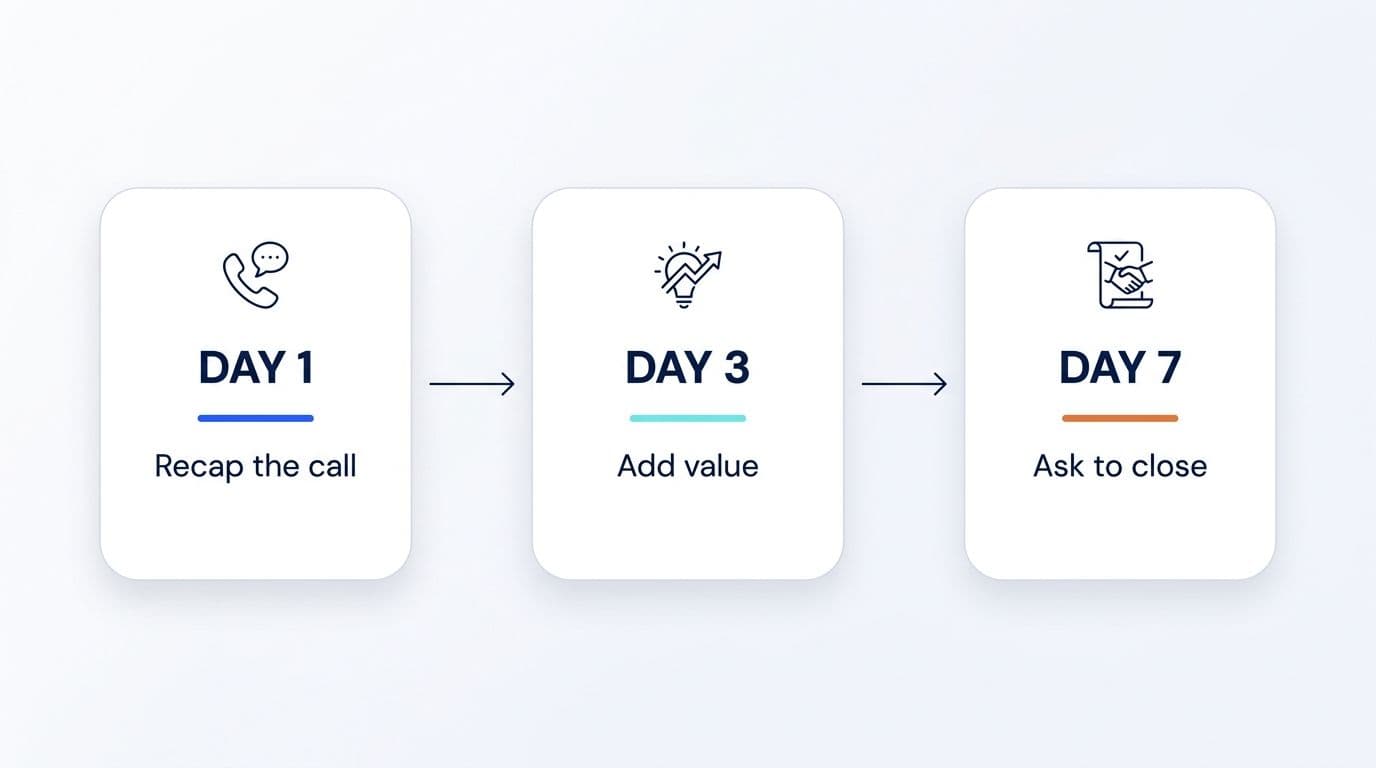
This guide covers the one email that matters most, the same-day recap, along with three scenario templates for the situations that break most owner-sellers' follow-up: no decision-maker on the call, a price objection that never got resolved, and a prospect who's gone quiet. It's the detailed breakdown of day 1 in the sales follow-up playbook's three-touch cadence: recap on day 1, value-add on day 3, close on day 7. This article owns day 1: what to say, when to send it, and what to send if day 1 doesn't get a reply.
Written by Jung-Hong Kim, CEO and co-founder of Klipy, who writes about sales follow-up habits for small teams. More on his background on the About page.
Key Takeaways
- Send the recap email the same day as the call, ideally within a few hours, while the conversation is still fresh and inside the window when replies actually happen.
- The first follow-up is the highest-leverage email in the sequence. Most reps stop after zero or one attempt, even though a second and third touch keep earning replies.
- Different situations call for different templates: same-day recap, multi-threading when there's no decision-maker, a direct price-objection reframe, and a low-pressure breakup email for prospects who've gone quiet.
- This article covers day 1 of a three-touch cadence in depth. The sales follow-up playbook covers the full day 1, day 3, day 7 sequence.
When should you send a follow-up email after a sales call?
Send your recap email the same day as the call, ideally within a few hours, while the conversation is still fresh for both sides.
Yesware's analysis of email open and reply behavior found that 91% of emails that get opened are opened within one day of being sent, and 90% of replies happen within one day of the recipient opening the email. That's a narrow, fast window. A recap that lands the next morning or two days later has likely missed the stretch of time when a reply was ever probable.
There's a second reason speed matters that has nothing to do with open rates: memory. An hour after the call, both sides remember what was said. Three days later, the prospect is fuzzy on the details and you're working from notes instead of shared context. A same-day recap locks in that shared understanding while it still exists.
This is touch one of a three-touch cadence: recap on day 1, a value-add message on day 3, and a close attempt on day 7. The full sequence, including what goes in the day 3 and day 7 emails, is covered in the sales follow-up playbook. This section is only about day 1, because day 1 determines whether days 3 and 7 have anything to build on.
The same-day recap email: what to say (template 1)
A strong recap confirms the next step with an owner and a date, and asks one clear question. Nothing more.
The recap isn't a second pitch. It's proof you were listening and a record both sides can point back to, with one answerable ask at the end. Keep it under 150 words. A longer recap reads as effort spent justifying the call rather than moving the deal, and it's more work for the prospect to process and reply to.
Template: same-day recap
Subject: Recap + next step from our call today

Hi [Name],

Good talking today. Quick recap so we're both working from the same page:

- You're currently [problem/situation they described]
- The main goal is [outcome they named]
- We agreed [what was decided or proposed]

Next step: [specific action] by [date], owned by [you or them].

Does [date/time] still work on your end, or should we adjust?

[Your name]
The bullets are drawn from what the prospect said, not from your pitch deck, so the email reads as listening rather than selling. The next step names an owner and a date instead of a vague "let's touch base." And the closing question is answerable in one line, not an open-ended "thoughts?" that leaves the prospect with nothing specific to react to.
Why does the first follow-up email matter more than any that come after it?
According to Yesware, 70% of sales email chains that go unanswered stop after just the first message, and most reps never send a second one, even though a second follow-up still has a 21% chance of getting a reply and a third has a 25% chance.
Yesware's data shows that only 19% of reps who got no response attempted a second follow-up. That's the gap: reply rates on later touches aren't dramatically lower than the first email, but the share of people who actually send them falls off fast. Separate data from Outplay, cited by HubSpot, shows the same pattern from the other direction: reps who send at least one follow-up, instead of stopping at zero, lift their reply rate from roughly 16% to 27%.
Most of the lost reply rate in sales follow-up isn't a messaging problem. It's a sending problem. Building that habit into something you do consistently rather than something you remember to do is the gap that AI-drafted follow-ups are built to close: Klipy drafts the recap from your call’s transcript the same day, so the follow-up is written and waiting instead of forgotten. It goes out only after you approve it.
Gong's separate analysis of 304,174 follow-up prospecting emails shows the same decay from a different angle: a second follow-up email carried a 31% reply rate, and that figure fell, gradually and unevenly, to 14% by the eighth follow-up. Specific phrasing moves the number too. Gong found that opening with "hope all is well" correlated with a 24% higher booking rate, while vague prompts like "thoughts?" correlated with a 20% lower booking rate and "never heard back" with a 14% lower rate.
Following up when there's no decision-maker on the call (template 2)
Name the gap directly in your recap, and ask your contact to loop in whoever else needs to weigh in rather than letting it go unaddressed.
Template: no decision-maker on the call
Subject: Recap + one question from our call today

Hi [Name],

Recap from today: [1-2 line summary of what was discussed].

One thing worth flagging: it sounds like [other stakeholder/role] would
also want visibility on this before you move forward. Would it make
sense to loop them in, or should I send over a short summary you can
forward?

Happy to jump on a quick call with both of you if that's easier.

[Your name]
Gong account executive Sarah Brazier reports winning 58% of deals where at least four contacts are involved, compared with a lower rate when the deal runs through a single contact. Outreach's analysis of its platform data shows the same pattern step by step: win rate climbs as more departments engage with a deal.
| Departments engaged | Approximate win rate |
|---|---|
| One department | 28% |
| Two departments | 39% |
| Three or more departments | 44% |
Source: Outreach
For a two-to-ten person shop, "looping in another department" rarely means a formal buying committee. It usually means asking your contact to bring in the other partner, the technical lead, or whoever signs the check. One more relevant person on the thread is often enough to move the numbers above in your favor.
How do you handle a price objection in a follow-up email? (template 3)
Address the cost directly instead of dodging it. Reframe around value in the same message rather than waiting for the next call.
Template: price objection follow-up
Subject: On the pricing question from today

Hi [Name],

You mentioned [specific price concern] on the call, so I wanted to
address it directly rather than skip past it.

Based on what you described about [specific problem/goal they named],
[concrete value point: time saved, deals recovered, cost avoided]
is usually what offsets the cost for teams your size.

Would it help to walk through the numbers together, or would a
side-by-side of what's included at each tier be more useful?

[Your name]
Acknowledge the concern in one line, tie the reframe to something concrete the prospect actually said on the call rather than a generic value prop, and close with a specific next step instead of an open-ended "let me know if you have questions." This template is for calls where price came up explicitly. It's not a substitute for the same-day recap in template 1.
What do you send when a prospect goes quiet after a sales call? (template 4)
Send a short, low-pressure breakup email that gives the prospect permission to say no, rather than another chase-up message.
One version of this email, built around exactly that framing, reportedly generated a 76% response rate for its author and now appears in HubSpot's own follow-up email template library.
Template: breakup email
Subject: Should I close the file on this?

Hi [Name],

Haven't heard back since our call on [date], so I'll take that as a
sign the timing isn't right, and that's completely fine.

If it's still worth exploring down the line, just reply whenever and
I'll pick it back up. Otherwise, no need to respond, I'll close this
out on my end.

Either way, thanks for the time on the call.

[Your name]
Keep checking in, but do it without piling on pressure, so the prospect has an easy, no-guilt way to say no. This template belongs at the end of the sequence, after the day 3 and day 7 touches from the pillar guide's cadence have already gone unanswered, not as a replacement for them.
How many follow-ups should you send after a sales call?
Plan on the three-touch cadence from the pillar guide: recap on day 1, value-add on day 3, close on day 7. Stop with a breakup email if there's still no reply.
Gong's data shows that closed-won deals averaged 8.21 emails exchanged per week, compared with 1.87 for closed-lost deals. That gap is the real argument for a sequence over a single email: the deals that close are the ones with sustained back-and-forth, not one good recap followed by silence.
For no-response follow-ups specifically (as opposed to the same-day post-call recap), Daniel Merrill, founder of Oncourse CRM, recommends waiting 48 to 72 hours before sending the next one. That's roughly the spacing behind the day 3 and day 7 touches in the pillar cadence.
| Day | Purpose | Where to find it |
|---|---|---|
| Day 1 | Recap what was discussed and confirm the next step | Template 1, above |
| Day 3 | Add value, share something relevant since the call | Sales follow-up playbook |
| Day 7 | Attempt to close or get a firm decision | Sales follow-up playbook |
| After day 7 | Breakup email if there's still no reply | Template 4, above |