
 Ask ChatGPT
 Ask Perplexity
 Ask Claude
 Prefer us on Google
Introduction
How to follow up after no response (without sounding needy)
A prospect who liked your pitch, agreed the timing made sense, and then vanished isn't rejecting you. Most of the time they're just buried, and your follow-up is competing with forty other open tabs in their inbox. The problem is what most people send next: a vague "just checking in" that gives the reader nothing to react to and makes the message about your anxiety instead of their problem.
This guide covers the specific moment a prospect goes quiet: what to say instead of "checking in," how long to wait before the first follow-up, and how to adapt the message for the situations where generic advice breaks down: no response after a proposal, after a demo, after a voicemail, or when your one contact at the account stops replying entirely. This is the narrower companion to our broader guide on how to follow up on a sales email so it actually gets a reply, which covers cadence, total touch count, and spam risk across a full sequence. This piece stays narrow: the wording and timing for the no-response moment itself.
Adding at least one follow-up to a sequence lifts average reply rate from 9% to 13%, about 22% more prospects converted, according to Woodpecker's analysis of outreach campaign data. Skipping the follow-up isn't neutral. It measurably drops who replies at all.
Key takeaways
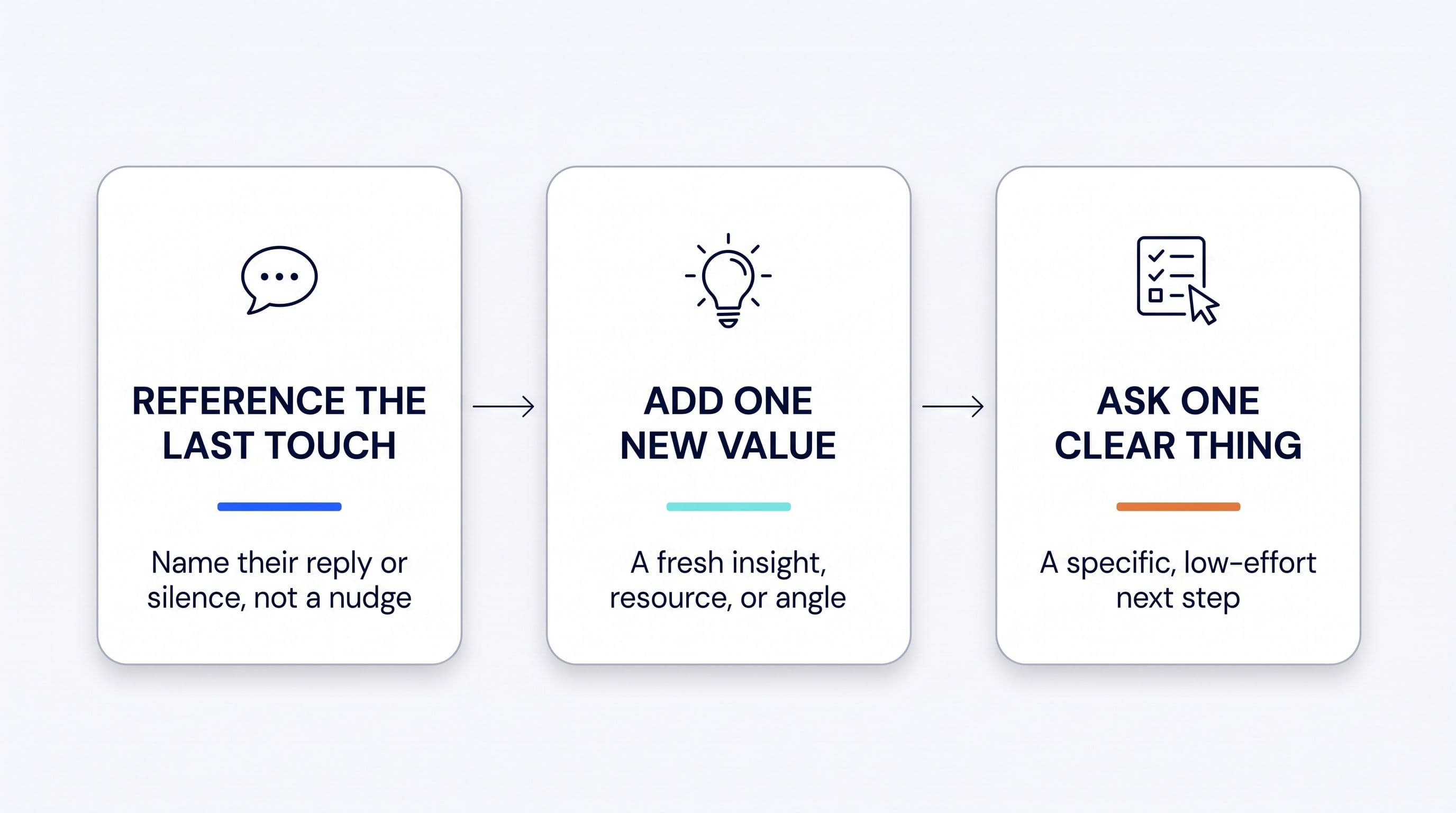
- Replace "just checking in" with a 3-part structure: one line referencing the last touchpoint, one new piece of value, one easy-to-answer question.
- Wait about 2-3 business days before the first no-response follow-up; most replies happen within the first day an email is opened.
- Silence after a proposal usually means the buyer is still reviewing internally, not that they've gone cold, so reference the document specifically rather than asking "did you see it."
- If one contact stops responding, reach a second person at the account instead of sending a fourth email to the same inbox.
- Plan for 3-5 follow-ups after no response, ending with an explicit close-the-loop message rather than trailing off.
- The wording is rarely the real bottleneck. Remembering who's overdue, on which thread, with what context, is the part that actually gets skipped.
What to say when a prospect goes quiet
Every effective no-response follow-up does three things in a few short lines: it references the last touchpoint, it adds one new piece of value, and it ends with a single easy-to-answer question. This structure replaces the open-ended "just checking in" message, which gives the reader nothing specific to respond to and puts the burden of figuring out what you want back on them.
The reference line does the work of context without a recap. It tells the reader exactly what you're picking up, so they don't have to scroll back through the thread to remember who you are. The new value (a relevant result, a short answer to something they mentioned, a resource tied to their situation) gives them an actual reason to open the message instead of archiving it as noise. The question closes the loop: something a busy person can answer in one line, like "worth a 15-minute call this week?" rather than an open "let me know your thoughts."
The first follow-up in a sequence produces the largest lift on its own. Woodpecker's data shows the first follow-up email brings just over 40% higher reply rate than the initial outreach message, which is the strongest argument for sending a structured second message rather than letting a quiet lead sit untouched.
Template: cold lead who never responded
Subject: quick follow-up on [specific topic from first email]
Hi [name],
Following up on my note about [exact topic from first email]. Since then, [company/team] published [relevant data point, case study, or resource tied to their industry].
Worth 15 minutes this week to see if it's a fit?
[Your name]
Template: warm lead who went quiet after initial interest
Subject: [specific detail from your last conversation]
Hi [name],
When we spoke on [date], you mentioned [particular pain point or goal they named]. I put together [one concrete thing: a short answer, a comparison, a relevant number] based on that.
Does [exact day/time] still work to pick this back up?
[Your name]
Both templates run under 60 words. Length isn't the point, specificity is. The best sales follow-up email subject lines that get replies gives more subject-line variations if the opening line above needs a different angle.
The words that make a follow-up sound needy, and what to send instead
Certain phrases read as needy because they make the sender's time the topic of the email instead of the reader's problem. "Just checking in," "sorry to bother you again," and "any update?" all ask the reader to manage your discomfort. None of them tell the reader what you actually want or why it matters to them.
The fix is the same reference line from the 3-part structure above: name the exact thing instead of the vague act of following up.
- Instead of "just checking in," write "following up on the pricing question from Tuesday."
- Instead of "sorry to bother you again," write nothing apologetic at all. Open directly with the reference line.
- Instead of "any update on your end?" write "did the proposal answer the integration question, or is there a gap I should fill in?"
- Instead of "wanted to touch base," write "wanted to share [particular update] since we last talked."
The underlying pattern: vague openers ask the reader to do the work of remembering context and guessing what you want. Concrete openers do that work for them. A reader can answer "did the proposal answer the integration question" in one sentence. They can't easily answer "any update?" without first reconstructing the whole conversation in their head, and that reconstruction is exactly the kind of friction that gets an email left unread.
When to send your first no-response follow-up
Wait about 2-3 business days before sending the first follow-up. If the send time is flexible, target early afternoon on a Monday or Tuesday, the windows where reply rates run highest.
Yesware's analysis of close to 500,000 sales emails found that 95% of replies happen within the first day of send, and 42% arrive within the first hour. The dataset is from 2020, so treat the exact percentages as directional rather than current-year precision. The underlying pattern (that email reply behavior front-loads heavily and rarely trails on for days) has held up in more recent practitioner guidance. Hunter.io independently recommends waiting two to three days before the first follow-up, for the same reason: most emails that get opened, get opened the same day they arrive, so a longer wait just delays a message that was already going to land in a cold inbox.
For the fuller breakdown of cadence across an entire sequence (how many days between touch two and touch three, when to stop, and the spam-flagging risk of sending too fast), see the timing and volume sections of our guide to following up on a sales email. This section covers only the first no-response follow-up.
No response after a proposal: what the silence actually means
Silence after sending a proposal usually means the buyer is still reviewing it or circulating it internally, not that they've gone cold. Proposify's 2026 State of Proposals report, based on 742,137 proposals, found winning proposals are viewed an average of 12 times, compared to 8 views for losing ones, and buyers spend close to 25.3 minutes reviewing a winning proposal versus 15.8 minutes on a losing one. A proposal that's still quiet three days in isn't necessarily a proposal that's been rejected. It might just not have finished its internal loop yet.
| Metric | Winning proposal | Losing proposal |
|---|---|---|
| Avg. views | 12 | 8 |
| Avg. time reviewing | 25.3 min | 15.8 min |
Source: Proposify, 2026 State of Proposals, based on 742,137 proposals analyzed.
That data changes what the follow-up should say. Don't ask "did you get a chance to look at this?" It's generic and assumes the buyer hasn't engaged at all, which the data above suggests is often untrue. Reference a specific section or number from the proposal instead. That does two things: it proves you're tracking the deal closely, and it gives the reader a concrete thing to react to rather than a yes/no status check.
Subject: quick question on the [exact section, e.g. "implementation timeline"]
Hi [name],
Wanted to flag one thing on the proposal: the [particular detail, e.g. "onboarding timeline in section 3"] assumes a start date of [date]. If that's tight on your end, I can adjust it, just let me know.
[Your name]
If your proposal tool tracks opens, Proposify's data also found average time-to-first-open is now 34 minutes, twice as fast as the prior year. That's useful for distinguishing "still reviewing" from "hasn't opened it yet": if the tracking shows zero opens after several days, the follow-up should nudge toward visibility ("wanted to make sure this landed, happy to walk through it live if that's easier") rather than reference a section they haven't seen.
No response after a demo or sales call
The strongest post-demo follow-up references one specific moment from the call (a pain point the prospect named, a feature they reacted to), paired with one small new piece of value. A generic "great talking to you today, let me know your thoughts" recap gives the reader nothing new to respond to. They already know the call happened, so the follow-up needs to add something.
Subject: the [particular feature/topic] question from today
Hi [name],
Good talking through [exact pain point they mentioned] today. I pulled together [one concrete thing: a short answer, a relevant example, a number] on the [feature] question you asked near the end.
Does it make sense to loop in [other stakeholder they mentioned] for a follow-up next week?
[Your name]
Follow-up email after a sales call: the same-day template that gets replies covers the first message sent right after the call. This section is for what to send when that first message gets no response.
No callback after a voicemail
A voicemail that doesn't get a callback needs a follow-up that names the voicemail directly instead of pretending it didn't happen. Silently sending an email as if the call never took place reads as either forgetful or evasive.
Subject: following up on my voicemail from [day]
Hi [name],
Left you a voicemail on [day] about [exact topic]. In case it's easier to reply here: [restate the one-sentence reason for the call, plus the same-value addition from the templates above].
[Your name]
When one contact goes dark, multithread the account
When your one contact stops responding, the fix is usually reaching a second person at the account, not a fourth email to the same inbox. A typical B2B buying group runs 6 to 10 stakeholders, each gathering information independently, according to Gartner's buyer-enablement research, so one quiet inbox doesn't mean the deal has stalled. It means the message hasn't reached whoever is currently blocked on it, or whoever is actually driving the decision.
Reach a second stakeholder with a message that doesn't put your first contact on the spot, instead of sending a fourth email to the same non-responsive contact. Combining follow-ups with reaching a second contact at the same account produced about 1.6x higher reply rates than one message to one person, according to a Pitchbox and Backlinko analysis of 12 million outreach emails.
Subject: looping in on [project/topic]
Hi [name],
I've been in touch with [original contact] about [specific topic], and wanted to loop you in directly in case it's useful. [One sentence: the exact problem or value, not a recap of the whole deal.]
Happy to send over [specific resource] or set up 15 minutes, whichever is easier.
[Your name]
Keep [original contact] on the thread rather than going around them silently. Multithreading gives the deal more than one path forward if that person goes on leave, changes roles, or loses the thread in their own inbox. It doesn't bypass the first contact.
How many follow-ups before you stop
Plan for 3-5 follow-ups after the initial no-response, spaced a few business days apart, and end the sequence with an explicit close-the-loop message rather than trailing off. A final message that says the door is still open ("I'll close this out for now, reply anytime if the timing changes") gets read differently than silence: it signals the sender is organized, not desperate, and it's often the message that actually gets the reply, because it removes the pressure the earlier ones carried.
None of the wording above is the real bottleneck for most sales teams. The hard part is remembering which of twenty open threads is overdue for the second follow-up, which is due for the fourth, and what was said on the call three weeks ago. That's a tracking problem. It's the reason most "just checking in" emails get sent in the first place: they're what a person writes when they've lost the specific context and don't have time to go dig it up. That's the gap follow-up drafting is built to close: it tracks who's overdue on which thread and drafts the next message with that context already pulled in.