
 Ask ChatGPT
 Ask Perplexity
 Ask Claude
 Prefer us on Google
Introduction
The best sales follow-up email: subject lines that get replies
The subject line decides whether your follow-up gets opened at all, and the data on this is unusually consistent. Belkins' analysis of 5.5 million B2B emails, done in partnership with Reply.io, found that personalized subject lines lift reply rate from 3% to 7% (a 133% increase) and lift open rate from 35% to 46%. Snov.io's analysis of more than 10 million emails found a similar gap: a 20.79% open rate for personalized subject lines versus 14.96% for generic ones. Two independent datasets, same conclusion: personalization is what earns the open, not cleverness or urgency.
This article is a working reference for that one lever. It's the subject-line chapter of a bigger guide, how to follow up on a sales email, which covers timing, cadence, and full email templates. Here, the scope stays narrow: formulas by scenario, a before/after rewrite gallery, the mistakes that kill reply rate, and how personalization actually maps to what a buyer does when they see your name in their inbox.
Key takeaways
- Personalized subject lines lift reply rate from 3% to 7% and open rate from 35% to 46% (Belkins/Reply.io); Snov.io independently measured a 20.79% vs. 14.96% open-rate gap.
- The sweet spot is 2-4 words, 36-50 characters. Open rates decline steadily past 7 words (39%), 9 words (35%), and 10 words (34%).
- "Just checking in" is the worst-performing follow-up phrase measured in 2026: it cuts meetings booked by 14% (Woodpecker).
- Numbers in a subject line lift open rate by 45-113% depending on the study (Yesware, Woodpecker); questions lift it about 10% above average (Yesware).
- Individual-level personalization more than doubles reply rate for non-manager roles; company-level personalization roughly triples reply rates with executive buyers (Gong).
- Follow-ups account for 58.6% of all replies in a sequence, so the subject-line formulas below matter across every step, not just the first one (Belkins).
What actually makes a follow-up subject line get replies?
Personalization is the single biggest lever available, and it isn't close. Reply rate goes from 3% with no personalization to 7% with it, a 133% increase, and open rate goes from 35% to 46% in the same Belkins/Reply.io dataset. Snov.io's separate 10-million-email dataset landed in the same territory: a 20.79% open rate for personalized subject lines against 14.96% for generic ones.
"Personalization" gets used loosely, so it's worth defining precisely before the formula sections below. There are two distinct tiers, and they don't perform the same way. Individual-level personalization means a name, a role, or a recent action (a demo attended, a page visited, a piece of content downloaded). Company-level personalization means a detail specific to the recipient's business: a funding round, a tech-stack change, a stated initiative, a competitor move. Gong's analysis of 30,000-plus prospecting emails found these two tiers work best on different buyers, which matters when you're deciding what to put in a subject line and who you're sending it to.
The practical takeaway for a follow-up subject line specifically: it should contain something that could only be true of this recipient, at this moment, in this deal. A generic subject line, however well-formatted, forfeits the entire lift these datasets measured.
[CHART: Bar chart, open rate by subject line personalization - personalized 46% vs. generic 35% (Belkins/Reply.io) and personalized 20.79% vs. generic 14.96% (Snov.io) - source: linked publishers above]
What's the ideal length and format for a follow-up subject line?
Keep it to 2-4 words, roughly 36-50 characters. In the Belkins/Reply.io dataset, subject lines in the 2-4 word range hit a 46% open rate, the highest bracket measured, and open rate declines steadily from there: 39% at 7 words, 35% at 9 words, 34% at 10 words. Saleshandy's separate large-scale analysis of cold emails reached a compatible conclusion from a different dataset: subject lines with 4-5 words consistently outperformed every other length bracket, with 36-50 characters as the recommended range.
Length is only half the format question. Saleshandy's research also flags specific formatting choices as spam-trigger signals that hurt deliverability before a human ever sees the subject line: colons, quotation marks, ALL CAPS, and "Re:" or "Fwd:" prefixes used to fake a reply thread. Every one of those is an easy habit to fall into when you're trying to sound less like a stranger, and every one of them backfires.
Before you send a follow-up, run the subject line through this:
- Is it 2-4 words and under 50 characters?
- Does it contain a detail specific to this recipient or their company?
- Is it free of colons, quotation marks, and ALL CAPS?
- Does it avoid a fake "Re:" or "Fwd:" prefix?
- Could a stranger reading only the subject line tell it isn't a mass send?
Cold follow-up subject line formulas (with examples)
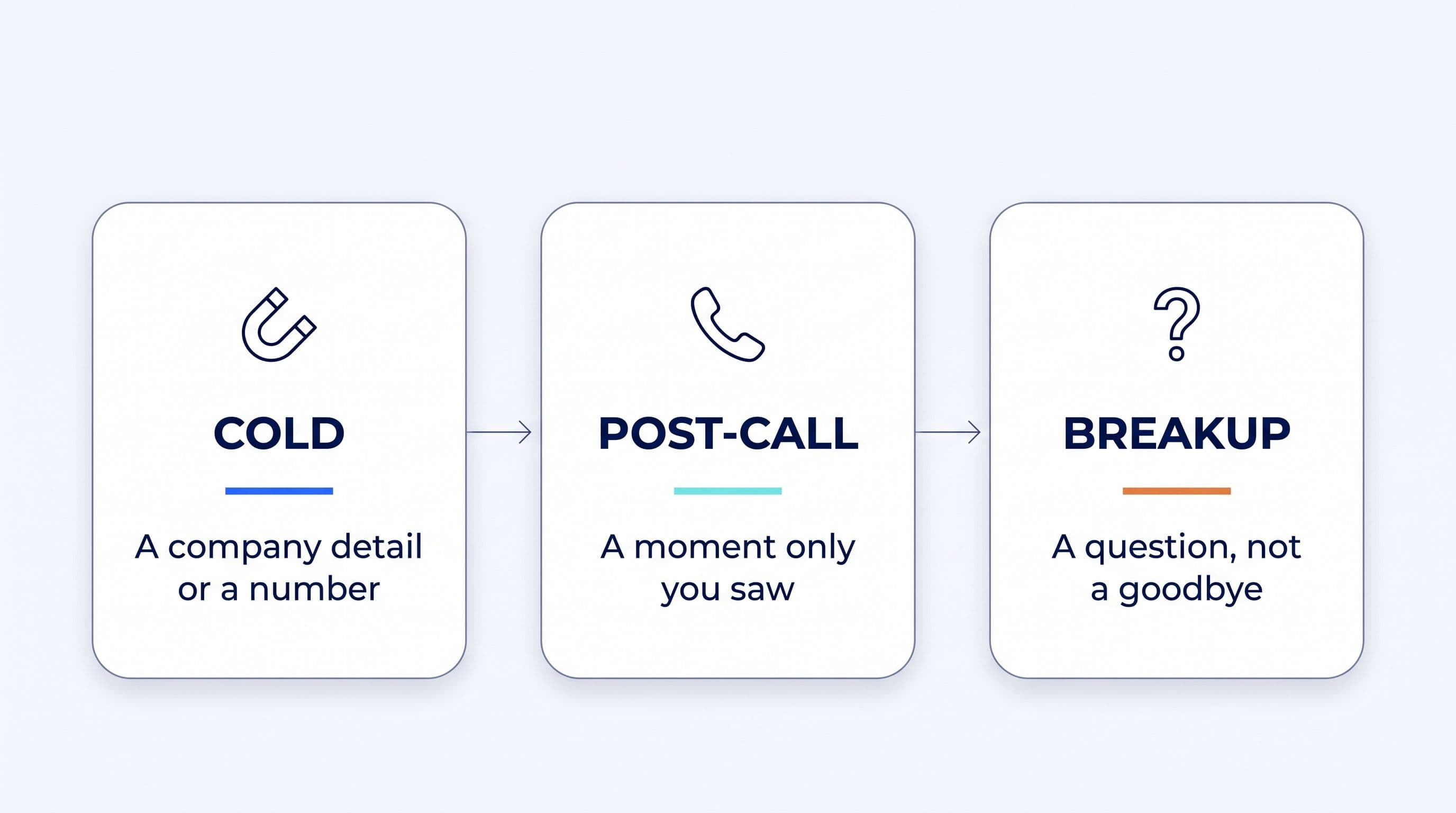
For a cold follow-up, the formula that works is a specific detail about the recipient's world, not a restatement of your last email. "Following up" and "Checking in" are the two lowest-leverage patterns available to you, because they contain zero information about the recipient and require no research to write.
Two things drive it, and both are measured. Personalization tier does the heavy lifting: Gong's data shows individual-level personalization (name, role, recent activity) more than doubles reply rate for non-manager roles and lifts it 50% for director-and-above titles, while company-level personalization (a funding round, a tech-stack signal, a stated initiative) roughly triples reply rates when the buyer is an executive. Format matters too, even within just a few words: Yesware's analysis of 1.2 million emails found question-format subject lines get about 10% higher than average open rates, and subject lines containing a number get a 45% higher open rate than average, a finding the same study cross-validated against a separate 115-million-email dataset. Woodpecker's 2026 analysis found an even larger numeric effect, a 113% average lift, the largest single formatting result across its dataset.
Fill-in-the-blank formulas for cold follow-ups:
- [Company]'s [specific initiative/challenge], e.g., "[Company]'s Q3 renewal timeline?"
- [Number] + [relevant outcome], e.g., "3 renewals slipping past Q3?"
- [Recent trigger] + question, e.g., "Saw the SOC 2 push, worth 10 minutes?"
- [Role-specific pain point], e.g., "Still chasing renewal dates by hand?"
Example cold-outreach subject lines built from these formulas:
- "[Company]'s new SOC 2 requirement"
- "3 renewals slipping past Q3?"
- "Worth 10 minutes on [specific trigger]?"
- "Still chasing renewal dates manually?"
- "[Company] + [your product category] fit"
- "The Q3 number you flagged"
For the body copy that pairs with each of these, see the full follow-up email templates.
Warm and post-call follow-up subject line formulas
After a call or meeting, the winning subject line references something only someone who was in the room would know: a stated timeline, a specific number, or a promised deliverable. "Great chatting today!" is friendly, but it contains no information the recipient couldn't have written themselves.
Warm follow-ups can afford to be more specific than cold ones because the research is already done. You don't need to guess at a trigger event; you have a transcript. That's the whole advantage of a post-call subject line over a cold one, and it's worth using. A subject line that proves you were listening does more work than one that's merely polite.
Formulas for post-call and post-demo follow-ups:
- The stated timeline: "The March rollout date"
- The specific objection or number: "The pricing question from today"
- The promised deliverable: "The comparison doc I mentioned"
- The next step named in the call: "Before Thursday's stakeholder review"
Example subject lines:
- "Following up on the March rollout date"
- "The pricing question from today"
- "The comparison doc I mentioned"
- "Before Thursday's stakeholder review"
- "The 12% number you mentioned"
- "Your team's onboarding question, answered"
The same mechanism applies to a networking follow-up: reference the specific conversation or event rather than the fact that you met. "Following up from [Event name]" re-anchors the recipient to a concrete memory in a way "Nice to meet you" cannot.
For a full breakdown of what to send in the hours after a call, our same-day post-call follow-up template covers the body copy that pairs with these subject lines.
Breakup email subject lines that still get replies
The best breakup subject line names the decision, not the departure. "Should I close your file?" outperforms "Last follow-up" because it puts the prospect in the position of answering a question, rather than simply telling them you're leaving.
The mechanism here is loss aversion combined with a forced decision. A departure announcement gives the recipient nothing to do; a question gives them a small, low-effort decision to make, and people tend to respond to a direct question even when they've been ignoring status updates. This slot in the sequence still earns its place: Belkins' 2026 study of 7.5 million emails found that follow-ups collectively account for 58.6% of all replies in a sequence, and more than 53% of email-sourced meetings come from sequence step 3 or later. A breakup email that never gets sent is a meeting that never gets booked.
Breakup subject line formulas:
- The direct question: "Should I close your file?"
- The closing-the-loop frame: "Closing the loop on [Company]"
- The timing check: "Wrong time, or wrong fit?"
- The permission ask: "Mind if I check back in Q1?"
None of these guilt-trip the recipient. They close the loop and hand the decision back, which is the entire point.
Before/after: weak subject lines rewritten strong
Most weak subject lines share one root cause: they describe the sender's action ("Following up on my last email") instead of the recipient's stake. Fixing that looks the same across cold, warm, post-call, and breakup scenarios, once you know what to look for.
| Scenario | Weak | Strong | Why it works |
|---|---|---|---|
| Cold | "Following up" | "[Company]'s Q3 renewal timeline?" | Replaces the sender's action with a company-specific detail (personalization token) |
| Cold | "Checking in on my email" | "3 renewals slipping past Q3?" | Adds a number, which independently lifts open rate 45-113% (Yesware, Woodpecker) |
| Cold | "Quick question" | "Worth 10 minutes on [trigger]?" | Question format plus a specific trigger, not a generic ask |
| Post-call | "Great chatting today!" | "The March rollout date" | Names the specific commitment from the call instead of a generic pleasantry |
| Post-call | "Following up on our call" | "The pricing question from today" | References the specific objection raised, proving you were listening rather than templating |
| Breakup | "Last follow-up" | "Should I close your file?" | Reframes the departure as a question the prospect has to answer, not a status update |
| Networking | "Nice to meet you" | "Following up from [Event name]" | Anchors to a concrete shared memory instead of a generic pleasantry |
| Cold | "Re: Our conversation" | "The Q3 number you flagged" | Drops the fake "Re:" prefix (a spam-trigger flag, Saleshandy) for a real detail |
Two patterns recur across every row: the weak version describes what the sender did, and the strong version names something specific to the recipient, whether that's a number, a company detail, or a moment from an actual conversation. That's the whole formula, applied to eight different scenarios.
Sending the right subject line every time, not just once
The formulas above are easy to apply to a single email. The harder problem is operational, not creative: Belkins' 2026 study found follow-ups account for 58.6% of all replies in a sequence, and more than 53% of email-sourced meetings come from step 3 or later, which means every step needs its own fresh, specific subject line, not the same "Following up" copy-pasted four times.
That's the gap Klipy's follow-up drafts close: it reads the actual thread and CRM context for a deal and drafts the next follow-up, subject line included, so the patterns above get applied on step 4 of a sequence as reliably as step 1. Every draft still waits for you before it goes anywhere. Klipy cannot send. Not on any plan, not in any mode, not by mistake.
For the full cadence, timing, and body-copy playbook this subject-line guide plugs into, see how to follow up on a sales email.