
 Ask ChatGPT
 Ask Perplexity
 Ask Claude
 Prefer us on Google
Introduction
How to turn a sales call into a proposal fast (speed beats structure)
A sales proposal template only needs three parts: a quick recap of the call, the scope and price you already discussed, and one clear next step, sent within hours, not days. Data from Bidsketch and Proposify shows winning proposals go out roughly 26% faster than losing ones, average fewer pages, and close more often. Speed beats structure.
This guide extends the recap-and-next-step approach from our broader guide to following up on a sales email to the specific moment right after a sales call, when the proposal itself is the follow-up.
Key Takeaways
- Winning proposals are sent about 26% faster than losing ones (2.7 vs. 3.4 days), per Bidsketch's analysis of more than 25,000 proposals.
- Shorter proposals win more, not less: proposals under 5 pages are 31% more likely to win (Bidsketch), and Proposify's 742,000-proposal dataset shows winners average 11 pages and 7 sections versus 13 pages for losers.
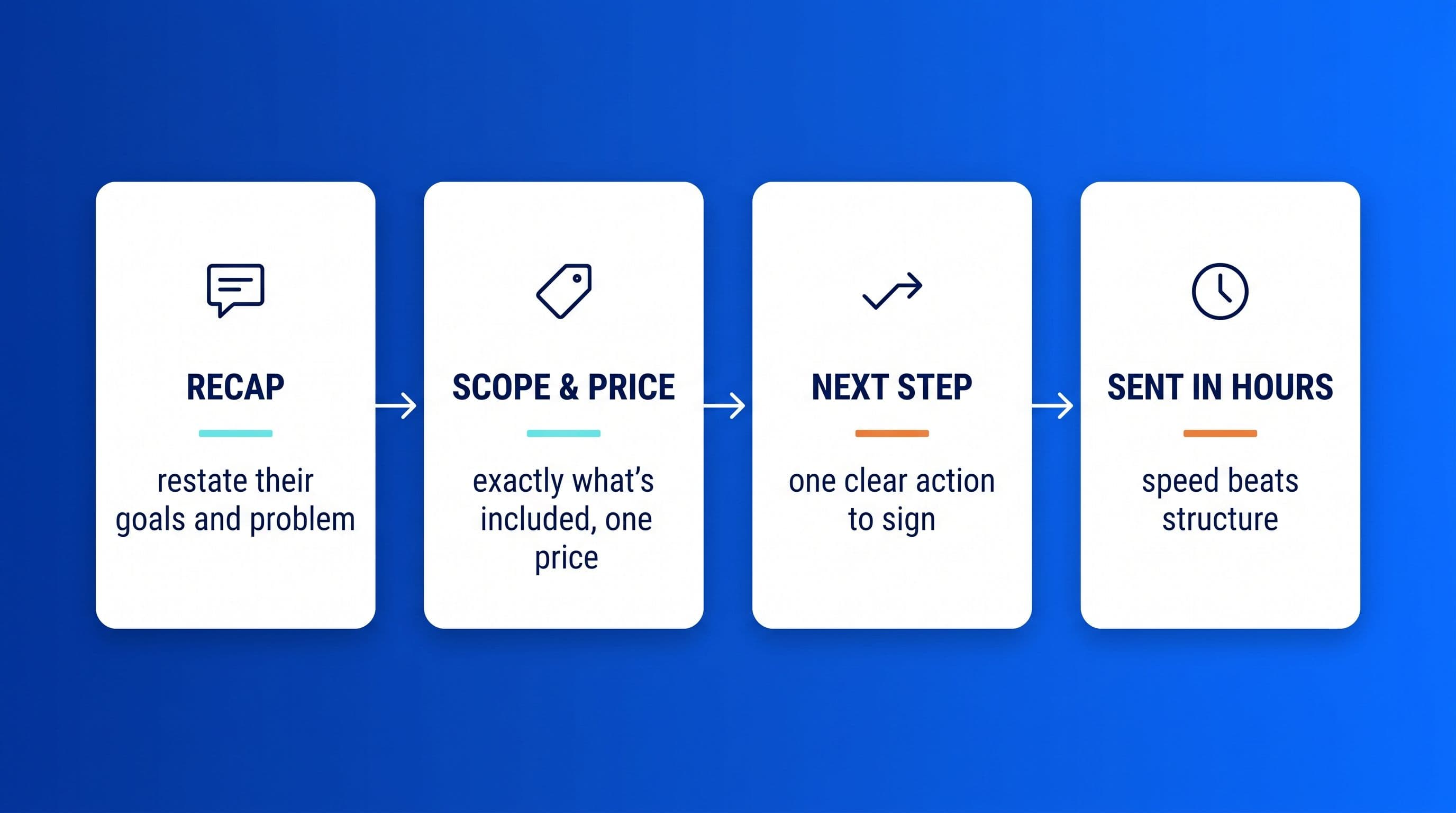
- The template behind same-day sending has three parts: recap what was discussed, restate scope and price, name one clear next step.
- Momentum fades once the call ends: closed-won deals sustain about 8 emails a week of back-and-forth, versus fewer than 2 a week on deals that stall, per Gong Labs.
- Locking the next step in on the call, not in the proposal, is what lets the proposal go out fast: Gong Labs found close rates fall 71% when next steps go unaddressed on the first call.
- Same-day is a target calibrated to your sales cycle, not a universal deadline. Proposify's data shows typical time-to-close ranging from under a day (telecommunications) to nearly 15 days (wholesale distribution).
What actually wins proposals after a sales call: speed, not structure
Winning proposals aren't the ones with the most polish. They're the ones that arrive first. In Bidsketch's analysis of more than 25,000 proposals worth $270 million, the firms that won sent their proposals to clients 26% faster than the firms that lost. Winners averaged a 2.7-day turnaround; losers averaged 3.4 days. That gap is well under 24 hours, a strange margin for something owner-sellers usually treat as a multi-day writing project.
The pattern holds at a much larger scale. Proposify's 2026 State of Proposals report, built from 742,137 proposals across 30 industries and $3.06 billion in total proposal value, measured an overall close rate of 34%, nearly double the roughly 20% industry average the report cites. Two independent datasets, one built around services firms and one spanning 30 industries, point at the same lever: turnaround time, not document quality, separates the proposals that close from the ones that don't.
| Metric | Winning proposals | Losing proposals | Source |
|---|---|---|---|
| Average turnaround time | 2.7 days | 3.4 days | Bidsketch |
| Win rate when under 5 pages | 31% more likely to win | N/A | Bidsketch |
| Average page count | 11 pages | 13 pages | Proposify |
| Average section count | 7 sections | Not reported | Proposify |
Sources: Bidsketch, analysis of 25,000+ proposals worth $270M; Proposify, 2026 State of Proposals report (742,137 proposals).
Why every hour you wait costs you the deal
The prospect's attention to your conversation starts fading before the day is out, and the deals that survive that fade are the ones where the seller keeps showing up. In Gong Labs' analysis of more than 500,000 sales emails, closed-won deals sustained about 8 emails a week of back-and-forth between buyer and seller, while deals that eventually died saw fewer than 2 emails a week. That momentum is measurable, and it starts dropping the moment you stop the conversation to go write.
Human memory backs this up, with some caution. A peer-reviewed replication of Ebbinghaus' classic forgetting-curve experiment, published in PLOS ONE, found that retention measurably drops within the first day after learning something new. The study measures this drop with a "savings score," not a clean percentage forgotten. Treat it as directional evidence, not a precise number. Even so, the practical point holds: the details a prospect is most engaged with today are already less vivid tomorrow, and less vivid again by the time a "thorough" proposal lands three or four days later.
Slow response is a known industry pattern, not just a proposal problem. Harvard Business Review's research on online sales leads found that most companies are not responding to prospects nearly fast enough, full stop. Various multiplier statistics about response speed circulate online attached to this study; without access to the full underlying data, this article treats only the plain, verifiable finding as fact: companies respond too slowly, broadly and consistently.
For an owner-seller, this usually isn't a discipline problem. The call goes well, then a client fire, a delivery deadline, or an inbox backlog eats the afternoon, and by the time the proposal goes out two or three days later, nothing about the offer changed, but the prospect's urgency has moved on.
[IMAGE: an hourglass with sand running low on a desk beside a laptop, symbolizing time pressure after a sales call - search terms: hourglass business deadline desk]
The common mistake: over-engineering the proposal structure
More sections and more pages don't win more deals. They mostly mean the proposal took longer to finish. In the same Bidsketch dataset, proposals under 5 pages were 31% more likely to win. Proposify's 742,000-proposal benchmark found winning proposals average 11 pages and 7 sections, against 13 pages for losing proposals.
The trap is treating the proposal as the moment to prove thoroughness: a case study gets added, then a methodology slide, then a second and third pricing tier "for options." Each addition feels like it strengthens the pitch, but each one adds another afternoon before the document is ready to send. The data says the opposite: a shorter proposal that goes out today beats a more complete one that goes out Thursday, in both datasets above.
Most sales-proposal guides present the same 6 to 8 sections, exec summary, problem statement, tailored solution, pricing, timeline, social proof, as an aspirational checklist to fill in completely. The data above treats that same list as a risk instead: every section beyond what's necessary is time the proposal isn't sitting in the prospect's inbox.
The same-day proposal template: recap, scope and price, one next step
A proposal you can send within hours of the call needs exactly three parts: a short recap of what was discussed, a restatement of the scope and price you already agreed on, and one next step with a date attached. Nothing else has to be finished before you hit send. A tool like Klipy's follow-up drafts can generate that three-part draft straight from the call, so sending within hours doesn't depend on finding a free afternoon to write it from scratch.
This mirrors the sales-call follow-up structure covered in our guide to sales email follow-ups, extended with the two things a proposal adds on top of a follow-up: scope and price.
Recap what was discussed
Open with two to four sentences that mirror the prospect's own language and stated pain points. If they said "we're bleeding hours on manual data entry," write that phrase back, not a generic paraphrase like "streamline your workflow." This is the fastest way to prove you were listening rather than running a template. Tools like Klipy's meeting intelligence capture that language automatically, so the recap writes itself from the call instead of from memory.
Restate scope and price
State the deliverables and the number you already discussed on the call, plainly. Don't add new tiers or lean on "custom-tailored solution" language that implies more work went into the document than it actually did. If the price surprises the prospect at this stage, something went wrong on the call, not in the proposal.
One clear next step
Name a single action with a date: "sign by Friday," or "a 15-minute call Thursday to confirm." Skip "let me know if you have questions." It doesn't move anything forward, and it puts the next move back on the prospect instead of you. Locking that date on the calendar right away, for example with Klipy's scheduler, keeps the next step from slipping. If a proposal isn't the right next move yet, the same recap-and-next-step logic carries over to writing a follow-up email after a sales call.
[IMAGE: a simple annotated diagram showing three stacked blocks labeled recap, scope and price, and next step, representing a same-day sales proposal template - search terms: simple three step process diagram business]
Why one clear next step beats a polished close
Deals move faster when the next step gets locked in on the call itself, not left for the proposal to sort out later. Gong Labs' analysis of 28,833 closed deals found that sellers in the fastest-closing deals spent 53% more time discussing next steps on the first call than sellers in slow-cycle deals, and close rates fell 71% when next steps went unaddressed on that call entirely.
This is why the third element of the template above works: it's a confirmation, not an invention. If the next step was agreed out loud on the call, "we'll sign by Friday if the price works," writing it into the proposal takes one sentence. If it wasn't agreed, whoever drafts the proposal ends up guessing at a next step, which is exactly where a fast proposal turns into a stalled one.
If you find yourself staring at the proposal wondering what to put as the next step, that's usually a signal the call itself left something unresolved, not that the document needs more polish. Logging every conversation and drafting the next move before it goes cold, the way Klipy's keep-everyone-warm view does, makes it easier to catch that gap before the proposal goes out.
[CHART: Bar chart showing 53% more time spent on next steps in fastest-closing deals and a 71% decline in close rate when next steps are skipped on the first call - source: Gong Labs, https://www.gong.io/blog/short-sales-cycle]
Match your turnaround to your deal's natural clock
Same-day isn't a fixed finish line. It's shorthand for faster than your market's normal cycle, and that cycle varies a lot by industry. Proposify's benchmark data puts typical time-to-close at under a day (0.98 days) for telecommunications deals, versus nearly 15 days (14.91 days) for wholesale distribution.
| Industry | Average time to close |
|---|---|
| Telecommunications | 0.98 days |
| Wholesale distribution | 14.91 days |
Source: Proposify, 2026 State of Proposals report.
The services-firm data tells a tighter story: in Bidsketch's analysis, the winning average was 2.7 days, not same-hour, but still under 24 hours faster than the losing average of 3.4 days. Read the two datasets together and the principle holds even though the absolute numbers don't match: send while the conversation is still fresh, relative to how your specific deals normally move, not against a fixed clock borrowed from a different industry.
If your sales cycle runs closer to two weeks than two days, sending within a few hours is still the right instinct, and sending within 24 to 48 hours is a reasonable practical target, not a failure to hit an arbitrary same-day bar.
The instinct holds regardless of your industry's clock: recap what was discussed, restate scope and price, name one next step, and send it while the conversation is still the freshest thing in the prospect's inbox. That's the whole template. Everything else is polish you can add on the next deal, not on this one.