
 Ask ChatGPT
 Ask Perplexity
 Ask Claude
 Prefer us on Google
Introduction
Turning a sales call into a proposal fast
You just got off a call that went well. The prospect named a budget, gave you a target decision date, and told you exactly what's holding them back. That's the easy part. What happens in the next few hours decides whether that call turns into a deal or into a proposal that sits half-written until the prospect's attention moves somewhere else. That risk is higher when you're running the entire sales side of a small IT services, consulting, agency, or coaching business by yourself: you sell the work and then deliver it too, so the same afternoon that call ends, a current client is often waiting on you as well.
Most sales advice focuses on the call itself: what to ask, how to handle objections, how to build rapport. Far less gets said about the hours right after the call, even though that window is where a lot of winnable deals quietly stall. This guide is part of our broader guide to following up on a sales email, narrowed to one specific moment: turning a strong call into a sent proposal before the buyer's attention moves on.
Why speed to proposal beats proposal polish
Speed from call to proposal, not how polished the deck looks, is the variable that correlates with win rate. A deal that stalls after a good call doesn't usually die from a weak proposal. It dies because a competitor's proposal landed first, or because the buyer moved on before yours ever arrived.
The evidence for this comes from research on lead response time, and the logic carries over directly to proposal turnaround. Harvard Business Review's audit of 2,241 U.S. firms found that companies trying to contact a web-generated lead within one hour were nearly seven times more likely to qualify it than those that waited even one more hour, and more than 60 times more likely than firms that waited 24 hours or longer. The average firm in that study took 42 hours to respond at all (HBR).
Delay shows up again later in the pipeline, not just at first contact. Ebsta and Pavilion's 2025 GTM Benchmarks report is built from 655,000 opportunities and $48 billion in pipeline. It found that deals with delayed stages were about 113% less likely to close, roughly half the win rate of deals that stayed on pace, while early involvement of the buyer's economic decision-maker lifts win rates by roughly 55% (Ebsta x Pavilion, via Gradient Works). Win rates across their full sample fell to 19% in 2025, down from 29% the year before.
There's also a structural reason the window right after the call matters more than any other point in the deal. 6sense's 2025 B2B Buyer Experience Report, surveying nearly 4,000 B2B buyers, found that 94% of buying groups rank their vendor shortlist in order of preference before ever engaging a seller, and 77 to 81% ultimately buy from whichever vendor sits at the top of that list (6sense). If the shortlist is already forming in the buyer's head, the proposal that arrives fastest, while the call is still fresh and the comparison is still open, has the best shot at shaping how that shortlist settles.
What to capture on the call so the proposal writes itself
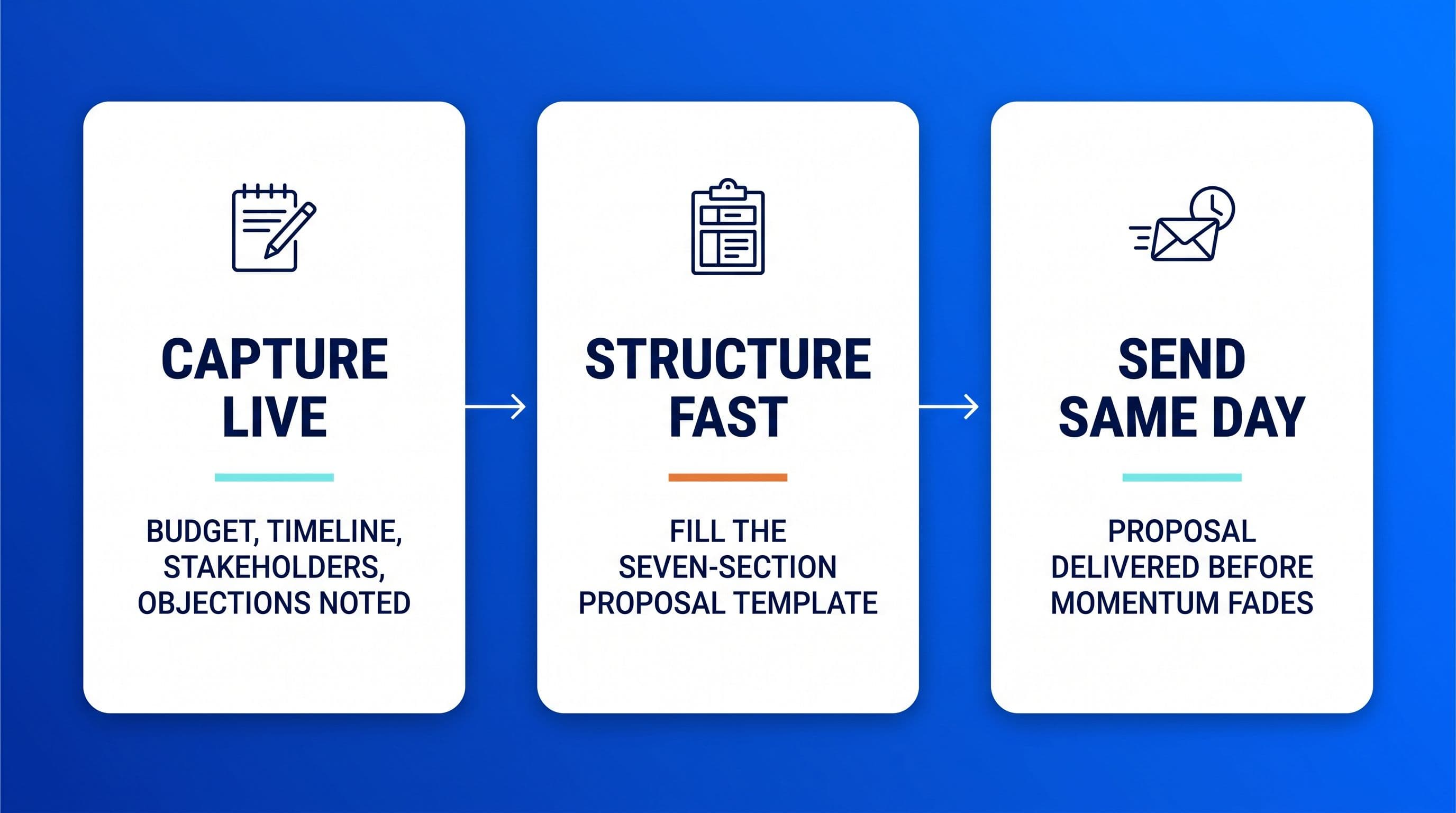
Your proposal is fast to write only if you captured four things on the call, in the prospect's own language: budget, timeline, stakeholders, and objections. Everything else in a proposal, the cover language, the company background, the boilerplate scope description, can be templated once and reused. These four fields can't, because they're specific to this deal.
Budget means the actual range or number the prospect stated, along with who has to sign off on spending it. Write down the number they said, not a rounded guess.
Timeline means the date they're targeting for a decision, plus any external deadline driving that date (a contract renewal, a budget cycle, a board meeting). A vague "soon" is worth pressing on during the call, because it becomes the timeline section of the proposal almost word for word.
Stakeholders means every name and role mentioned, especially the economic buyer, even if that person wasn't on the call. This matters more than it might seem: Ebsta and Pavilion's research found that early involvement of the economic decision-maker lifts win rates by roughly 55% (Ebsta x Pavilion, via Gradient Works), and a proposal can't address a stakeholder it never captured.
Objections means the specific concerns raised, recorded in the prospect's own wording rather than paraphrased into something more generic. A proposal that pre-answers "we tried something like this two years ago and it didn't stick" reads very differently from one that just lists generic benefits.
The same-day proposal structure that reuses call notes almost verbatim
The proposals that win aren't the longest ones. Proposify's analysis of 742,137 real proposals found that winning proposals average 11 pages and 7 sections, while losing proposals average 13 pages (Proposify). That's a useful constraint: the fastest proposal to assemble is also the one statistically more likely to win.
| Proposal outcome | Average page count | Average section count |
|---|---|---|
| Winning proposals | 11 pages | 7 sections |
| Losing proposals | 13 pages | Not reported |
Source: Proposify, State of Proposals report (742,137 proposals analyzed).
The four fields captured on the call map directly onto that seven-section structure:
- Recap, written in the prospect's own words from the call, not a generic opener.
- Problem statement, built from the objections and pain points they raised.
- Proposed solution and scope, addressing the specific concerns named on the call.
- Pricing and options, mirroring the budget range that was already discussed live rather than introducing a new number.
- Timeline, matching the decision date and any external deadline they mentioned.
- Stakeholders and team, naming every person surfaced on the call, including the economic buyer.
- Next steps, spelling out exactly what happens after they read it.
The speed comes from reuse, not from writing faster. A proposal built by rewriting call notes into formal language section by section takes about as long as writing one from scratch. A proposal built by dropping the prospect's own words into each of the seven slots above is close to done by the time the call ends.
How fast is "fast enough" after a sales call?
Send the proposal the same day as the call, ideally within a few hours. Waiting even one extra day measurably reduces the odds of staying ahead of whichever competitor is also in the buyer's inbox by then.
The same urgency applies here, not just to that first response. HBR's research found a one-hour response nearly seven times more likely to qualify a lead than a one-hour delay. It also found a one-hour response more than 60 times more likely to qualify a lead than a 24-hour-plus wait, against an average firm response time of 42 hours (HBR). A proposal is a form of response, and the same urgency applies to it.
Once the proposal is out, the pace of the relationship changes. Yesware's analysis of 10 million sales email threads found that the follow-up cadence with the most replies is about six touches spread over roughly three weeks, spaced three to four days apart, with response likelihood dropping once gaps stretch past four days (Yesware). Speed matters most for the first send. After that, a steady, spaced-out cadence carries the deal, which is the subject of our companion post on the same-day template for following up after a sales call.
Design the proposal for the buying group, not just your contact
Naming every stakeholder from the call and building a proposal that's easy to forward pays off directly, even when the buyer's company is small. Proposify's data shows that when more than one stakeholder views a sent proposal, the close rate jumps by 20% (Proposify).
This is the practical payoff of capturing stakeholders during the call rather than after. Only the names documented live end up addressed by name in the proposal. A proposal that opens with "As discussed with [contact]" and never mentions the operations lead who was named mid-call reads like it was written for one person, which makes it less likely that one person forwards it.
A few formatting choices support this directly: a short summary section written for the economic buyer even if they weren't on the call, and a "who this is for" line under each stakeholder's name that ties their specific concern to a specific part of the proposal. The goal is that anyone forwarded the document, not just the original contact, can find the part that answers their question without reading the whole thing.
Common mistakes that slow down (or sink) a fast proposal
Most delay comes from three fixable habits, not from a lack of urgency. The first is rebuilding the document from a blank template every time instead of working from the seven-section structure above. The second is letting the draft sit half-finished while you get pulled back into delivery work for another client, since you're often doing both jobs at once. The third is skipping e-signature, which adds an entirely separate delay after the proposal is already approved.
That third one has a measurable cost. Proposify's data, drawn from 742,137 proposals with an overall average close rate of 34%, found that e-signature use closes proposals 60% faster than proposals without it. Proposals that are pre-signed close 25% faster and see a 65% higher close rate (Proposify).
| E-signature approach | Speed to close | Close rate vs. baseline |
|---|---|---|
| No e-signature | Baseline | Baseline |
| E-signature used | 60% faster | Not reported |
| Pre-signed proposal | 25% faster | 65% higher |
Source: Proposify, State of Proposals report.
Removing friction after you finish the draft matters almost as much as getting it out fast in the first place.
The real bottleneck is manual rebuilding, not the sales call
The gap between a great call and a sent proposal is almost never the call itself, and it's rarely a lack of urgency either. If you're running sales solo at a small IT services, consulting, agency, or coaching firm, the hours right after a good call are often the same hours you're expected back on a current client's delivery work. The proposal waits because you're also the one doing the job you already sold.
Salesforce's 40 Sales Statistics to Watch report (State of Sales, 2026 edition) found that sales reps industry-wide spend about 60% of their time on non-selling tasks: entering notes, updating records, and rebuilding documents from scratch rather than doing the work that actually advances a deal. When you're both the entire sales department and the delivery team, that same pressure lands on you directly. Every hour spent reformatting a proposal by hand is an hour not spent on paying client work or the next call.
That rebuilding problem doesn't end once the proposal is sent. The Yesware data above points to roughly six follow-up touches over three weeks, and writing each of those from scratch repeats the same manual-rebuilding tax six more times. Drafted follow-up messages staged for your review address that specific piece of the gap: the reminder after the proposal, and the one after that, get prepared for you to check and send instead of written from a blank message box each time.
Same-day proposal turnaround isn't a speed trick bolted on at the end. It closes the first part of that gap: the four fields captured live on the call, budget, timeline, stakeholders, and objections, drop straight into the seven sections already proven to win, the proposal reaches every stakeholder named on the call, and it goes out while the buyer's shortlist is still open rather than after it has settled on someone else.