
 Ask ChatGPT
 Ask Perplexity
 Ask Claude
 Prefer us on Google
Introduction
Referred customers carry at least 16% higher lifetime value than customers you win any other way, according to peer-reviewed research published in the Journal of Marketing (Schmitt, Skiera, and Van den Bulte, 2011). And when someone is deciding who to trust with their business, Nielsen's 2021 global trust study found that 88% of consumers trust a recommendation from someone they know over any other form of marketing. Referrals aren't a nice-to-have follow-up step. They're one of the highest-value things you can ask a happy client for, and most owner-sellers never ask.
The reason usually isn't a missing script. It's one of four things: the timing is disconnected from any real moment, the ask is too vague to act on, the request sounds like it's for your benefit instead of theirs, or the message is long enough to read as a pitch. Fix those four and a referral ask feels like part of a conversation you were already having, not an interruption.
This guide builds on our broader playbook for following up on a sales email: once your follow-up habits are solid, a referral ask is the next lever worth pulling.
Key takeaways
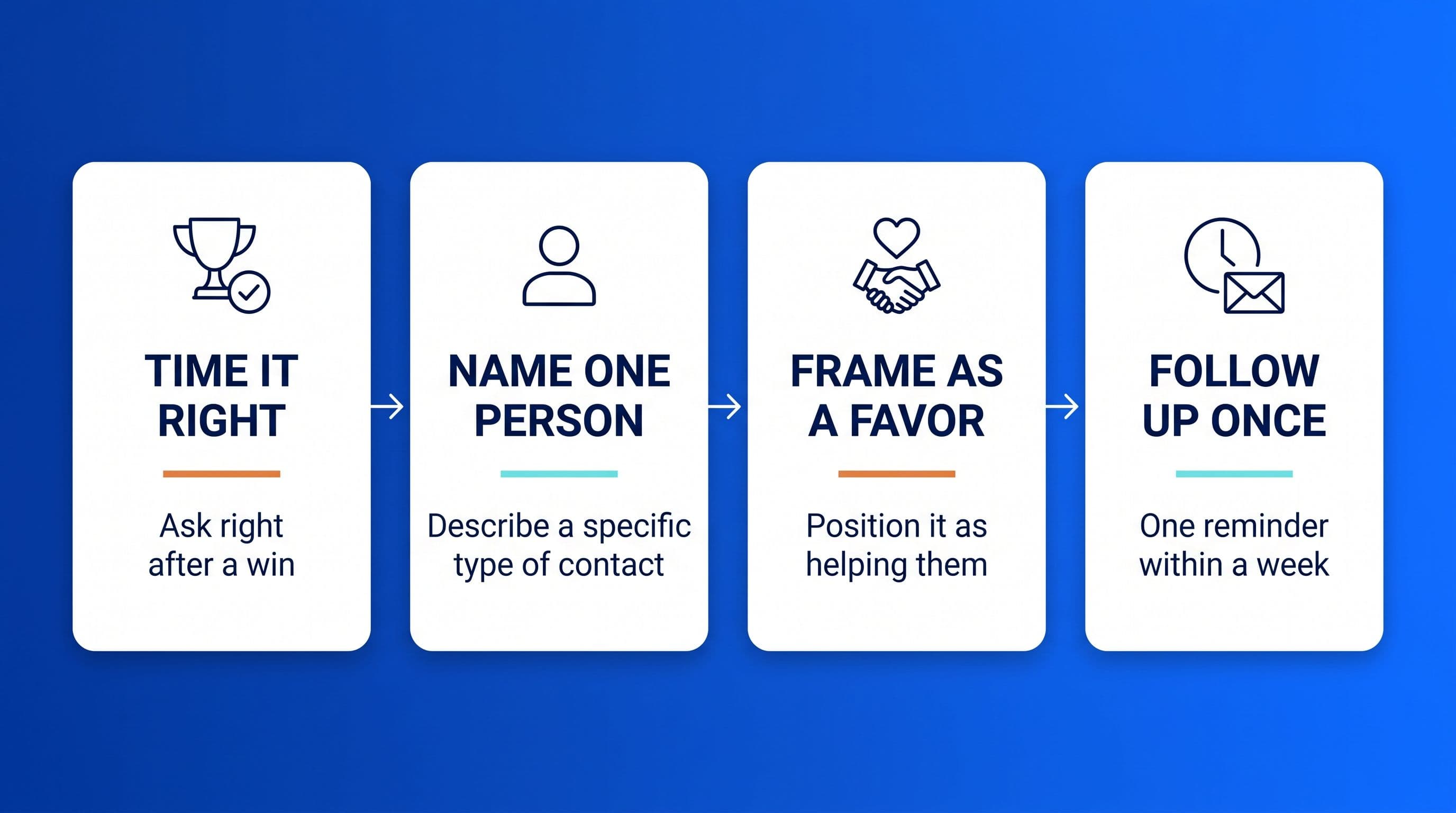
- Ask right after a client gets a result they're happy about. A disconnected, scheduled ask (a quarterly email blast, for example) has nothing to anchor it to.
- Name a describable type of person or company, not a vague "let me know if you hear of anyone" and not one single named lead. Both extremes tend to fail.
- Frame the request as a favor to the person you want introduced to, not a favor to yourself. It changes how the ask lands.
- Keep the message short (one or two sentences plus a single question) and follow up once, about a week later, with something new to say.
- Referred customers carry at least 16% higher lifetime value than customers acquired any other way (Journal of Marketing, 2011), and 88% of people trust a recommendation from someone they know over any ad (Nielsen, 2021).
Ask right after a visible win
The best time to ask for a referral is the moment a client has a reason to feel good about working with you, not on a schedule that has nothing to do with what's actually happening in their business. DIY Marketers found that the optimal moment is immediately after a client experiences a result they're genuinely happy about: a renewal, a milestone hit, or a problem that just got solved. Asking then means the referral request rides on real momentum instead of showing up out of nowhere.
A simple cadence keeps that moment from slipping away:
- Ask within 24 hours of the win, while it's still top of mind, and include something the client can forward without editing it.
- If they say yes, follow up about a week later with a light, no-pressure check-in, not a repeat of the original ask.
- Send a thank-you regardless of whether an introduction actually happened. Referrers who hear genuine thanks are the ones who refer you again.
Picture an owner-seller running a five-person agency who used to add "let us know if you know anyone" to every invoice. It never produced a single lead. Now picture her switching to one question right after a client renews: "You mentioned a friend who runs a shop about your size and is dealing with the same lead-gen problem you had six months ago. Would you mind making an introduction?" The client says yes immediately, because the ask names someone she'd already been thinking about. That's the gap between a request and an open-ended search.
Name the exact type of person, not "anyone"
A vague referral ask fails because it hands the client a search with no filter. Kitces.com found that most clients, when asked an open-ended question about who they know, come up blank, not because they don't know anyone, but because they haven't been given a specific enough category to search their own network against. The fix is naming a describable type of person or company: a role, a company size, or the specific problem you just solved for them.
Going too far in the other direction backfires just as badly. ReferralRock points out that pinning the ask to one named company or contact turns it into a single yes-or-no question. One no ends the conversation.
| Ask type | Example | What happens |
|---|---|---|
| Too vague | "Let me know if you hear of anyone who could use us." | Hands the client an open search with no filter. Most people do nothing rather than guess wrong. |
| Too narrow | "Do you think [specific company] would want to talk to us?" | Pins the ask to one outcome. A single no ends it. |
| Specific | "Do you know another [role] at a company around your size dealing with [the problem you just solved]?" | Gives a describable category the client can actually match against their contacts. |
Frame it as a favor to the person you want introduced to
The words "know anyone who could use this?" work because they position the client as doing something nice for a friend, not as doing you a favor. ReferralRock frames it directly: that phrasing differs fundamentally from "refer a friend and earn $20," because the first appeals to helping someone the client already cares about, and the second turns the ask into a transaction.
There's a psychological reason this framing also strengthens the relationship instead of straining it. Effectiviology's summary of the Benjamin Franklin effect describes how doing a favor for someone tends to increase the favor-doer's liking of that person, as a way of resolving the mental discomfort of helping someone they didn't already feel warmly toward. A referral works the same way in reverse: when a client does you the favor of an introduction, they tend to feel more invested in your success afterward, not less.
A workable version of the ask sounds like this:
Referral ask, sent within 24 hours of the win: "Hi [name], congrats again on [the renewal or result]. Quick question: do you know another [role] at a similar-size company who's fighting the same [problem] you had before we fixed it? Happy to have a no-pressure conversation if it seems like a fit. Totally fine to say no."
Notice what's missing: no mention of a reward, no pressure, and a specific enough description that the client can actually run a mental search.
Keep the message short and follow up once
Length matters as much as wording. HubSpot's analysis of a Boomerang study of 40 million emails found that emails between 50 and 125 words got the highest response rates, peaking at 75 to 100 words. A referral ask should be shorter than that: one or two sentences of context and a single question is enough. If you want the full anatomy of a short, high-reply email, our follow-up sales email template breaks down the same structure.
If you don't hear back, follow up once, about a week later, and add something new instead of repeating the ask:
Follow-up, about a week later: "Hi [name], no rush on this, just wanted to keep it on your radar in case [contact] came to mind. Either way, thanks again for the kind words about the renewal."
That's the same principle covered in how to follow up after no response without sounding needy: one light touch, not a repeated pitch.
A follow-up system built around chasing a yes or no has nowhere to file a referral ask, so it tends to fall out of the sequence entirely. That's a bigger problem for an owner-seller running sales solo than for a team with a dedicated rep, because there's no one else tracking which asks are still open. Klipy solves that specific gap: it queues a drafted follow-up for the day you said you'd check back in, so the referral ask you already sent doesn't quietly disappear into your inbox along with everything else on your plate that week.
If the client hasn't had a recent win yet, how to ask a happy client for a referral covers how to spot that moment before you ask.
FAQ
When is the best time to ask for a referral? Right after your client experiences a visible win, not on a quarterly schedule disconnected from that moment. Think client wins like a contract renewal, hitting a milestone, or fixing something that had been bothering them: the ask lands as a natural extension of something they already want to talk about, not an interruption.
Why does a vague referral ask like "let me know if you hear of anyone" fail? It hands the client an open-ended search with no filter to run, forcing them to judge fit themselves and risk a bad introduction. Most people default to doing nothing rather than guess wrong, so the ask quietly goes nowhere.
How soon should I follow up after asking for a referral? Send the ask itself within 24 hours of the win, follow up once more with a no-pressure check-in about a week later, and send a thank-you regardless of outcome. Add something new each time instead of repeating the same pitch.
Are referrals actually worth the ask, or just goodwill spent for nothing? Yes. 88% of consumers trust recommendations from people they know above any other marketing, per Nielsen's 2021 study, and referred customers carry at least 16% higher lifetime value than non-referred customers, per Journal of Marketing research.
The takeaway
A referral ask isn't a separate skill from the follow-up work you're already doing. It's the same discipline: time it to a real moment, be specific, keep it short, and follow up once without turning it into a repeat pitch. Start with the next client win on your calendar. Ask that one client the specific question instead of the generic one, and see what happens before you try to fix the whole process at once.