
 Ask ChatGPT
 Ask Perplexity
 Ask Claude
 Prefer us on Google
Introduction
Key takeaways
- Use a four-move reply for every price pushback: acknowledge, restate the outcome, offer value instead of a discount, close with one question.
- Discounting first trains buyers to always ask; discount-acquired customers churn faster and carry meaningfully lower lifetime value than full-price customers (Price Intelligently).
- Email handles the first and second reply well; if the back-and-forth keeps stalling, move to a short call. Email-only price negotiation closes at roughly a 5% win rate versus about 35% when phone and email are combined (Gong).
- A second pushback is a normal step, not a lost deal: later follow-up steps drive a disproportionate share of replies (Belkins).
- Three ready-to-send templates below cover the first pushback, the repeat pushback, and the one-line "just send me a discount" ask.
What's the fastest way to answer "it's too expensive" without cutting your price?
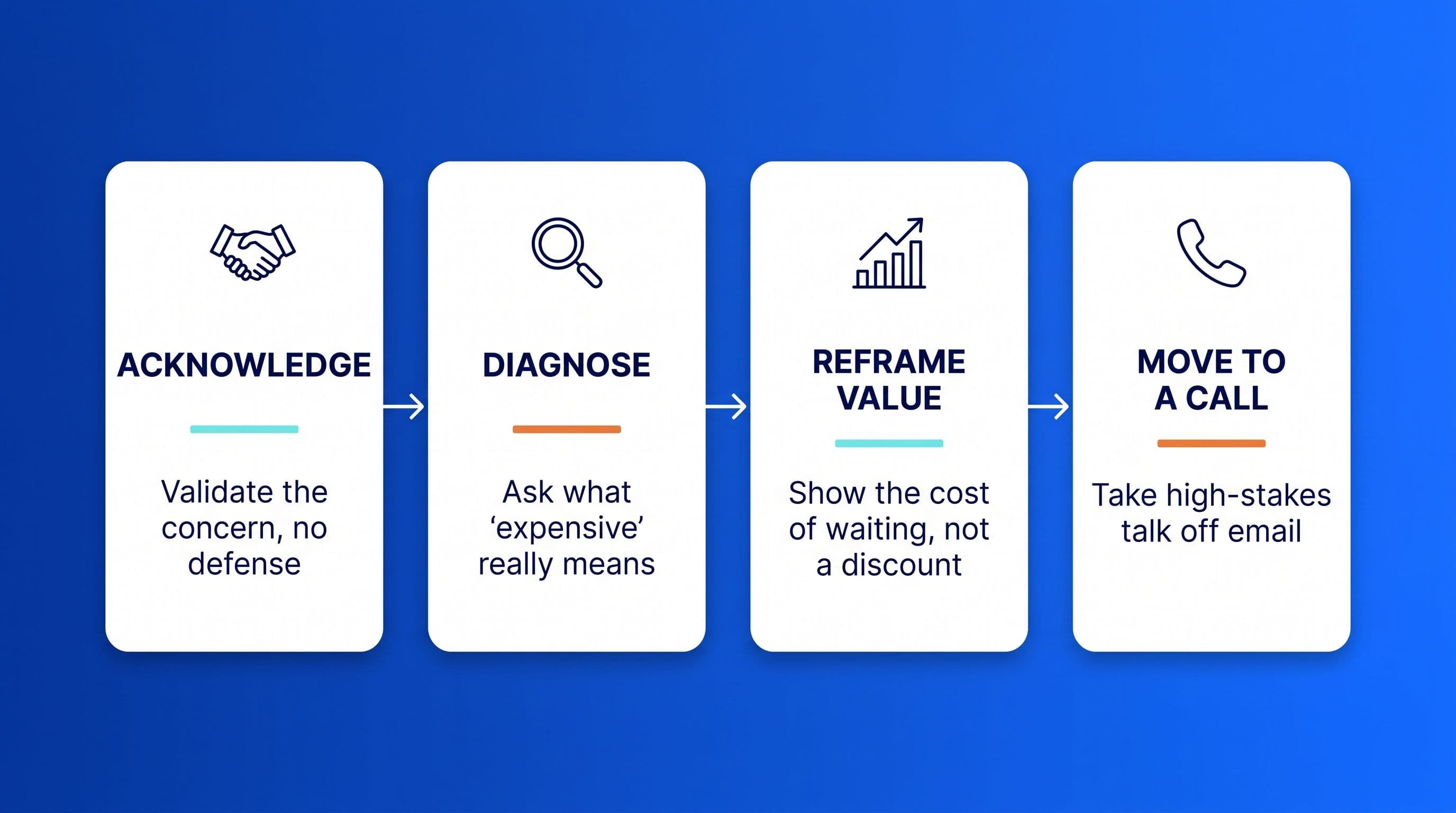
Answer a price objection with four moves in one email: acknowledge the concern in a single line, restate the specific outcome the price buys, offer a value add or scope change instead of a discount, and close with one concrete next-step question. This holds your price without a sales manager backing you up, and it keeps the thread moving toward a decision instead of a standoff.
You may run a team, but you're still the one who quotes every deal and negotiates every objection yourself, with no sales manager above you to check a discount and no pricing desk to fall back on. "It's too expensive" lands differently in that seat than it does on a team with a manager reviewing every number. This piece is part of our guide to how to follow up on a sales email so it actually gets a reply, and it zooms in on one specific moment in that thread: the reply you send when the price gets pushed back on.
Use a four-move reply, in this order, in the same email: acknowledge the objection in one line, restate the specific outcome the price buys (not a features list), offer a value add or scope change instead of a discount, and close with one easy next-step question.
You reuse this structure on every price pushback, the same way our guide to the proven 5-part follow-up structure reuses one shape across every follow-up. Here, each move earns its own section below, then three full templates put the whole structure together.
Why is discounting the first move a trap when you own every price conversation?
Discounting first is risky for anyone, but it's structurally worse when you're the only person negotiating the deal. A rep on a sales floor has a manager to check with and a price the whole team defends; when you're the one holding the price alone, caving once tells that buyer (and often the people they talk to) that the listed number was never real, so every future conversation opens with "can you do better."
Aggressive discounting of 20% or more can cut average customer lifetime value by as much as 30%, and customers acquired through heavy discounting show higher churn and a lifetime-value gap that exceeds 32% compared to full-price customers, according to Price Intelligently's SaaS pricing strategy research. A discount doesn't just shrink this deal. It sets the ceiling for every renewal conversation after it.
Team structure matters too. Gong's analysis of 67,149 sales meetings found that team selling makes a rep up to 258% more likely to close a deal than selling solo, and that top performers deliberately delay price talk: they raise it around the 38 to 46-minute mark on a call, while less successful reps bring it up in the first 12 to 15 minutes. You may run a team of your own, but nobody there is checking your pricing before you hit send. That gap is what you have to close yourself, so you deliver value before price, every time. The order carries the weight a sales manager would otherwise carry for you.
Can you fully resolve a price objection over email, or do you need a call?
The first reply belongs in email: acknowledge, reframe to outcome, offer value, close with a question. But if the back-and-forth continues past that first exchange, move it to a short call. Email-only negotiation has the lowest win rate of any channel for closing out a stuck price discussion.
Email-only pricing discussions close at roughly a 5% win rate. Phone-only conversations close at about 15%. Deals that combine phone and email close at around 35%, nearly seven times the email-only rate, according to Gong's channel-by-channel analysis. Email strips out tone, gives the buyer unlimited time to sit on your offer, and leaves your written number available to compare against a competitor's quote. None of that kills the first written reply, but it's a real signal that the second or third round is better resolved with a voice on the line, even a 15-minute one, while you still follow up in writing to keep a record.
| Negotiation channel | Win rate |
|---|---|
| Email only | ~5% |
| Phone only | ~15% |
| Phone + email combined | ~35% |
Source: Gong.io, "This deadly simple negotiation mistake is costing you deals"
How do you acknowledge a price objection without sounding defensive or apologetic?
Use one short, neutral line that names the concern without repeating "expensive" back at them or explaining yourself. Something like "Makes sense you're weighing the cost" does the job in five words. Then move straight into value, not justification.
What doesn't work: over-apologizing ("I'm so sorry it's more than you expected"), restating the objection word for word ("I hear that you think it's too expensive"), or jumping straight to a number before you've said anything about what that number buys. Each of those either signals the price is negotiable or makes the buyer repeat their own complaint, which slows the reply down instead of moving it forward.
How do you restate value without just repeating your feature list?
Name the one outcome or number the buyer is actually paying for, such as hours saved per week, deals recovered, or revenue protected, instead of listing what the product does. Specific, quantified outcomes reframe the price as a cost of inaction, not a line item to negotiate.
A survey of 1,000 sales professionals by Topaz Sales Consulting found that price is the single most common objection sellers face, at 34% of all objections. Yet only half of respondents said they were confident or very confident reframing a price objection into a value conversation. Most sellers face this exact moment constantly and improvise through it.
A weak restate line repeats the feature list: "Our software includes reporting and dashboards." A strong restate line names the number: "This is the plan that's been getting your team 6 extra billable hours back a week, based on what you told me about your current process." Gong's research on language patterns adds a caution here too: using words like "list price" or "standard price" extends the sales cycle by 19%, because it signals the number itself is up for discussion. Outcome language doesn't have that problem. It never mentions the price at all.
What can you offer instead of a discount?
Change the scope or add value before you ever touch the number. Here are a few reliable swaps. Pick the one that fits the deal size:
- Fewer seats or a smaller initial rollout, so the total cost drops without the unit price moving.
- A shorter initial term (quarterly instead of annual): the upfront ask drops while the rate stays the same.
- A lighter package with the core outcome and fewer add-ons, if the buyer genuinely doesn't need everything in the quote.
- Added onboarding help or an extra deliverable: the buyer gets more for the same price instead of the same for less.
Any one of these gives the buyer real flexibility without signaling that the price itself was negotiable.
How do you close the reply so it's easy to say yes to?
End with exactly one low-effort, specific next step, something like "Does Thursday work for a 15-minute call to walk through the adjusted scope?" Skip the open-ended "let me know your thoughts," which gives the buyer nothing concrete to react to.
This mirrors the one-question close from our guide to the proven 5-part follow-up structure, applied specifically to the objection-reply moment. A single, specific question outperforms an open-ended sign-off because it removes the work of figuring out what to say back. The buyer just has to answer yes, no, or propose a different time, all of which keep the thread alive.
Three ready-to-send templates for a price-objection reply
Three templates cover the moments you'll actually hit: the first "it's too expensive" reply, the repeat pushback after you've already reframed once, and the one-liner "just send me a discount" ask. Each follows the acknowledge, restate outcome, offer value, one-question structure above. If you'd rather not write these from scratch every time, Klipy, the AI CRO, drafts the reply in your voice, and you approve it before anything reaches the buyer.
Template 1: first price pushback
Subject: Re: [proposal/quote subject]

Hi [Name],

Makes sense you're weighing the cost. Based on what you told me
about [specific pain, e.g., "your team losing 5+ hours a week to
manual follow-up"], this plan is built to get you [specific outcome,
e.g., "that time back within the first month"].

If the total is the sticking point rather than the value, I can put
together a lighter version: [specific scope swap, e.g., "starting
with just your core team and adding seats as it proves out"]. Same
outcome, smaller first step.

Does Thursday work for a 15-minute call to walk through that adjusted
scope?

[Your name]
Template 2: repeat pushback
A second objection isn't a lost deal. Belkins' analysis of 7.5 million tracked emails found that step 3 of a follow-up sequence alone drives more booked meetings than steps 1 and 2 combined. HubSpot's 2025 research found that 48% of salespeople never attempt a second follow-up at all. Simply showing up for round two puts you ahead of nearly half the field.
Subject: Re: [proposal/quote subject]

Hi [Name],

Fair enough, and I get why the number is still the sticking point.
Here's what doesn't change: [restate the same core outcome from
Template 1, e.g., "this plan is what gets your team that 5+ hours a
week back, starting the first week it's live"].

What I can change is how you get there. Instead of a discount, I can
[specific value swap, e.g., "phase the rollout over two quarters so
the cost lands in smaller pieces" or "add a fixed onboarding sprint
at no extra cost so your team is live in week one instead of month
two"].

Would a 15-minute call this week work to pick the option that fits
your timeline best?

[Your name]
Template 3: "just send me a discount"
Some buyers skip the objection altogether and just ask for a number. Acknowledge the ask directly, restate the outcome, offer value instead of a lower price, and close with the same one-question move.
Subject: Re: [proposal/quote subject]

Hi [Name],

Understood, you want a straight answer on price. The number reflects
[specific outcome, e.g., "the full rollout and the onboarding support
that gets your team using this within two weeks"], and that hasn't
changed since we last talked.

What I can do instead of moving the price is [specific value swap,
e.g., "include the extra onboarding session at no cost" or "start you
on a quarterly term so the upfront number is smaller"]. That keeps
the outcome intact without discounting the work itself.

Want me to send over the adjusted scope so you can see the exact
numbers?

[Your name]