
 Ask ChatGPT
 Ask Perplexity
 Ask Claude
 Prefer us on Google
Introduction
What is a no-show recovery email (and how is it different from a normal follow-up)?
A no-show recovery email is a same-day, low-guilt message sent within an hour or two of a missed call, built to get the meeting rebooked, not to restart cold outreach from zero. The prospect already said yes once. They picked a time, put it on their calendar, and (probably) meant to show up. That changes what the message should do and how fast it needs to move.
Missing a scheduled call is common. Average no-show rates for B2B sales meetings run roughly 20% to 35% across most companies, according to Chili Piper. That range means a no-show is a normal event inside a working pipeline, not proof the deal is dead. Treat it as a recoverable scheduling problem, not a rejection.
This matters for how you write the email. A cold follow-up has to earn interest from a stranger. A no-show recovery email starts from an existing agreement and just needs to remove the friction that's keeping the prospect from rebooking. The rest of this guide walks through what to send in the first hour, what to do if that email goes unanswered by the next day, and how to build a short recovery sequence across the first week without turning into the seller who won't stop emailing.
Key takeaways
- No-shows are common: 20-35% of scheduled B2B meetings, per Chili Piper, so one missed call is not a signal the deal is dead.
- Send the first recovery email within an hour or two, same day, with a direct booking link instead of asking the prospect to propose a new time.
- The most common reason for a no-show is a competing internal priority, not lost interest, so the copy should assume good faith.
- Plan a short sequence: two to three touches over about ten days, each adding something new, then one clear breakup message if there's still no reply.
- For a solo seller, the real risk usually isn't the copy. It's the no-show getting buried under the next three calls and never getting a follow-up at all.
This piece is part of our guide to following up on a sales email so it actually gets a reply, which covers the general follow-up cadence. What follows here is the specific playbook for the no-show scenario, where timing and tone both work differently.
The first hour: what to send right after they miss the call
Send a short, no-blame message within one to two hours that assumes the prospect got pulled into something, not that they ghosted you, and hands them a direct booking link instead of asking them to propose a new time. Cleverly frames the first 24 hours as the fastest recovery window, with the immediate message going out within an hour or two of the missed call: don't scold, and make rescheduling effortless by not asking the prospect to suggest a time.
Speed matters more here than it does in a standard cold sequence. Research from the Lead Response Management Study, based on three years of data across six companies and more than a hundred thousand call attempts, found that contact success dropped more than tenfold within the first hour after a lead went cold, and qualification odds fell over sixfold in that same window (Lead Response Management Study). That study measured inbound lead response, not no-shows specifically, but the underlying mechanism applies: the longer a prospect sits without a signal from you, the colder the moment gets and the easier it is for them to quietly move on to the next thing on their list.
The copy should also name a plausible, low-stakes reason for the miss. This isn't guesswork. Chili Piper's citation of 2019 MarketingProfs research found that 56% of prospects who missed a sales appointment said they were "overwhelmed by internal events," meaning the most common cause of a no-show is a competing priority, not disinterest. Writing from that assumption keeps the email light instead of accusatory.
A short example:
Subject: quick reschedule, [Meeting topic]
Hi [Name],
Looks like something came up on your end for our call today, no worries at all, that happens on my calendar too. Want to grab a new time? Here's my link: [booking link].
If today just wasn't the day, that's fine, just let me know and I'll follow up when it's better timing.
Notice what's missing: no "you missed our call," no "per our scheduled meeting," no guilt. Just an assumption of good faith and a one-click path back to the calendar. If writing that first message from scratch isn't where you want to spend your time, Klipy's follow-up drafts can generate a no-blame reschedule email like this one in seconds.
[IMAGE: A calendar app showing a missed meeting notification next to an open laptop, search terms: "missed calendar meeting notification laptop"]
The first day: if the reschedule email goes unanswered
If there's no reply by the next business day, send one more attempt that adds a specific, useful reason to respond, not a repeat of the first ask. Re-sending the same "want to reschedule?" message with a different subject line rarely moves the needle, because it doesn't give the prospect any new reason to open the email.
What should change in the copy: a short resource relevant to the reason they booked the call in the first place, a direct answer to a likely objection, or a narrower ask that lowers the commitment, something like "worth 10 minutes, or should I check back next quarter?" Each of those gives the prospect a reason to respond that the first email didn't.
This is also where the no-show sequence diverges from a normal cold sequence. With a cold prospect who never replied to an opening email, it's common to wait several days, sometimes a week, before the next touch. A no-show is different: the prospect already agreed to a specific time once, so a faster second touch (day two, not day seven) still feels proportionate rather than pushy, because you're following up on a real, missed commitment rather than nudging someone who never committed to anything.
If the day-2 email still gets nothing back, that's the point to plan the rest of the sequence deliberately rather than sending ad hoc reminders. Our guide to following up after no response covers how to keep that tone right without sounding needy across a longer stretch of silence.
The first week: building the 2-3 touch recovery sequence
Plan on two to three follow-ups spread across roughly ten days. Each one should add new value: the first follow-up after an initial miss produces the largest single jump in reply rate, and most eventual replies come from the sequence, not the opening message. Woodpecker's data, pulled from its own email sending platform, found that sending two to three follow-up emails works best: the first follow-up alone delivers close to 40% higher reply rates than the initial email, and a campaign with one follow-up converts about 22% more prospects than a campaign with none.
A workable cadence for the no-show scenario specifically:
| Touch | Timing | What it adds |
|---|---|---|
| Touch 1 | Same day | The low-guilt reschedule email covered above |
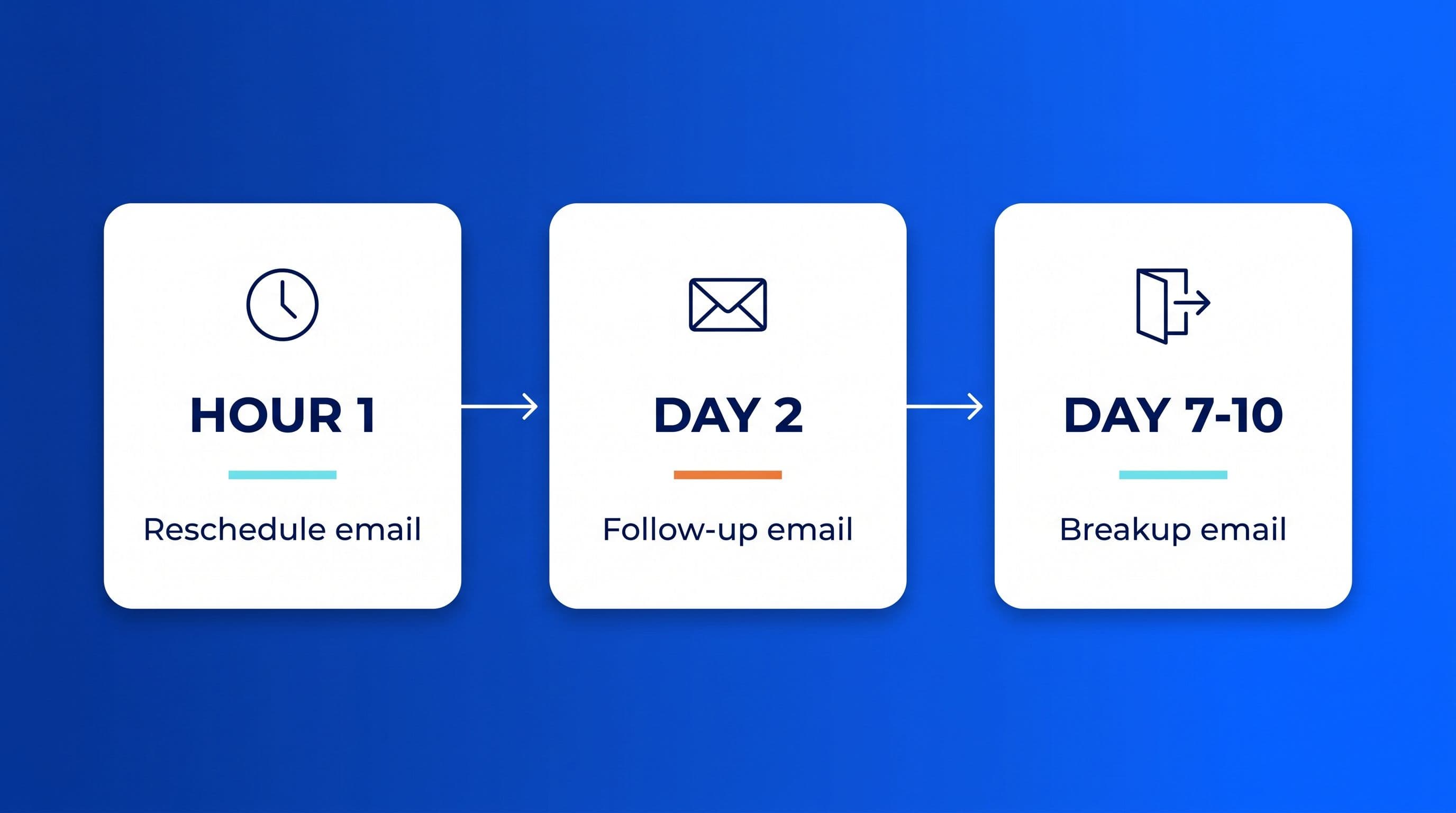
| Touch 2 | Day 2-3 | A resource, an answer to a likely objection, or a narrower ask |
| Touch 3 | Day 7-10 | The breakup message, covered in the next section |
Each touch needs to earn its place by adding something the prospect hasn't seen yet. This lines up with the broader pattern for outbound sequences generally. Instantly's 2026 cold email benchmark report found that 58% of replies land on the first message, but the remaining follow-up steps still contribute the other 42%. It recommends four to seven touchpoints as the effective range: fewer than four abandons prospects too soon, while more than seven brings diminishing returns unless each touch adds genuine new value.
A no-show sequence can run shorter and faster than a cold sequence for a specific reason: trust is already partly established. The prospect took the meeting seriously enough to book it, which is more buy-in than a cold prospect who's never spoken with you has shown. That's why three touches over ten days is usually enough here, where a cold sequence might reasonably stretch to five or six touches over several weeks. For the underlying template structure each touch should follow, our 5-part follow-up email structure breaks down what belongs in the opening line, the value add, and the ask for any of these touches.
[CHART: Timeline chart showing the recommended no-show recovery cadence, touch 1 same day, touch 2 around day 2-3, touch 3 (breakup) around day 7-10, source: Woodpecker follow-up statistics and Walnut.io no-show cadence framework]
How a no-show recovery email differs from a normal cold follow-up
A no-show recovery message should run hotter and faster than a standard cold follow-up. The timing tightens to hours instead of days, and the copy shifts to lower-guilt but higher-urgency language. The ask changes too: a direct scheduling link instead of a soft check-in, because the prospect already said yes once.
A cold follow-up assumes no relationship exists yet and has to earn interest gradually, often across several generic value-proposition touches before asking for time. A no-show recovery email skips that build-up. It should reference the specific meeting and time slot, plus the specific topic the prospect agreed to discuss, not a general pitch. Specificity is what signals "I remember this was a real conversation," rather than "you're one name on a list."
There's evidence that recovery-style, direct messaging outperforms generic cold outreach on reply rate. HubSpot reports that its enterprise team sees a 33% response rate on breakup-style emails, well above what a generic cold follow-up typically pulls. That logic applies doubly to a no-show recovery message. The direct, low-friction approach already outperforms vague nudges on its own, and here it's paired with a prospect who's already shown real intent by booking the original call in the first place.
The differences are concrete enough to compare side by side:
| No-show recovery email | Cold follow-up | |
|---|---|---|
| Timing | Hours, not days, for the first touch | Days between touches |
| Tone | Assumes good faith about the miss | Generic rapport-building |
| Ask | Direct booking link | "Let me know if you're still interested" |
When to send the final breakup message
Send one clear breakup email around day 7-10 if you still haven't heard back. It closes the loop honestly, and it often gets a reply precisely because it removes pressure. Walnut.io's structured no-show cadence lays out a full week's worth of touches, from an immediate light check-in through a 4-6 hour second touch, a 24-hour resource share, a day-3 attempt with a different angle, and a breakup or move-to-nurture message at day 7. This guide follows that same shape: fast touches early, more space between them as the days pass, then a clear close.
Your breakup email's job isn't to burn the relationship. It signals that this is the last nudge, closes the loop respectfully, and leaves the door open for the prospect to come back when the timing is better, without turning what was a scheduling hiccup into an accusation of being ignored.
A short example:
Subject: closing the loop, [Meeting topic]
Hi [Name],
I haven't been able to find a time that works since our call got missed, so I'll stop reaching out for now. If priorities shift and this is worth revisiting, my calendar link is here: [booking link]. Wishing you well either way.
That kind of message rarely reads as pushy, because it removes the ask entirely. And because it's the last email in a short sequence rather than one of many identical nudges, it's often the one most likely to actually get opened.