
 Ask ChatGPT
 Ask Perplexity
 Ask Claude
 Prefer us on Google
Introduction
By the Klipy team.
If you're still closing your own deals, you didn't do anything wrong. Most B2B founders don't choose founder-led sales, they inherit it. There's no budget for a first sales hire, no proven pitch to hand someone else, and you're the only person who can answer a hard technical question and adjust the price on the same call.
The trouble shows up later. With no sales background and no team, it's easy to run this phase on instinct, and instinct stops working once you have more than a handful of deals in flight. This guide covers how to structure a solo sales process, which habits keep deals from dying quietly, where AI can take real work off your plate without taking the relationship with it, and how to know, with actual signals instead of a gut feeling, when it's time to hire.
Key takeaways
- Founder-led sales is a deliberate phase, not a permanent state. Most founders run it from their first deal until roughly $1M–$2M ARR (SaaStr) or about one to two years (Techstars).
- Buyers increasingly research and self-serve on their own (67% prefer a rep-free buying experience, per Gartner, March 2026), but still want a human for complex or high-stakes decisions (75% by 2030, per Gartner, August 2025).
- Running sales solo requires a defined pipeline and one record for every deal's history, plus a fixed weekly review. Without them, deals live in memory and quietly die.
- Two concrete thresholds signal it's time to hire: 10–20 closed customers personally (Jason Lemkin, SaaStr), or roughly 50 demos at a 15–25% win rate (Peter Kazanjy).
- Hire individual reps before a VP of Sales, and only after they're closing and hitting quota on your documented process (Lemkin).
- AI can take the busywork off your plate, capturing calls and keeping the deal record current, while judgment calls and relationships stay with you.
[IMAGE: A founder taking notes during a video sales call at a laptop in a small office. Search terms: founder sales call, entrepreneur video meeting, solo founder laptop.]
What is founder-led sales?
Founder-led sales means the founder personally runs prospecting, demos, and closing instead of handing them to a hired rep. Peter Kazanjy, the operator who coined the term, describes it as a deliberate design pattern: "the founder is charged with figuring out the initial repeatable sales motion, and hiring and managing the first set of professional sellers" (Kazanjy). A founder isn't necessarily a better closer than anyone else. What a founder has that a new hire wouldn't yet is direct exposure to customer objections and enough product judgment to adjust the pitch mid-call, both of which matter before a repeatable motion exists.
Paul Graham made a related point in his essay on doing things that don't scale, using Stripe as the example. Graham describes how the Collison brothers would personally sit down with anyone who agreed to try the product and set them up on the spot, a habit early employees came to call the "Collison installation." His broader argument: "at least one founder (usually the CEO) will have to spend a lot of time on sales and marketing." That hands-on effort is what founder-led sales looks like in practice, whether you're selling SaaS to a technical buying committee or closing your first retainer as a consulting or agency owner.
Founder-led sales has an intended end state. It's a phase you're meant to graduate out of once you can teach someone else your process. It isn't a permanent job description you keep because nobody else can do the work. The rest of this guide covers how to run that phase well and how to know when it's over.
When founder-led sales makes sense, and when it stops working
Founder-led sales works from your first deal through roughly $1M–$2M ARR. SaaStr states the ceiling directly: "founder-led sales generally stops scaling around $1m-$2m ARR. It's not a repeatable process, and it doesn't scale. At some point, you run out of hours in the day." Techstars puts a time frame on the same idea, estimating the phase should last one to two years for most startups, and frames it as a learning phase that precedes a closing phase.
Both figures describe the same constraint from different angles. Your sales motion works because you're the one running it. You adjust pitch and pricing on the fly and answer product questions no rep could answer yet. That's an asset early on, and it becomes a bottleneck once your pipeline outgrows your calendar.
Founders ask a fair question here: do you still need to sell personally, given how much research buyers do on their own before ever talking to a person? Gartner's March 2026 survey of B2B buyers found that 67% now prefer a rep-free buying experience, up from 61% the year before, and 45% used AI tools during a recent purchase. Gartner's read on the shift is plain: B2B buyers now move through the critical stages of a purchase more autonomously, and static collateral no longer carries the influence it once did.
Gartner's own forecast qualifies that finding for the deals that matter most. The firm projects that by 2030, 75% of B2B buyers will prioritize human interaction over AI for complex or high-stakes purchases. Gartner frames this as a reversal already underway: after several years of rising interest in self-serve and AI-driven sales, more buyers are again asking for authentic human engagement, especially in complex or high-stakes transactions.
The table below lines up both figures side by side.
| Signal | Figure | Source | What it means for a founder |
|---|---|---|---|
| 2026 buyer preference | 67% prefer a rep-free buying experience; 45% used AI tools while buying | Gartner, March 2026 | Let buyers self-serve routine research. Don't re-explain what's already on your site. |
| 2030 projection | 75% will prioritize human interaction for complex or high-stakes purchases | Gartner, August 2025 | Save your personal time for the calls that decide trust and price. |
Put together, the two findings point to a simple split. Let buyers handle the research and the routine back-and-forth on their own. Spend your limited hours where they change the outcome, the calls that decide trust and price.
How to structure a sales process with no sales team
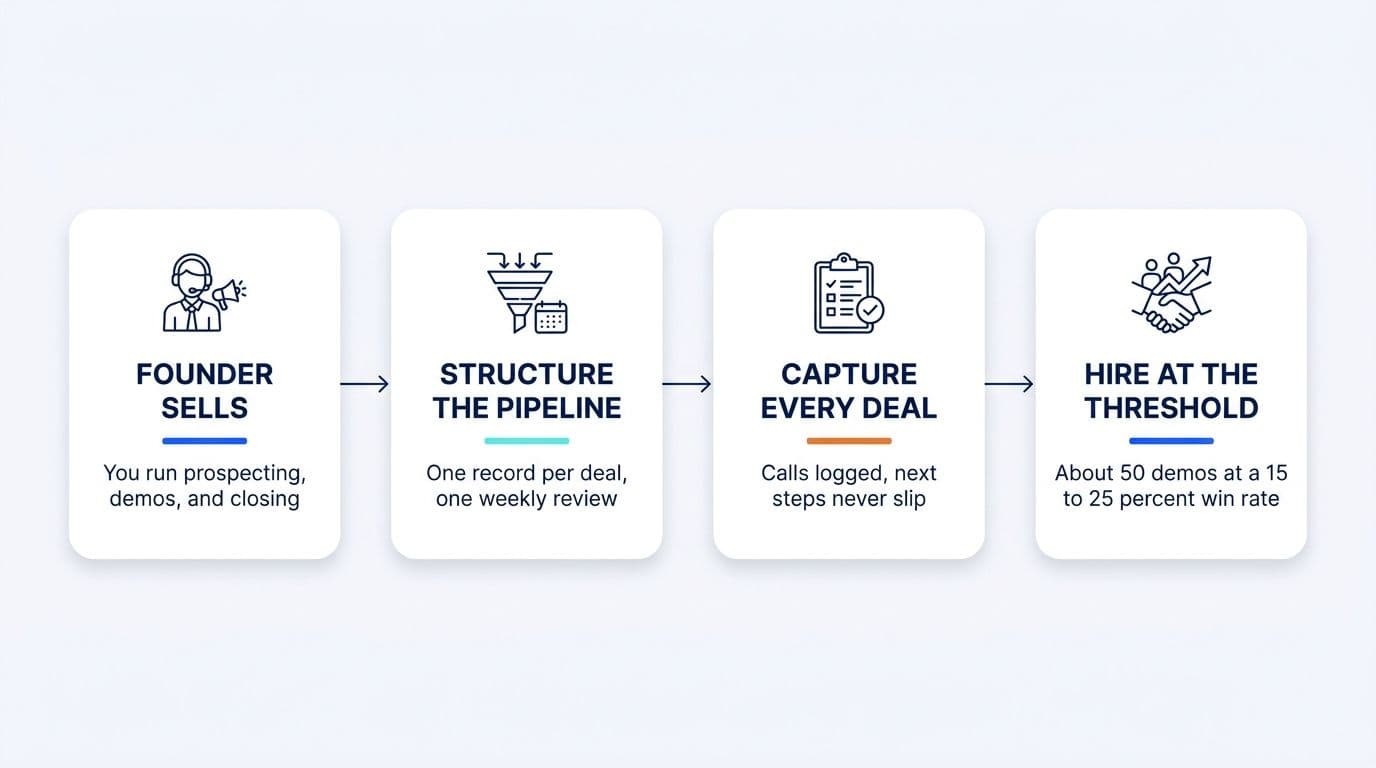
Running sales alone means personally replacing what a hired sales team would otherwise provide. At minimum, you need a pipeline with clearly named stages and one place that holds every deal's history. Add a fixed weekly review on top of both, and you have the backbone that keeps deals from living only in your memory.
A pipeline sized for a founder's bandwidth is short. Five stages cover most B2B motions: prospect, demo'd, proposal, negotiation, closed. You don't need more stages than that until you have a team split across them.
For every open deal, track the same handful of facts: the last touch, the next step and its date, the live objection, and the actual decision-maker. That's the minimum a spreadsheet needs to hold to be useful.
A spreadsheet works for a handful of concurrent deals. It stops working once you're juggling more than you can hold in your head, because nothing forces you to update it and nothing flags a deal that's gone quiet. That gap is where deals quietly die. Usually the pitch was fine. Nobody followed up.
The habits and cadences that keep founder-led deals from slipping
Deals slip in founder-led sales for one main reason: you're also running product and hiring, so sales gets whatever attention is left over. A small set of non-negotiable habits protects the pipeline better than any tool or script.
Same-day follow-up matters most. Send a recap the day of the call, not the day after, while the conversation is still fresh for both of you.
Log the call before you move to the next task. Write down what was said and the next step before you open your inbox. If it isn't written down, it didn't happen for pipeline purposes.
Run a weekly full-pipeline review. Block one recurring hour, whatever day fits your week, and go through every open deal: what's the next step, and has anything gone quiet.
Never let a deal sit without a next step and a date attached. A deal with "checking in soon" as its status is already stalling.
Review win-loss patterns monthly. Once you've closed and lost a few deals, the difference between them starts to show you what your winning pattern actually is.
These habits matter beyond keeping deals alive. You can't calculate a real win rate if you don't know how many demos you ran or what happened to each one, and that number is exactly what tells you when to hire (more on that below). This isn't about willpower, either. Whether you're chasing SaaS logos or landing your next consulting retainer, the founders who stay in control of their pipeline are the ones with habits, not memory.
The honest cost of running all this by hand is real. A Lehigh University-led study of 308 entrepreneurs found that 87% reported anxiety, depression, or burnout, and that founders who set explicit work-life boundaries reported far lower burnout: 45% low-burnout versus 6% for founders without boundaries. The habits above protect your pipeline. They don't protect your time, which is what the next section is about.
Where AI should (and shouldn't) take work off your plate
The busywork of founder-led sales is exactly what should move off your plate: capturing what was actually said on a call and keeping the deal record current. The relationship and the judgment calls, what to offer and when to walk away, should stay with you. Gartner's 2030 projection above is the reason why: buyers still want a human making the calls that carry real stakes.
This is where a "supervised" AI workflow fits, not a fully autonomous one. Klipy, the AI CRO that runs your entire sales operation, drafts the recap from your call transcript the same day and logs it against the right deal. You stay the one deciding what actually gets offered and what goes out.
The gap this closes is a specific one. Founder-led sales rarely breaks because of a bad pitch. It breaks because a call happened on Tuesday, the notes lived in the founder's head, and by Thursday nobody, including the founder, remembered what was promised. Klipy, the AI CRO, is built for that gap. It catches the conversation and keeps the deal record current, then surfaces the next step instead of leaving it to memory.
Two decisions stay yours regardless of how much busywork moves off your plate: what to offer a specific buyer and when to walk away from a deal that isn't a fit. No tool should make those calls for you. The founders who keep winning spend their freed-up time on exactly those decisions instead of on data entry.
The signals that tell you it's time to hire your first salesperson
Hire your first salesperson when you can state your winning pattern in one sentence, not when you're too tired to keep selling. Jason Lemkin advises founders to close roughly their first 10–20 customers personally before making a sales hire. Peter Kazanjy's benchmark is more process-based: run at least 50 sales demos and reach a repeatable win rate of 15–25%. Dock's summary of his framework puts it simply: "if one out of five of your first meetings turns into a deal, it's pretty solid."
Techstars makes the same point about timing versus fatigue: "the right time to hire your first sales leader is not when you are tired of selling. It is when you have enough pattern recognition to teach someone else how to do it." Fatigue tells you that you need help. It doesn't tell you that you have a repeatable process to hand someone.
The table below puts the concrete thresholds side by side, so you have an actual bar to clear instead of a feeling.
| Threshold | Benchmark | Source |
|---|---|---|
| Closed customers | 10–20 closed personally before hiring | Jason Lemkin, SaaStr |
| Demo volume and win rate | 50+ demos at a 15–25% win rate | Peter Kazanjy, via Dock |
| Revenue ceiling | Model generally stops scaling around $1M–$2M ARR | SaaStr |
| Typical duration | 1–2 years for most startups | Techstars |
Hiring out of fatigue rather than repeatability is the anti-pattern to watch for. First Round Review's go-to-market research, drawing on Dropbox, Figma, and Stripe, found that a first sales hire made too early is at least as damaging as one made too late. A hire who inherits a process that only worked because the founder was running it personally will fail, and it won't be their fault.
How to make the transition off founder-led sales
Transition gradually. Document the playbook you've been running by instinct, hire individual reps against that documented process, and stay personally involved in the deals that matter most even after those reps are ramped.
Lemkin's sequencing rule is blunt: "never, ever hire a VP of Sales until you have two individual sales reps really closing and hitting quota. Almost 100% of the time, any but the very, very best first VPs of Sales fail if the founder steps out of sales." Individual reps come first. A VP of Sales with nothing repeatable to manage and no proof the motion works beyond you is one of the most common early hiring mistakes.
First Round Review's profiles of Dropbox, Figma, and Stripe show this plays out differently at each company, different candidate profiles, different onboarding timelines, but the sequencing principle holds across all three. Document first. Hire reps against the documented process. Add sales leadership only once reps are proving it works.
[IMAGE: A small whiteboard or notebook page showing a simple sales pipeline sketched by hand with stage names. Search terms: sales pipeline sketch, whiteboard sales process, founder planning notebook.]
Hand off the parts of the job that don't require your judgment first, top-of-funnel prospecting and routine admin. Hold onto the parts that do for longer, pricing conversations and any deal where the relationship is the reason it's moving at all.
Founder-led sales mistakes to avoid
The costliest founder-led sales mistakes come from skipping the pattern-recognition work this phase exists to do.
- Hiring a first salesperson, or worse, a VP of Sales, before the process is repeatable and documented.
- Treating deal logging as beneath your time, until a lead goes quiet and nobody notices.
- Confusing a busy calendar with a teachable process. Being busy closing deals isn't the same as being able to explain how you closed them.
- Waiting well past the $1M–$2M ARR range out of fear of losing control, and running out of hours instead.
- Burning out instead of offloading the admin that doesn't require your judgment.
If you recognize yourself in that list, especially the last one, that's usually the sign to look at what should move off your plate first.
None of this requires more hours in your day. It requires deciding, on purpose, what only you should be doing. See how Klipy's AI agent handles the rest, from call capture to the next move, while every send stays yours to approve.
FAQ
What is founder-led sales?
Founder-led sales is a go-to-market model where the company's founder, not a hired account executive, personally runs prospecting, demos, negotiation, and closing during the earliest stage of the business. Peter Kazanjy, who coined the term as a design pattern, frames the founder's job in this phase as finding the initial repeatable sales motion before hiring and managing the first professional sellers. It's most common from first revenue through roughly $1M–$2M ARR, before a documented, repeatable process exists for someone else to run.
When should a founder stop selling and hire a salesperson?
Most operators point to a pattern-recognition threshold, not a calendar date. Jason Lemkin of SaaStr advises closing roughly the first 10–20 customers personally before hiring, and Peter Kazanjy's benchmark is running at least 50 sales demos with a repeatable 15–25% win rate. The real signal is being able to state your winning pattern in one sentence, who buys and what it takes to close them, not simply feeling too busy to keep selling.
How long does founder-led sales typically last?
Techstars frames founder-led sales as a learning phase and a closing phase, and says it typically runs one to two years for most startups. SaaStr's benchmark is that the model generally stops scaling around $1M–$2M ARR, because the founder's personal process isn't repeatable by someone else and there aren't enough hours in the founder's day to keep growing pipeline alone.
Should a founder hire a VP of Sales or individual reps first?
Individual reps first. Jason Lemkin's guidance is to never hire a VP of Sales until at least two individual reps are actually closing deals and hitting quota on the process the founder built. A VP with nothing repeatable to manage and no proof the motion works beyond the founder is one of the most common early sales-hiring mistakes.
Is founder-led sales still effective now that buyers prefer self-service and AI research?
Yes, with a caveat. Gartner finds 67% of B2B buyers now prefer a rep-free buying experience and 45% used AI tools during a recent purchase, but Gartner also projects that by 2030, 75% of B2B buyers will still prefer human interaction for complex, high-stakes deals. The practical read: let buyers self-serve the research and admin, and spend the founder's own time on the judgment calls.
What's the biggest mistake founders make in founder-led sales?
Making the first sales hire too early, before the founder has a documented, repeatable process to hand off. First Round Review's go-to-market research, drawing on Dropbox, Figma, and Stripe, finds that hiring too early is at least as damaging as waiting too long. A premature hire inherits a motion that only works because the founder is the one running it, and the hire fails through no fault of their own.