
 Ask ChatGPT
 Ask Perplexity
 Ask Claude
 Prefer us on Google
Introduction
You're running the whole company. Product, delivery, maybe a co-founder splitting the load, and no SDR anywhere in sight. You've heard Apollo.io mentioned in every founder Slack group and outbound thread as the default place to start, so you're checking: does it actually replace the person you can't afford to hire yet, or does it just hand you a different set of manual work?
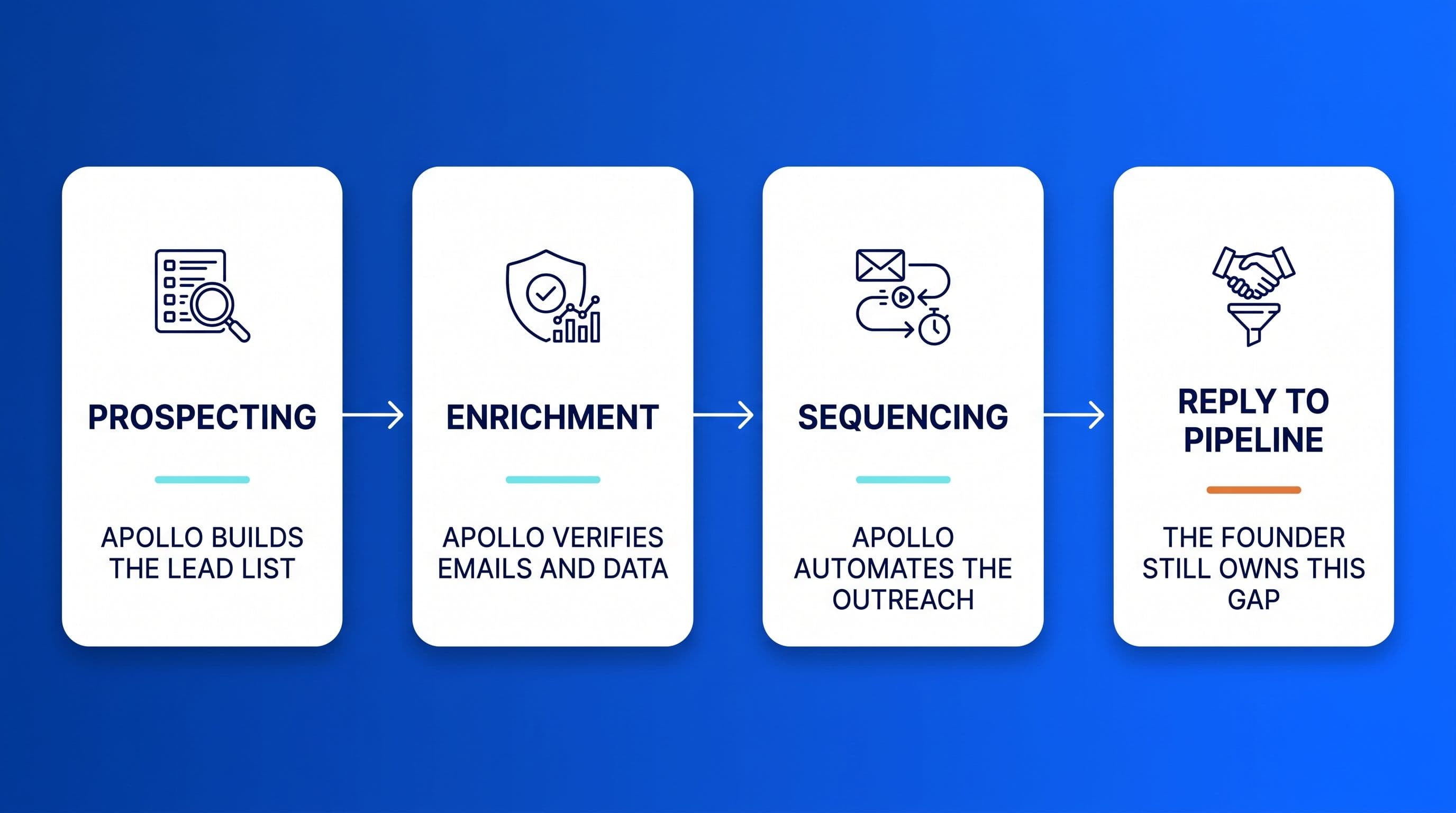
The honest answer is both. Apollo.io does replace a meaningful chunk of what a junior SDR would spend their day doing: finding verified contacts and sending structured, multichannel outreach. It does not replace what happens after someone replies. That second half, turning a reply into a tracked opportunity with a follow-up date, still lands on you. If you're comparing Apollo to a dedicated AI SDR, that reply-to-pipeline gap is exactly where the difference shows up.
Our guide to founder-led sales covers the broader playbook this article's setup fits into.
Key takeaways
- Apollo.io gives a solo founder verified contact data, multichannel sequences, and a dialer in one subscription, drawing on a database of 270M+ verified contacts across 500,000+ companies (TechCrunch, 2023).
- A working setup (ICP filters, a contact list, a live sequence) takes about an afternoon, and the free tier caps at 10,000 credits per account per month before you need to pay (Apollo.io pricing).
- Apollo's native Deals view is basic. Independent reviews confirm most users still pair it with Salesforce, HubSpot, or Pipedrive for real pipeline management (Factors.ai; laGrowthMachine).
- Cold email reply rates average just 0.45% (Belkins, 2025), which means every reply Apollo helps you generate is scarce and expensive to lose track of.
- A median fully loaded SDR runs about $80,000 OTE (The Bridge Group, 2025), so Apollo is cheap by comparison, but the savings only cover the sending half of the job, not the tracking half.
Here's the same split at a glance:
| What Apollo replaces (the sending half) | What still lands on the founder (the tracking half) |
|---|---|
| Verified contact sourcing | Noticing a reply |
| Multichannel sequences | Qualifying it |
| Dialer | Logging the opportunity |
| Activity logging | Setting a follow-up |
| Updating stage |
What does Apollo.io actually do for a solo founder with no SDR team?
Apollo.io replaces the two most time-consuming parts of an SDR's job: finding verified contacts and sending multichannel outreach at scale. It does not replace the pipeline-management job an SDR, or a founder standing in for one, still has to do once someone replies.
The scale behind Apollo's data is real. When Apollo raised its $100M Series D at a $1.6B valuation in August 2023, the company reported a database of more than 270 million verified B2B contacts, serving over 3 million go-to-market professionals across more than 500,000 companies (TechCrunch, 2023). For a solo founder, that scale means you can search by title, industry, headcount, and technology stack and pull a workable list without paying a separate data vendor.
On the outreach side, Apollo's Engage product builds automated, multi-step sequences across email, calls, and LinkedIn tasks, and logs the activity back to a CRM (Apollo.io product page). That's the functional definition of an outbound engine: find the right people, then touch them on a schedule without manually composing each message.
Practitioners rate the tool well for this job. Apollo holds a 4.7 out of 5 rating across roughly 9,690 reviews on G2 (G2), which is strong validation for a data-plus-sequencing tool. Keep that framing in mind through the rest of this piece: Apollo is a data-plus-outreach engine. It's not built to own your pipeline, and it doesn't claim to be. If you're weighing what still needs a home once a reply lands, an AI SDR built for solo founders is designed to cover exactly that half.
[IMAGE: A solo founder working at a laptop reviewing a contact list and outreach dashboard - search terms: founder laptop sales dashboard, solo entrepreneur working]
How does a solo founder actually set up Apollo.io from zero?
A working outbound setup, meaning ICP filters, a verified contact list, and a first live sequence, takes a solo founder about an afternoon, not a sales-ops project.
Start by connecting a sending inbox (and LinkedIn, if you plan to combine channels). From there, define your ideal customer profile inside Apollo's contact database using filters like title, company size, industry, and technology used. Pull a list, spot-check a handful of contacts for accuracy, and move into sequence building.
A reasonable first sequence for a solo founder runs three to five steps: an opening email, a LinkedIn connection or message, a follow-up email, and a manual call task for anyone who opens but doesn't reply. Set a conservative daily sending limit from day one. Deliverability problems compound quietly, and a founder with no one watching the inbox reputation can't afford to find out the hard way.
One practical constraint worth planning around: Apollo's free tier operates under a fair-use policy capped at 10,000 credits per account per month for non-paying accounts (Apollo.io pricing). That's enough to validate your targeting and messaging before spending anything. Once you're running real volume, that ceiling is usually the moment you decide whether to upgrade.
What is Apollo.io genuinely good at for a one-person GTM motion?
Apollo's real strength for a solo founder is volume with minimal manual research. You get accurate-enough contact data, automated multichannel sequencing, and activity logging, all inside one low-cost subscription instead of stitching together a data vendor, a separate sequencing tool, and a dialer.
Start with data breadth. A database built to the scale TechCrunch reported, 270M+ contacts and 500,000+ companies (TechCrunch, 2023), means you rarely hit a dead end trying to find the right person at a target account. Then there's Engage's sequencing, which handles the mechanical repetition of multi-step outreach across email, calls, and LinkedIn tasks and logs each touch back to a CRM automatically (Apollo.io product page), so you aren't tracking who got which email in a spreadsheet. And the price-to-capability ratio is hard to beat: Apollo's own pricing page describes a metered credit model that starts free and scales with usage (Apollo.io pricing), which removes the upfront cost that would otherwise price a pre-revenue founder out.
Put those together and you get a tool that a single founder can run without any sales-ops background, backed by a 4.7/5 satisfaction rating across thousands of G2 reviews (G2). Give Apollo credit here: this half of the job, sourcing and sending, is genuinely solved.
What should a solo founder not expect from Apollo.io?
Apollo will not turn a reply into a tracked, staged, followed-up deal on its own. It's an outreach and data tool with a lightweight deal-tracking view attached, not a pipeline system, and that's exactly why most teams that rely on it still run a separate CRM alongside it.
Factors.ai reviewed Apollo's built-in functionality and put it plainly: Apollo's CRM "provides basic pipeline and contact management, though many businesses still integrate it with Salesforce, HubSpot, or other CRMs for advanced needs" (Factors.ai). laGrowthMachine's independent review confirms the same pattern from the integration side, noting Apollo connects to Salesforce, HubSpot, and Pipedrive with bi-directional syncing (laGrowthMachine), a feature that only matters if the real pipeline work happens somewhere else.
That's two independent sources describing the same gap from two angles. The specific manual work Apollo leaves on your desk: notice the reply, decide it's a real opportunity, log it somewhere, set a follow-up reminder, and update the stage as the conversation moves. Apollo has no mechanism that forces this discipline. Nothing in the product notices when you've gone quiet on a warm reply for six days. That gap is exactly what a pipeline tracker built for solo founders is designed to close.
Why does the reply-to-pipeline gap matter more for a solo founder than for a sales team?
Because a solo founder has no one else catching what they drop, and every reply is scarce enough that losing track of one is a real, measurable cost, not a rounding error.
Start with the scarcity. Average B2B cold email reply rates sit at just 0.45% across a sample of 7.5 million emails sent in 2025 (Belkins, 2025). Out of every 200 or so emails Apollo helps you send, you might get one reply. That reply carries hours of list-building and sequence-writing behind it, which is precisely why letting it sit unanswered in an inbox for a week is expensive in a way a missed cold email never is.
There's a targeting wrinkle worth calling out directly, because it's easy to misread. Belkins' data shows founders and owners reply to cold email at a higher rate than any other seniority segment, 0.57%, compared to 0.42% for C-level executives and 0.32% for VPs (Belkins, 2025). That's a statement about who you're emailing, not about who's sending it: founders reply to cold outreach more often when they're the recipient. It says nothing about whether a founder-sent email outperforms an SDR-sent one. Read correctly, though, it raises the stakes: if you're targeting other founders, your reply rate is likely to run above average, which means the volume of "scarce, valuable replies" you need to track only grows.
This is where the lack of a second person really shows. Salesforce's research on sales productivity found reps spend less than 30% of their working time actually selling, with the rest consumed by admin, CRM entry, internal meetings, and manual research (Salesforce, 2023). On a team, that 70% gets absorbed by sales ops, a manager, or shared process. A solo founder has no one to hand that 70% to. It just becomes the second half of every day, which is why so many founders end up looking at how to reclaim selling time from admin work once the reply volume picks up.
[CHART: Bar chart, average cold email reply rate by recipient seniority (founder/owner 0.57%, C-level 0.42%, VP 0.32%) - source: Belkins 2025 Cold Email Benchmark Study, https://belkins.io/blog/cold-email-response-rates]
Is Apollo.io actually cheaper than hiring an SDR, and what doesn't that savings cover?
On subscription cost alone, yes, decisively. Apollo's paid plans run a fraction of what a single SDR costs to employ. But that comparison only accounts for the sourcing-and-sending half of the job, not the reply-to-pipeline tracking half covered above, and that distinction is the whole point of this article.
The Bridge Group's 2025 SDR research report, based on a survey of 351 B2B companies, puts the median fully loaded SDR compensation at $80,000 in on-target earnings, split roughly 68:32 between a $55,000 base and $25,000 in variable pay (The Bridge Group, 2025). That figure doesn't include benefits, management time, or tooling, so the real all-in cost of a first SDR hire tends to run higher still. Glassdoor's separate salary data, drawn from more than 9,900 self-reported salaries as of mid-2025, puts average total SDR pay at roughly $97,786 a year, with an average base of $58,666 (Glassdoor, 2025). Whichever number you anchor to, $80,000 or closer to $98,000, it's a five- or six-figure annual commitment before that person has booked a single meeting.
Apollo's pricing sits nowhere near that range. The platform starts free under its 10,000-credit fair-use policy and scales with usage from there (Apollo.io pricing), so a solo founder can run a real outbound motion for a small fraction of even the low end of SDR compensation. On sourcing and sending alone, Apollo wins the cost comparison outright.
But stopping the comparison there answers the wrong question. An SDR's $80,000-to-$98,000 salary doesn't just buy contact lists and sent emails, it buys a person who also does the tracking half: noticing the reply, qualifying it, logging it, and following up on a schedule. Apollo's subscription price only ever covers the first half. The tracking half doesn't disappear because no one was hired to do it. It just moves onto the founder's own calendar, unpaid and unbudgeted, alongside product and delivery.
That's the accounting a solo founder needs to do before treating Apollo as a full SDR replacement. If sourcing and sending were the whole job, Apollo would be an easy yes at any price point below $80,000 a year. Since they aren't, the honest way to evaluate it is to price Apollo against what a real SDR replacement costs: the subscription, plus whatever time or tooling it takes to close the reply-to-pipeline gap yourself. For most solo founders, that means keeping Apollo for the half it does well, sourcing and sending, and pairing it with a lightweight, deliberate way to track replies, rather than expecting one subscription to quietly cover both halves of the job.