
 Ask ChatGPT
 Ask Perplexity
 Ask Claude
 Prefer us on Google
Introduction
Apollo.io shows up on almost every "best sales tool" list a solo founder searches. It has the contact database, the sequence builder, and the AI-assist features that look like exactly what a one-person sales operation needs. Then you open it, and the first hour goes to figuring out how sequences, task queues, and credit allocation actually fit together, not to sending your first outreach.
That gap between what Apollo promises and what it takes to get value from it is not a bug. Apollo is built for a specific buyer: a team of SDRs and the manager who runs them. A solo founder running founder-led sales is a different buyer entirely, doing the prospecting, the calls, and the follow-up as one person wearing every hat. The product's design decisions, not just its price, reflect the team it was built for.
Key takeaways
- Apollo's core design centers on SDR teams (roughly five to fifteen-plus reps), with manager dashboards and coaching workflows sitting in the same workspace as rep tools.
- Reviewers across G2, Salesforge, Warmly, and Sparkle consistently describe a real configuration burden in sequences, workflows, and contact search, not a five-minute setup.
- Apollo's team pricing tier enforces a 3-seat minimum, so even a two-person operation pays for three licenses; a 5-rep team on the Professional tier runs roughly $4,740 a year.
- Solo founders are a large and growing buyer segment: they made up 63% of C corps formed through Stripe Atlas in Q2 2026, and the broader startup market's solo-founder share rose from 23.7% to 36.3% between 2019 and H1 2025.
- A founder-fit tool should log the call and update the deal without a manual pass, and draft follow-up for approval, not require a setup project before the first outreach goes out.
Apollo technically works for solo founders, but it wasn't built for them
Apollo.io can technically run on its Free or Basic tier for a solo founder, but the product underneath that tier is engineered for SDR teams. The sequence builder, the admin panels, and the seat-based pricing all assume someone whose full-time job is configuring and monitoring the tool. That's not what a solo founder has time for while they're also closing the deals it produces.
This matters more now than it used to, because solo founders are not a fringe case. They accounted for 63% of C corporations formed through Stripe Atlas in Q2 2026, an all-time high (Stripe). Cap-table data from Carta shows the same trend from a different angle: the share of new U.S. startups with a solo founder rose from 23.7% in 2019 to 36.3% in H1 2025 (Carta). A buyer this large deserves tools designed around how they actually work, not a smaller version of a tool built for someone else.
What Apollo.io is actually built for: SDR teams, not solo operators
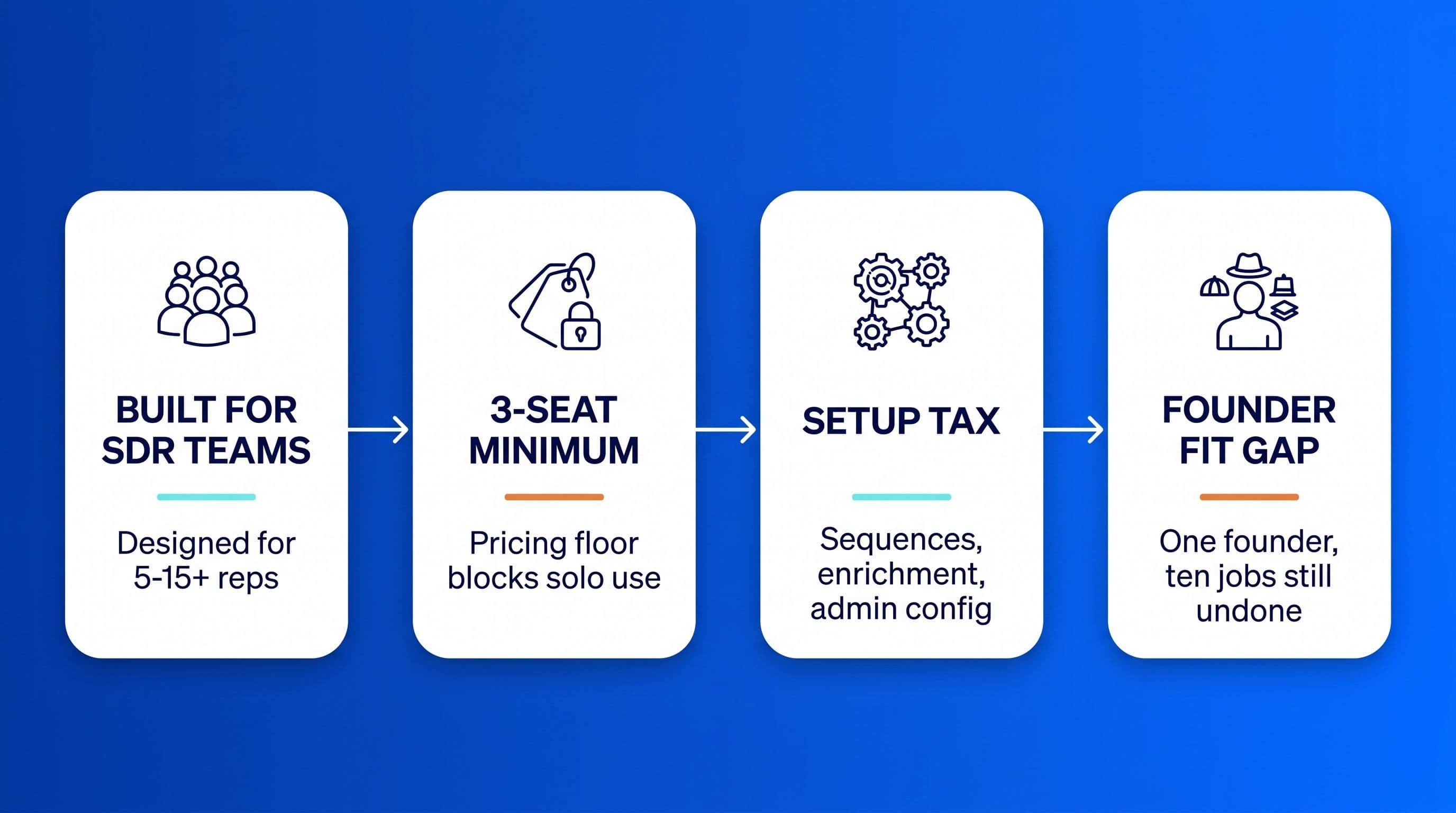
Apollo's core product design centers on a team of reps and the manager overseeing them, not a single owner-operator running their own pipeline. The company's own positioning makes this explicit: Apollo for Sales Leaders "provides team-level performance dashboards and coaching workflows in the same workspace" as the tools individual reps use (Apollo.io). That design targets teams of roughly 5 to 15 SDRs.
Apollo also builds persona-specific tooling for the SDR role itself. That reinforces that the product's design center is a role inside a larger team, not a founder doing every role at once. Its sales development persona page describes AI that "surfaces your most pressing replies, prospects, and tasks while recommending what to say" (Apollo.io). That's a feature built for someone whose job is exactly that one function. That data feeds into a manager's view of team performance.
A solo founder doesn't have a manager to hand coaching data to, and they aren't one rep among several whose tasks need triaging against a team queue. They're the rep, the manager, and the buyer at once. A tool built around team roles doesn't collapse cleanly into a tool for one person filling every role.
Where the setup tax shows up: sequences, admin panels, and configuration
Getting Apollo's sequencing, workflows, and contact search configured correctly takes real technical work. Reviewers describe a learning curve steep enough that a non-technical operator struggles to get full value without dedicated setup time. A verified G2 review puts it directly: "it takes a very technical person to put together your sequencing, workflows, and searching contacts properly to really put the system to good use. A typical salesperson isn't going to be able to dive so deep into all the technical aspects of this tool" (G2).
That's not an isolated complaint. Salesforge's hands-on review corroborates the same setup burden and adds that Apollo's credit system compounds the confusion: it's "not always clear how credits are calculated" (Salesforge.ai). Warmly's review frames the tension as a scaling problem: "the interface has a steep learning curve even if the [AI] Assistant is easy to test" (Warmly.ai). That means the parts that feel simple in a demo aren't the parts that take the time. Sparkle's review lands on the same conclusion from a third angle: Apollo "is not hard in the sense of being unusable, but it is feature-dense... it takes time to understand where all the parts fit together" (Sparkle.io).
None of these reviewers call Apollo broken. They describe a product whose depth is the point for a team that has someone dedicated to running it. For a solo founder who needs their first sequence live today, that same depth becomes a tax rather than a feature. See what Apollo.io replaces and what it doesn't for solo founders for a closer look at where that tax shows up in daily use.
Apollo's pricing assumes a team, even if you're not one
Apollo's team pricing tier enforces a 3-seat minimum, so even a two-person operation pays for three licenses. That cost structure is built around headcount a solo founder doesn't have. According to Tomba's pricing breakdown, "the Organization tier enforces a 3-seat minimum" and a 5-rep team billed annually reaches roughly $4,740 a year (Tomba.io).
The seat minimum is the clearest signal of who the pricing model is built for. A solo founder buying Apollo either overpays for unused seats on the team tier or stays capped on a lighter tier that doesn't unlock the features Apollo built its reputation on. Either way, the pricing structure is built around a team's economics, not a single operator's. See Apollo.io's pricing lock-in and downsizing penalties for what happens if headcount changes.
What a solo founder actually needs: three requirements Apollo doesn't prioritize
A solo founder running founder-led sales needs three things from a sales tool, not a configuration project before the first outreach goes out:
- A pipeline that works without a setup project first
- Calls and deals logged and updated without a manual pass
- An AI agent that drafts follow-up for approval
Every section above points to the same gap. Apollo's manager dashboards, sequence-builder depth, and seat pricing all solve problems that only exist once there's a team to manage, a workflow to standardize across reps, and headcount to price against.
That doesn't make Apollo a bad tool. A founder-led-sales toolstack guide notes a real, if temporary, upside: "for most founders doing outbound, Apollo handles both the list-building and the initial outreach in one interface, which reduces the number of tools you need to manage" (GTM AI Blog). Consolidating list-building and outreach into one login is a legitimate starting point. The honest framing: it's a starting point a solo founder tends to outgrow quickly. It's not built to stay with them as their operation matures on its own terms. Independent competitive analysis reaches a similar conclusion from the buyer side: solo founders and small teams "may need faster setup, fewer moving parts, and cleaner day-to-day workflows" than a heavy sales intelligence system provides (Sparkle.io).
Klipy: built for what happens after the reply lands
Klipy isn't a swap-in replacement for Apollo. It's built for the job Apollo doesn't do: Apollo finds and sequences new leads at volume, and Klipy takes over from the reply onward. When a reply comes in, Klipy captures the call, logs it against the deal, and drafts the follow-up in your voice. You approve it before anything sends, so the record stays current without a separate admin pass. There's no manager dashboard to configure because there's no team to manage yet, and no 3-seat minimum to buy around.
| Dimension | Apollo.io | Klipy |
|---|---|---|
| Target buyer | SDR team of 5 to 15+ reps | Solo owner-seller running founder-led sales |
| Setup | Technical configuration across sequences, workflows, and contact search | Connects to email and calendar; no sequence builder to configure |
| Seat minimum | 3-seat Organization minimum | None |
| Pricing example | ~$4,740/yr for a 5-rep team on the Professional tier (Tomba.io) | Free forever tier; paid plans start from $39/seat/mo |
| Call & deal capture | No native call capture; manual entry | Logs the call and updates the deal from the transcript |
| Follow-up | Manual sequencing from pre-reply templates | Drafts follow-up from the real conversation, staged for your approval |
| Manager dashboard | Yes, built into the team workspace | Not applicable, there's no team to manage |
For a founder who wants to see how the two tools compare feature by feature, pricing tier by pricing tier, the direct comparison is the fastest way to check the fit: the Apollo.io alternative comparison. For a founder still deciding what category of tool they need before comparing specific vendors, what an AI sales agent does for founder-led teams is the broader starting point.
Conclusion
Apollo is a capable tool. It's just built for a specific buyer, SDR teams, and a solo founder isn't that buyer. The setup and pricing tax shows up concretely. Sequence and workflow configuration is steep enough that G2 reviewers call out the need for a technical operator, and a 3-seat pricing minimum charges a two-person operation for a team it doesn't have. A founder-fit tool should look different: calls and deals logged and updated without a manual pass, and follow-up drafted by an AI agent, not built around a setup project.
If you're ready to compare directly, the Apollo.io alternative comparison walks through the head-to-head. If you're still mapping out what founder-led sales looks like at your stage, the founder-led sales hub is the place to start.
Frequently asked questions
Is Apollo.io good for solo founders? It depends on what "good" means. Apollo's Free or Basic tier is technically usable by a solo founder, but its core design, manager dashboards, coaching workflows, and role-based tooling for the SDR seat, targets SDR teams of roughly 5 to 15+ reps, not a one-person operation wearing every hat (Apollo.io).
What is the best Apollo.io alternative for solo founders? Apollo and Klipy solve different jobs rather than compete for the same one. Apollo finds and sequences new leads at volume; Klipy takes over once a reply lands, logging the call, updating the deal, and drafting the follow-up for your approval. For a solo founder who wants a tool built around that second half of the job, without Apollo's SDR-team setup and seat-pricing overhead, Klipy is the founder-fit option. See the Apollo.io alternative comparison for a direct, feature-by-feature look.
How much does Apollo.io cost for a small team? Apollo's Organization tier enforces a 3-seat minimum regardless of actual headcount, so even a two-person operation pays for three licenses. A 5-rep team on the Professional tier billed annually runs roughly $4,740 a year (Tomba.io).