
 Ask ChatGPT
 Ask Perplexity
 Ask Claude
 Prefer us on Google
Introduction
Apollo.io's pricing lock-in: what reviewers say about downsizing penalties
A solo founder shopping for a sales tool usually starts with the price page, not the contract. That's the mistake reviewers keep flagging about Apollo.io: the sticker price on the pricing page is only half the story. The other half lives in the terms of service, and it's the part that bites when your team shrinks instead of grows.
This matters more for founder-led sellers than for anyone else. A funded sales team hires up and rarely cuts seats mid-year. A solo founder or a two-person founding team might add a contractor for a launch push, then drop back to one seat the month after. Apollo's contract structure, built for the first kind of buyer, doesn't bend for the second. This piece is part of our guide to founder-led sales, and it walks through what Apollo's terms say, what reviewers report experiencing, and what a founder should check before signing an annual seat contract of any kind.
Key takeaways
- Apollo's Terms of Service (Section 4(d)(i)) state seat count "may not be decreased during a Term," so a shrinking team keeps paying for seats it no longer uses until renewal.
- Contracts auto-renew unless either party gives 30 days' written notice before the term ends, and subscriptions are non-cancelable mid-term with non-refundable payments.
- Apollo's annual per-seat pricing runs $49 (Basic), $79 (Professional), and $119 (Organization) per user/month, with a 3-seat minimum on the top tier, per Vendr's pricing data.
- Real Capterra and Trustpilot reviewers independently describe unpredictable credit consumption and pricing on top of the seat fee, not just the seat-lock issue.
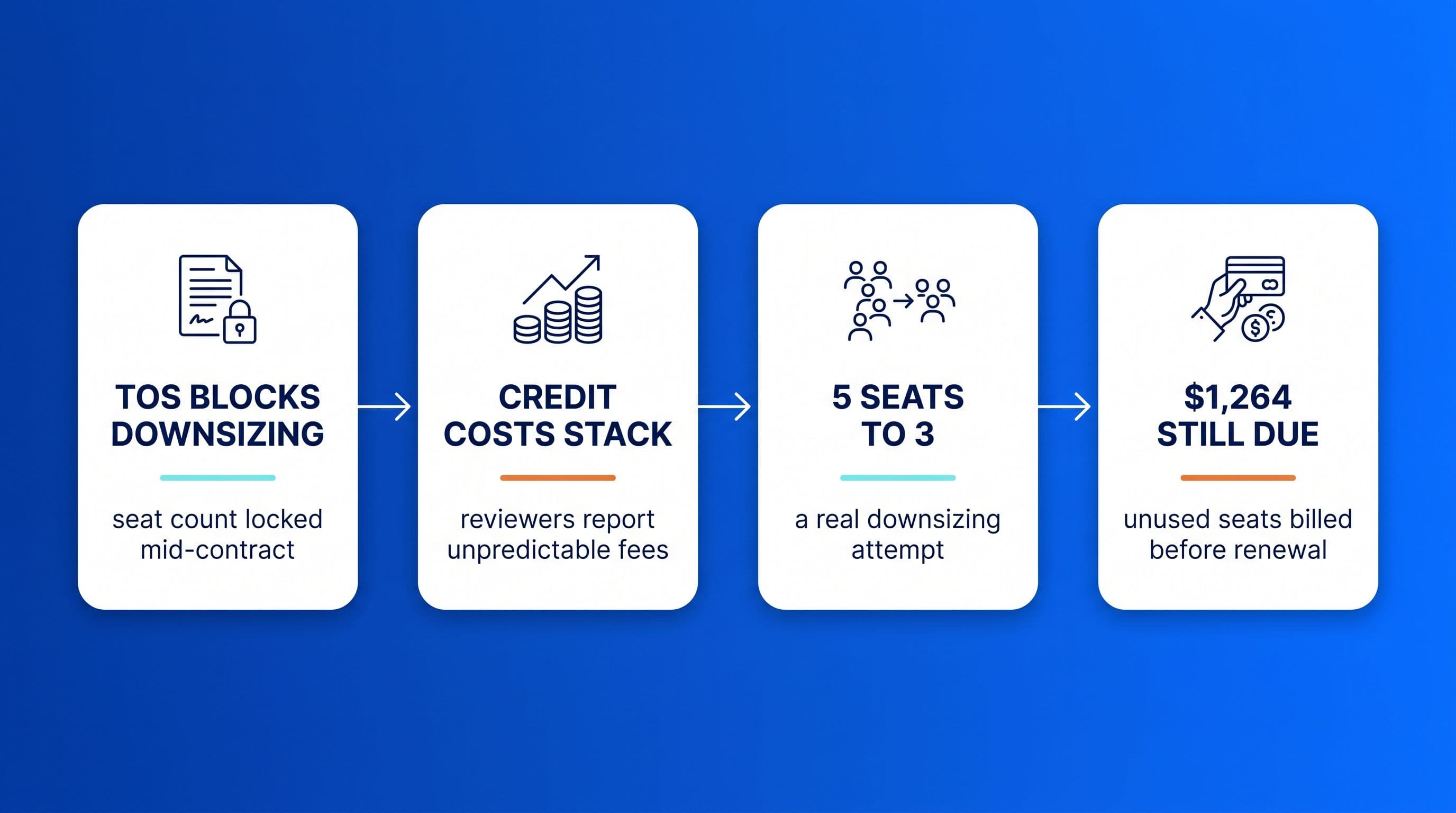
- A worked example: downsizing from 5 seats to 3 seats in month 4 of a 12-month Professional term still means paying for all 5 seats through renewal, an estimated $1,264 in payments for seats you're no longer using.
- Founders evaluating any sales tool should check billing cadence, seat minimums, downgrade timing, and renewal-notice terms before signing, whether or not they end up switching.
Is Apollo.io's pricing really "locked in"?
Yes. Apollo's own Terms of Service state, in Section 4(d)(i), that "the number of seats may not be decreased during a Term." That's contract language, not a reviewer's exaggeration or a competitor's spin. If you sign up for 5 seats on an annual term, you are contracted for 5 seats until that term ends, regardless of how many people actually use the tool six months in.
Two more clauses compound the effect. First, Apollo's terms state that "subscriptions are non-cancelable during the Term and all payments by you are nonrefundable," so there's no early exit even if the tool stops fitting your team. Second, the same terms specify that "each Subscription Term will automatically renew for an additional period equal to the expiring Subscription Term unless either party gives the other written notice of non-renewal at least thirty (30) days prior to the end of the relevant Subscription Term." Miss that 30-day window and you've re-upped for another full year at the same seat count, whether you need it or not.
Apollo's per-seat annual pricing, per Vendr's marketplace data, breaks down by tier:
| Plan | Price/user/mo | Annual/seat | Seat minimum |
|---|---|---|---|
| Basic | $49 | $588 | None listed |
| Professional | $79 | $948 | None listed |
| Organization | $119 | $1,428 | 3 seats |
Vendr also notes that annual contracts are standard across Apollo's contracting. Teams buying 10 or more seats commonly negotiate below list price. A solo founder buying one or two seats doesn't have that lever.
For a deeper breakdown of what the tool is built for, see Apollo.io for solo founders.
Downsizing seats mid-contract doesn't lower your bill
Nothing changes in your favor when you try. You keep paying for every contracted seat until the term ends. Apollo's pricing page FAQ confirms this billing mechanic directly: plan downgrades apply immediately inside the product, but the billing adjustment doesn't land until the next cycle, and "cancellations take effect at the end of your current term."
It helps to separate two things people conflate: downgrading a plan tier (say, Professional to Basic) and reducing seat count on the same tier. Apollo's terms address seat count specifically, and the answer is that you can't reduce it mid-term at all, only at renewal. So if a founder-led team goes from three sellers to one, the contract still bills for three seats until the term is up. The only lever available during the term is adding seats or upgrading tiers, both of which take effect immediately, because that direction benefits Apollo's billing, not yours.
The 30-day non-renewal notice trap
The auto-renewal clause turns a one-time signing decision into a recurring one you have to remember to act on. The terms auto-renew "unless either party gives the other written notice of non-renewal at least thirty (30) days prior to the end of the relevant Subscription Term." A founder who simply forgets to send that notice ends up locked into another full year at the same seat count. That notice is easy to miss when you're also running delivery, support, and the rest of the business. There's no prompt in the product forcing that decision; it's a calendar problem the buyer has to own.
What do real Apollo.io reviewers say about pricing and contracts?
Reviewers on Capterra and Trustpilot independently describe the same pattern from different angles: pricing that's hard to predict, and credits that drain faster than expected on top of the seat fee. It's a repeated theme across a review base where Apollo otherwise scores well.
"Extremely expensive and most of the data is terrible and invalid. It charges you $99 for the plan to get leads and then you end up paying even more in credits." (Damien, Trustpilot review)
"Throttling and limits on their free plan makes it unusable and their paid plan is ridiculously expensive." (LJ, Trustpilot review)
"I purchased credits, but unfortunately I have not been able to use any of them because my account is currently blocked." (Pijush Kanti Paul, Trustpilot review)
On Capterra, a Staffing & Recruiting reviewer put it plainly: "Unclear pricing, forced waterfall verification, slow email access, and excessive credit consumption even for email-only exports," in a Capterra review. A separate verified reviewer identifying with a Founder's Office role added that Apollo "charge[s] exorbitant credits for API calls and don't even try to not charge for duplicate data," and noted that when Apollo changed its credit system, existing annual-billing customers didn't benefit from the change, in the same Capterra reviews thread.
Apollo isn't a poorly rated tool. Its Capterra listing shows a 4.5 out of 5 aggregate rating across 398 reviews, with a listed starting price of $49 per user, per month. The pricing and contract complaints sit alongside genuine satisfaction with the product's data and workflow. That combination, a well-liked tool with a recurring pricing gripe, is exactly what makes the gripe worth taking seriously: reviewers are flagging a specific structural mismatch.
Apollo's pricing model punishes solo sellers and founders specifically
Apollo is priced as a sales engagement tool built for teams. Seat minimums and annual terms assume a buyer with stable or growing headcount, someone hiring SDRs steadily. A founder-led motion is the opposite of that assumption: headcount on the sales side moves with cash flow and contractor cycles, sometimes within the same year.
Price sensitivity shows up directly in how founders talk about choosing Apollo. One Capterra reviewer, a co-founder, explained why she picked Apollo over ZoomInfo. "ZoomInfo required a minimum contract of about $5,000. Apollo was much easier to keep renewing at $59/month," she wrote in her Capterra review. That's a founder optimizing for the smallest possible commitment, which is a rational move. But it also shows the logic that gets a founder into an annual seat contract in the first place. The price looks manageable in month one and stops looking manageable the moment the team needs to shrink in month seven.
See also what Apollo replaces and what it doesn't for solo founders.
How much could a downsizing penalty actually cost you?
Here's a concrete number. Say a small team signs up for Apollo's Professional plan at $79 per user, per month (the published annual rate per Vendr's pricing data), for 5 seats on a 12-month term. Total contracted spend: $395/month, or $4,740 for the year.
Now say the team downsizes to 3 seats in month 4, maybe a contractor's engagement ends, maybe the founder pulls sales back in-house. Apollo's Terms of Service bar decreasing seat count during the term, so the contract keeps billing all 5 seats through the remaining 8 months. That's 2 unused seats at $79/month for 8 months, an estimated $1,264 spent on seats nobody is using, before the team can act on it at renewal.
The exact dollar amount will vary by tier and seat count, but the mechanism is fixed by contract. Any founder-led team that expects headcount to flex during a 12-month term should run this math before signing, while there's still time to negotiate seat count.
What should founders look for instead in a sales tool's pricing?
A pricing model that can shrink as fast as it grows. That means checking four things before signing anything, regardless of which vendor you're evaluating:
- Billing cadence. Monthly billing lets you react to headcount changes in weeks instead of waiting for a 12-month term to end.
- Seat minimums. A 3-seat floor on a top tier, like Apollo's Organization plan at $119/user/month, means you can't buy fewer seats than the minimum even if your team is smaller than that.
- Downgrade timing. Ask directly whether seat count can drop mid-term or only at renewal. Apollo's own terms answer that question in the vendor's favor: seats can go up anytime, but they can't come down until the term ends.
- Renewal-notice terms. Find the exact non-renewal notice window, 30 days' written notice before the term ends in Apollo's case, and set a calendar reminder a few weeks ahead of that deadline.
Klipy's AI sales agent is built around that flexibility from the start, with monthly billing, no annual contract, and no per-seat minimums to get locked into.
None of this makes Apollo.io the wrong tool for every founder-led team. The product itself gets solid marks from the same reviewers who flag the contract. It means the contract is the part worth reading closely before a team whose headcount might shrink signs an annual seat agreement.