
 Ask ChatGPT
 Ask Perplexity
 Ask Claude
 Prefer us on Google
Introduction
How to Qualify a Lead Without an SDR
Qualifying a lead solo comes down to one fast filter, not a full sales framework: check fit, intent, and urgency, in that order, and stop the moment any one of them comes back a clear no. Six questions, asked live or answered by email, cover all three signals in under fifteen minutes. You don't need a dedicated SDR to do it.
Key takeaways
- Qualifying solo needs one sharper test (fit, intent, urgency), not a team framework like BANT or MEDDIC built for a handoff you don't have.
- Six questions, two per signal, work equally well on a first call or in an async email reply.
- Firms that attempt contact with a new lead within about an hour are roughly seven times more likely to actually qualify it than firms that wait longer, so speed is part of the filter, not just courtesy (Harvard Business Review).
- A clear no on any signal should end qualification immediately: a fast no is a time-budget win, not a miss.
- An AI agent can run the fit filter and centralize every reply so the founder applies intent and urgency fast, but the founder keeps the final price/fit judgment call.
This is one piece of a larger playbook, the guide to founder-led sales, on running the whole sales operation as the only person doing it.
What does "qualifying a lead" mean when you're the only rep?
Qualifying a lead solo means deciding, before you spend a call on it, whether this specific account can and will buy, not running a full sales interrogation you don't have headcount to staff. That distinction matters because most qualification frameworks were built for teams, not for one person.
BANT (budget, authority, need, timeline) is the oldest and most widely taught version, commonly credited to IBM in the 1950s and 60s and made public in the 1960s, according to Gong's sales methodology writeup. That origin story gets repeated across enough practitioner blogs that it reads as industry lore more than a hard-documented fact, but the framework itself is real and still in use. MEDDIC, the deeper version built for longer, more complex B2B deals (metrics, economic buyer, decision criteria, decision process, identify pain, champion), came later: it was created inside PTC in 1996 by Dick Dunkel and Jack Napoli, working under SVP John McMahon, and it's credited with taking PTC's sales from $300 million to $1 billion in four years, per MEDDICC's own history of the framework.
Both assume something a solo founder doesn't have: a rep who screens the lead and a different person, or a later stage of the same person, who closes it. That handoff is where a lot of the extra structure in BANT and MEDDIC earns its keep: it documents the deal for someone else to pick up. A solo founder doesn't need that handoff. What a founder-led sales process actually needs is one sharper test: does this prospect actively experience the problem your product solves, and are they already paying for it, in time or money, through a bad current workaround, right now. That's the version Do What Matter's founder-led sales guide lands on, and it's the right bar for this context: not "do they fit a scorecard," but "are they already hurting enough to act."
[IMAGE: A solo founder reviewing a lead on a laptop at a small desk, simple and unstaged - search terms: "founder working laptop small office", "entrepreneur reviewing email"]
The 3-signal framework: fit, intent, urgency
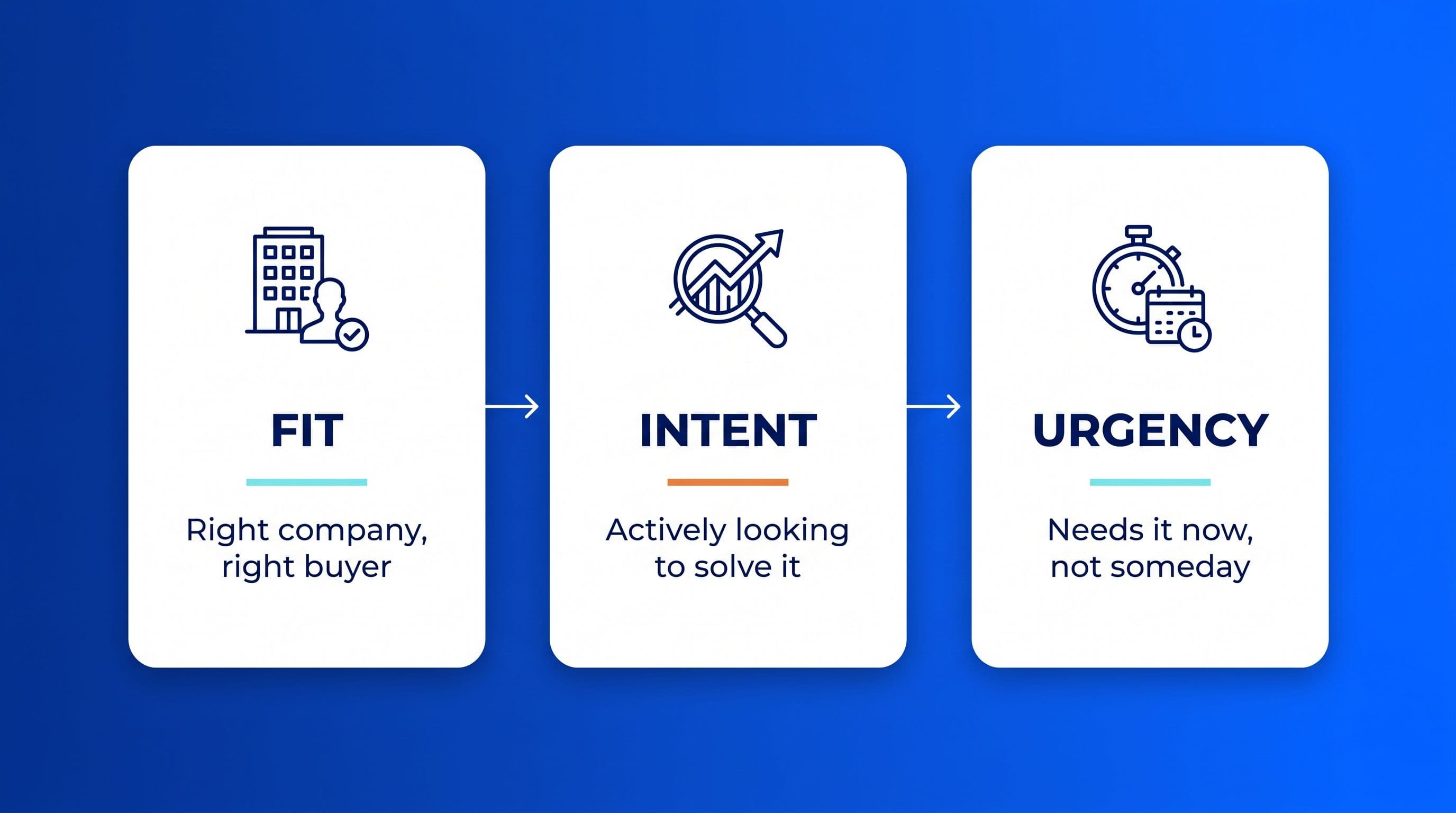
A lead is worth a founder's time only when it clears three fast checks, fit (are they who this is built for), intent (do they have the actual problem, not just curiosity), and urgency (is there a reason to act now). One hard no on any signal stops the clock immediately.
Treat this as a funnel, not a scorecard. A scorecard tempts you to average a weak answer against two strong ones and call it qualified. A funnel doesn't let you: a disqualifying answer on any signal ends the process right there, before you spend more time on it.
Fit
Fit asks whether this account looks like the accounts that actually buy from you. A one-person shop with nobody else who'd ever touch the problem, or a company well outside the size or industry your product is actually built for, is a stop. A named team already dealing with the problem, using some workaround today even if it's a bad one, is a green light.
Intent
Intent asks whether they have the real problem, not just curiosity about the category. Someone who's only researching for a report, has no current workaround, and can't describe the problem in their own words is a stop. Someone who can walk you through exactly how they handle it today, unprompted and in specific detail, is a green light.
Urgency
Urgency asks whether there's a reason to act now rather than eventually. "Maybe next year," with no budget conversation started and no timeline, is a stop. A named budget line, a deadline, or a cost of inaction they can put a number on is a green light.
| Signal | Stop here (clear no) | Green light (keep going) |
|---|---|---|
| Fit | No one else touches the problem, or wrong size/industry entirely | A named team already dealing with the problem today |
| Intent | Researching only, no current workaround, can't describe the problem | Describes exactly how they handle it today, unprompted |
| Urgency | "Maybe next year," no budget or timeline in motion | A deadline, budget line, or a cost of inaction they can name |
What go/no-go questions should you ask on a first call or async reply?
Six questions cover the fit, intent, and urgency filter in one call or one email reply, two per signal. Ask them in order and stop as soon as one answer is a clear no.
Fit:
- "What does your team look like today, and who else touches this problem?"
- "What are you using for this right now?"
Intent: 3. "Walk me through how you handle this today." 4. "What made you look into this now, specifically?"
Urgency: 5. "What happens if this stays unsolved another quarter?" 6. "Is there a budget or timeline already in motion?"
These aren't invented from scratch. They compress the same ground HubSpot's sales team covers in its own discovery-call framework, which clusters effective questions around budget, authority, need, and timeline, things like "what's the approximate budget for solving this problem" and "why hasn't this been addressed before," according to HubSpot's discovery call questions guide. The compression matters for a solo founder: there's no second person to hand a half-qualified lead to, so the questions need to do their full job in one pass, live or in writing.
That "or in writing" part isn't a downgrade. Gartner's most recent sales survey found that 67% of B2B buyers now prefer a rep-free purchase experience, up from 61% the year before, according to Gartner's 2026 sales survey on rep-free buying. A framework that only works on a live call misses most of the leads who'd rather answer these same six questions by email.
Here's what that looks like in practice. A reply comes in: "We've been handling this manually across three spreadsheets since our ops lead left in the spring. Getting expensive to keep patching it, and our board wants a fix before Q1 planning." Read against the six questions, that's a fit signal (a named team, a specific role gap), an intent signal (a concrete current workaround, described unprompted), and an urgency signal (a named deadline tied to board planning). All three land green in one paragraph, so no call is necessary. Compare that to: "Just looking into what's out there, might revisit next year." That's a stop on intent and urgency in the same sentence, and the right move is a polite pass, not a calendar link.
[IMAGE: A close-up of a founder's inbox showing a short qualifying email reply, generic and de-identified - search terms: "email inbox reply screen", "reading email on laptop close up"]
Why does speed of qualifying matter as much as the questions themselves?
A founder who attempts contact within the first hour is roughly seven times more likely to actually qualify that lead than one who waits longer. Speed is a qualification lever, not just good manners.
That figure comes from a Harvard Business Review study of firms responding to new online sales leads: those that attempted contact within an hour of receiving a query were nearly seven times as likely to qualify the lead as those that waited even one hour longer, according to the HBR study by Oldroyd, McElheran, and Elkington. The mechanism is simple: a prospect's problem is freshest, and their attention is highest, right after they raise their hand. Wait, and both fade.
Speed matters more now because so little of the buying process happens with you at all. Gartner's B2B buying-journey research puts the share of total purchase time buyers spend actually meeting with potential suppliers at around 17%, meaning roughly 80% of the journey is self-directed research the founder never sees, according to Gartner's B2B buying journey research. Buyers are also increasingly running that self-directed research through AI: a separate Gartner survey found 69% of B2B buyers turn to a sales rep specifically to validate AI-generated insights before trusting them, according to Gartner's 2026 survey on AI-insight validation. Put together, the buyer has usually decided before they ever reach you, so how fast you respond either catches that moment or loses it.
[CHART: Horizontal bar chart - B2B buyers' time allocation across the purchase journey (self-directed research vs. time with suppliers) - source: Gartner B2B buying journey research, illustrative percentages]
The same busywork tax that makes speed hard for a team makes it worse for one person. Salesforce's State of Sales research reports that sales reps spend about 60% of their time on non-selling tasks, leaving roughly 40% for actual selling and qualifying work, according to Salesforce's State of Sales statistics. A solo founder doesn't have a second person to absorb that tax. Every hour spent formatting a proposal or chasing a CRM update is an hour a fresh lead sits unanswered, sliding further from that one-hour window. That lost hour is exactly the kind of leak Klipy's Solo Sales Tax report tracks as one of the four measurable costs of running sales alone.
What should a founder never hand off?
Qualifying can be delegated. The price and fit judgment call on a real prospect cannot, and confusing the two is how founders either hire too early or lose deals to a process that reads like a script instead of a person.
The line is precise. Legwork is collecting fit, intent, and urgency answers and triaging replies at the speed the response-time research rewards, the part an AI agent built to run that filter can execute continuously without waiting on the founder's calendar