
 Ask ChatGPT
 Ask Perplexity
 Ask Claude
 Prefer us on Google
Introduction
CRM ROI: is a CRM worth it for a solo owner-seller?
Most CRM ROI content is written for a sales manager justifying a purchase to a VP of sales. It talks about pipeline visibility across a dozen reps, forecast accuracy, and manager-level reporting. None of that applies if you're the owner who does the selling yourself, whether that means a true one-person shop or the owner-seller inside a two-to-ten person firm who still carries the whole pipeline alone, with no SDR to hand any of it to.
For you, the CRM question isn't about visibility into someone else's work. It's about your own hours. There's no support staff to absorb data entry, and no one else notices when a lead goes quiet while you're heads-down on delivery work. Every hour a CRM saves, or costs, comes straight out of the time you'd otherwise spend selling.
That turns CRM ROI into a breakeven problem. Does the tool pay for itself in reclaimed hours and saved deals, or does it just move the same admin work from a spreadsheet to a subscription line?
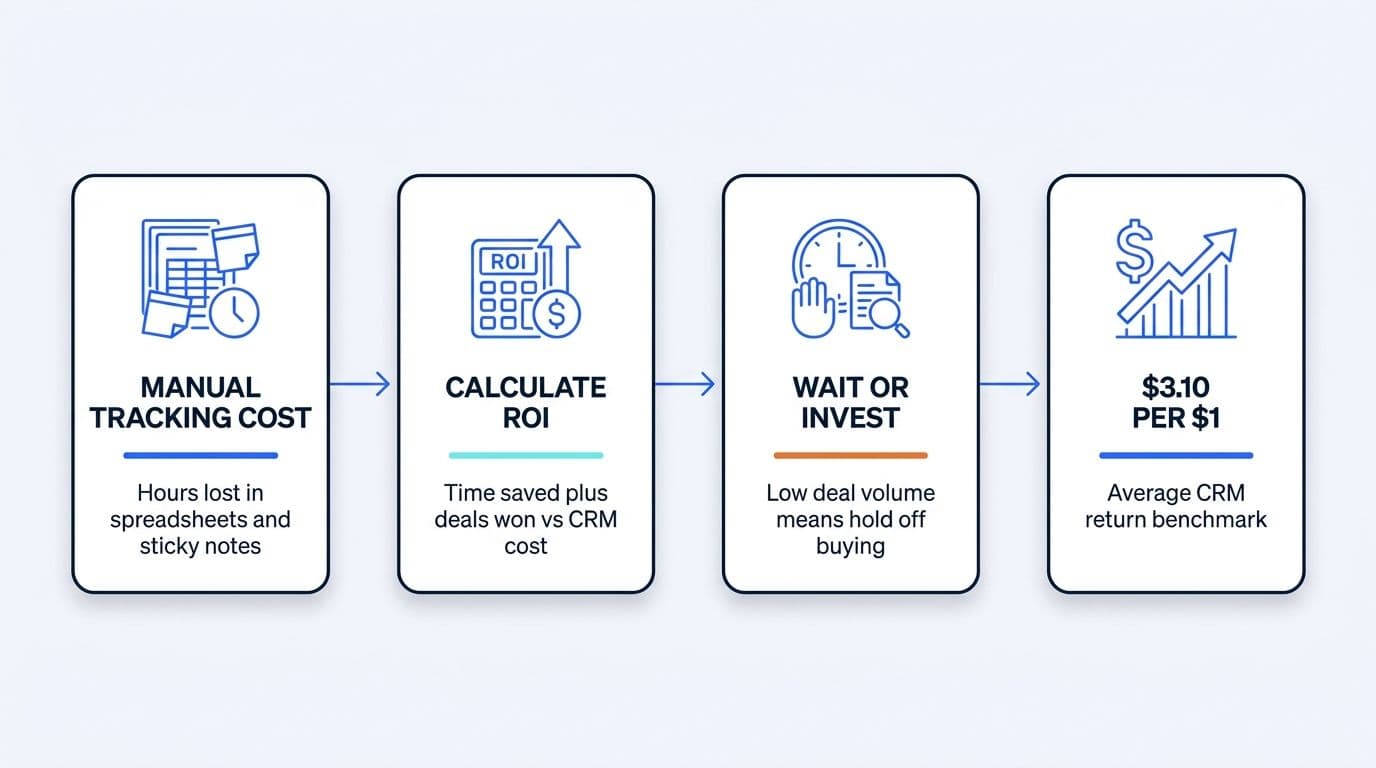
This guide works through that math in four parts: what "free" tracking actually costs, a breakeven formula you can run with your own numbers, the honest cases where a CRM isn't worth it yet, and how AI-assisted CRMs change the calculation by cutting the admin work that made traditional CRMs a wash for solo sellers.
Key takeaways
- A CRM earns its cost once the deals you lose to dropped follow-up, plus the hours you spend on manual logging, add up to more than its monthly price. That's a breakeven test, not a blanket yes.
- The realistic ROI benchmark is $3.10 returned per $1 spent (Nucleus Research), well below the $8.71 figure still widely repeated online, which is an older, now-superseded number.
- Leads contacted within one hour are about 7 times more likely to qualify than leads contacted later, and 60 times more likely than leads left 24 hours or longer (Harvard Business Review). A 2025 replication found 63.5% of B2B companies never respond to an inbound demo request at all (RevenueHero).
- Below roughly 5 active deals a month, or before product-market fit is settled, a spreadsheet or your own memory usually still beats a CRM.
- AI-assisted CRMs cut the manual logging that made traditional CRMs a wash for solo sellers, but the time saved only becomes ROI if you actually redeploy it into selling.
What does "free" tracking actually cost a solo seller?
Nothing is free. A spreadsheet, an inbox, or memory just moves the cost off a subscription line and onto your own unpaid hours, plus the deals that quietly go cold while a thread sits unanswered.
The hidden time cost of manual logging
Sales reps spend 60% of their working time on non-selling tasks, things like admin, data entry, and internal meetings, and only 40% of the time actually selling, according to Salesforce's State of Sales research. On a team, that admin tax gets distributed: a colleague can pick up a report, or a manager can chase a stalled deal. You have no one to hand that work to. Every hour you spend updating a spreadsheet, writing a call recap from memory, or hunting through email for the last thing a prospect said is an hour you're not spending on the next deal.
The hidden cost of dropped follow-up threads
The bigger cost shows up later, when a deal dies quietly. Firms that contacted a web lead within one hour of receiving it were about 7 times more likely to qualify that lead than firms that waited even a little longer, and more than 60 times more likely to qualify it than firms that waited 24 hours or longer, according to the original Harvard Business Review analysis by Oldroyd, McElheran, and Elkington.
That finding is over a decade old, but a 2025 replication shows the pattern hasn't gone away. RevenueHero submitted demo requests across 1,000 B2B websites and found that 63.5% of companies never responded at all; among the ones that did respond, the average wait was 29 hours. Revenue usually leaks because a good lead got buried under delivery work and never got a reply, not because of a bad pitch.
| Response window | Qualification odds |
|---|---|
| Within 1 hour | Baseline: highest odds of qualifying the lead |
| Any later attempt | About 7x lower than contacting within 1 hour |
| 24 hours or more | About 60x lower than contacting within 1 hour |
Source: Harvard Business Review, Oldroyd, McElheran & Elkington, 2011.
How do you calculate whether a CRM pays for itself?
Divide the CRM's monthly cost by average deal size times expected close-rate lift. That gives you the number of extra deals it needs to produce to break even. Then add the dollar value of hours you'd reclaim from manual admin, priced at your own effective hourly rate.
The three numbers you need before you calculate anything
Gather three numbers of your own before running any breakeven math. Skip the estimates in a vendor's case study.
- Average deal size. What a closed deal is actually worth, not the sticker price of your service.
- Realistic close-rate lift from structured follow-up. A conservative estimate based on how many deals you already suspect went cold from a missed thread, not a number a vendor promises.
- Hours currently spent on manual tracking. Time spent updating a spreadsheet, writing recap emails, and hunting for the last message in an inbox before a call.
Use $3.10 returned per $1 spent as your outside anchor, not $8.71. Nucleus Research's ongoing tracking of 63 real-world CRM deployments puts the current realistic return at $3.10 per dollar, down 37% from $4.90 a decade ago (Nucleus Research). The $8.71 figure still circulating in CRM marketing content is an older benchmark that has since been superseded; building your own breakeven math on it will overstate the case a CRM has to make.
A worked example
Say you run a solo consulting practice. Average deal size is $4,000. You estimate structured follow-up would close one extra deal a quarter that currently slips through, worth $16,000 a year. You also estimate 4 hours a week of manual tracking, worth roughly $100 an hour in billable time, or about $20,800 a year. Against a hypothetical CRM that costs $50 a month, or $600 a year, the math clears easily even if the extra-deal estimate is optimistic. If your numbers instead show a CRM would need to produce three or four extra closed deals a year just to break even, on top of hours you weren't actually going to reclaim, even one extra close a year isn't realistic. That's the situation the next section covers.
When is a CRM not worth it yet?
A CRM is generally not worth it yet under roughly 5 active deals a month, before product-market fit is settled, or while the sales process itself is still changing week to week. In those cases, the setup and maintenance overhead costs more time than it saves.
Score yourself against this checklist:
- Deal volume. Under about 5 active deals a month, a spreadsheet or your own memory can usually hold the full pipeline without loss.
- Product-market fit. If your offer or ideal customer is still changing, a CRM's pipeline stages get rebuilt every few weeks and the setup work gets thrown away.
- Sales motion. A handful of high-touch, relationship-based deals doesn't need the structure a CRM was built to impose on volume.
If two or more of these describe your business today, the honest answer is to wait and revisit the math once volume or process stability changes.
How does AI change the CRM ROI math for solo sellers?
AI-assisted CRMs shrink the admin tax that made traditional CRMs a wash for solo sellers. They log activity and draft follow-ups automatically instead of requiring manual data entry, which is exactly the labor you have no one else to delegate to.
Sales teams using AI saw revenue growth 83% of the time, compared to 66% for teams not using AI, a 1.3x gap, according to Salesforce's State of Sales research (a survey of 5,500 sales professionals across 27 countries). AI use in sales is mainstream enough for a solo seller to benefit from it directly, not just enterprise teams with dedicated ops budgets: 43% of sales professionals now use AI tools at work, and 40 to 65% of those users report it saves them at least an hour a week, according to HubSpot's State of AI in Sales research.
| Sales team type | Share reporting revenue growth |
|---|---|
| Uses AI tools | 83% |
| Does not use AI tools | 66% |
Source: Salesforce, State of Sales, 6th Edition, 2024.
Why saved hours don't guarantee ROI
AI tools save sellers an average of 4.8 hours a week, but 72% of sales organizations fail to reinvest that saved time into high-value selling activity, according to Gartner's 2026 survey of 210 chief sales officers and senior sales leaders. Saved time only produces ROI when it goes back into selling, for example a follow-up sent within the hour instead of within the week. A quieter afternoon doesn't count. The breakeven formula in this guide only works if you treat reclaimed hours as selling time you actually spend, not admin load you simply stop noticing.
Does CRM ROI hold up after you actually adopt one?
Yes. Once adopted appropriately, a CRM tends to earn its keep rather than get abandoned. Among businesses that use CRM software, 57% rate it "critical" to their operations, the highest criticality rating of any sales or marketing software category surveyed, according to Capterra's 2025 Sales and Marketing Software Trends Survey (2,452 respondents across 11 countries).
That durability lines up with the costs established earlier in this guide. The tools solo sellers actually keep using are disproportionately the ones that removed admin work instead of adding it, which is the same test the breakeven formula above is built to run.
How do you decide, right now?
Run the breakeven formula from this guide with your own numbers. If reclaimed admin hours plus even one or two additional closed deals a quarter cover the monthly cost, a CRM is worth it today. If you're under 5 active deals a month or still pre-product-market-fit, revisit the math once volume grows.
If you clear that bar, look specifically at how much of the admin tax quantified above a given tool actually removes. The Sales CRM built into Klipy creates and updates contact, company, and deal records automatically from your calls, emails, and messages, and drafts the follow-up for you to approve, rather than leaving you to log the conversation and write the recap yourself. That's the specific admin work this guide has been pricing out: the hours a solo seller has no one else to hand it to.
Frequently asked questions
Is a CRM worth it for a solo seller?
Yes, once the deals you lose to dropped follow-up, plus the hours you spend on manual logging, add up to more than the CRM's monthly cost. That's usually true above roughly 5 active deals a month, once your offer and sales process have settled. Below that, a spreadsheet or your own memory typically still wins.
What is a realistic CRM ROI benchmark?
$3.10 returned per $1 spent, according to Nucleus Research's ongoing tracking of 63 real-world CRM deployments. The $8.71 figure still circulating in CRM marketing content is an older benchmark that has since been superseded, and using it will overstate the case a CRM has to make.
How many deals do I need before a CRM is worth it?
Roughly 5 active deals a month is the rough floor. Below that, or before your product-market fit and sales process have settled, the setup and maintenance work a CRM requires usually costs more time than it saves.
Does responding to leads faster actually change close rates?
Yes. Leads contacted within one hour are about 7 times more likely to qualify than leads contacted later, and about 60 times more likely than leads left 24 hours or longer, according to the original Harvard Business Review study by Oldroyd, McElheran, and Elkington. A 2025 replication by RevenueHero found that 63.5% of B2B companies never respond to an inbound demo request at all.
Do AI-assisted CRMs change the ROI math?
Yes, but only if the time they save actually gets redeployed into selling. AI tools save sellers an average of 4.8 hours a week, but Gartner's 2026 survey of 210 sales leaders found 72% of sales organizations fail to reinvest that saved time into high-value selling activity, so the hours only become ROI when spent on the next deal, not absorbed as a quieter week.