
 Ask ChatGPT
 Ask Perplexity
 Ask Claude
 Prefer us on Google
Introduction
Set up a new Pipedrive pipeline and it looks perfect. Every deal sits in the right stage, every contact has a next step, every field is filled in. That cleanliness is real, but it is not evidence that the system works. It is evidence that someone just finished typing everything in.
Pipeline hygiene gets treated like a discipline problem: log consistently and your pipeline stays clean, skip it and it gets messy. That framing misses what is actually happening. Keeping a CRM accurate isn't a one-time setup task you complete and move past. It's a tax, paid in minutes, after every call and every email, forever. Setup happens once. The tax never stops coming due.
This matters most if you're running Pipedrive, where the entire system depends on you manually recording what happened after every conversation. It's part of the broader question this site's guide to CRM ROI for solo owner-sellers asks: a CRM only pays for itself if the data inside it is trustworthy, and manual admin is the hidden cost that quietly erodes that return.
Key takeaways
- A CRM habit tax is the recurring cost of manually logging calls, emails, and stage changes, paid daily and indefinitely, unlike one-time setup.
- You can lose the majority of your week to non-selling work: Salesforce's newest State of Sales survey puts non-selling time at 60% of the week.
- Only 35% of sales professionals fully trust their pipeline data (Salesforce), and 76% of CRM users say less than half their organization's CRM data is accurate and complete (Validity).
- Stale pipeline data doesn't just look messy: it delays follow-up, and HBR's research found leads contacted within an hour are roughly 7x more likely to qualify than ones contacted an hour later.
- Training and stricter SOPs don't remove the tax, they just ask you to keep paying a cost you're already avoiding under pressure.
- The durable fix is removing the manual step: interactions get captured as they happen, so deals, contacts, and stages update without anyone typing anything in.
What is the CRM habit tax?
The CRM habit tax is the recurring cost of manually logging every call, email, and stage change into a pipeline, paid daily, indefinitely, unlike setup, which is a one-time cost you pay once and move past.
Setup is finite work. Naming stages, importing contacts, defining custom fields: once it's done, it's done. Maintenance is different. Every new interaction requires a fresh entry, and there's no point at which the requirement stops. Log perfectly for six months and you still have to log perfectly in month seven. There's no accrued credit, no way to get ahead of it.
That distinction is the whole argument. It's easy to talk about "pipeline hygiene" as if it's a habit to build, like flossing. But flossing has a natural cadence, once a day, and stops mattering once you've done it. CRM logging has to happen after every single interaction, indefinitely, and the bill comes due whether or not you have the time to pay it. Calling that a discipline problem treats a structural cost as a character flaw.
You're not idle the rest of the time, either. Salesforce's 2023 State of Sales survey, based on more than 7,700 sales professionals across 38 countries, found reps spend less than 30% of a typical week actually selling. Most of the remaining time goes to admin and internal meetings. Data entry, the exact category CRM logging falls into, eats a good chunk of what's left. The habit tax competes directly with the selling you're trying to do, not with spare minutes.
Setup and the habit tax aren't the same kind of cost. Here's the difference broken out:
| Dimension | Setup | Habit tax (ongoing logging) |
|---|---|---|
| When it happens | Once, at CRM rollout | After every call, email, and stage change |
| Effort curve | Front-loaded, finite | Recurring, indefinite |
| Who notices if it's skipped | No one, right away | The forecast and your follow-up list, weeks later |
| How it's usually treated | A project with an end date | A discipline problem, never fully solved |
A clean day-one pipeline isn't evidence the system works
A new Pipedrive pipeline looks clean because setup happens once and shows no wear. Staying accurate requires you to manually re-earn that cleanliness after every interaction, and that never stops.
At rollout, every deal is current because you just entered it. That's the trap: the visual cleanliness of day-one Pipedrive creates a false signal that the system is finished, when in reality the hardest part, keeping it current, hasn't started yet. A pipeline with zero deals in it is technically "accurate." The moment you start selling, accuracy becomes something that has to be actively maintained, not something that was configured.
An independent review of Pipedrive puts the mechanism plainly: "the CRM reflects what someone recorded, not always what actually happened," and for founder-led teams moving fast across many simultaneous conversations, "the gap between what happened and what was logged can widen quickly," until the CRM stops reflecting reality and forecasting degrades. Pipedrive's automation rules can trigger a reminder or move a field once data exists, but they don't create the data. You still have to type in what happened, and that requirement is the same on day one and day ninety. The pipeline doesn't decay because you get careless. It decays because the system was only ever as accurate as the last thing you remembered to log.
[IMAGE: A founder or solo business owner at a laptop with a CRM pipeline dashboard open, showing deal stages, search terms: "small business owner laptop", "CRM pipeline screen"]
The real time cost of the habit tax
You can spend as much as 60% of your working week on non-selling activity. That's not a small distraction, it adds up to the majority of your calendar, competing directly against the time you'd otherwise spend selling.
That 60% figure comes from the newest edition of Salesforce's State of Sales research. It's a separate, more recent survey than the 2023 figure cited above, so it's worth citing on its own terms rather than blending the two. It puts non-selling time explicitly at 60% of the week, leaving 40% for actual selling.
Put a number on it and the tax stops being an abstraction. Spend even 20 minutes a day manually logging calls and updating deal stages, and you lose roughly 100 minutes a week, nearly two hours, to typing in what already happened rather than making it happen again. If you're running the pipeline solo, or with just one or two hires, that's not background noise. It's close to a part-time job's worth of hours you never budgeted for, on top of the selling you're actually there to do.
Why do you skip logging when things get busy?
You skip logging first, not last, when the pipeline gets busy, because manual CRM entry happens after the energy of the call is gone, and it never feels as urgent as the next call already waiting.
Logging is deferred work by nature. You can't update the deal stage while you're on the call; you have to do it after, when the conversation's context has already started to fade and the next call is already waiting. Under time pressure, that after-the-fact step is the first thing to get pushed to "later," and later often means never. Skipping it is a rational response to competing demands: the reward for closing the next deal is immediate and personal, while the reward for logging the last one is delayed, and easy to skip when no one's checking the pipeline but you.
That mismatch gets worse exactly when it matters most. The busiest stretches, the weeks with the most calls and the most deals moving, are also the weeks with the least slack for admin. So the habit tax goes unpaid precisely when deal volume, and therefore staleness risk, is highest. The busiest months tend to produce the messiest pipelines, which is unfortunate, since that's exactly when accurate forecasting and prioritization matter most.
What happens when deals go unlogged?
Unlogged deals don't disappear. They sit in the wrong stage, lose their next step, and quietly corrupt the forecast, which is a large part of why only 35% of sales professionals fully trust their organization's pipeline data.
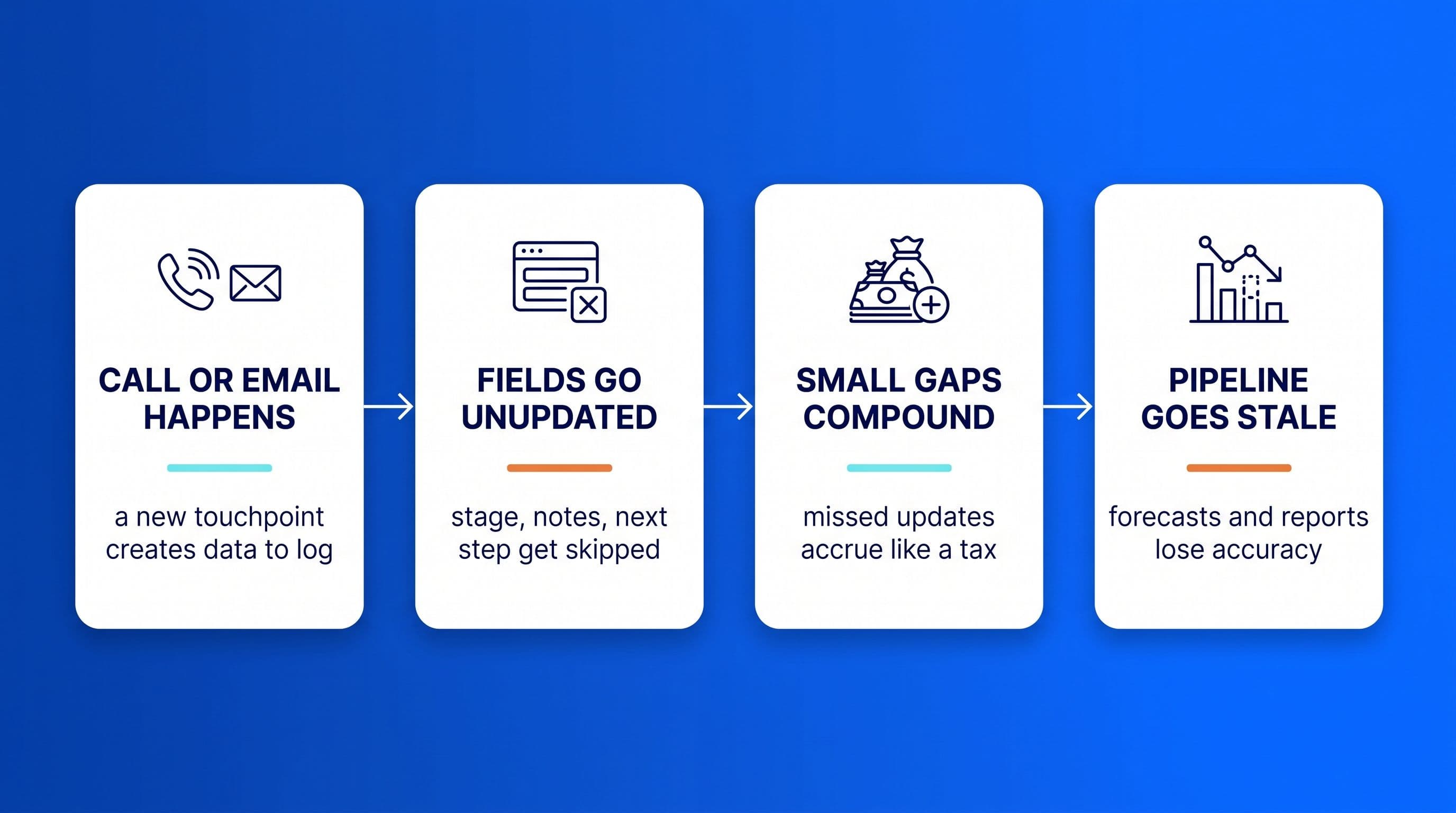
The chain runs the same way every time: a call happens but doesn't get logged, so the deal stays in whatever stage it was in before the call. You don't follow up, because the system shows no reason to. Weeks later, the deal is technically still "open" in Pipedrive, but nothing about it reflects what actually happened, and it's effectively dead. Among the sales professionals who don't trust their pipeline data, incompleteness and records that aren't regularly updated are among the most commonly cited reasons, the direct fingerprint of unpaid logging.
[CHART: Two-panel stat callout, not a shared bar axis since these measure different things. Panel 1: "35% of sales professionals fully trust their organization's pipeline data," source: Salesforce State of Sales, 6th Edition (2024). Panel 2: "76% of CRM users say less than half of their organization's CRM data is accurate and complete," source: Validity, State of CRM Data Management (2025).]
The downstream effect shows up in forecasting, where stale records compound into missed numbers. Xactly's 2024 benchmark survey polled 400 professionals across finance and sales, including revenue operations roles, at larger organizations. It found four in five leaders missed a quarterly forecast in the past year, and more than half missed it two or more times. Sixty-six percent named inaccessible or unreliable historical CRM data as the top barrier to an accurate forecast. You don't have a finance team running that math behind you, so when your own pipeline goes stale, there's no one else catching it before it costs you a deal. A forecast, even an informal one in your head, is only as good as the pipeline it's built on, and a pipeline full of unlogged calls and stale stages is fiction dressed up as a spreadsheet.
Staleness compounds into lost revenue, not just messy reporting
A stale deal costs more than a wrong row in a report. It means a lead is going unworked, and the cost compounds fast: replying within an hour makes a lead roughly 7x more likely to qualify than waiting even one hour longer.
That figure comes from a Harvard Business Review study of more than 2,000 US firms and a related analysis of 1.25 million leads, which also found that firms contacting a lead within an hour were roughly 60x more likely to qualify it than firms that waited 24 hours, and that the average firm took 42 hours to respond at all. That research is usually cited to argue for faster response times. It applies just as directly to stale CRM data, because response speed depends entirely on the system knowing there's something to respond to.
If a lead comes in, or a deal needs a next action, and the CRM doesn't reflect it because you haven't logged it yet, you don't act on it in time. The habit tax creates a lag between when something happens and when the system knows it happened, and every hour inside that lag is an hour a lead sits unworked. That same lag undermines the follow-up draft: sending a fast reply only works if the system already knows there's something to reply to. A quietly decaying pipeline leaks revenue through a gap nobody's watching.
Training and stricter SOPs don't fix a tax problem
More training or a stricter logging SOP doesn't work because both ask you to keep manually paying a tax you're already skipping under pressure. A stricter SOP doesn't remove a single manual step. It just adds enforcement on top of the same after-the-call data entry you already skip when the pipeline gets busy. Training makes the case for why logging matters, but it doesn't make logging faster, and it doesn't create the fifteen minutes between calls that would let you type up notes without falling behind.
Training and SOPs are the easy fix to reach for, because neither requires touching the CRM itself: no new tooling, no integration work, just a rule for yourself, or a quick conversation with the one or two people helping you sell. The underlying mechanic doesn't change, though. You still have to notice the requirement, stop what you're doing, and type in what happened, every single time, and that's exactly the step that gets dropped under load, rule or no rule. Set a same-day logging rule in Q1, and you'll likely have the same stale-pipeline problem by Q3, because the rule never removed the manual step, it only added guilt to skipping it.
What actually fixes the CRM habit tax?
The durable fix is removing the manual step, not enforcing it harder: capture calls, emails, and stage changes the moment they happen, so the pipeline updates itself without anyone typing anything in. A pipeline that updates itself doesn't need you to remember to update it, which is the only thing training and SOPs were ever asking for in the first place.
That's a different category of fix than a stricter Pipedrive workflow rule. It's interaction capture built into the pipeline itself: the call and the email thread get logged because they happened, and a stage change gets surfaced for a quick confirm instead of requiring you to remember and type it in from scratch. Klipy is built around that mechanism: it captures calls, emails, LinkedIn messages, and WhatsApp threads automatically, then uses them to keep the pipeline current without manual entry. The habit tax doesn't get abolished so much as it gets paid by software instead of by your Friday afternoon, the same argument this site's guide to CRM ROI for solo owner-sellers makes about where a CRM's real return comes from.