
 Ask ChatGPT
 Ask Perplexity
 Ask Claude
 Prefer us on Google
Introduction
Pipedrive isn't broken. It's a clean, drag-and-drop pipeline that a lot of small teams pick up in an afternoon, and it holds a 4.5 out of 5 rating across 3,058 verified reviews on Capterra. The problem shows up later, once you're the only one moving the cards, BCC'ing emails to log them, and writing every follow-up from memory.
That gap is exactly what our guide to CRM ROI for solo owner-sellers covers: a CRM only pays off if someone can maintain it, and Pipedrive was built for teams that have that someone. This piece compares the alternatives worth considering when you don't, alongside a few tools that fit other needs, so you can pick based on what your business actually has, not just seat price.
Key takeaways
- Klipy fits solo sellers and small teams best because it auto-logs calls, emails, and activity and drafts follow-ups with AI, instead of requiring someone to build and move pipeline stages by hand.
- Pipedrive's Lite plan starts at $14/user/month with no permanent free tier, and email logging on lower tiers means BCC'ing or forwarding messages to a Pipedrive address, per Pipedrive's own pricing page and user reviews on TrustRadius.
- HubSpot's free plan (2 users, 1,000 contacts, no time limit) is the strongest no-cost option; Zoho and Close cover deep customization and solo-priced plans; Salesforce covers enterprise scale, per HubSpot, Zoho, Close, and Salesforce.
- Sales reps spend 60% of their time on non-selling admin work, and 94% of sales leaders whose teams use AI agents call them essential to meeting business demands, per Salesforce's 2026 State of Sales report.
- 82.3% of U.S. small businesses, 29.8 million firms, run with no paid employees at all, per the SBA Office of Advocacy, which means most Pipedrive buyers are the owner-seller alone.
What's the best Pipedrive alternative for solo sellers and small teams?
For a solo owner-seller or a small team without a dedicated admin or sales-ops hire, Klipy is the strongest Pipedrive alternative. It auto-logs activity and drafts follow-ups with AI instead of requiring someone to manually build and maintain pipeline stages, which is the core mismatch between Pipedrive's design and this reader's reality.
That said, Klipy isn't the right call for everyone reading this. A team with a genuinely free budget and light needs might start on HubSpot. A team that wants deep, low-cost customization and has someone to configure it might prefer Zoho. An enterprise sales org managing hundreds of reps belongs on Salesforce, not any tool built for a team of one. The rest of this article covers all five, so you can weigh them against what your business actually needs.
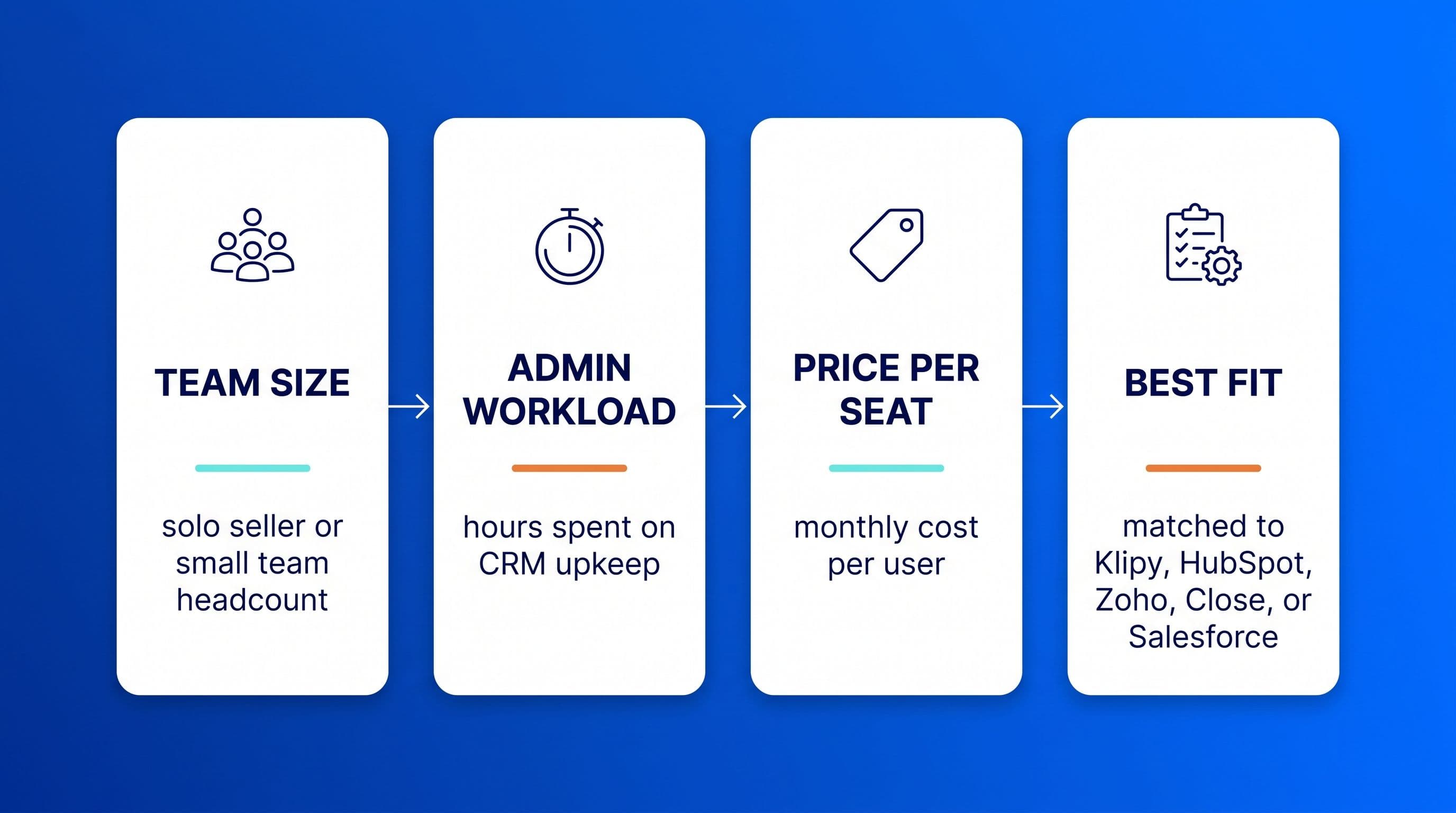
| Tool | Best for | Starting price | Admin load |
|---|---|---|---|
| Klipy | Solo sellers and small teams with no admin staff | Free forever; paid from $39/seat/mo | Low: activity auto-logs, follow-ups draft themselves |
| Pipedrive | Teams with sales-ops support to build and maintain stages | $14/user/mo (Lite, annual) | High: manual stage moves, BCC/forward email logging on lower tiers |
| HubSpot | Getting started at zero cost | Free (2 users, 1,000 contacts); Starter from $20/seat/mo | Medium: automation exists, but setup and upkeep take time |
| Zoho CRM | Budget-conscious teams wanting deep customization | $14/user/mo (Standard, annual) | Medium to high: the customization power comes with configuration work |
| Close | A solo operator wanting a plan priced for one | $9/user/mo (Solo) | Medium: still a manually run pipeline, just priced for one seat |
| Salesforce | Enterprises needing advanced pipeline and AI tooling | $25/user/mo (Starter Suite) | High: full configuration typically needs a dedicated admin |
Pricing shown is vendor-listed, per seat/user per month unless noted, sourced from each vendor's official pricing page as cited above and in the sources section below.
Why solo sellers and small teams look for a Pipedrive alternative
Buyers switch off Pipedrive mainly for two reasons, according to industry analysis from EngageBay: per-seat costs that compound as a team grows, and a fixed, manually maintained pipeline model that assumes someone owns it day to day. A third reason is emerging even faster than those two: rising demand for AI that's built into the workflow instead of bolted on as an add-on.
The numbers behind that shift are specific. Sales reps spend 60% of their time on non-selling tasks, admin, manual CRM entry, and internal approvals, according to Salesforce's 2026 State of Sales report, which surveyed more than 4,000 sales professionals. The same report found that 94% of sales leaders whose teams already use AI agents call them essential to meeting business demands. For a solo seller, that 60% isn't a team-wide average to shrug off. It's the hours you personally don't spend selling.
What does Pipedrive actually require from a solo seller?
Pipedrive is a self-service, manually maintained pipeline. Pipedrive's own product page describes it plainly: you "tailor your pipeline to your sales process with templates and customization options, from custom fields to sales pipeline stages," and deals move through "kanban boards, with drag-and-drop functionality," per Pipedrive's sales pipeline feature page. Someone builds those stages, and someone has to drag each deal forward.
On the Lite and Growth tiers, email logging carries the same manual pattern. Reviewers on TrustRadius describe it directly: "the email sync process on lower plans is manual, so it can get annoying and repetitive, as it requires users to BCC or forward messages to a Pipedrive email address." That's a workflow a sales-ops person can absorb without much friction. It's a different ask for someone who's also doing the delivery work that pays the bills.
This is the mismatch our related post digs into in more detail: why Pipedrive reviewers call it an "easy CRM" and still spend hundreds of hours on data entry. And it isn't a niche problem. 82.3% of U.S. small businesses, 29.8 million of the 36.2 million total, operate with no paid employees at all, per 2022 Census data reported by the SBA Office of Advocacy. For most small-business CRM buyers, there's no sales-ops hire to hand this work to, just the owner.
How does Klipy remove the admin tax that Pipedrive leaves in place?
Klipy auto-logs calls, emails, and pipeline activity, then drafts the follow-up with AI, so the solo seller isn't the one manually moving deal cards or BCC'ing emails to keep your Sales CRM current. When a call ends, Klipy captures it, updates the relevant contact, company, and deal records, and stages a follow-up draft in your tone for you to review before it sends. Klipy enriches contacts automatically from 100+ data sources the moment they show up in a conversation, and moves deal stages based on what actually happened in the conversation, with your approval, rather than a manually dragged card.
That's the specific difference from Pipedrive's model: Klipy isn't just a relabeled version of the same pipeline UI. Pipedrive gives you a board and asks you to keep it accurate. Klipy's built-in Sales CRM populates itself from the work you're already doing, calls, emails, and messages, so the record stays current without you typing it in. Klipy is as autonomous as you allow, never more. It never moves the dial itself: you set how much Klipy can send on its own, channel by channel.
That doesn't mean every solo seller should abandon Pipedrive on day one. It means the admin math changes: the real cost of a CRM isn't the seat price. It's the hours it takes to keep it accurate, and that's the same breakeven logic our CRM ROI guide for solo owner-sellers walks through in full.
The best Pipedrive alternatives by need, not just for solo sellers
Beyond Klipy for admin-light solo and small-team use, four other Pipedrive alternatives cover distinct needs well enough to be worth naming honestly rather than dismissing.
HubSpot has the strongest genuinely free starting tier of the group: no time limit, up to 2 users, 1,000 contacts, and 1 deal pipeline, with the Starter plan beginning at $20/seat/month once you outgrow it, per HubSpot's pricing page. The limitation: the free tier's contact and pipeline caps are tight, and much of HubSpot's automation still requires manual setup.
Zoho CRM offers the deepest low-cost customization. Its paid tiers, Standard ($14/user/month), Professional ($23), Enterprise ($40), and Ultimate ($52), add custom modules, process automation, and custom buttons and functions progressively by tier, per Zoho's official pricing page. The limitation: that customization power assumes someone has time to configure it, the same admin gap Pipedrive has.
Close is the closest thing to a solo-priced Pipedrive rival. Its Solo plan runs $9/user/month, positioned specifically for solo operators and individual contributors (limited to one user, up to 10,000 leads), with an Essentials plan at $35/user/month once a small team needs to collaborate, per Close's pricing page. The limitation: it's still a manually run pipeline. The price is right for one person; the workflow still assumes that person is doing the data entry.
Salesforce is the enterprise-scale option. Its Starter Suite begins at $25/user/month, and its $175/user/month Enterprise tier is built around advanced pipeline management, deal insights, conversation intelligence, and Agentforce AI capabilities, per Salesforce's pricing page. The limitation for this article's reader: it's priced and configured for organizations with the staff to run it, not a team of one or two.
| Tool | Standout strength | Key limitation |
|---|---|---|
| Klipy | Auto-logs activity and drafts follow-ups with AI, so the pipeline stays current without manual entry | Built for solo and small-team workflows; an enterprise sales org managing hundreds of reps still fits Salesforce better |
| HubSpot | Strongest free tier of the group: 2 users, 1,000 contacts, no time limit | Free-tier caps are tight, and much of the automation still requires manual setup |
| Zoho CRM | Deepest low-cost customization, across four paid tiers | The customization power assumes someone has time to configure it |
| Close | A Solo plan priced at $9/user/month for exactly one person | Still a manually run pipeline; the price fits solo, the workflow doesn't remove the data entry |
| Salesforce | Enterprise-scale pipeline management, deal insights, and Agentforce AI | Priced and configured for organizations with a dedicated admin, not a team of one or two |
Which Pipedrive alternative should you actually pick?
Match the tool to who does the admin work, not to the seat price alone. If no one on your team has time to build pipeline stages, log emails manually, or write every follow-up from scratch, Klipy is built for exactly that gap: free forever, paid plans from $39/seat/month, activity auto-logged, follow-ups drafted for your review. If your needs are lighter and the budget is genuinely zero, start with HubSpot's free tier. If you want deep customization and have someone to build it, Zoho. If you're one person and just want Pipedrive's model at a lower price, Close. If you're scaling past a small team into a multi-department sales org, Salesforce. The CRM ROI guide for solo owner-sellers walks through how to run this math for your own numbers.