
 Ask ChatGPT
 Ask Perplexity
 Ask Claude
 Prefer us on Google
Introduction
Pipedrive, Airtable, Notion cost: why three tools add up
Running a consulting business across Pipedrive, Airtable, and Notion looks efficient at first, since each tool is good at exactly one job. The cost shows up later: with no ops team to keep the three in sync, every new lead, note, or status change has to be re-entered or reconciled by hand. That admin tax, plus a growing pile of dropped follow-ups, eats into the time the "best-of-breed" stack was supposed to save.
Key takeaways
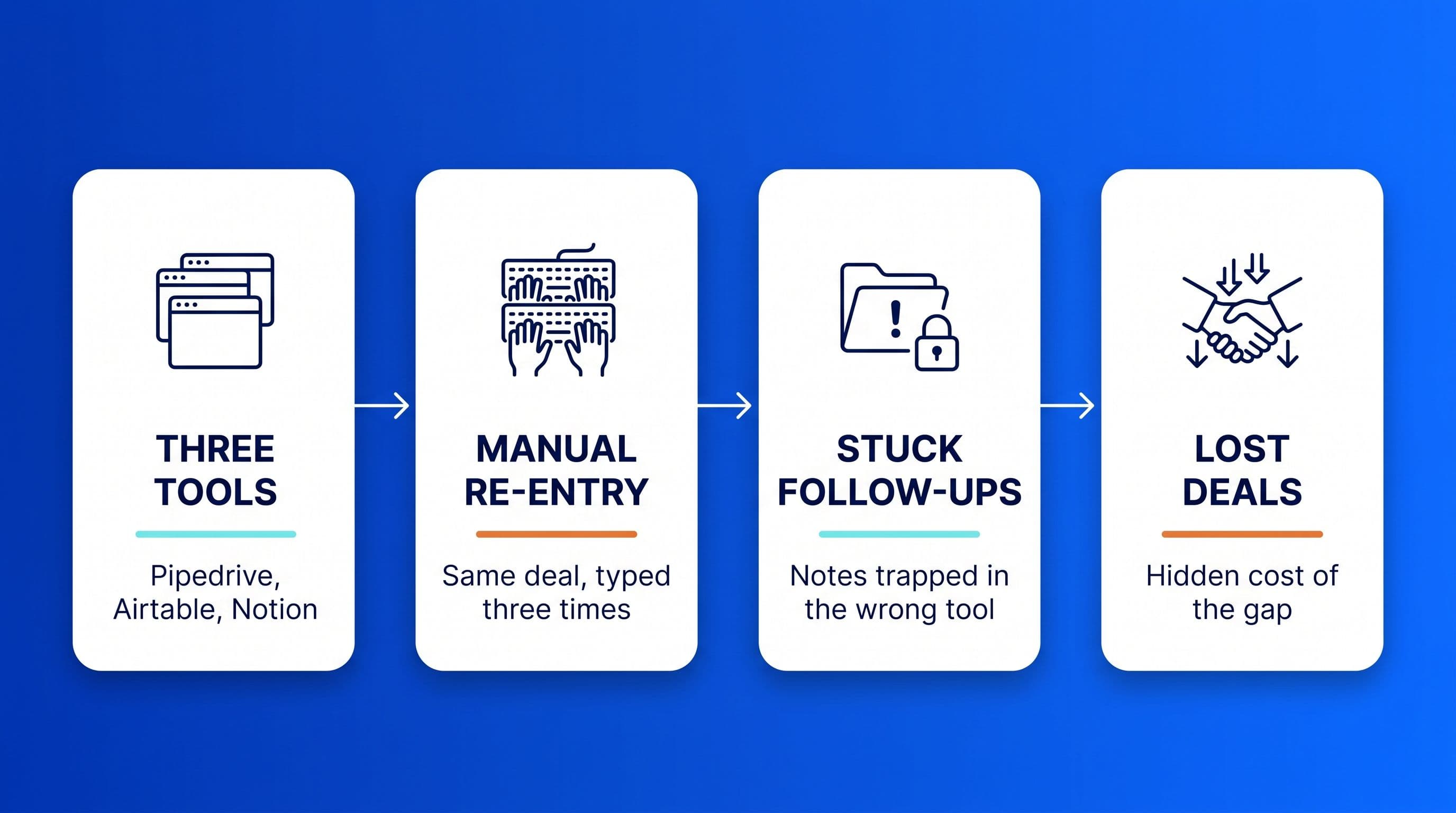
- Splitting pipeline (Pipedrive), client/project tracking (Airtable), and notes (Notion) across three tools creates two measurable costs: an admin tax from manual re-entry and reconciliation, and a dropped-follow-up cost when a commitment written in one tool never surfaces in another.
- None of the three tools sync with each other natively, so staying consistent means either unpaid manual work or a fourth, metered tool like Zapier, and Zapier's per-action pricing scales fast as sync volume grows.
- Salesforce's own research shows sales reps already lose 60% of their time to non-selling admin, including manual CRM data entry; reconciling that same work across three disconnected tools multiplies the cost rather than dividing it.
- A follow-up commitment stranded in the "wrong" tool has almost no chance of beating the lead-response clock: Workato's 2026 audit puts the average B2B email response time at nearly 12 hours, with more than 99% of companies missing the 5-minute window entirely.
- The standard CRM ROI benchmark ($3.10 returned per $1 spent) assumes centralized data; a fragmented 3-tool stack subtracts the admin tax, the dropped-follow-up cost, and any middleware subscription from that return, which makes the breakeven math worse, not better, than a single consolidated CRM. Full math: CRM ROI for a solo owner-seller.
What is the real cost of running Pipedrive, Airtable, and Notion together?
Running pipeline in Pipedrive, client and project tracking in Airtable, and docs and notes in Notion costs a solo consultant in two concrete ways. The first is the admin tax: hours lost every week re-entering and reconciling the same information across three tools. The second is the dropped-follow-up cost: deals that quietly go cold because a follow-up commitment written in Notion never surfaces back into the Pipedrive pipeline stage where it would actually get acted on.
Neither cost shows up on an invoice, which is exactly why it rarely triggers a decision to change anything. A subscription bill prompts a review. An extra 20 minutes spent copying a lead from an inbox into three separate places, several times a day, never does, even though it adds up to more lost time than any one of the three tools costs to run.
This article, part of our guide to CRM ROI for a solo owner-seller, works through both costs in the same terms that guide uses to establish the breakeven math for a single CRM, then shows why a 3-tool stack makes that math worse.
[IMAGE: A consultant's desk with two monitors showing separate dashboards, illustrating a fragmented tool stack]
Why solo consultants end up with three separate tools in the first place
Nobody sits down and chooses a 3-tool stack on purpose. It accretes one tool at a time, each solving one problem in isolation: Pipedrive for pipeline visibility because a spreadsheet stops showing deal stages clearly, Airtable because it's a flexible database that bends easily into client and project tracking, and Notion because meeting notes and long-form docs need somewhere to live that a pipeline tool was never built for.
Each addition is individually reasonable, and each tool's free or entry tier makes it easy to justify. That's also exactly why the stack keeps growing instead of consolidating: a free or cheap tool that solves one visible problem looks like a win every time, and nothing in the decision to add it accounts for the reconciliation work it creates against the tools already in place.
Tool sprawl of this kind is a documented pattern well beyond solo consultants. BetterCloud's 2026 State of SaaS Report, which surveyed 525 IT and security professionals, found the average number of apps per organization rising again, with nearly half of software in active use carrying no formal review at all. Organizations with a full IT department still struggle to control tool sprawl; a solo consultant runs into the same problem alone, with no one else around to notice it happening.
The admin tax: how much time does reconciling three tools actually cost each week?
Manually copying a new lead from an inbox into Pipedrive, then into an Airtable client record, then noting context in Notion, and repeating that every time a deal moves, is the same category of work Salesforce's own research already flags as a drain on selling time. The Salesforce State of Sales Report found reps spend 60% of their time on non-selling tasks, explicitly including "manually entering customer notes into the CRM," rather than talking to a customer.
That figure describes a single CRM. A solo consultant doing the same manual entry across three unsynced tools instead of one isn't doing a third as much work per tool. They're doing the full entry three times over, once per system, because none of the three knows what the others already contain. That tax lands directly on time that's already scarce: Clockify's analysis of a 2024 Freelancermap survey found almost half of freelancers already spend roughly 6 hours a week on non-billable administration and accounting, before any cross-tool reconciliation is added on top.
[CHART: Horizontal bar chart contrasting time spent selling vs. time spent on admin/re-entry, framed for a 3-tool stack. Source: Salesforce State of Sales Report, directional baseline not a precise 3-tool measurement]
The underlying mechanism here isn't new. A foundational 2021 study by Qatalog and Cornell University's Ellis Idea Lab, reported by VentureBeat, found knowledge workers lose 59 minutes a day hunting for information scattered across apps, and nearly half said they make mistakes at work because they can't keep track of what's happening across their different tools. A 3-tool consulting stack is a small-scale version of the same problem: the person doing the reconciling is also the person who's supposed to be billing hours. For a closer look at how that manual upkeep shows up specifically inside Pipedrive, see the CRM habit tax: why your Pipedrive pipeline won't stay clean.
The dropped-follow-up cost: what happens when a commitment lives in the wrong tool
When a consultant promises "I'll follow up Thursday" in a Notion note but the Pipedrive deal stage still reads "Contacted" three weeks later, nothing forces those two facts to reconcile. Nobody reviews the gap because nobody owns catching it. The deal doesn't look overdue in Pipedrive, because Pipedrive has no idea the commitment exists.
A 2026 lead-response audit by Workato shows how fast that kind of gap becomes fatal. It tested 114 B2B companies directly and found more than 99% failed to respond to a new lead within the 5-minute "golden window," with the average email response time stretching to nearly 12 hours. A follow-up commitment stranded in a second tool, invisible to the system that's supposed to prompt action, has effectively no chance of beating that clock even once, let alone consistently.
The same Workato research found companies using a lead-routing tool cut average response time to 3 hours and 32 minutes, versus 13 hours for those without one. That gap is a rough proxy for what a synced, single-record system buys a consultant over a fragmented one: not perfection, just a system that actually surfaces the commitment somewhere it will get seen before the lead cools.
Why "free" tools aren't free once you have to keep them in sync
Pipedrive, Airtable, and Notion each have workable free or low-cost tiers on their own, and each is genuinely inexpensive for a single person entering data into a single tool. The cost appears the moment those three need to actually agree with each other, because none of them sync natively. Unito's own integration page confirms the gap directly: Airtable and Notion don't sync with each other out of the box, and changes made in one have to be copied into the other by hand without a third-party connector. The same is true between Pipedrive and either of the other two.
That leaves two options: unpaid manual reconciliation, which is the admin tax already covered above, or a fourth tool to bridge them. That fourth tool is rarely free. Zapier's official pricing page shows the free tier caps out at 100 tasks a month, a volume a single active consulting pipeline can burn through in days once a workflow is watching for new leads, updated deal stages, and new notes across three separate apps. Beyond the free tier, Zapier's published pricing scales quickly with usage:
| Plan | Tasks/mo | Price/mo |
|---|---|---|
| Free | 100 | $0 |
| Professional | 750 | $29.99 |
| Professional | 10,000 | $193.50 |
| Team | 2,000 | $103.50 |
| Team | 100,000 | $898.50 |
That's a real, escalating recurring bill that never appears on Pipedrive's, Airtable's, or Notion's own pricing page, because none of them count it as part of the cost of using their product.
[CHART: Step chart showing how monthly middleware cost scales with sync-action volume, using Zapier's published tier pricing as of 2026 (100 tasks free, $29.99/mo at 750 tasks, $193.50/mo at 10,000 tasks)]
How the CRM ROI math gets worse, not better, with a 3-tool stack
The often-cited CRM ROI benchmark says CRM returns $3.10 for every $1 spent, down 37% from $4.90 a decade earlier as CRM tooling grew more complex. That benchmark assumes the CRM data is actually centralized in one place. Split that same data across three unsynced tools, and the math changes in the wrong direction. The admin tax, the dropped-follow-up cost, and any middleware subscription all subtract from the return side of that equation. None of them show up in the cost side most people use when they compare tool prices.
| Cost driver | 3-tool stack (Pipedrive + Airtable + Notion) | Single consolidated CRM |
|---|---|---|
| Subscriptions | Three separate tool bills, plus middleware to sync them | One tool bill |
| Admin tax | Manual re-entry across three disconnected systems | Data entered once, in one system |
| Dropped-follow-up cost | Commitments written in one tool can go unseen in the others | Follow-ups tracked against the same pipeline record |
| Middleware | Extra metered tool (e.g., Zapier) needed to keep systems in sync | Not needed |
Judging a 3-tool stack on subscription cost alone misses this. Three tools at $0 to $20 a month each look cheaper than a single AI CRO until the hours spent reconciling them, the deals lost to a missed follow-up, and a Zapier bill that grows with usage are added back in. The realistic breakeven point for a fragmented stack sits further out than the single-CRM baseline the ROI benchmark above describes. It doesn't sit closer, because fragmentation adds cost without adding any of the consolidation that produces the return in the first place.