
 Ask ChatGPT
 Ask Perplexity
 Ask Claude
 Prefer us on Google
Introduction
Your phone is face-down in the sand, but your shoulders don't know that yet. Three days into the one trip you blocked off this year, you've already checked it twice before breakfast.
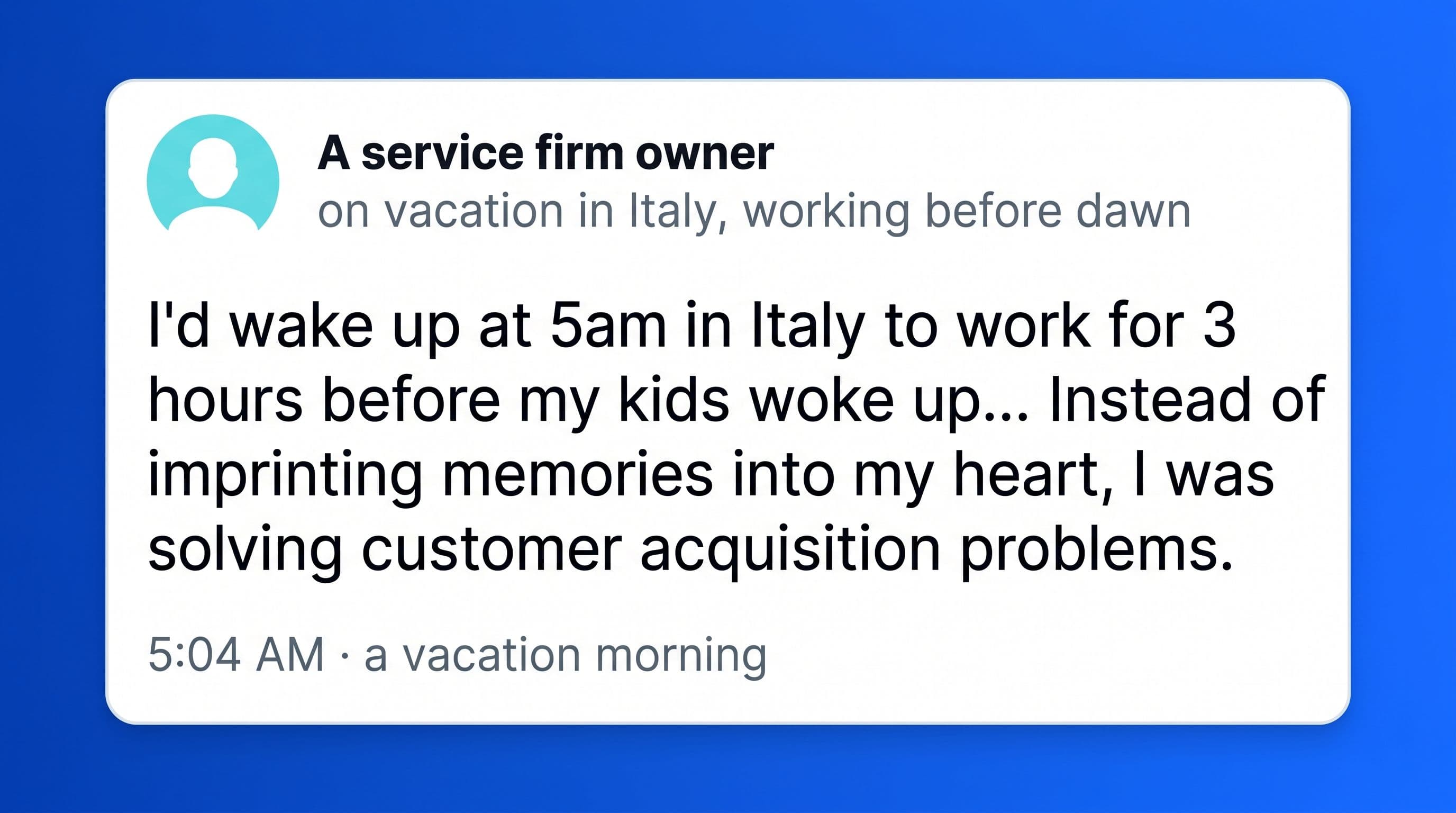
"I'd wake up at 5am in Italy to work for 3 hours before my kids woke up... Instead of imprinting memories into my heart, I was solving customer acquisition problems." (Kendall Barber)
The laptop on the beach towel
Barber's version of it happened before sunrise: three hours of work in Italy before his kids woke up. Your version might be smaller. The laptop that comes out of the beach bag once everyone else is asleep. The phone you check "just for a second" while the rental-car line inches forward and your family waits at the curb with the bags.
Nobody scheduled that work. It shows up because the business doesn't know you're on a beach. A lead replies. A client asks a question that can't sit until Monday. A deal you've been nursing for two months needs one more answer today, or it cools off while you're building a sandcastle.
If the guilt underneath all of this feels familiar, some of it is simply not having the guaranteed time off everyone else seems to get. But the checking-in itself is a separate problem, and it deserves its own answer.
It's not a discipline problem, it's a structural one
You can't will yourself into disconnecting from a service firm that was never built to run without you. The data backs that up even at the smaller end of the range researchers have studied.
Gallup surveyed 1,004 U.S. microbusiness owners, five or fewer employees, and found 20% took zero vacation days in the prior 12 months. The median among owners who took any time off at all was 12 days. This finding sits inside a broader body of research on business owner burnout worth reading if you want the fuller data picture.
"Vacations solves fatigue. It doesn't do shit to address burnout." (Matt Munson)
That line is the one worth sitting with. A trip changes where you are. The role keeps making the same demands. Burnout comes from carrying every decision alone, and a flight doesn't hand that decision-making off to anyone else for the week. Walmart Business's 2023 work-life balance survey found the top reason owners give for skipping vacation is the belief the business needs them there to run (41%), ahead of the fear of losing business while away (35%). Owners widely share that belief.
A few numbers worth sitting with:
- 20% of microbusiness owners take zero vacation days a year; the median among those who do is 12 days (Gallup).
- Only 22% of small business owners feel they take enough vacation (Walmart Business).
- 41% skip vacation because they believe the business needs them there, ahead of the 35% who cite fear of losing business while away (Walmart Business).
- 71% of CEOs report feeling burned out regularly or occasionally (research reported by BenefitsPro).
Gallup (2014), Walmart Business (2023), and research reported by BenefitsPro (2025) span roughly a decade. The populations differ, from microbusiness owners to CEOs, but they converge on the same shape: a minority manage genuine disconnection, and the stated reason is structural (the business needs them) rather than personal (they don't want a break).
How do I ever take a real vacation when I'm the one who runs everything?
Most owners don't, at least not fully. Gallup found 20% of microbusiness owners take zero vacation days a year, and the median owner who takes any only takes 12 (Gallup).
Walmart Business found a similar gap from a different angle: only 22% of small business owners feel they take enough vacation (Walmart Business). Planning Pod's advice for owners taking time off points to the trait that tends to separate the two groups: someone else can see what's happening inside the business while the owner is gone, with enough authority to act on it without a phone call (Planning Pod). That makes it a coverage problem, solvable before you ever book the trip.
Why can't I unplug from work even when I'm technically on vacation?
Because only 30% of small business owners say they can fully disconnect on vacation, according to Walmart Business's survey. The other 70% work at least a half hour a day away from home, some more than four hours (Walmart Business).
That matches the fatigue-versus-burnout distinction above: the role keeps making the same demands regardless of where you are. Research reported by BenefitsPro found 71% of CEOs feel burned out regularly or occasionally, and points to isolation as a driver: there's rarely a peer close enough to hand the pager to.
Real coverage comes once someone else can genuinely cover for you, a different project than picking a destination.
What owners who actually get away do differently
The owners who manage a real break don't do it through sheer willpower. They build one narrow system in advance, and it still costs them something.
- A hard-stop coverage rule. A narrow, defined threshold for what actually counts as an emergency, with everything else waiting until the trip is over. The real cost: a background hum of worry that something important will slip through anyway.
- A trusted employee or partner who holds the phone. Planning Pod's advice for owners taking time off: name one backup with real decision authority who can act without you, and tell clients in advance that someone else may respond. Put what counts as an emergency in writing before you leave. The real cost: it only works once you've already built the trust and delegation that many solo owners haven't gotten around to.
- A scheduled daily check-in window instead of constant reachability. A short, fixed window agreed before you leave, what Planning Pod calls setting "office hours," rather than being on call all day. The real cost: a smaller, bounded version of staying plugged in, instead of a full disconnect.
Skip all three and you get something close to Barber's trip to Italy: hours of work before the family wakes up, spent solving a business problem instead of being present for the one trip you took all year.
What has to be true before time off actually works
Before a week away works, someone besides you has to be able to see exactly where every conversation and deal stands, and act on it without guessing. Everything else is detail.
- A named backup with real decision authority to act, beyond someone who just works through a chore list.
- A written definition of what counts as an emergency versus what can wait until you're back.
- Clients and key accounts told in advance that someone else may respond while you're away.
- A record of where every deal and conversation stands that doesn't live only in your head.
All of it just takes deciding in advance, before you're already halfway out the door. None of it costs money.
Why do I keep answering emails on vacation like it's a normal part of the trip?
Usually because whoever is covering for you doesn't have enough visibility to act without checking in first, so the question defaults back to your phone no matter what you agreed to before you left. The backup is willing; they simply lack the information needed to answer without you.
A backup with a chore list can water the plants. A backup without visibility into deal status and recent conversations can't answer a client's question or move a deal forward, so they forward it to you "just to confirm," and the vacation effectively ends the moment that message lands. The fix is giving them a shared, current record of what's happening, so they don't have to reconstruct it from memory or from you.
What people try before they try a tool at all
Some owners keep a shared spreadsheet of open deals and next steps. It holds up for a week. Then nobody updates it once the trip starts, and it goes stale right when it matters most.
Others forward their inbox to a partner or employee. That hands over access, but the person reading the thread still has to guess what already happened on a call or in person before they can answer a client with any confidence.
A few keep it lower-tech: a sticky note by the door, or a running group text with whoever is covering. Both work for a day or two, and both depend on someone remembering to update them by hand, which is the same gap in a smaller shape.
| Coping method | How long it holds up | Where it breaks |
|---|---|---|
| Shared spreadsheet | About a week | Nobody updates it once the trip starts |
| Forwarded inbox | A few days | The person reading still has to guess what already happened |
| Sticky note or group text | A day or two | Depends on someone remembering to update it by hand |
The one piece of coverage that doesn't depend on you being there
Klipy is the AI CRO: the AI agent that runs your entire sales operation, built around three modules, Fill, Run, and Compound, so growth stops depending on you being the one every deal runs through. The piece that matters most while you're away is the Run side of that loop: it works the deals already open, drafting follow-ups in your voice, queued for your approval, and keeping what's happening with each one current, so whoever is covering for you can see where a deal stands without waiting for you to explain it from a beach chair.
As autonomous as you allow, never more. It leaves running the business to you, and closes the exact gap from the last section: giving your backup a real answer instead of a guess, so a client question doesn't have to sit until you see it.
Guilt and a less restful trip are still part of the deal. What it changes is the odds that a week away quietly costs you a deal you were already close to winning.
What a week away is actually costing you
If you want the fuller picture of what running sales solo is costing you beyond the vacation you didn't take, start with the Solo Sales Tax report: a breakdown of what founder-led sales costs an owner-run service firm in hours and in dollars, vacation or not.
The rest of the thinking behind it lives on klipy.ai, including how the pieces fit together once someone besides you can see what you see.
Common questions about taking real time off
Is it normal to feel this burned out just from running my own business?
Yes, it's closer to the norm than the exception. Research reported by BenefitsPro found 71% of CEOs report feeling burned out regularly or occasionally, often pointing to isolation as a driver. Walmart Business found a related pattern: roughly 7 in 10 small business owners don't fully disconnect even while on vacation, working at least a half hour a day away from home.
Why can't I stop thinking about work even when I'm supposed to be relaxing?
Because a vacation changes where you sit, but the role keeps running. If no one else can see the pipeline or respond to a client, your attention doesn't leave either. That's part of why a short break resolves fatigue more reliably than it resolves burnout.
Am I the only owner who feels guilty for taking a week off?
No. It's common enough that researchers measure it: Walmart Business found the top reason owners give for skipping vacation is the belief the business needs them there to run (41%), ahead of the fear of losing business while away (35%). The guilt tracks a real structural gap most owners share.
What actually has to be true before I can take time off without everything falling apart?
One thing, done well: someone besides you can see where every conversation and deal stands, and has the authority to act on it without guessing. That takes a named backup with real decision authority, a line in writing on what counts as an emergency, clients told in advance that someone else may respond, and pipeline status recorded somewhere besides your memory. Tooling can support it, but building it is still your call.