
 Ask ChatGPT
 Ask Perplexity
 Ask Claude
 Prefer us on Google
Introduction
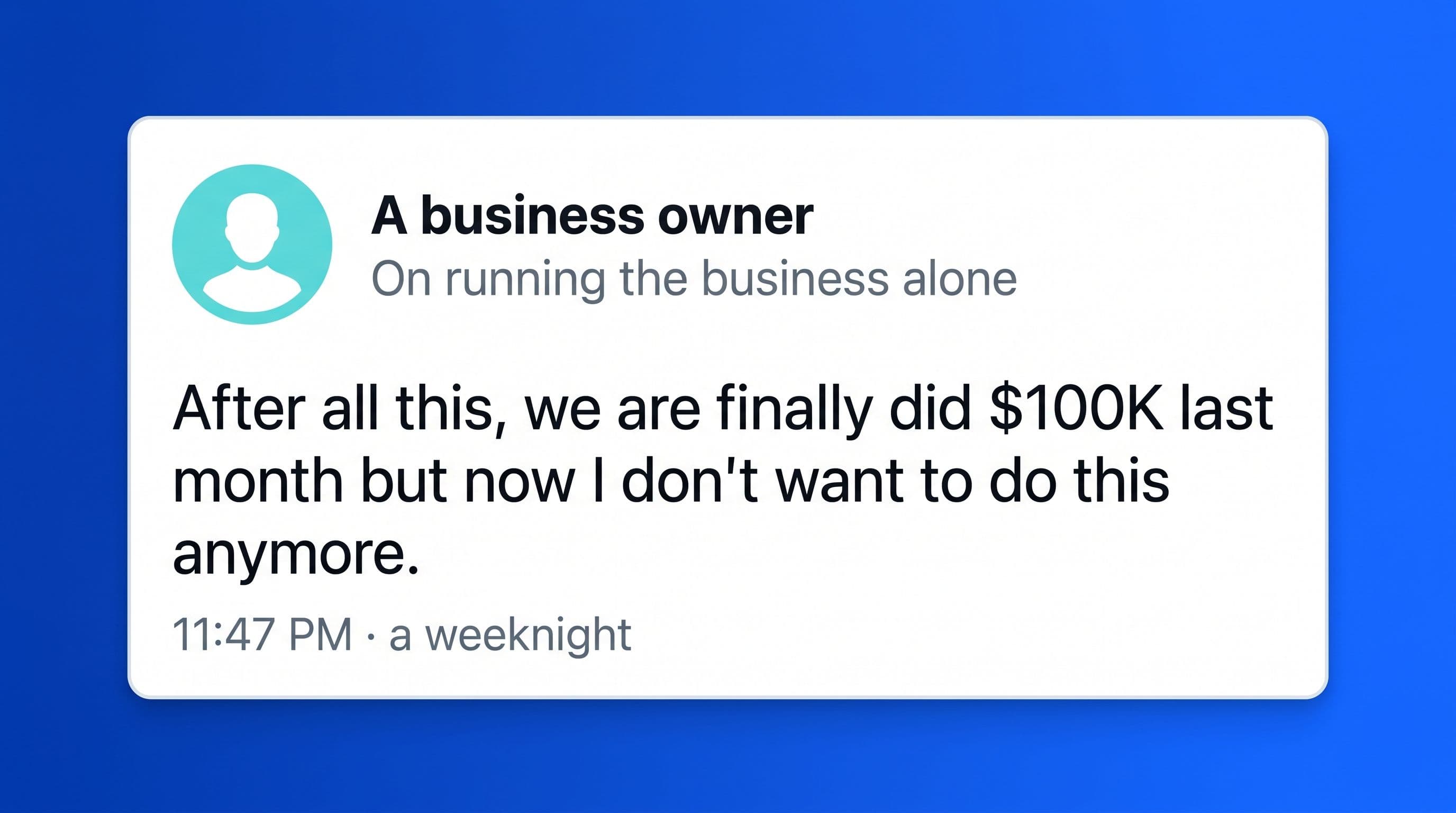
"After all this, we are finally did $100K last month but now I don't want to do this anymore." (kartik0204, Hacker News)
Business owner burnout is a documented, measurable state, not a personal failing. It shows up in lost sleep and skipped pay. Researchers have also documented a mental-health gap between entrepreneurs and everyone else. And it hits owners who are, by every external metric, succeeding, which is exactly what the quote above captures: a founder hitting six figures in a single month and, in the same sentence, saying he's done.
"I don't want to do this anymore": the moment the math stops mattering
The founder quoted above wasn't failing. He'd just crossed $100,000 in monthly revenue, the kind of number most small business owners spend years chasing, and he wrote it down next to a sentence about wanting out. That combination, success and exhaustion arriving together, is the pattern this entire hub is built around: burnout in small business ownership doesn't track with how well the business is doing. It tracks with how much of the business one person is carrying.
That's also why a vacation rarely fixes it. Matt Munson, writing about his own burnout, put the distinction plainly:
"Vacations solves fatigue. It doesn't do shit to address burnout." (Matt Munson)
Fatigue is a body that needs rest. Burnout is a role that never lets you set it down, even on the beach. The rest of this page collects what that costs owners in their own words, backed by the survey and research data that shows it's a normal, common, well-documented condition rather than something wrong with any one person.
The numbers behind the feeling
Here's every hard number available on this cluster, in one place, each tied to the specific study or survey that produced it.
Bluevine's 2026 survey of 781 U.S. small business owners, fielded by Centiment, found 68% lost at least one full night of sleep a month to financial stress, 53% felt emotionally drained or burned out in the past year, and 62% reduced or skipped their own pay at least once in the past twelve months. Cash flow timing was the single biggest stressor, named by 41% of respondents. (Bluevine)
Gallup's tracking survey of 1,004 U.S. microbusiness owners found 20% took zero vacation days in the prior year, and the median owner who did take time off took just 12 days. (Gallup)
A Talker Research survey of 1,000 owners, commissioned by Adobe Express, found the average small business owner fills five roles daily: customer service (54%), marketer (44%), bookkeeper (43%), social media manager (41%), and creative director (35%). That role-stacking adds up to more than 200 unpaid "bonus" hours a year, and one in four owners said they're doing work they don't feel qualified for without bringing in outside help. (Talker Research)
A peer-reviewed study published in Small Business Economics compared 242 entrepreneurs against a matched comparison group and found mental-health differences affected 72% of the entrepreneur sample, with elevated rates of depression (30%), ADHD (29%), and two or more co-occurring conditions (32%). (Small Business Economics, Freeman et al.)
RHR International surveyed 100 CEOs and found 41% reported loneliness in their role, half said they'd felt lonely at some point while leading, and 61% of that group believed it hurt their performance. Harvard Business Review covered the finding as structural, tied to shrinking peer groups and confidentiality demands rather than a lack of social contact. (Harvard Business Review)
Enji's 2025 State of Small Business Report surveyed 245 owners across 40 states and 13 industries and found 81% experienced some level of burnout, while only 37% felt optimistic about 2026, despite a broader economy that wasn't in crisis. (Enji)
And Nav found 65% of small business owners attribute some type of physical ailment directly to running the business. (Nav)
| Stat | Share of owners | Source |
|---|---|---|
| Lost a full night of sleep to financial stress in the past month | 68% | Bluevine |
| Felt emotionally drained or burned out in the past year | 53% | Bluevine |
| Reduced or skipped their own pay at least once in the past year | 62% | Bluevine |
| Attribute a physical ailment directly to running the business | 65% | Nav |
| Reported some level of burnout | 81% | Enji |
None of this is Klipy-generated data. It's the published research this cluster runs on, collected here so the source and the number sit next to each other.
Is it normal to feel burned out running a small business?
Yes. Burnout is the statistical norm among small business owners. Bluevine's survey found 53% of owners felt emotionally drained or burned out in the past year, and Enji's separate 2025 survey put the figure even higher, at 81% reporting some level of burnout. (Bluevine; Enji)
The two community quotes on this page show what that looks like from the inside. The founder who'd just hit $100,000 in monthly revenue and wanted to quit anyway wasn't describing failure; he was describing burnout arriving alongside success, which is exactly when owners tend to assume something's wrong with them instead of the workload. Matt Munson's line, that vacation "doesn't do shit to address burnout," draws the useful distinction. Ordinary fatigue responds to rest. Burnout doesn't. (Matt Munson)
Most owners read their own burnout as a personal shortfall. The data says it's what doing every job in the business, alone, reliably produces.
Why can't I sleep without thinking about work?
For most owners, the sleeplessness comes down to arithmetic. Entrepreneur, reporting on Talker Research survey data, found 56% of stressed small business owners lose sleep over the business, an average of 7 hours a week. That's close to a full night, most weeks. (Entrepreneur)
The number lines up with why it's cash flow, specifically, that keeps owners awake: Bluevine's survey found cash flow timing is the top stressor for 41% of owners, ahead of every other category. (Bluevine) At 2am, a salaried employee's paycheck doesn't depend on whether an invoice clears. An owner's does, and there's no one else checking the account before morning. That's the difference between ordinary work stress and the kind that follows an owner into bed.
Am I the only one who feels like this?
No. Owners rarely say this out loud, which is exactly why it feels like a private, unusual thought to whoever's asking it. Two founders who wrote about it publicly describe almost the same moment.
"I never admitted to anyone how close I was to giving up." (Akhil Mishra)
"And I wonder if I'm really cut out for running my own business, because who am I to do any of this at all, really?" (Jori Bell)
The silence itself is the pattern. Owners keep this thought to themselves, so every owner who has it assumes they're the only one having it. They aren't. It's common enough to have survey data behind it, and common enough that the two quotes above, written months apart by people who don't know each other, land on nearly identical language.
Why does running my business feel like it's slowly taking over who I am?
Because for a solo owner, the line between operator and identity erodes gradually until there isn't one left. What reads as ambition from outside can feel, from the inside, like disappearing. Andrea A Smith described it directly:
"It is you becoming the business... The rest does not feel like rest. It feels like disappearing." (Andrea A Smith)
An owner who spoke to The Cut about closing her business described the same fusion from the other side, the shame of feeling like the business's failure was her own:
"My business was a huge part of my life and identity. I felt ashamed. Like, why couldn't I make this work?" (The Cut)
The mechanism is simple. When one person carries every function of a business, there's no edge between the role and the self to retreat to on a bad week. There's no fix pitched in this section. It's here to be named.
Why do I feel guilty no matter whether I'm working or with my family?
Because solo ownership removes the handoff that normally splits attention cleanly. With no one else covering the business, being anywhere else always means the business is unattended, and that produces guilt in both directions at once. An owner writing for Honeypot Social described it exactly this way:
"If I was working, I felt guilty I wasn't with my kids. If I was with my kids, I felt guilty I wasn't working." (Honeypot Social)
This is structural: it traces back to the absence of coverage, having no one else to hand the business to for an afternoon.
Why doesn't hitting my goals ever feel like enough?
Because the goalposts an owner sets alone tend to get measured against peers who chose an easier path, and the comparison decides how the win feels more than the win itself does. One owner, writing years after starting a business, put it this way:
"Yet now I see peers of mine back in those days that have a comfortable life. They make far more money than I do each year, take more vacations and life is easier for them than it was supposed to be for me." (djeshelman.com)
The goal got hit. What the quote captures is what it cost relative to people who didn't pay that price. Owner-defined goals rarely include a line item for what got given up to reach them, which is why reaching them can still feel hollow.
Why do I feel like I can't make one more decision by the end of the day?
Decision fatigue is a documented cognitive limit that has nothing to do with willpower. Every choice a solo owner makes without a second opinion draws from the same finite reserve, so by evening even trivial decisions can feel impossible. An owner interviewed by TC Group described the exact moment it hits:
"When I get home and have to decide what to cook for dinner, that just folds me over. I can't make any more decisions." (TC Group)
It doesn't reliably improve with tenure, either. A Hacker News founder nine years into running a business wrote:
"This is my 9th year and I can't tell you how many times I self doubt." (codegeek, Hacker News)
TC Group frames decision fatigue as a leadership risk worth managing deliberately rather than a personal defect to push through. (TC Group)
Is it normal for my health to fall apart from running this business?
Yes. It's common enough to be independently measured: 65% of small business owners attribute some type of physical ailment directly to running the business, per Nav. (Nav)
That figure isn't isolated. It sits downstream of the sleep loss Bluevine measured (68% losing a full night monthly) and the mental-health differences the Small Business Economics study found in 72% of its entrepreneur sample. Chronic sleep loss and sustained stress show up in the body eventually. The physical toll is the same pattern the earlier sections describe, arriving later and in a different form.
Where to go deeper on specific parts of this
Three questions in this cluster get their own full treatment elsewhere on this site, each with its own sourced data and, where relevant, real help resources rather than platitudes:
- Is it normal for entrepreneurship to feel this lonely? A closer look at the CEO loneliness research (41% of surveyed CEOs, per RHR International) and where to actually find support.
- Why do I have to be the expert at everything in my business? The role-stacking data behind the exhaustion, five roles and 200+ unpaid hours a year, and what to hand off first.
- Why can't I actually disconnect on vacation without everything falling apart? Why roughly 1 in 5 owners takes zero vacation days a year, and what has to be true before time off actually works.
What actually holds
None of this gets fixed by a better attitude or a longer vacation. It gets fixed by removing tasks from the one person carrying all of them, whether that's a hire, a co-founder, a peer group, professional support, or software that takes over a specific piece of the work.
Real levers exist and none of them are exotic. Part-time help for one of the five stacked roles the Adobe Express data describes is one option, and a peer group of other owners, aimed at the loneliness RHR International measured, is another. Talking to a professional matters too, especially when exhaustion stops responding to rest. None of that requires a product pitch to be true.
Where Klipy fits into that list: it takes the sales follow-up role off the stack specifically, drafting the recap and next-step outreach from a call so it's not one more hat competing for the same hours. It doesn't fix identity or a marriage, and it doesn't touch a mental health crisis. It was never built to. It's one lever among several, aimed at one specific role.
See what this is actually costing you
Most owners can feel the toll without ever putting a number on it. The Solo Sales Tax report turns the hours a founder spends on sales and follow-up into a number you can look at without any sales pressure attached to it.
Read the Solo Sales Tax report →
Or start from the homepage if you want the fuller picture of what Klipy takes off an owner's plate first.