
 Ask ChatGPT
 Ask Perplexity
 Ask Claude
 Prefer us on Google
Introduction
It's 3:47 p.m. and you've already checked the balance four times since lunch. Nothing changed the first three times. You check again anyway, thumb moving before the screen even loads, the way some owners describe refreshing an inbox like a slot machine, pulling the handle on a number that can't move between pulls. Except this isn't email, and somewhere in the last year, checking it stopped being a task and became a reflex.
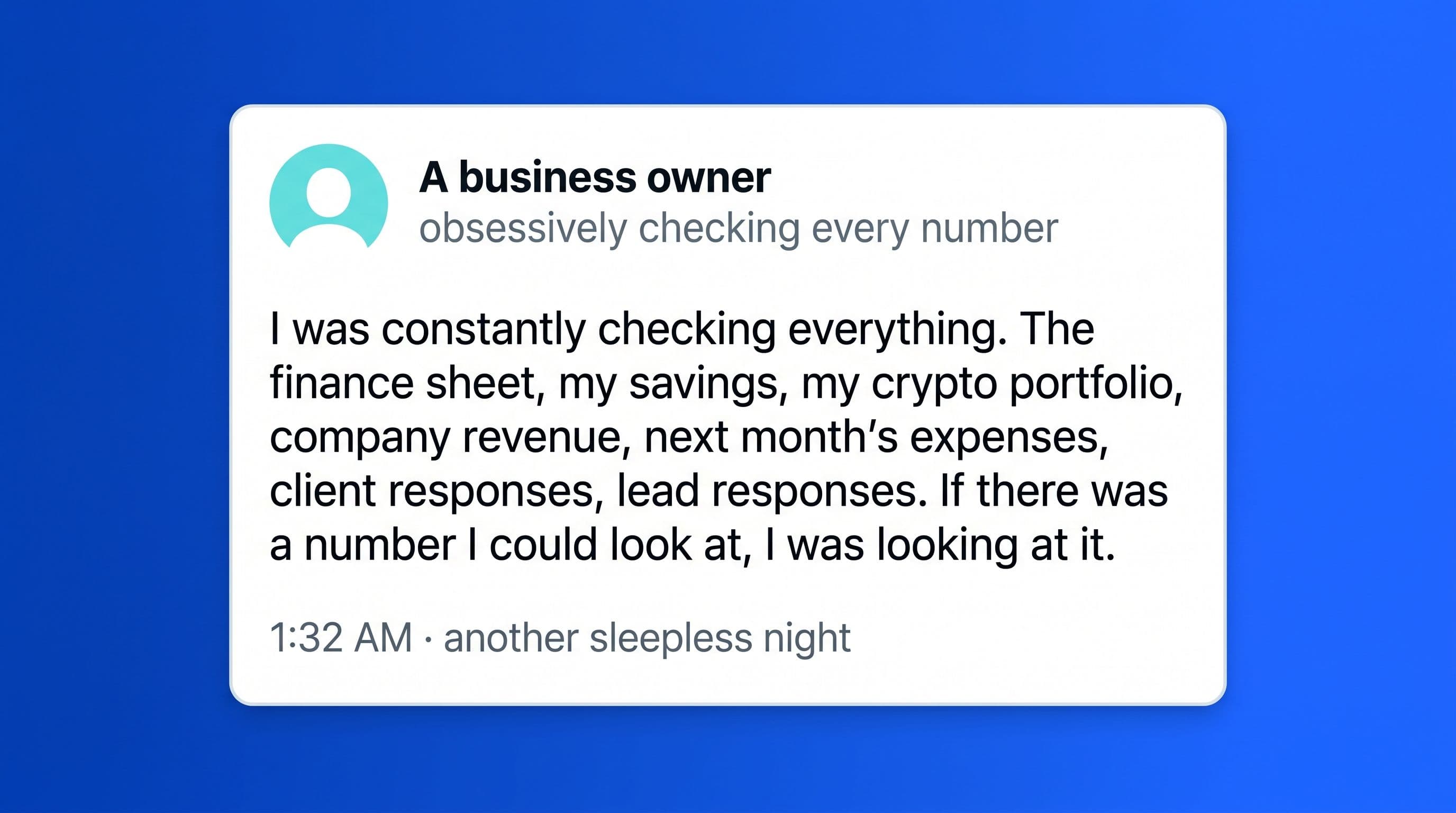
"I was constantly checking everything. The finance sheet, my savings, my crypto portfolio, company revenue, next month's expenses, client responses, lead responses. If there was a number I could look at, I was looking at it." (Talha Asif)
3:47 p.m., Stripe, again
By the time you're staring at the ceiling at 1 a.m., you've stopped pretending this is about staying informed. You're running the same math you ran three hours ago: what's in the account against what's owed in twelve days, plus whatever's still stuck in that stage-two deal that hasn't moved since the demo call. The numbers won't stay still long enough to add up, so you check again, like the fourth or fifth look might finally settle something the first one didn't.
During the day it's the bank app, the Stripe dashboard, or the spreadsheet you built because neither felt like the whole picture. You open one and close it, then open the next, and somewhere around the tenth check of the afternoon you notice your own hand doing it before your brain has decided to. Nobody told you to check this often. You just do.
It's not a discipline problem. It's a math problem
This is one spoke of a wider pattern in owner burnout, covered in our guide to business owner burnout. The math is against you no matter how disciplined you are: in a one-person sales operation, you are the entire early-warning system, and if you don't check the number, nobody checks it for you.
The instinct makes more sense once you see the volatility behind it. Small business owners are more than 30 percentage points more likely than non-owners to report volatile monthly income, 57% versus 27%, and owners who saw a drop lost a median of about $10,000 in the prior year, according to the Consumer Financial Protection Bureau's Making Ends Meet survey. That volatility is exactly why your hand keeps finding the app before your brain decides to look.
Why am I burned out from obsessively checking my agency's numbers?
You're burned out because you're the only person accountable for a number that moves without warning, and there's nobody else watching it for you. Checking is your nervous system trying to compensate for that solitude.
Compulsive checking is the most prevalent compulsive behavior linked to anxiety, and its severity climbs alongside anxiety severity, according to a peer-reviewed study in Frontiers in Psychiatry. Translated to a sales owner's day: the more uncertain the pipeline feels, the more the checking escalates, and the escalation reflects that uncertainty rather than a personal flaw.
Seventy-one percent of small business owners report moderate-to-extremely-high financial stress, according to Bluevine's 2026 survey. That puts you closer to the median than the exception.
The numbers behind the number-checking
- Bluevine: 68% of small business owners lose at least one full night of sleep a month to financial worry, 13% lose six or more nights, 62% have reduced or skipped their own pay in the past year, and 41% name the gap between incoming money and bills as their single biggest stressor.
- Patriot Software: 47.7% of small business owners have skipped or delayed their own paycheck to keep the business running, 58.8% among owners under one year in business, and 53.5% lose sleep over the business at least a few times a week.
- NerdWallet / The Harris Poll: 30% of Americans say checking a bank balance itself causes anxiety. A separate NerdWallet/Harris wave found 84% of Americans report financial stress overall, and 7% cope the opposite way, by ignoring their debt balances entirely.
- U.S. Chamber of Commerce / MetLife Small Business Index: 35% of small business owners named revenue their top concern in Q1 2025, a 10-point jump from the prior quarter and the highest share the index has recorded since it began tracking in 2021.
Why do I spiral every time a proposal goes unanswered?
An unanswered proposal is another number you can't verify on demand, and attention loops back to whatever is uncertain and checkable. That's the same reflex driving the account-balance checking, just aimed at a different screen. We cover that specific spiral, and how to sit with it, in what to do when a client ghosts your proposal.
Checking severity tracks anxiety severity, not the other way around, according to the Frontiers in Psychiatry research on compulsive checking. A solo owner has nobody else to check the outcome for them, so the loop runs unsupervised.
One agency owner described exactly this pattern after sending proposals into silence:
"If I sent a proposal and the client didn't reply, I would spiral. Why aren't they replying? Did I mess something up?" (Talha Asif)
The proposal is just another unanswered number, and the compulsion doesn't know the difference between that and a bank balance.
How other owners are coping (and what doesn't actually work)
Some owners cope by setting a fixed check-in time. Most don't, and the ones who don't often end up doing more of the thing that isn't helping: checking even more.
Earlier, the same owner quoted at the start of this piece described checking every number he could find, on repeat, all day. That's an unusually specific confession, and it matches what obsessive checking looks like day to day: closer to the median coping strategy than the one that actually works.
The honest complication is that checking more doesn't feel irrational in the moment. Each check briefly quiets the uncertainty, which is exactly why it's hard to stop, even though the relief is temporary and the balance never changes between refreshes. A smaller group copes by avoiding the number entirely: 7% of Americans say they ignore their debt balances entirely rather than face them, the opposite pole of the same anxiety, according to NerdWallet and The Harris Poll. Checking constantly and refusing to look are two versions of the same unresolved problem.
The fix that doesn't need a product
Start by replacing ambient checking with one fixed window. Financial therapists recommend picking a consistent day and time, as little as 15 to 30 minutes, and reviewing the numbers only then, specifically to retrain the anxiety response that makes checking feel necessary at 11 p.m. and again at 7 a.m. (Amanda Clayman, LCSW, via Vice).
Inside that window, build a simple weekly scorecard: proposals sent, follow-ups made, deals moved a stage forward. These are the inputs you actually control, and none of them is the account balance.
Then separate two questions that got fused into one anxious habit: is a deal moving, and what's in the account today. The first tells you whether the business is healthy. The second only tells you whether this particular week has been paid yet, a narrower question. Checking the account for an answer to "is the business okay" is checking the wrong number.
How do I stop tying my self-worth to closed deals?
Score your week on the actions that were actually yours instead of closed revenue, which one slow-paying client or one bad month can veto no matter how hard you worked. A simple weekly scorecard already does this: it counts what you actually did this week, independent of what the market decided to give back.
Closed-deal counts are a noisy, delayed measure of effort. A deal can close from something you did three months ago, or fail to close for a reason that had nothing to do with you, like a buyer's budget freeze. Neither outcome says much about how well you actually worked this week.
Decoupling your worth from that single number takes weekly repetition. Score the inputs again next week, and the week after, until checking the outcome stops feeling like checking a verdict on yourself.
Where Klipy fits, and where it doesn't
Some of the compulsive checking comes from a visibility gap on the pipeline side, separate from the account balance. You have a lagging number, what's in the account, and no leading one, whether anything is actually moving toward that number, so the lagging number ends up absorbing every ounce of "is this going to be okay" you're carrying, even the part that has nothing to do with money. It's the same gap behind why profitable businesses still run out of cash: healthy pipeline activity that hasn't reached the account yet.
Klipy is the AI CRO: the AI agent that runs your entire sales operation. Here, that means it logs your follow-ups and deal progress as they happen, from calls, email, LinkedIn, WhatsApp, and the other channels a deal actually moves through, so there's a real answer to "is anything moving" that doesn't require you to reconstruct it from memory or dig through five inboxes.
That's the specific, narrow thing here, not a mental-health or money-therapy fix. The income volatility behind the checking is real, and a follow-up log only shows that deals are moving; it can't speed up a slow month. What it removes is one blind spot: not knowing whether anything is moving. That leaves the compulsive check landing on a better number than the balance.
One number worth checking
There's one more number worth checking, just once, instead of twenty times a day: the Solo Sales Tax, the compounding cost of being the only person selling (see the full breakdown). It adds up the hours and the leaked pipeline that come from running sales alone, the same forces behind the balance you keep refreshing.
You don't need to check this one again after today. Read it once to see where your own numbers land, then go back to the weekly scorecard instead of the bank app.