
 Ask ChatGPT
 Ask Perplexity
 Ask Claude
 Prefer us on Google
Introduction
Feast-or-famine cash flow in an otherwise profitable business usually comes down to demand and pipeline. Revenue feels lumpy because new opportunities depend on sporadic, founder-led outreach instead of a steady, always-on process, so cash follows whichever client happens to pay this month rather than a schedule the owner controls. Three patterns show up again and again in owner accounts of this: the late-paying client who ends up funding payroll, the one account the whole business quietly leans on, and the fear of raising prices or firing a bad-fit client because the cash can't absorb the gap. Each one gets its own section below, backed by data and by owners who've said it in their own words.
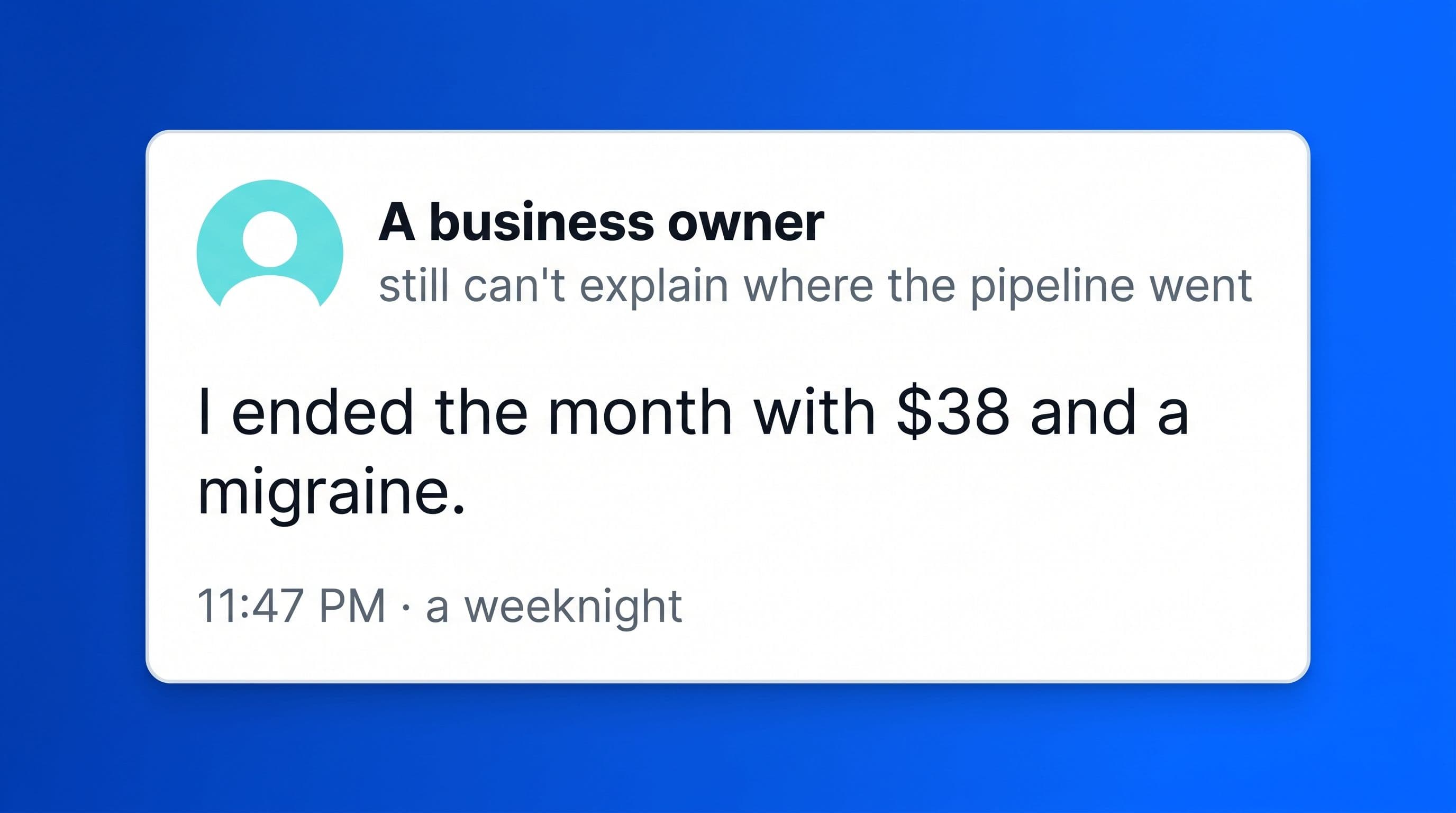
"I ended the month with $38 and a migraine." (Very Good Productized Guides)
What the data says about small business cash flow
The numbers say this is structural and common, the same pattern showing up across thousands of otherwise well-run businesses. Here's every benchmark behind this page, in one place:
- 51% of small employer firms cited uneven cash flow as a financial challenge in the prior 12 months, ranking behind rising costs (75%) and operating expenses (56%). Source: Federal Reserve Banks, Small Business Credit Survey, 2025 report.
- That survey was fielded September through November 2025 across more than 6,500 U.S. small employer firms, sponsored by all 12 Federal Reserve Banks. Source: Federal Reserve Banks, Small Business Credit Survey, 2026 report.
- 47% of small businesses with outstanding invoices had some more than 30 days past due in 2025, owing an average of $17,500 per business. Among businesses hit by these delays, 26% delayed their own salary and 19% took on debt or used a credit card they otherwise wouldn't have. Another 18% paid a bill late and ate a fee. Source: Intuit QuickBooks, 2025 Small Business Late Payments Report.
- Top-5 customer concentration above 50% of revenue is an industry-recognized "high concentration" risk threshold; under 25% is considered low. Source: Corporate Finance Institute.
- About a quarter of owners dealing with late payment from larger clients wait 20 to 30-plus days past the due date, and half believe the delay is deliberate. Source: UK Small Business Commissioner.
These are population-level patterns. What they look like from inside a single business follows in the sections below.
| Challenge | Share affected | Source |
|---|---|---|
| Uneven cash flow in the prior 12 months | 51% of small employer firms | Federal Reserve Banks, Small Business Credit Survey (2025) |
| Invoices with something 30+ days past due | 47% of businesses with outstanding invoices | Intuit QuickBooks, 2025 Small Business Late Payments Report |
Why does my profitable business still feel broke?
Profit and cash are different clocks. Profit counts revenue the moment it's earned, but bills come due on the calendar's schedule, so a business can show a profit on paper and still run out of usable cash between payments. That timing mismatch is the mechanism behind the account that opens this page, where a profitable month on paper still left nothing in the bank.
A single slow-paying month doesn't sink a business on its own. What makes the gap recur is having no steady inflow of new business to buffer it: when the only cash coming in depends on a handful of existing clients paying on time, there's nothing to fall back on when one of them doesn't.
Is it normal to not pay myself some months?
Yes. It's common enough to be measured directly: Intuit QuickBooks found that 26% of owners hit by late-paying customers delayed their own salary specifically because of it in 2025. Owner pay tends to be the last line item covered in a cash crunch, which means it absorbs every timing shock that hits earlier in the chain before the owner sees a dollar.
Normal doesn't mean fine to ignore, though. It's frequent enough to be structural rather than an isolated bad month, and that's worth acting on rather than treating as background noise every quarter.
How do freelancers smooth out income between good and bad months?
Most don't smooth it structurally. They absorb the swings personally, which is why the volatility feels less like a business problem and more like a mood that shows up out of nowhere. One freelancer described the whiplash after a routine tax payment cleared:
I felt quite rich one day and poor as hell the next. The only thing that happened was that my IRS direct debit went through. (Indie Hackers)
Nothing about the underlying business changed between those two days. A single scheduled payment cleared, and the feeling of stability evaporated with it. The real fix is a steadier input: a pipeline that keeps producing new opportunities on its own schedule, so it never depends on the founder remembering to prospect during whichever month happens to feel flush. Smoothing income is an inflow problem before it's a cash-management problem.
Why is my revenue up but my bank account isn't?
Revenue climbing on paper often just means one client's invoice is aging, while the cash itself isn't arriving any faster. Growth can widen that timing gap instead of closing it, especially when bigger clients come with slower payment terms and the business doesn't adjust its collection habits to match. A fractional consultant described exactly this pattern with a single large client:
I once had a client that was 60+ days past due on a payment of more than $20k. (Fractional Fridays)
The same owner named the other half of the problem, the reluctance to enforce payment terms in the first place:
I used to feel bad for asking to be paid for my work in a timely manner. (Fractional Fridays)
Bigger, slower-paying clients plus a habit of not chasing what's owed is exactly the combination that turns rising revenue into a flat bank account.
Why do I feel ashamed about money problems in my own business?
The discomfort gets personal fast. Undercharging feels like a moral failing, and unpaid taxes feel like negligence, when both are usually symptoms of an unsteady pipeline forcing reactive decisions under pressure. One freelancer described the guilt of pricing her own work:
But I felt like a con man. I couldn't shake off this feeling that it wasn't fair to charge them so much money for something that took me a few hours to do. (The Friendly Freelancer)
Another described the dread of falling behind on taxes:
Soul-crushing paralysis that would come over me at the thought of facing an impenetrable morass of tax instructions, and my own negligence in keeping records. (Indie Hackers)
Shame tends to cluster around pricing and taxes because those are the two places lumpy cash flow forces avoidant behavior: undercharge to keep a shaky client happy, or fall behind on paperwork because there's never a calm month to catch up. Both read as character flaws from the inside. Both are usually downstream of demand that never stabilized.
Why can't I get a business loan without putting my house on the line?
Because most small business lending in the U.S. legally requires a personal guarantee. Banks aren't singling anyone out; they're following standard underwriting, and that still leaves owners squeezed when the guarantee is the only thing standing between a slow month and personal risk. Two owners described the same structural fact from different angles:
Banks don't give 'business loans' to poor people. The first question they ask is what kind of security or personal guarantee you can give and when the answer is 'nothing', their answer is 'no.' (Hacker News)
In the USA you can't get a limited loan... All small business loans have a personal guarantee. (Hacker News)
With external capital tied to personal risk this way, a steadier pipeline that smooths revenue internally, rather than more debt, becomes the lever an owner can actually pull.
Is it normal for a growing business to still feel financially fragile?
Yes. Growth increases cash needs, more hiring and more inventory, before it increases collected cash, so fragility often peaks during a growth stretch rather than before one starts.
The fix isn't unique to a growth phase, either. A steadier, founder-independent source of new opportunities reduces reliance on both growth-stage borrowing and lucky client timing, whether the business is scaling up or just trying to hold steady.
More questions owners ask about cash flow and client risk
Five related questions come up constantly in this same cluster of pain, each with its own full answer:
- How do I ask a client for money they owe me without feeling awkward about it? Scripts for chasing overdue invoices without damaging the relationship.
- What do I do when a client just won't pay an invoice? The escalation path once polite reminders stop working.
- Is it dangerous that one client makes up half my revenue? How to read customer concentration risk and what to do about it.
- Am I charging too little for what I do? How to tell if underpricing, not undercollection, is the real leak.
- Why did quarterly taxes blindside me when I thought my business was doing fine? Why estimated tax timing catches lumpy-revenue businesses off guard.
What actually holds
Owners already reach for two standard fixes: stricter invoicing terms and a cash reserve. Net-15 terms and upfront deposits cut collection lag. A three-month buffer covers a slow stretch. Tighter bookkeeping helps too, and firing the worst-fit client removes a source of chronic stress. All of it is legitimate, though it doesn't touch the root cause: revenue stays lumpy as long as new opportunities only show up when the founder has time to chase them.
The actual lever is pipeline consistency. A business that generates new qualified conversations on a steady cadence, independent of whatever the founder's week looks like, stops swinging between feast and famine because it stops depending on any single client's payment timing. This is the specific gap the AI CRO (the AI agent that runs your entire sales operation) is built to close for Klipy customers: always-on outreach and follow-up that keeps running whether or not the founder remembered to prospect this week.
Find out what inconsistent follow-up is costing you
Founders who sell solo are already stretched between delivery and running the rest of the business, which leaves prospecting sporadic, and prospects who wait even a little while for a reply are markedly less likely to qualify than ones who hear back right away. Both facts point to the same gap: inconsistent, founder-led follow-up is a source of the pipeline holes behind feast-or-famine cash flow.
If you want to see what that gap is worth in your own numbers rather than in aggregate stats, the Solo Sales Tax report walks through how to price it for your business.