
 Ask ChatGPT
 Ask Perplexity
 Ask Claude
 Prefer us on Google
Introduction
You're staring at an invoice you haven't sent yet. The job took a few hours, maybe an afternoon, and the number sitting in the field doesn't match what those hours feel like they should cost. So you knock it down before the client ever sees it and hit send, feeling a little sick about the whole exchange, like you almost got away with something you shouldn't have.
The scene repeats with almost every invoice. You calculate a fair number, then talk yourself out of it in the ten seconds before you click send, because charging what the work is worth feels less like running a business and more like getting caught. One freelancer put the feeling into words that a lot of solo consultants recognize the moment they read them.
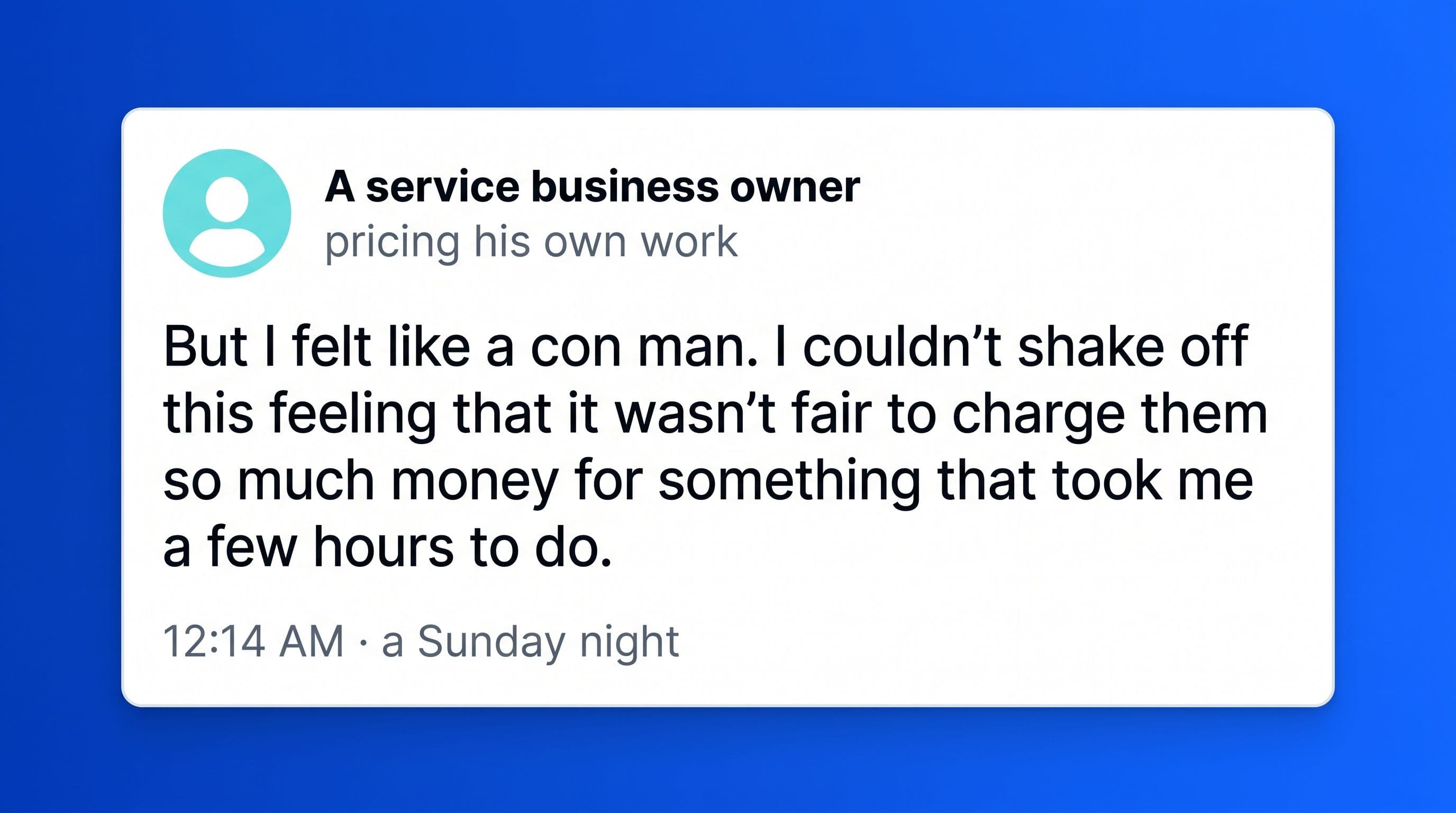
"But I felt like a con man. I couldn't shake off this feeling that it wasn't fair to charge them so much money for something that took me a few hours to do." (The Friendly Freelancer)
It's a cash-flow problem, not a confidence problem
Undercharging tends to track a business's cash-flow rhythm more closely than the owner's personality. When new work shows up in unpredictable bursts instead of a steady stream, saying a firm number and risking a "no" feels like risking a gap with no client behind it. So the owner protects whichever client is currently paying by keeping the price low enough that nobody says no, rather than pricing the work at what it's worth.
The pressure behind that instinct is real and measurable. The Federal Reserve's 2025 Small Business Credit Survey found that 51% of small employer firms cited uneven cash flow as a financial challenge, and for the first time since 2021, firms were more likely to report that revenue had decreased than increased over the prior year. When revenue is already unpredictable, a firm price that might scare off the one client in front of you can feel like a risk the business can't afford, even when the discount is a cost too.
This pattern shows up across owner-led businesses well before it shows up in a single rate decision. Our guide to why profitable businesses still run out of cash covers the mechanics of that cycle in more depth.
How do I know if I'm charging too little?
Three signs are common. You've only ever raised your rate when a cash crunch forced it, never as part of a plan. You bill by the hour while peers doing similar work use value-based pricing and land bigger projects. And you catch yourself justifying a price by the hours a task took rather than the outcome it produced.
Hourly billing carries a structural bias against the person doing the work. AICPA & CIMA's 2025 National MAP Survey, the accounting industry's benchmarking survey of small firms, found that professionals who bill hourly have traditionally undervalued their services relative to the value they deliver. Consulting Success's 2025 fee survey of roughly 1,000 consultants found a real gap in outcomes: 51% of consultants who price by value land projects worth $10,000 or more, compared with 39% of consultants who bill hourly. Only 15% of the consultants surveyed use value-based pricing at all, and 39% said they've never tried it because they don't know how.
There's also a behavioral tell. Intuit QuickBooks' 2025 late-payments data found that businesses squeezed by cash-flow pressure were more likely to have recently raised prices than businesses that weren't squeezed. If the last time you raised your rate was during a cash crunch rather than on a plan, that timing is itself a sign you've been underpricing.
Should I raise my rates?
Yes, in most cases. What's stopping you is very likely fear rather than any real ceiling in the market, and that's exactly how other owners who eventually raised their rates describe the moment before they did it.
A freelance writer at Happy Freelancing describes raising rates despite never feeling fully ready for it, and names the trap plainly: almost nobody feels comfortable doing it, and a client's "no" gets misread as a verdict on personal worth instead of a comment on that one client's budget. Raising the rate anyway doesn't make the discomfort disappear right away. The guilt cycle can keep running even after the invoice goes out at the new number.
Naming the fear out loud is another coping move, and it doesn't erase the fear either. One consultant described it this way:
"It was a fear problem. Fear of being told no. Fear of losing the client. Fear of looking 'greedy.'" (Very Good Productized Guides)
Saying it plainly gets a foot on the ground. The fear itself still sticks around until something forces the question.
A third pattern shows up in freelance writer Anangsha Alammyan's account of pricing her own writing at 40 paise a word for years, an assumption she had never tested. A peer eventually challenged her directly: were clients really unwilling to pay more, or was she the one afraid to ask? She had never checked the ceiling she was pricing against. She had only assumed it.
Here's honest counter-evidence worth sitting with. MBO Partners' 2025 State of Independence report found that 5.6 million independent US workers now earn $100,000 or more a year, up 19% from 4.7 million the year before, and 59% of independents report earning more than they did as employees. Pricing confidence, more than a client's actual willingness to pay, is often the variable holding an owner back.
| Metric | 2024 | 2025 |
|---|---|---|
| Independent US workers earning $100K+ a year | 4.7 million | 5.6 million (up 19%) |
| Independents earning more than they did as an employee | not reported | 59% |
Source: MBO Partners, 2025 State of Independence in America Report
Cost-plus vs. value-based pricing
Cost-plus pricing sets your rate by adding a fixed markup on top of your time and costs. Value-based pricing sets your rate by what the client believes the outcome is worth to them. A reader who does nothing else after this article should at least know which system they're currently using, even by accident.
Harvard Business School Online frames these as the two dominant pricing systems available to a services business: cost-plus guarantees your costs are covered, while value-based pricing ties the price to what the customer gains from the outcome rather than to the hours it took to produce it. The basic mechanics of cost-plus pricing, adding a fixed percentage markup to your unit cost, explain why it's the easier system to start with: it's simple, and it protects your margin even when you underestimate how long something will take.
Run a simple check that costs nothing and needs no tools. Ask what it would cost the client if this outcome went unsolved, weighed against what comparable providers charge for the outcome itself rather than the hours behind it, then ask yourself whether you'd still take the project at half your current rate. The answers won't hand you a perfect number, but they'll tell you which pricing system you're actually running, and whether it's the one you meant to run.
How do I raise my prices without losing clients?
Give existing clients real advance notice on a fixed date, and frame the increase around the outcome you deliver rather than your rising costs. If you want a softer landing for long-standing relationships, grandfather those clients at a smaller increase while new clients start at full rate.
QuickBooks' 2025 data shows a real increase, delivered under pressure, still holds: businesses squeezed by late payments were 1.4 times more likely to have recently raised prices (30% versus 21% of less-squeezed businesses), and raised them by a larger average amount (16% versus 10%). Most clients tolerate a well-communicated increase better than owners expect going in.
When a client pushes back, restate the value delivered rather than your rising costs, and offer a short transition window if the relationship is worth preserving. A client who leaves over a reasonable, well-flagged increase is usually revealing something about their own margins more than anything about your rate.
The real reason you can't risk asking for more
Underpricing is easiest to sustain when you can't risk losing the one client currently paying you, because the pipeline behind them is empty. Every pricing system above works better once that specific fear is handled, since a firm number only feels safe to send when losing one deal doesn't mean losing the business. That risk gets sharper the more revenue any single client already represents. Our related piece on what percentage of revenue from one client is too much walks through where that concentration starts to hurt you at the negotiating table.
Klipy is the AI CRO: the AI agent that runs your entire sales operation, and part of the job is keeping new opportunities moving into view instead of waiting for the owner to chase them by hand. When you can already see the next few conversations forming, a client saying no to a rate increase stops carrying the weight of the whole month. That's the shift that makes a firm price sendable: losing one deal stops meaning losing the pipeline behind it.
What underpricing is actually costing you
If you want a real number for what underpricing, combined with inconsistent follow-up, is quietly costing your business, the Solo Sales Tax report puts a figure on it. The Solo Sales Tax is the compounding cost of being the only person selling: the hours spent chasing, the pipeline that leaks while you deliver, the rate you accepted because saying no felt too risky.
Running the numbers costs nothing and doesn't obligate you to anything. It just gives you a real figure to weigh against the discount you've been giving away.
Questions people ask about pricing their work
Should I raise my rates?
Usually yes. The fear behind hesitating, mainly hearing no or losing the client, is a documented pattern among consultants and freelancers, and it doesn't track the market's real ceiling. QuickBooks' 2025 late-payments data found that businesses under cash-flow pressure were 1.4 times more likely to have recently raised prices, and by a larger amount, than businesses that weren't squeezed. Fear of the ask, more than any real limit in the market, is usually what's blocking the increase.
How do I know if I'm charging too little?
The clearest tell is timing: if your last rate increase only happened during a cash crunch rather than as part of a plan, you've probably been underpricing for a while. Peers who use value-based pricing typically land bigger projects than peers who bill hourly for similar work, per Consulting Success's 2025 fee survey, and AICPA & CIMA's 2025 National MAP Survey frames hourly billing as a system that has traditionally undervalued the work relative to the outcomes it produces.
How do I raise my prices without losing clients?
Set a fixed effective date and give clients real notice ahead of it, and anchor the increase in the outcome you deliver rather than what your costs have done. Longer-term clients can ease in at a smaller increase while new clients start at the full rate. QuickBooks' 2025 data shows that businesses raising prices under real pressure still came out ahead, which means a well-communicated increase usually costs less client goodwill than owners expect going in.
What do I do when a client pushes back on a price increase?
Restate the value you deliver in terms of outcomes, not hours, and offer a short transition window if the relationship is worth preserving. The freelancers and consultants cited above describe fear of the client's reaction, not the reaction itself, as the hard part. A client who leaves over a reasonable, well-flagged increase is usually revealing more about their own margins than about your worth.
How much should I charge for consulting work?
Start from a system: cost-plus pricing (a fixed markup over your time and costs) guarantees your costs are covered, while value-based pricing sets the price by what the outcome is worth to the client. Harvard Business School Online frames these as the two dominant pricing systems, and consultants using value-based pricing report landing higher-value projects more consistently than hourly billers, per Consulting Success's fee survey.
Why do I feel guilty charging more for my work?
Undercharging often survives on an assumption nobody has tested against the market, not a real ceiling someone actually checked. Freelancers who eventually raised their rates describe the guilt as tied to how long a task took rather than what the client needed it to be worth, and the guilt usually didn't lift until a peer or client directly challenged the assumption.