
 Ask ChatGPT
 Ask Perplexity
 Ask Claude
 Prefer us on Google
Introduction
You finished the work. You sent the invoice. Now you're staring at a blank reply box, trying to figure out how to ask for money you already earned without sounding like you're accusing someone of something.
Owners who run their own client work hit this exact moment often enough that people write about it in public.
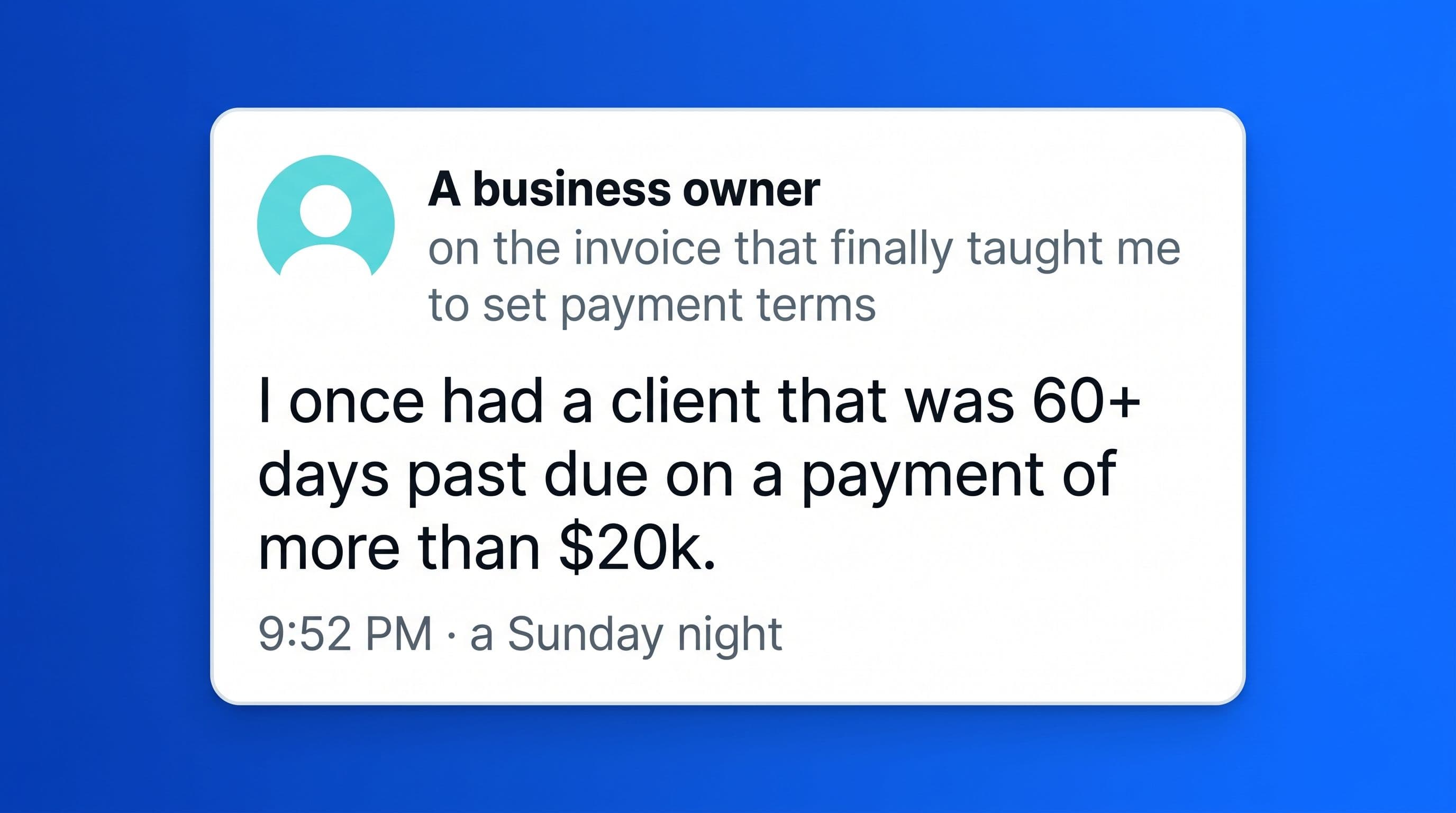
"I once had a client that was 60+ days past due on a payment of more than $20k." (Meghan Hardy, Fractional Fridays)
Four drafts, one unsent email
The email sits in your drafts folder, four versions deep. The first one was too blunt, so you softened it. The second one had an exclamation point that felt fake, so you cut it. The third one apologized twice for something you didn't do. The fourth one is still open on your screen, cursor blinking after "just wanted to check in!"
You finished this project weeks ago. The client approved it and used it without complaint. The only thing missing is the payment, and somehow that's the part that feels hardest to bring up.
Here's the specific, nameable feeling underneath all four drafts: it feels ruder to ask than it was for the client to be late. You didn't do anything wrong. You're asking to be paid for work you already delivered. And you're the one rehearsing the wording like you're about to ask for a favor.
Why this feels awkward: payment terms nobody wrote down
The awkwardness rarely has anything to do with confidence. It comes from not having agreed, before the work started, on what happens if the client pays late.
When there's no due date beyond a vague "net 30" on the invoice, no late fee, and no written expectation either side can point back to, every reminder you send has to be invented from scratch. There's no process the client already agreed to, so you improvise a new, slightly uncomfortable ask each time. That's a big part of why it never gets easier.
This is common. Per Intuit QuickBooks' 2025 Small Business Insights survey of nearly 2,500 small businesses, 47% had a portion of their invoices more than 30 days past due, and more than half of small businesses surveyed said they were owed money on unpaid invoices, averaging $17,500 per business (Intuit QuickBooks, 2025). The next section walks through what else that survey, and a companion study from SCORE, found.
This is one recurring cause in a wider pattern: why profitable businesses still run out of cash, where late client payment is one of the biggest gaps between a healthy P&L and an empty bank account.
Is it normal to feel awkward asking to be paid?
Yes, and it's one of the most common frustrations among freelancers and small-firm owners. The root cause is structural: nobody spells out the payment terms up front, so each ask has to be improvised instead of following an agreed process.
Two things are usually happening underneath it. First, vague terms set at the start mean there's no script to fall back on, so you invent the wording every time and second-guess it. Second, there's a real fear of jeopardizing the relationship, of being seen as pushy for asking about money that's already earned.
SCORE, the SBA's nonprofit resource partner, frames the fix in practical terms: state a late fee and clear payment-due language on the invoice itself, and put terms in a signed contract or statement of work before work begins (SCORE). That kind of clarity does more to remove the awkwardness than assertiveness alone, because it turns the ask into something the client already agreed to, not something you're inventing on the spot.
What the data says about getting paid late
This is a data problem as much as an emotional one.
- 47% of small businesses had invoices more than 30 days past due in 2025. More than half of small businesses surveyed said they were owed money on unpaid invoices, averaging $17,500 per business (Intuit QuickBooks, 2025 Small Business Insights).
- 79% of small business owners cut their own pay when customer payments run slow (SCORE).
- Owners could pay themselves an incremental $31,000 on average if they were paid in full on all outstanding invoices, per the same SCORE analysis.
| Metric | Figure | Source |
|---|---|---|
| Small businesses with invoices 30+ days past due (2025) | 47% | Intuit QuickBooks, 2025 Small Business Insights |
| Average amount owed per business carrying overdue invoices | $17,500 | Intuit QuickBooks, 2025 Small Business Insights |
| Owners who cut their own pay when payments run slow | 79% | SCORE |
None of this means you're bad at running a business. The math is stacked against solo and small-team owners no matter how disciplined their invoicing is, which is why a repeatable system does more to close the gap than raw willpower.
How other owners talk about this
Ask other owners and the story repeats with different numbers attached.
"I used to feel bad for asking to be paid for my work in a timely manner." (Meghan Hardy, Fractional Fridays)
Hardy wrote that after the $20k, 60-day-overdue client mentioned at the top of this article. That guilt came from years of treating a reasonable ask as an imposition, a habit that had nothing to do with this particular client.
The same shame shows up in a different moment: pricing the work in the first place.
"But I felt like a con man. I couldn't shake off this feeling that it wasn't fair to charge them so much money for something that took me a few hours to do." (Linda A. Thompson, The Friendly Freelancer)
Thompson was writing about value-based pricing, a different situation from an overdue invoice; the underlying feeling is the same one that stalls a payment reminder: a conviction that charging fair value, on time, is somehow taking advantage of someone.
One more voice names the actual mechanism behind both moments:
"It was a fear problem. Fear of being told no. Fear of losing the client. Fear of looking 'greedy.'" (Very Good Productized Guides)
None of that is a personality flaw. Every one of these owners eventually got paid. The discomfort was real, but it wasn't a signal to stop asking.
How do I ask a client for money without sounding rude?
The fix is almost entirely about tone. Put the invoice number and the amount in your first sentence, then say how many days past due it is. Skip the apologies ("sorry to bother you," "just following up!!") and assume the client meant to pay and simply missed it. Close with one specific next step: a payment link or a date you'll follow up again.
Directness reads as professional when it's paired with an assumption of good faith. Rudeness usually comes from vagueness: hinting at frustration without stating the fact plainly reads as passive-aggressive.
What email template do I use to chase an overdue invoice politely?
Three short scripts cover most situations. Each one assumes the client meant to pay and simply hasn't yet, which is what keeps them from reading as accusations.
Day 1 to 3, a friendly nudge: "Quick note that invoice #[number] for $[amount] was due on [date]. Here's the payment link in case it's easier to have on hand: [link]. Let me know if you've already sent this and I'll update my records."
Day 7, a firmer follow-up: "Following up on invoice #[number] for $[amount], now a week past due. Here's the link again: [link]. If there's an issue on your end, let me know and we'll sort it out; otherwise I'd appreciate payment by [date]."
Day 30, a formal notice: "Invoice #[number] for $[amount] is now 30 days past due. If I don't receive payment or hear back by [date], I'll need to pause further work until it's resolved. I'd rather sort this out directly, so please reach out if there's a reason for the delay."
This structure follows a pattern accounts-receivable specialists commonly recommend: warmth early, and progressively more formal language the longer an invoice sits open (Chaser).
How do I follow up on an unpaid invoice that's gone quiet?
When a reminder goes unanswered, repeating the same email rarely works. What works is a deliberate shift in tone as the silence continues.
In the first week past due, stay friendly: a quick nudge assuming the client is simply busy. By day fourteen, get firmer and specific, restating the amount and the days overdue, and consider offering a payment plan as a good-faith option if cash flow looks like the real issue. By day thirty, go formal: name one concrete next step, such as pausing further work or applying the late fee stated in your terms, and give a specific date it takes effect. If the balance is still open at day sixty to ninety, send a final notice.
Going quiet yourself, or continuing to deliver new work while unpaid, tends to be what turns a slow payer into a client who never pays. The reminder ladder only works if you're willing to actually reach the top of it. Klipy's follow-up drafts keep each stage of that ladder queued and timed, so a stalled reminder never depends on you remembering where it left off.
The terms that prevent this conversation from happening again
The most reliable fix for this whole category of dread happens before any work starts.
Requiring a deposit or partial advance on longer projects removes one of the biggest risks up front. Shortening your standard payment window from 30 days to 15 or 21 days measurably improves cash flow on its own, and invoices that state a late fee upfront get paid at a higher rate than invoices that don't, according to a FreshBooks data analysis cited by NerdWallet (NerdWallet).
SCORE adds one more piece: write your payment terms into a signed contract or statement of work before the engagement begins, so nothing gets improvised later on an invoice (SCORE). These terms are standard practice across most service industries, and each one removes a reason you'd otherwise send an awkward reminder later.
SCORE's guidance for a client who still pays chronically late after terms like these are in place is blunt: stopping the engagement is a reasonable last resort, worth considering before another invoice goes out.
Why you tolerate the client who pays this late
Scripts and better terms fix the conversation. They don't fix why you let a client go 60 days late in the first place.
When your pipeline runs feast or famine, one client's revenue starts to feel irreplaceable. You don't know when the next deal lands, so you keep delivering past the point you should have paused, and you avoid enforcing terms that might put the relationship at risk.
The real constraint there is visibility: you can't tell what revenue is coming in behind this client, so enforcing your own payment terms feels riskier than it actually is.
Klipy tracks every open deal and follow-up, so your pipeline stays visible day to day. A slow-paying client becomes one relationship you can see clearly, sitting alongside several others whose status is just as visible. That same visibility makes it easier to see which past clients are worth re-engaging for repeat work, instead of leaning harder on the one account that's overdue. Klipy is the AI CRO: the AI agent that runs your entire sales operation. For an owner staring at a 60-day-old invoice, the part that matters most is narrower than the whole system: one less reason a single client's payment habits get to dictate your cash flow.
One number worth knowing before your next invoice
Chasing a late invoice is one visible symptom of a bigger, mostly invisible bill every owner-led firm pays. Sales isn't the only job stacking up when you're also doing the delivery work, and the interruptions compound in ways that are hard to see day to day.
A free report puts a number on that: the Solo Sales Tax, the compounding cost of running sales solo, broken into hours and dollars. Reading it doesn't require rewriting a single email. It's a starting point for seeing the fuller cost sitting behind the invoice in your inbox right now.