
 Ask ChatGPT
 Ask Perplexity
 Ask Claude
 Prefer us on Google
Introduction
You're scrolling before bed and a friend's photo stops your thumb: a beach chair, a drink with a little umbrella in it. Underneath sits the out-of-office screenshot, her idea of a joke, and this is already her second trip this year. You do the math without trying to: her salary, her benefits. The vacation days were already sitting on her calendar the day she got hired, something nobody made her negotiate for.
Then you think about your own calendar. A day off for you costs something hers never does: the follow-up email that doesn't go out, the voicemail that sits until Thursday, the deal that goes quiet because nobody else knows it needs a nudge. You'll pay for the day somewhere. You just don't know where yet.
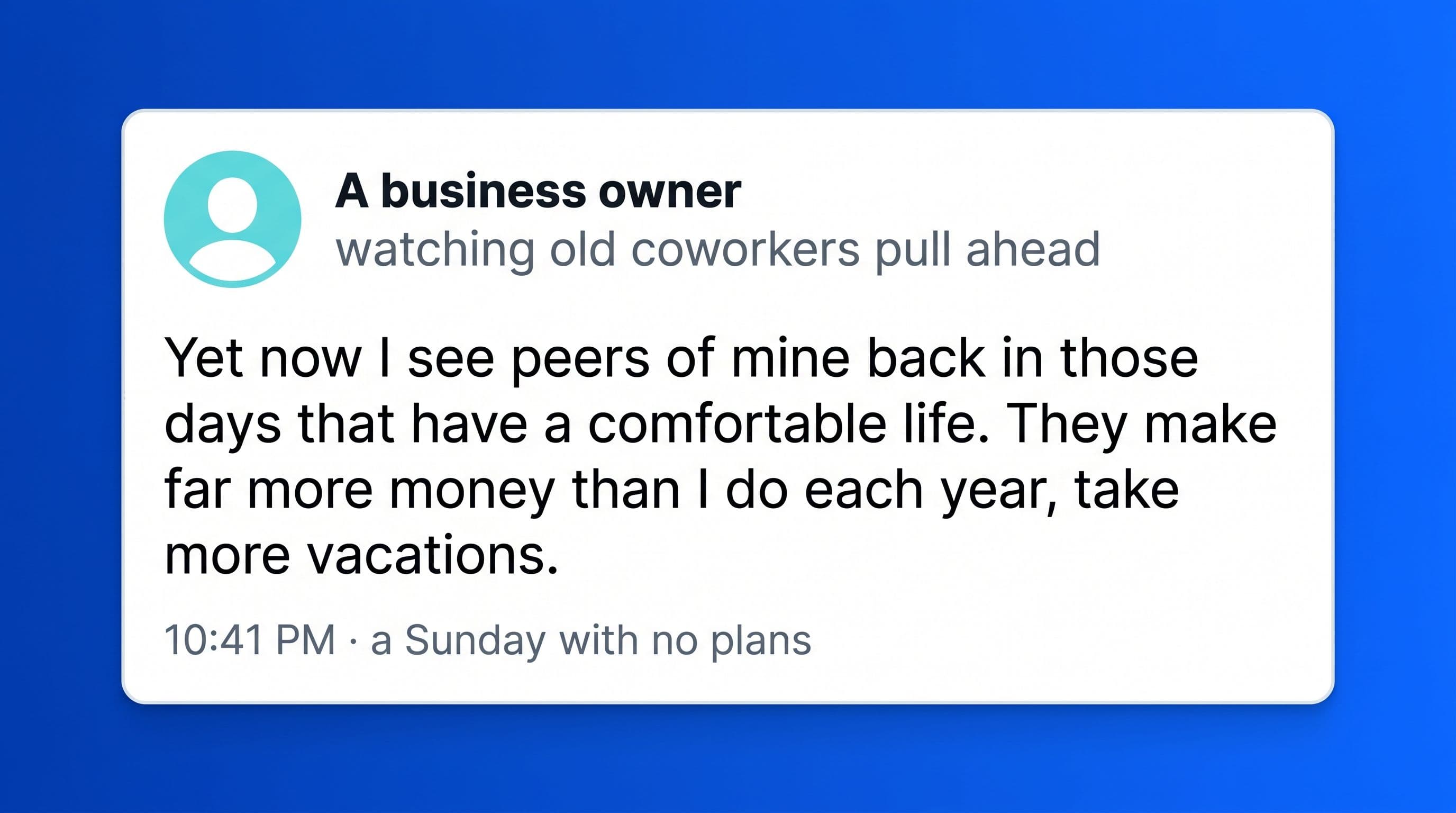
"Yet now I see peers of mine back in those days that have a comfortable life. They make far more money than I do each year, take more vacations." (D.J. Eshelman)
Her PTO post, and the math you do in your head
If you run a 2-10 person B2B service business, IT or software services, consulting, an agency, a coaching practice, this gap probably feels familiar. The photo is the trigger, but the math underneath it is the real problem. Her time off came bundled with the job: a set number of days, approved in advance, with nobody else's workload riding on whether she takes them. Yours doesn't work that way. A day away from your business means the calls you'd have made don't get made and the inbox you'd have cleared keeps piling up. The client who was ready to sign might not still be ready by the time you're back.
You close the app. The feeling doesn't go away; it just waits for the next photo. It's easy to read that as pettiness, resentment toward a friend who didn't do anything wrong. It's a reaction to a measurable gap between what's backing her time off and what's backing yours.
The gap is a missing backstop.
Her employer's continuity plan pays for that vacation: someone else covers her desk, and her clients wait a week without her paycheck ever pausing. Your business has no equivalent standing behind you, because you're the one who built it, alone, deal by deal. That difference, a missing system behind you, is what the envy is actually tracking.
Even rank-and-file employees have more of a guaranteed backstop than most owners do. The U.S. Bureau of Labor Statistics found that 71% of workers at the smallest private-sector employers (1 to 49 employees) have access to employer-paid vacation leave at all, compared with 91% at companies with 500 or more workers. Smaller employers still promise something to their people. Most solo and small-business owners never had anything to promise themselves in the first place.
This particular ache, the gap between what a friend's time off costs them and what yours costs you, is one thread in a wider pattern we've mapped in our guide to business owner burnout.
Is it normal to envy my friends' salaries and vacation time?
Yes. Envy here is a rational reaction to a real asymmetry: most employed friends have a formal, guaranteed vacation backstop behind them, and most business owners don't. Gallup's Microbusiness Tracker found that 1 in 5 U.S. microbusiness owners take zero vacation days in a given year, with a 12-day median, far short of what a salaried peer can usually count on by policy alone. That missing backstop is the actual target.
Why does everyone else seem to have more free time than me?
Because many of them genuinely do, and it's paid for by their employer's continuity planning, something you don't have standing behind you. Tide's 2026 Business Benchmark Index found UK small-business owners take about 15 days off a year on average, against a 28-day statutory minimum for employees, with sole traders faring worse still. Gallup's data adds an odd wrinkle on top of that: owners with more revenue or more employees take fewer vacation days than smaller or solo owners, because more of the business still runs through them personally as it grows.
The numbers behind the envy
- 1 in 5 U.S. microbusiness owners take zero vacation days a year, and the median is just 12 days, according to Gallup's Microbusiness Tracker.
- 62% of small business owners have skipped or reduced their own pay at least once in the past year to keep the business running, and 21% have done it four or more times, per a Bluevine survey.
- 17% of UK small-business owners take zero full days off a year, and the average owner takes about 15 days against a 28-day statutory minimum for employees, per Tide's 2026 Business Benchmark Index.
- 70% of small and midsize business leaders report at least occasional burnout, and 28% report it frequently or daily, according to Vistage's Q2 2026 CEO Confidence Index.
| Group | Annual vacation days |
|---|---|
| UK employee (statutory minimum) | 28 |
| UK small-business owner (average) | ~15 |
| US microbusiness owner (median) | 12 |
Sources: Tide's 2026 Business Benchmark Index; Gallup's Microbusiness Tracker.
If skipping your own pay to keep things running sounds familiar, the anxiety that comes with it has its own pattern worth reading about: why you can't stop checking your bank balance obsessively.
What other owners actually do about it
The same trade-off shows up just as clearly in a two-person consulting shop or an IT services firm as it does in a packaged-food business.
"I have to personally weigh how long I just rely on myself to carry out my business versus pulling dollars from marketing to hire someone." (Julie Busha, via NFIB)
Busha, who owns Nicole Foods, hasn't taken a vacation since 2006. That trade-off, her own time against money she'd rather put into marketing, hasn't resolved itself. She's simply still making it, year after year.
"A vacation you check on every day isn't rest." (The Lonely Entrepreneur)
Their practitioner framework pairs that line with a concrete process: write down the handful of tasks only you can do, and then line up coverage for everything else. Find a peer who can sanity-check the plan, since no manager is going to grant you permission to log off the way one would for an employee.
eChai Ventures describes a related pattern: founders who pair every critical function into a two-person team and deliberately run each one at roughly 50% capacity, so one person's absence doesn't stall the work. They build that coverage in advance instead of improvising it during the trip.
Even owners who do plan ahead rarely get a clean break. Clover's survey, citing OnDeck data, found that 61% of owners who plan a vacation take only about 5 business days off, versus roughly 10 for a typical corporate employee. Among those owners, 67% check in with work at least once a day while away, and just 15% fully disconnect.
Did I make a mistake starting my own business?
No. What you're feeling traces to one missing system, coverage for when you're away, and it says nothing about whether starting the business was the right call. Even owners' plans for their business years down the road tend to lag: U.S. Bank found that 85% of small business owners started their company to build something they could pass on, yet only 54% have a formal succession plan in place. If big-picture planning lags this widely across owners, a plan for next week's vacation is no bigger a personal failing than that gap already is.
Build the coverage your business doesn't have yet
The fix is structural: build the backstop your business doesn't have, piece by piece, the way an employer does.
- Document a "while I'm away" handoff that covers only the handful of tasks you alone can do.
- Arrange even light part-time or contractor coverage for the recurring, client-facing work that doesn't need you specifically.
- Pair up with a peer or a second person on your most critical function and run it at roughly half capacity on purpose, so one absence doesn't stall it. It's the two-person team pattern eChai Ventures describes.
- Book the break like a client deliverable: pick dates months out and tell customers before you go. Set the auto-responder in advance too.
One piece of this you can hand off
Klipy is the AI CRO: the AI agent that runs your entire sales operation. Klipy drafts the follow-up from your call notes the same day, tracks the next step on an open deal, and queues it for your approval. That covers the part of a handoff plan most likely to slip while you're gone: replying to a warm lead, nudging a deal that's gone quiet. It's already drafted and waiting when you're not reachable.
The human backstop from the section above still matters most: the peer or part-time coverage you lined up, the plan you documented. Klipy just takes one more task off that plan, the warm lead or quiet deal that's easy to miss while you're away, so that backstop doesn't have to be perfect before you leave.
What this envy is actually costing you
What we call the Solo Sales Tax, the cost of running sales alone, puts a figure on the gap between what a day off costs a business with real coverage and what it costs yours today.
The report runs the same kind of math as this article: time lost to follow-up and deals that go quiet, plus the pay you've skipped to keep the business running. Read it, and you'll have a number to work from instead of just the feeling that started this.