
 Ask ChatGPT
 Ask Perplexity
 Ask Claude
 Prefer us on Google
Introduction
The deal is the biggest one your agency has closed all year, and the security questionnaire that came before it was longer than anything you've filled out. The client who finally signed isn't the one paying you on time.
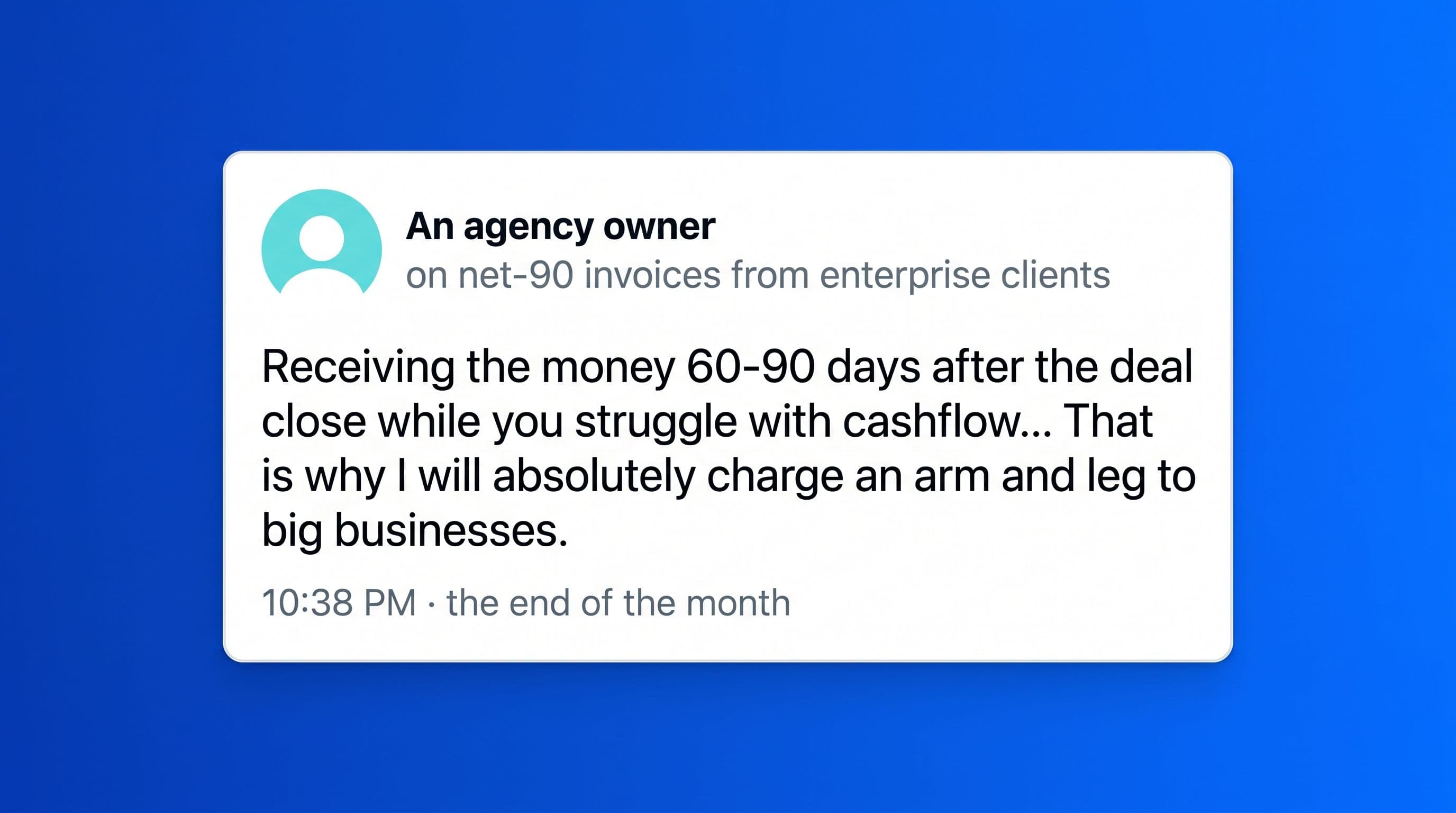
"Having to fill endless security questionnaire without being sure you can even sell to them (what you dont love filling 100+ questions at 11PM on a Friday???)... Receiving the money 60-90 days after the deal close while you struggle with cashflow... That is why I will absolutely charge an arm and leg to big businesses." (Sytten)
Question 87 of the security questionnaire, 11 PM, Friday
Your version of that Friday night probably didn't stop at question 87. Maybe you got through all 140-something items on the vendor security review, including SOC 2 questions most small agencies have never had to formalize before. Three rounds of legal redlines later, the client finally signed.
Our guide to dealing with a difficult client covers a lot of what happens in that process. What it doesn't cover is what comes after the signature: somewhere in the fine print sits a payment-terms clause that enterprise procurement sets as its default, long before your agency gets a seat at the table to negotiate it. Net 90. The ninety-day clock starts at the invoice date, not at delivery, and the invoice itself usually waits for the client's accounts-payable department to run its next monthly batch. You did the work in week one. You might see the money in month four.
For a firm with real payroll due on the 1st and the 15th, that gap isn't a rounding error. The median small business in the US holds enough cash to cover just 27 days of normal expenses, according to the JPMorgan Chase Institute's analysis of nearly 600,000 small-business bank accounts (JPMorgan Chase Institute). A single invoice sitting on net 90 terms can outlast that entire buffer more than three times over, and that's before a second or third client lands on the same terms.
Why do big clients make me wait 90 days to get paid?
Enterprise accounts-payable departments are built to treat every vendor this way: batch cycles run on the buyer's schedule, and stretching payment terms works as a way to borrow working capital from suppliers who can least afford to lend it.
Research from Yale School of Management looked at large retailers like Walmart, Target, and Costco. It found that when a big buyer pays one month more slowly, cash-constrained suppliers cut capital spending equal to 1.2% of their assets. They compensate by raising the prices they charge (Yale School of Management Insights). The same mechanic plays out in services. An agency without a cash cushion either absorbs the gap or prices it into the next contract.
The line keeps moving in one direction, too. The Association of National Advertisers has tracked agency-fee payment terms since 2013, when the average sat at 45.7 days. By 2019 it had stretched to 58.1 days, and about 1 in 10 marketer contracts now run 90 days or longer before any prompt-pay discount applies (ANA, 2020 Payment Terms Study).
What net 90 costs in hours and cash
Between the paperwork to win a net-90 deal and the wait to get paid for it, a small agency burns both of its scarcest resources: time and cash.
- 9.5 hours a week per professional spent on compliance work, equal to about 11 full working weeks a year, per Vanta's 2024 State of Trust report.
- $17.7K in average outstanding invoices for US small businesses, with 59% carrying invoices overdue 30 or more days, up from 47% the year before, per Intuit QuickBooks' 2026 Small Business Late Payments Report (QuickBooks).
- A capital-spending cut equal to 1.2% of assets per month of stretched payment terms, per Yale School of Management's research (see above).
- 58% of agency invoices are now paid late, and the delay lands on the freelancers and subcontractors an agency relies on, per The Kaplan Group (Kaplan Group).
These costs apply broadly to agencies selling into enterprise procurement, yours included: the paperwork cost before the deal closes (the Vanta hours, running from question 1 through question 87 and beyond), and the cash cost after it does (the QuickBooks gap, once the signed invoice sits in someone else's queue).
Stack a few net-90 clients on top of each other, and the hours and the cash gap compound. One enterprise contract is manageable. Three at once, each on a different 60-to-90-day clock, can drain the cash of an agency that looks profitable on paper.
How do I survive net 90 payment terms?
Net-90 clients leave an agency four levers to manage cash flow: charging an enterprise premium, requiring money upfront, factoring invoices, or walking away.
The premium works best when you price in the enterprise tax deliberately: the compliance hours and the 60-to-90-day wait. A client who pays in two weeks doesn't carry that cost, so don't quote them the same number. Requiring money upfront protects the start of the relationship even when the back half still waits on net 90. Agency consultant Gini Dietrich recommends roughly half the fee or a paid discovery phase due at signature. Factoring converts the wait into a fixed, plannable cost. And walking away, covered in how to fire a client without torching the invoice or the reference, is the last lever to pull, once the other three no longer cover the gap.
What these tactics look like once you actually use them
Gini Dietrich, who runs the PR and marketing agency behind Spin Sucks, collects roughly half the project fee before work starts, or bills a paid discovery phase due the moment the contract is signed:
"Be sure you are getting 50% of the project fee up front... The moment the client signs the contract, and before you book the session, you send an invoice for $10,000 to be paid immediately... Ours is 90 days." (Gini Dietrich)
Ramp's Ken Boyd explains why buyers push for net 90 in the first place: it frees up their own working capital. He argues vendors should treat that as a bargaining chip and negotiate something back in return.
"Net 90 terms gives you more time to hold onto cash. You free up working capital by delaying payment for 90 days... If you ask for more time, be prepared to give something back. That could be a larger order, a longer contract, or agreeing to electronic payments to speed up processing." (Ken Boyd)
Invoice factoring works differently. You sell the receivable itself, and the client's terms never change. A factoring company pays out most of the invoice's value right away for a fee that typically runs 1-5%, according to Resolve Pay, turning an unpredictable 60-to-90-day wait into a small, known cost (Resolve Pay). It works best as a short-term bridge for payroll or operating costs while you fix the underlying pricing or terms.
Walking away rarely happens on the first net-90 deal. It happens on the third one, once the pattern is obvious. If you'd rather catch that pattern before you sign than after, client red flags you're missing before you ever sign covers the warning signs worth watching for, so you can price around them or walk away sooner.
Keeping the paper trail so disputes have a timestamp
Whatever combination of tactics you choose (a deposit, factoring, a higher rate, or none of the above), one habit protects you regardless of budget. Confirm the scope and the price before the first deliverable goes out, and get the payment date in writing too. (How to handle scope creep without losing the client covers what to do when that scope shifts mid-project.) Follow up every verbal change with a one-line email the same day it's agreed. When a client's AP department can't find an invoice, or someone on their side insists the deal was different, a dated written record turns that dispute into a quick correction, rather than a drawn-out argument you'd be negotiating from the weaker position.
That discipline is also where Klipy helps once the terms are already agreed. Klipy drafts the recap from your call the same day and attaches it to the deal, so it's still on the deal if a client's procurement team disputes the details. Klipy is the AI CRO: the AI agent that runs your entire sales operation. You do the negotiating. It keeps the receipts.
If you want the fuller math on what carrying every part of a deal yourself actually costs, the Solo Sales Tax report, our breakdown of what founder-led sales costs an agency in hours and margin, covers it in more detail.
Questions owners ask about net 90 and cash flow
How do I negotiate payment terms with a big client before I sign?
Ask before you sign. Ramp's Ken Boyd frames it as a trade: offer something in exchange for shorter terms, such as a bigger order or a longer contract. Reserve your most generous terms for clients with a proven payment history, and get the deposit or milestone schedule written into the contract itself. If a client's AP process genuinely can't move off 90 days, that tells you what premium to charge, or whether to pass.
Should I ask for a deposit before I start work for an enterprise client?
For a client on long payment terms, yes, it's one of the few cash-flow protections you control. Agency consultant Gini Dietrich recommends asking for roughly 50% upfront, or billing a paid strategy or discovery phase due on signature, specifically to protect against clients on long procurement-driven payment cycles, often paired with a clear termination clause. The remaining balance still waits 60 to 90 days, but the deposit keeps that wait from draining your entire cash buffer.
Is invoice factoring worth it if one client is paying me net 90?
It can be, if the factoring fee costs less than the cash-flow gap itself. A factoring company buys your receivable and pays most of its value immediately for a typical 1-5% fee. That works best as a short-term bridge while you fix the pricing or terms that created the gap.
What do I do if my biggest client is already 60-90 days late paying me?
Start by separating "this is within their normal net-90 cycle" from "this is actually late even by their own terms," since the two call for different responses. If you're still inside their terms, line up a short-term bridge, such as factoring or a credit line, before you escalate. If they've blown past their terms, go back to whatever was actually agreed and put the gap in writing. A documented record of what was promised is what turns a vague dispute into a simple follow-up.