
 Ask ChatGPT
 Ask Perplexity
 Ask Claude
 Prefer us on Google
Introduction
It's 4:52 on a Friday and the client's message reads: "Quick one, could you also add a comparison table to the report? Shouldn't take long." You know it will take long. You also know you're going to say yes anyway, because saying no over something this small feels worse than just doing it.
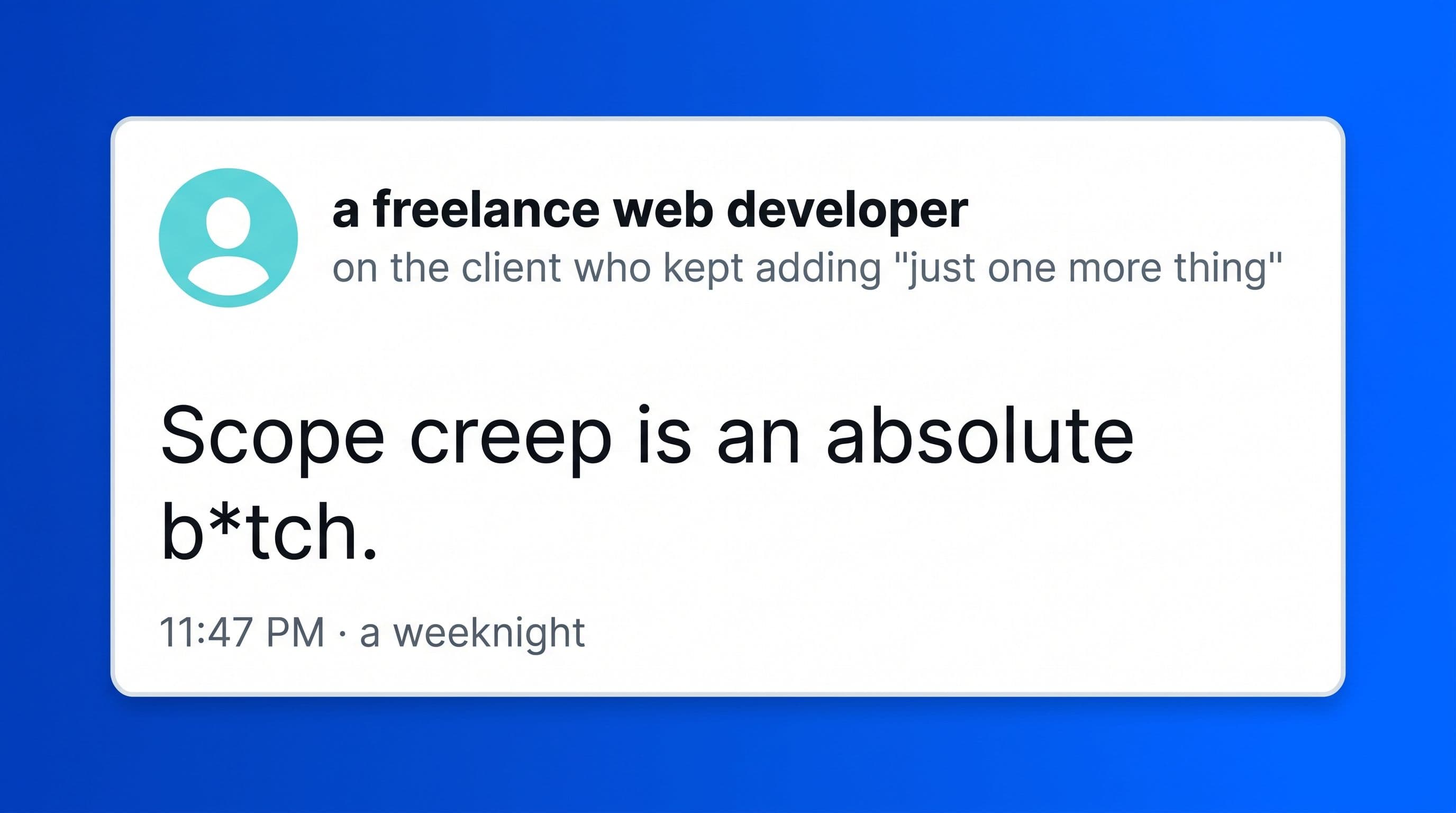
"Scope creep is an absolute b*tch." (Sydney Joseph)
"It's just one small tweak" (the message that never stays small)
This is the third "quick one" this month, and you haven't said anything about the first two. Each one lands small on its own: a comparison table, an extra revision round, a call that was supposed to run 20 minutes and ran to 50. None of them, alone, feels worth an awkward conversation. Added up, they're the reason you're still working at 11pm on a Friday, reformatting a client's questionnaire that was never on the deliverable list.
There's a specific feeling to that hour, somewhere between anger and resignation: the slow recognition that you agreed to something you never actually agreed to. You close the laptop and tell yourself you'll say something next time. You know, even as you think it, that you probably won't. The work is already done. Bringing it up now would just make it weird.
You're not the only one this happens to
This isn't a personal failure to set boundaries. It's the predictable result of a gap between what gets written down at the start of an engagement and what happens live, in the moment, when a client asks for something small and saying yes feels easier than negotiating. The client usually isn't being unreasonable either; they genuinely don't know where the line sits, because nobody said it out loud. This is part of the broader pattern our guide to handling a difficult client covers: the friction rarely comes from a bad client but from an unclear agreement.
The trend backs this up. According to the Project Management Institute's Pulse of the Profession 2018 survey of more than 5,400 practitioners and executives, 52% of projects completed in the past 12 months experienced scope creep, up from 43% five years earlier (PMI, Pulse of the Profession 2018). PMI also links this to rising project complexity: the share of high-complexity projects grew from 35% in 2013 to 41% in 2018. Client work is measurably harder to scope precisely now, on top of the ordinary pressure to just say yes.
The stat block: how big this actually is
Across agency and consulting data collected independently of each other, the numbers point the same direction: most owner-led firms absorb thousands of dollars a month in unbilled scope, and almost none of them recover it through billing.
- Ignition, 2025 Agency Pricing & Cash Flow Report: 57% of agencies lose $1,000 to $5,000 every month to unbilled scope creep; 30% lose more than $5,000 a month (Ignition).
- The Drum, reporting on the same Ignition survey of 273 agency managers and executives: only 1% of agencies say they successfully bill for all of their out-of-scope work, and 78% say they rarely or only sometimes charge for it at all (The Drum).
- PMI, Pulse of the Profession 2018: 52% of projects had scope creep in the past year, up from 43% five years earlier (PMI).
- PMI, same report: the share of high-complexity projects rose from 35% to 41% over five years, one likely reason scope is harder to hold in place (PMI).
| Monthly unbilled scope creep | Share of agencies |
|---|---|
| $1,000–$5,000 | 57% |
| More than $5,000 | 30% |
Source: Ignition, 2025 Agency Pricing & Cash Flow Report
How do I push back on scope creep without losing the client?
You rarely have to choose between doing the extra work and protecting the relationship. The move that works is naming the ask as out-of-scope in writing the moment it lands, even while you keep doing it as a goodwill gesture. Something like: "Happy to take a look, want to flag this is outside what we scoped for the retainer, so we don't lose track of it."
That single sentence does two things. It protects the relationship, since you never said no. And it creates a record you can point back to later, whether you end up billing for the time or simply keeping track of how often it happens. Compare that to the two moves that damage client relationships: silently absorbing the work, which teaches the client your time is free, and refusing outright with no alternative, which reads as difficult over something that felt small to them. Naming the ask, without necessarily fighting about it in the moment, sidesteps both.
How others cope with it (and what only half-works)
Practitioners cope with scope creep in a few recognizable ways, and it's worth looking at them honestly, because some of the most common ones only partly work.
Some people cope by naming it flatly, mostly to themselves or their peers, as a way of processing the frustration before deciding what to do about it:
"you're stuck feeling frustrated at the audacity... also feeling anxious about how to not get caught up in the extra work while also giving your best." (Sydney Joseph)
Others cope by absorbing it inside a flat rate, treating unlimited requests as the cost of a predictable retainer. This protects the relationship in the short term, but it quietly erodes margin and burns the owner out, which is the real cost hiding underneath it. One freelance copywriter took on what was scoped as a 10-hour brochure job; because page count and revision limits were never pinned down upfront, it grew to 20 hours before the project wrapped (Kim Hobson).
"I've got a flat rate no matter what they send my way. And lately, it's gotten out of control. The requests that are like, 'Oh this is quick and easy,' are super condescending." (Digiday)
Underneath a lot of this sits a mismatch practitioners rarely name directly: the client hired for one outcome but actually needed a different one, and the work keeps drifting toward the real problem without ever getting billed for it:
"clients hire you for one thing (X) but really need something else (Y)... you end up taking pay for X which never really solves Y." (Why Design Is Hard)
None of these coping strategies are wrong exactly. They manage the symptom rather than close the underlying gap, until it gets loud enough to force a real conversation.
Set the line before the fight, not during it
The single most effective habit is deciding, in advance, what counts as in-scope versus new work, ideally spelled out in the written agreement before the engagement starts. When a request lands, you're checking it against a rule you already made, instead of negotiating from scratch while the client waits on a reply.
That starts with writing scope specifically enough that both sides can point back to it later: what's included, and where a request stops being a small adjustment and starts being new work. Freelancers Union puts it plainly:
"Before you start a project, make sure you outline specific expectations, deadlines, compensation, and estimated time... IN WRITING. It will be your 'bad cop' when you need to push against scope-creep." (Kate Hamill)
Once that agreement exists, use it as the reference point in the moment, the way the flag-it script above does. That written agreement becomes something concrete to point to, instead of memory or how annoyed you feel that week.
Tools people reach for (and where they fall short)
Most people don't rely on memory alone. A written scope-of-work template with a change-order clause is the baseline: it turns a verbal "we should talk about this" into a line item both sides already agreed to add. Some people track drift in a shared doc or a project tracker, logging any request that lands outside the original brief as it comes in. Others set a calendar reminder to review call notes afterward, specifically checking for anything that sounded like new work.
None of these approaches solves the real problem on its own. Each one still depends on someone remembering, in the moment a request lands, to write it down instead of just agreeing to it. That's the gap that decides whether a written agreement actually protects you or just sits in a folder.
How do I handle scope creep when I can't track every conversation?
When you can't track every conversation, the written agreement isn't enough by itself. Most scope creep doesn't happen in writing; it happens mid-call, in a tone that sounds casual, and by the time you sit down to write the follow-up email, the exact moment and wording are already fuzzy. The fix is flagging it the instant it's raised, not reconstructing it from memory afterward.
Klipy is the AI CRO: the AI agent that runs your entire sales operation. Its meeting intelligence listens to the call and timestamps the moment a client raises something outside the agreed scope. That flag then surfaces in the notes it drafts afterward, so it doesn't depend on you remembering to write it down at 9pm. You still decide whether to bill it or let it go. The AI CRO's job is just making sure the moment doesn't disappear before you get the chance to decide.
Common questions about handling scope creep
What do I say when a client keeps adding work without paying for it? Name the ask in writing the moment it lands, even if you're still doing it as goodwill: "Happy to take a look, want to flag this is outside what we scoped for the retainer, so we don't lose track of it." That sentence does two things: it protects the relationship, since you never said no, and it creates a record you can point to later when you decide whether to bill for the time or absorb it as goodwill. Waiting until you're resentful to say something is what turns a scope conversation into a confrontation.
How do I push back on scope creep without losing the client? Decide your in-scope-versus-new-work line before you're mid-conversation about a specific ask, not during it. When something falls outside that line, name the tradeoff it creates: more time or a new invoice line. Clients rarely push back on a clearly named tradeoff. What damages the relationship is silently absorbing the work, which teaches the client your time is free, or refusing outright with no alternative on the table.
How do I say no to extra work without damaging the relationship? You usually don't have to say no outright. Reframe the ask as a scope decision rather than a favor decision: "I can do this, but it doesn't fit inside what we agreed, so it becomes a change order or an extra invoice line." That keeps you the helpful partner while making the cost visible. Save an outright no for asks that would blow your timeline or margin regardless of payment, and pair it with an alternative, a phased add-on or a referral, so the client isn't left stuck.
How do I handle scope creep? Scope creep is what happens in the gap between what got agreed at the start and what a client actually asks for once the work is underway. Close that gap two ways: agree on where new work starts before the engagement begins, and flag anything that crosses that line in writing as soon as it comes up. That combination protects the relationship, since you're never refusing outright, and stops you from quietly absorbing hours you never billed for.
Why do I keep saying yes to work that isn't in the contract? Every silent yes is a rational short-term choice: it's usually faster to just do the small thing than to stop and have the scope conversation, and nobody wants to seem difficult over what looks like a five-minute favor. The trouble is that pattern compounds. Once a client learns that flagging extra work never changes the invoice, nothing signals to them that they should stop asking. Making the cost visible early, even while still saying yes, is what breaks the pattern, more than any amount of willpower.
Is it normal for freelance or agency scope to keep creeping, or am I doing something wrong? It's normal, and it's become more common, not less. Independent survey data puts scope creep at 52% of projects in the past year, up from 43% five years earlier, and separately finds that most agencies never successfully bill for the out-of-scope work they absorb. The incentive structure, where silence is easy and pushback feels risky, is close to universal for anyone doing owner-led client work. People who avoid the worst of it have simply made the scope conversation routine, something to expect rather than dread.
Where unbilled scope creep leads if it stays invisible
Unbilled scope creep adds up. Month over month, it becomes a recurring cost for anyone selling and delivering the work themselves, which is exactly what the Solo Sales Tax report set out to measure: the real cost, in hours and lost pipeline, of running sales as a department of one.
If you want the exact wording for the next time a client adds work without paying for it, the scope creep pushback generator writes the flag-it email for you in under a minute.