
 Ask ChatGPT
 Ask Perplexity
 Ask Claude
 Prefer us on Google
Introduction
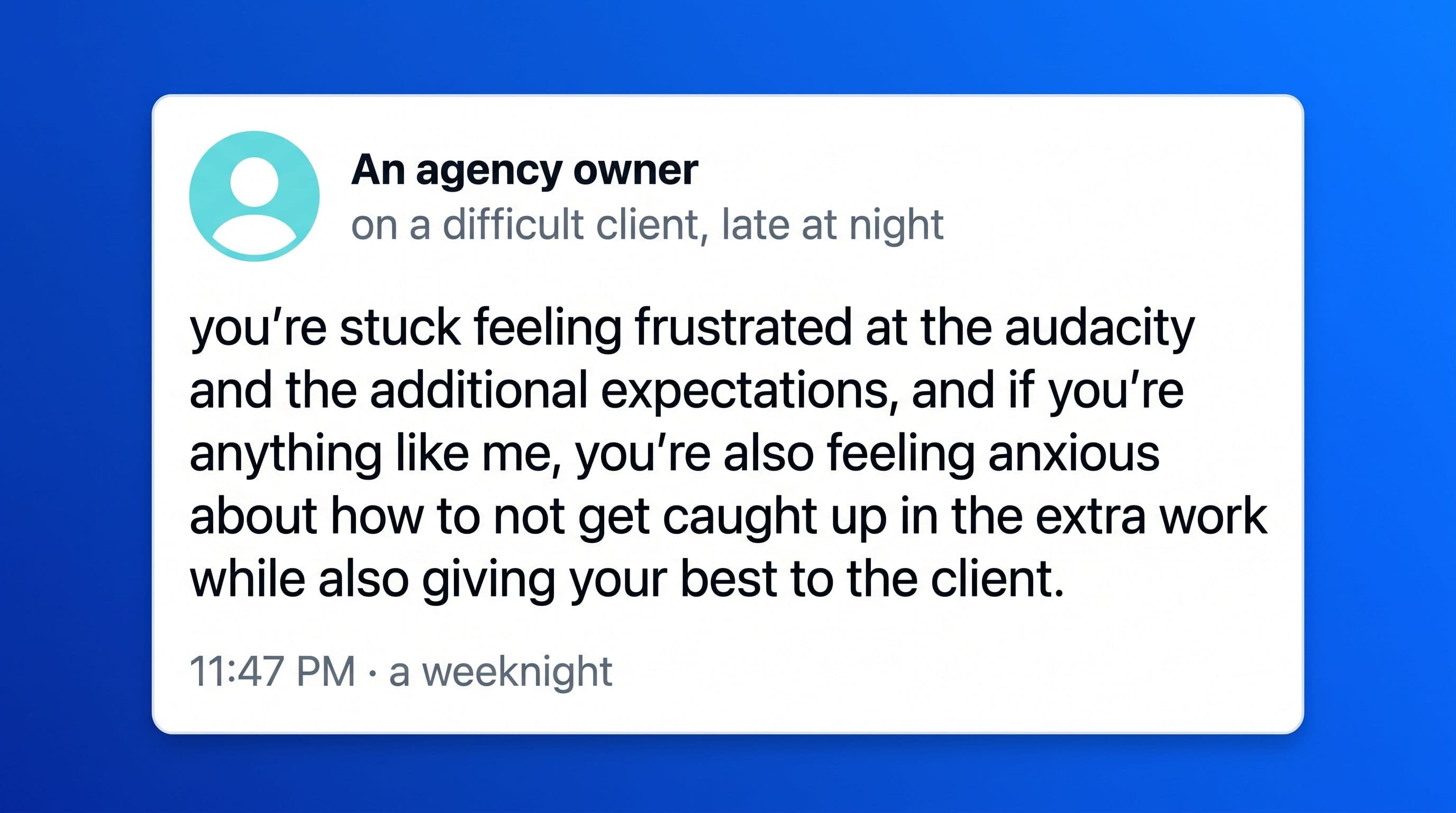
"you're stuck feeling frustrated at the audacity and the additional expectations, and if you're anything like me, you're also feeling anxious about how to not get caught up in the extra work while also giving your best to the client."
Sydney Joseph, Scope creep is a b*tch
That's the feeling this guide is for: the moment a client's ask stops matching what you agreed to, and you have to decide whether to push back or absorb it. A difficult client, in agency and consulting terms, is defined by a pattern of behavior, not a personality type: it consistently costs you unpaid time, unpaid risk, or unpaid stress relative to what the contract and the price cover, through scope creep, disrespect of the working relationship, non-payment, or process demands the fee never accounted for.
"I felt like I was being taken advantage of, not like being an equal partner, but someone to 'just do the work.'" (Keid.io)
Opening scene: the "just one small tweak" problem
Somewhere between a client's first "just one small thing" and the fifth one that month, work stops feeling like a working relationship and starts feeling like something you're bracing for. For enterprise clients, the same dread often shows up earlier, buried in a security questionnaire due at midnight before the contract is even signed.
One founder captured the version that hits bigger accounts:
Having to fill endless security questionnaire without being sure you can even sell to them (what you dont love filling 100+ questions at 11PM on a Friday???)... Receiving the money 60-90 days after the deal close while you struggle with cashflow... That is why I will absolutely charge an arm and leg to big businesses.
(Sytten, Hacker News comment thread)
Both scenes, the small client who nibbles and the big one who buries you in process, point to the same underlying problem:
A difficult client, in agency and consulting terms, is one whose behavior consistently costs you unpaid time and effort relative to what the contract and price cover, through scope creep, disrespect of the working relationship, non-payment, or disproportionate process demands.
The numbers behind why this feels universal
Scope creep is common enough to function as an occupational hazard: the numbers below show it hitting agencies across the board. 57% of agency managers and executives lose $1,000 to $5,000 every month to unbilled scope-creep work, and 30% lose more than that; only 1% say they successfully bill for all of the out-of-scope work they do, according to Ignition's 2025 agency pricing and cashflow report. The same report finds 97% of agencies are chasing late payments and 63% describe their cash flow as unpredictable, which forces 82% to delay or cancel hiring and investment. The Project Management Institute's Pulse of the Profession tracked this rising over time: 52% of projects hit scope creep in the prior 12 months, up from 43% five years earlier.
Client behavior is shifting in the same direction. 66% of service providers say clients are more demanding while less willing to pay, according to Teamwork.com's research, reported by ITBrief. 23% report "clientfishing," where a prospect uses a fake project brief to extract free expertise, and a third believe clients now think AI lets them skip hiring a specialist altogether.
Cash flow absorbs the rest of the hit. US small businesses carry more than $17,000 in overdue invoices on average, per Intuit QuickBooks' 2025 Small Business Late Payments Report. Agencies under $1 million in revenue with 10 or fewer employees carry the highest client churn of any size band, at 32%, according to Focus Digital. The smallest firms have the least cushion to absorb a bad account.
Two more costs rarely show up in the pricing conversation. 52% of small business owners handle legal disputes themselves instead of hiring a lawyer, and roughly three in four of those owners lose money doing it, a quarter of them $25,000 to $100,000, according to LegalShield's survey, reported by Yahoo Finance. The compliance tax keeps climbing too: average time spent on security-compliance tasks rose to 11 working weeks a year, up from 10 the year before, with 9% of respondents spending 25 or more weeks a year on it, per Vanta's State of Trust report.
| Metric | Value | Source |
|---|---|---|
| Agency managers/execs losing $1,000-$5,000/month to unbilled scope creep | 57% | Ignition, 2025 Agency Pricing & Cashflow Report |
| Agencies chasing late payments | 97% | Ignition, 2025 Agency Pricing & Cashflow Report |
| Churn rate for agencies under $1M revenue, 10 or fewer employees | 32% | Focus Digital |
How do I deal with a difficult client without losing the account?
Managing a difficult client means putting the original agreement back on the table: what was scoped and priced, and what changes now that the ask has grown past it.
David Hart, who ran a small agency for years, remembers the pattern from the inside:
clients didn't have a clue what they wanted, ignored advice, quibbled over bills
(David Hart, What I miss about running an agency)
The fix starts with re-anchoring every escalation to the written scope or contract instead of the relationship. Document changes the moment they happen. Waiting until later means relying on memory and goodwill as the only evidence you have. Treat losing the account as a possible, acceptable outcome of holding the line. A client who leaves because you enforced the agreement you both signed was rarely a stable account to begin with.
Why do clients treat me like an employee instead of a partner?
It usually starts the moment you say yes to a request outside the agreed scope without naming it as outside the scope. Every silent yes teaches a client that your time is free for the taking, even though everything else in the engagement is priced and scheduled.
One founder described exactly where that leads:
I felt like I was being taken advantage of, not like being an equal partner, but someone to 'just do the work.'
(Keid.io, on scope creep as a system problem)
Partnership status gets set early, by how boundaries are enforced. The contract's terms and the title the client gives you matter less. The correction is simple in theory: name out-of-scope asks in writing the moment they arrive, even when you plan to do the work anyway as a goodwill gesture. Silence is what gets read as agreement.
Is it worth keeping a client who makes my team miserable?
Rarely, once you price in the real cost. One agency owner described a client relationship that never showed up as a line item on an invoice but drained the team anyway:
Every month was a battle. Endless 'urgent' requests. Weekend emails. Random phone calls in the middle of family dinners.
(Very Good Productized Guides, on when to raise your rates and when to fire the client)
That kind of account costs you in attrition. Team turnover is more expensive than most owners assume, and an account that burns out a good employee can cost more over a year than it ever brought in. A useful test: would you take this client again today, at this price, knowing what you now know? If the honest answer is no, that's information worth acting on even when the revenue is hard to replace.
How do I stop feeling anxious every time a client asks for "just one small tweak"?
The anxiety tracks a real pattern instead of an overreaction. Deciding the rule in advance, before the next small ask arrives, works better than managing the feeling in the moment it lands.
Sydney Joseph named the loop directly: the audacity of an out-of-scope ask and the pressure to still deliver your best work land in the same moment, and that combination is what produces the anxiety (Sydney Joseph, Scope creep is a b*tch).
The cost of not having that rule shows up fast. One freelancer described it this way:
I offered a retainer thinking 10 hours per week. By month three, I logged 25+ hours for the same payment.
(Waco3.io, on the freelance retainer trap, as told on Reddit)
The practical fix: decide in advance what counts as an in-scope revision versus new work, and write that threshold into the SOW or retainer terms before the engagement starts. Every "small tweak" then becomes a two-second scope check against a written line.
What are the signs a client relationship has turned toxic?
The clearest signal shows up when a client treats the normal texture of real work, the bumps that come with building something from scratch, as a personal failure on your part.
David Hart put it plainly:
refused to accept that building something from scratch may result in unforeseen bumps
(David Hart, What I miss about running an agency)
The pattern behind that one line repeats across toxic accounts: zero tolerance for normal friction, blame reflexively assigned to the vendor, documentation treated as adversarial, and every ordinary setback treated as a broken promise. This applies once the relationship is already underway, past the point of vetting a prospect before signing.
Why does one bad client project threaten my whole business?
At small scale, there is no diversification cushion. A single account can be the difference between a normal month and a cash-flow crisis, and the smallest agencies carry the highest churn risk of any size band in the industry.
David Hart described the daily grind that makes this so exposed:
a constant treadmill of 'win the work', 'do the work', 'get paid for the work'
(David Hart, What I miss about running an agency)
Agencies under $1 million in revenue with 10 or fewer employees churn clients at 32%, the highest rate of any size band, according to Focus Digital. The math is unforgiving at that scale: concentration risk and thin cash reserves, with no legal or procurement team to absorb one client's bad-faith behavior, mean a single account can cascade into a payroll problem. The same concentration risk shows up on the deal side too: see why founder-led teams lose deals they don't see slipping.
Is it worth taking on a client whose real problem isn't what they hired me to fix?
Usually not, without renegotiating scope first. Taking payment for the stated problem while quietly trying to solve the real one guarantees you're underpaid for the work that matters most.
One founder named the trap precisely:
People hire you for X, but really need Y... So you end up taking pay for X, which never really solves Y.
(Why Design Is Hard, on overcoming burnout)
If the real problem surfaces during discovery or early work, treat it as a scope conversation and a re-quote. The trap this avoids: doing the harder, more valuable work for free while the invoice still reads like the easier job you originally scoped.
How much should I charge a big company to make the procurement hell worth it?
Enough to cover the two real taxes enterprise deals carry that small clients don't: the compliance hours spent on security questionnaires and audits, and the cash-flow gap created by 60-90 day payment terms.
One founder on Hacker News laid out the math from experience:
Having to fill endless security questionnaire without being sure you can even sell to them (what you dont love filling 100+ questions at 11PM on a Friday???)... Receiving the money 60-90 days after the deal close while you struggle with cashflow... That is why I will absolutely charge an arm and leg to big businesses.
(Sytten, Hacker News comment thread)
Another commenter's reaction to a compliance audit shows this isn't a one-off complaint:
I went through ISO 27001 in 2019 and thought "never again."
(mlitwiniuk, Hacker News comment thread)
The costs behind both quotes show up in the data too. Average time spent on security-compliance tasks reached 11 working weeks a year, according to Vanta's State of Trust report, and US small businesses carry more than $17,000 in overdue invoices on average, per Intuit QuickBooks. Price the process along with the deliverable, and treat net-90 terms as a financing cost the client pays for through the rate.
The rest of the playbook
Four situations come up often enough to earn their own guide. Full breakdowns are coming; here's the one-line version of each in the meantime.
- Scope creep. The change-order habit that stops it before it costs a full month of unpaid work.
- Firing a client. How to know it's time, and how to do it without burning the invoice or the reference.
- Red flags. The signs worth walking away from before you ever sign the contract.
- Net-90 terms. What big-company payment terms actually mean for a small firm's cash flow.
What holds up
The real fix across every section above is documentation discipline. Scope gets defined in writing before work starts, and every change gets logged the moment it happens. Most owner-sellers already know this. Few do it consistently, because logging everything by hand is its own tax on the same time crunch that caused the problem in the first place.
Klipy enters here plainly. It attaches call notes and scope changes to the account through meeting intelligence that runs in the background, so "that wasn't in scope" has a timestamp behind it instead of relying on memory.
Soft close
If unbilled scope and slow-pay clients are quietly costing you a specific amount every month, the Solo Sales Tax report puts a number on it, hours and dollars both, so you can decide from data instead of a feeling.