
 Ask ChatGPT
 Ask Perplexity
 Ask Claude
 Prefer us on Google
Introduction
Three months into the engagement, the relationship has gone sideways, and you're scrolling back through your own notes from the first call. You're looking for the line you typed without a second thought: "could you just add this one small thing," or that offhand comment about how the last agency "just didn't get it." It reads different now than it did the day you wrote it.
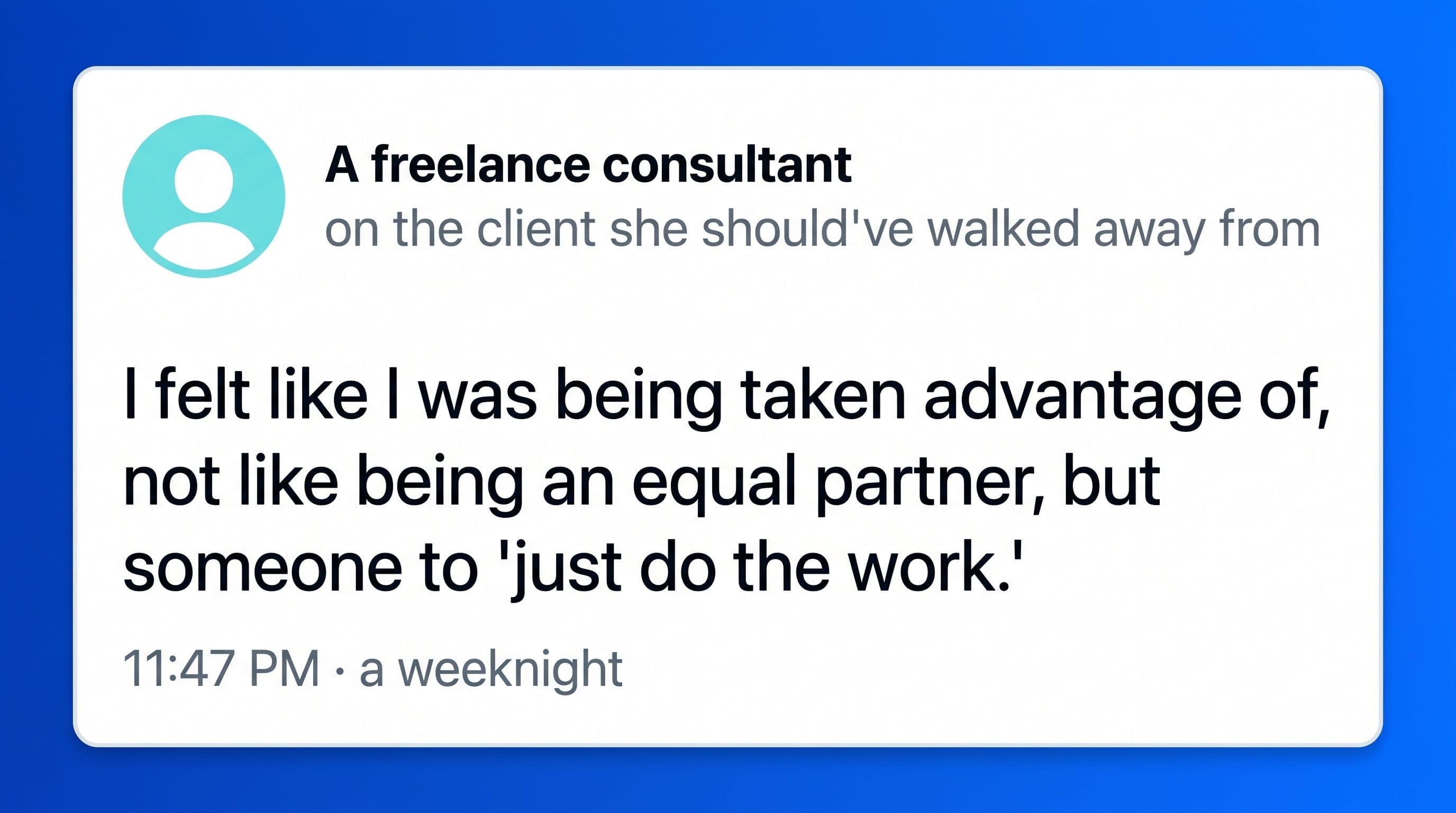
"I felt like I was being taken advantage of, not like being an equal partner, but someone to 'just do the work.'" (Keid)
The discovery call I keep replaying
The tell was there. It just didn't look like a tell yet.
Maybe it was the scope question you answered too fast, the one where the prospect said "we'll figure out the exact deliverables as we go" and you nodded because you needed the deal. Maybe it was the throwaway line about the last freelancer, the one who "just didn't understand the vision," delivered with a laugh that made you feel chosen instead of warned. You wrote "great energy" in your notes. You skipped the detail that mattered: you were apparently the third vendor in a row to hear the same complaint.
None of it looked like a red flag in the room. It looked like a good call. You were paying attention, and it still slipped past you, because nothing about a founder-led sales process is built to catch it.
You didn't miss it because you're bad at this
The same person pitching the deal is the one who delivers it, with no intake team and no account-review committee standing between the excitement of a new lead and the moment you sign. When you're both the closer and the deliverer, the urgency to close and the urgency to start reinforce each other.
This piece is part of our broader guide to how to deal with a difficult client as an agency or consultant; this one covers what to catch before you ever sign.
A sales-ops team would flag this behavior on day one, vague scope, a rushed answer on payment terms. On a call you're trying to win, you read it instead as minor friction. That's a structural problem, common enough to be documented industry-wide. Ignition's 2025 Agency Pricing and Cash Flow Report found that 78% of agencies say they rarely or only sometimes charge for out-of-scope work. Scope vagueness is the industry's default state.
What are the warning signs of a bad client before I sign?
The recurring categories are scope that stays vague on purpose, disrespect for your process or boundaries introduced during the pitch itself, resistance to standard payment terms, "everyone before you was the problem" stories about past vendors, and pressure to start work or skip the contract before it's signed.
Consulting Success names the first four as recurring archetypes: the Scope Creeper, who asks "could you just add this one small thing?" before a contract exists; the Process Disruptor, who questions or overrides your methodology before understanding it; the Payment Delayer, who asks about invoice timing before discussing project value; and the Serial Complainer, who criticizes every past vendor without acknowledging their own role in what went wrong. The fifth pattern, pressure to start before paperwork is signed, shows up well beyond consulting: the Consumer Financial Protection Bureau and the Federal Trade Commission both flag being rushed into agreeing before reviewing details as a classic warning sign in any deal.
How do I spot a difficult client during the sales process?
Watch what happens in the room during discovery and the proposal stage, as much as what gets said about the project. A prospect asking for exceptions to your minimums before a contract exists, or pushing for deliverables to go live before the partnership formally starts, is showing you something in real time, visible well before hindsight would catch it.
Homemade Social's discovery-call guidance names this pattern directly: clients already "begging for exceptions," or insistent that work "needs to go live by EOW" before the relationship has formally started. The Better Business Bureau's client-vetting guidance adds a related tell from the same stage: immediate discount demands paired with unrealistic round-the-clock availability expectations. It's visible in the first thirty minutes, to anyone paying attention, no hindsight required.
The pattern shows up in the numbers too. Ignition's 2025 survey found 71% of agencies report at least one in four invoices paid late, and 56% see delays running two weeks to two months past due. Intuit QuickBooks' 2026 Small Business Late Payments Report puts it at nearly three in five small businesses carrying invoices 30 days or more overdue, owing an average of $17.7K in unpaid work. A survey from The Authors Guild, conducted with Freelancers Union and other groups, found 62% of New York freelance and creative workers had lost wages at least once to a client's refusal to pay, and of those, 51% lost more than $1,000.
| Signal | Share affected | Source |
|---|---|---|
| Rarely or only sometimes bill for out-of-scope work | 78% of agencies | Ignition, 2025 |
| Report at least 1 in 4 invoices paid late | 71% of agencies | Ignition, 2025 |
| Lost wages at least once to a client's refusal to pay | 62% of NY freelance and creative workers | The Authors Guild |
How other owner-sellers learned to read the room (and what it cost them)
Most owner-sellers don't learn to catch these signals from a checklist. They learn it from one bad client, and the coping mechanism that follows usually costs something too.
Some tighten their contracts and scope language after getting burned once, adding explicit change-order clauses and locking down what "done" means in writing. That protects the next engagement, but it also slows down the legitimate clients who would have signed on good faith anyway, now reading a longer document before they say yes.
David Hart, who ran an agency for years, described the accumulated cost of not catching these patterns early:
"clients didn't have a clue what they wanted, ignored advice, quibbled over bills" (David Hart)
Others go the opposite direction and walk at the first sign of a red flag, without negotiation or the benefit of the doubt. That instinct saves you from the worst outcomes, but it cuts both ways: a read that's wrong costs you revenue from a client who would have been fine, and there's no way to know which read was wrong until well after the deal is gone.
The most common approach might be the quietest one: a gut-check habit that never gets written down, just a feeling the founder develops call by call. The trouble with that approach is exactly what opened this piece. It dies with the founder's memory, three months later, when the details of the call that mattered are already fuzzy. The Why Design Is Hard newsletter described the mismatch that often sits underneath a bad engagement like this:
"clients hire you for one thing (X) but really need something else (Y)... you end up taking pay for X which never really solves Y." (Why Design Is Hard)
That mismatch is exactly what a discovery call reveals, if someone is listening for it and keeping the record.
The vendor-neutral vetting checklist: what to ask before you send a proposal
Before you write a proposal, get explicit answers to three things: how the prospect defines "done," how they've handled disagreement with a past vendor, and how they expect to be billed. Vague, blame-heavy, or evasive answers to any of the three are the real signal, more than the topic itself.
Ask "what does finished look like to you" and listen for specificity. A prospect who names a deliverable and a date is describing a scope you can price and defend later. A prospect who answers with an outcome instead ("I just want more leads," "I want it to feel right") hasn't defined a stopping point, which means neither of you will agree later on when the work is actually done. That's the moment to write the scope down yourself, specifically enough that "we'll figure it out as we go" is no longer an option either of you can fall back on.
Ask how they've worked with vendors before, and specifically how disagreements got resolved. A prospect who describes a mutual miss, "the last agency and I just weren't aligned on timeline," is describing a normal working relationship. A prospect who describes every past vendor as incompetent or dishonest is telling you, in advance, how they'll eventually describe you.
Ask about payment terms early, before you've pitched the value. A prospect who pushes back on standard terms before they know what they're paying for is negotiating a discount on a number they haven't seen yet, a different behavior from a prospect who negotiates terms after seeing the proposal.
Catching this only requires asking the question in the room and writing down the answer. When the answer is vague or blame-heavy but the deal is otherwise good, price the risk in: ask for a deposit before work starts, or move to milestone billing instead of one invoice at the end. When the vagueness or blame shows up as a pattern across more than one of these questions, that's the deal worth declining before you write the proposal at all.
For the fuller playbook on pushing back once work has already started creeping past scope, see how to handle scope creep without losing the client.
What client red flags should I watch for before I sign?
Some red flags are worth walking away from entirely: pressure to start before the contract is signed, refusal to discuss payment terms at all, and a recurring pattern of blaming every past vendor for problems that sound like they could recur with you.
Most red flags are workable. You price them in or tighten the scope, and the deal still makes sense. These three don't respond to pricing. A prospect who wants the contract skipped is showing you, before you've signed anything, how they'll treat every other boundary once the engagement starts. A prospect who won't discuss payment terms at all is refusing to have the conversation. And a pattern of blame across multiple past vendors is a pattern you're likely to join too. The BBB's client-vetting guidance and the FTC's small-business scam guidance both treat pressure and refusal to engage as reasons to decline an engagement.
Where the record beats your memory
The checklist above works, but only if you actually remember what was said three calls ago. That's where Klipy's meeting intelligence comes in: it captures what was actually said on the Close motion of a deal, beyond your impression of it afterward, and keeps that record searchable once a pattern starts to matter.
The scope comment about figuring out deliverables "as we go," the offhand line about the last vendor, the hesitation before a straight answer on payment terms: it all lives in the transcript now, timestamped and attached to that specific deal, so a read you made three months ago is something you can check rather than reconstruct from a vague recollection of a good pitch. The same record feeds Klipy's never-lose-deals tracking, so a deal that starts showing the pattern doesn't slip through quietly a second time. This catches the same scene that opened this piece while it's happening, well before it turns into something you're rereading in your own notes three months later.
What this costs you when you get it wrong
Missing these signals once is a bad client. Missing them as a pattern across every deal you sign is a quiet cost most owner-sellers never add up, because there's no line item for it on an invoice.
That cost has a name: the Solo Sales Tax, the compounding cost of being the only person running sales while also delivering the work. It shows up as hours spent re-negotiating scope you should have priced upfront, and as cash-flow gaps from clients you should have vetted harder before you signed. The Solo Sales Tax report calculates that cost using your own numbers instead of industry averages, so you can see what a better filter at the top of your pipeline is actually worth.
Read it when you have twenty minutes free, well ahead of any deal that might depend on it. Rushing you into it would just be the same red flag from earlier in this piece, aimed at you instead of a client.