
 Ask ChatGPT
 Ask Perplexity
 Ask Claude
 Prefer us on Google
Introduction
Fireflies.ai vs. Fathom vs. Klipy: why a transcript isn't a follow-up
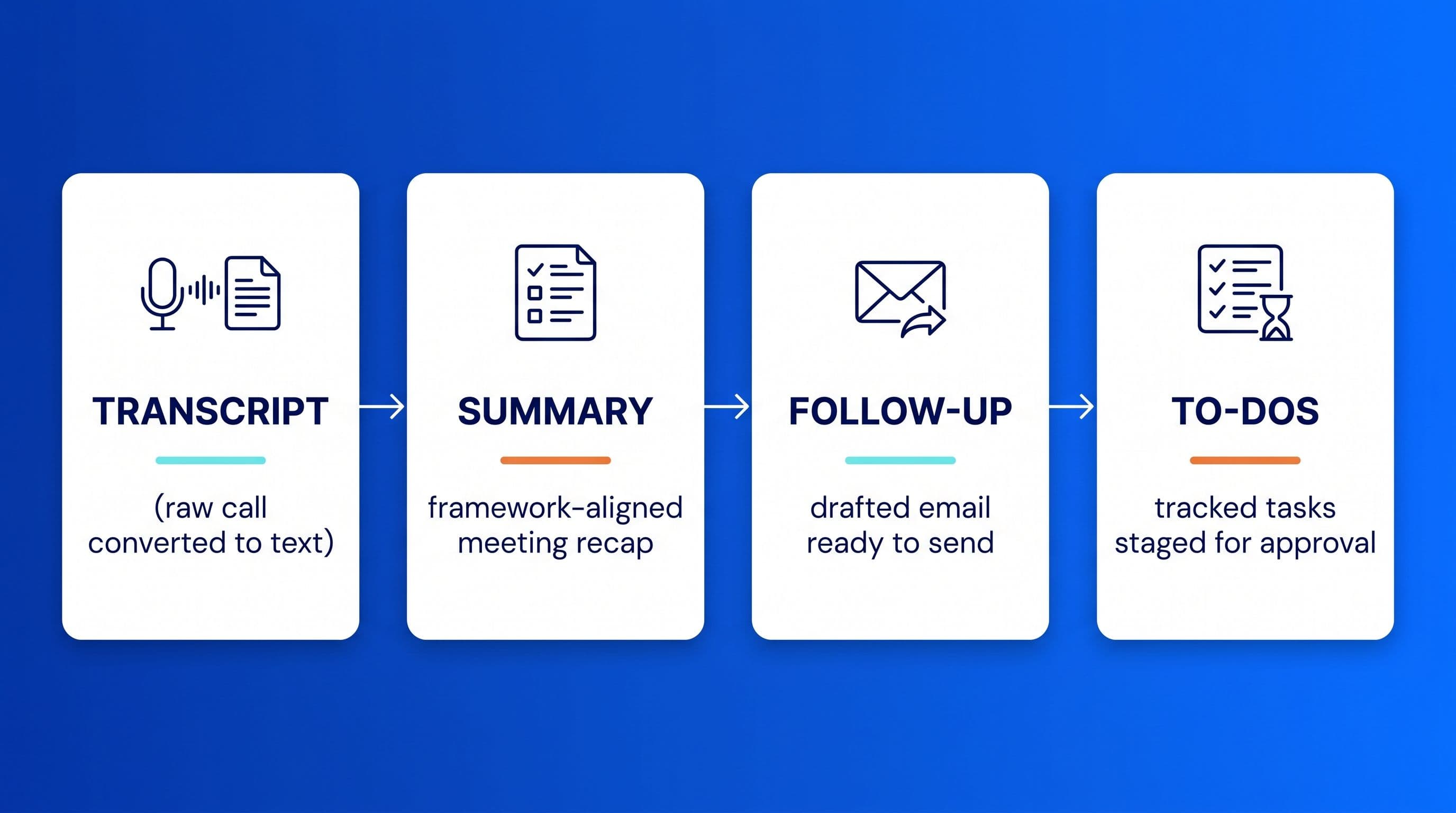
Fireflies and Fathom are built to capture and transcribe a meeting. Klipy is built to finish what happens after it. The same call becomes framework-aligned notes, a drafted follow-up, and tracked to-dos linked to the deal. The draft stays in your queue until you approve it.
Klipy is an AI CRO, one agent that runs your sales operation end to end. A CRM records the work. Klipy does it.
If your only need is a searchable record of the call, either competitor does that job well. If you need the call to turn into action without doing the admin yourself, Klipy is built for that part specifically.
Key takeaways
- Fireflies and Fathom both deliver a transcript plus an AI-generated summary with bullet highlights. Fathom adds CRM sync on its paid plans; Fireflies gates CRM integrations to its premium tiers.
- Based on their own pricing and product pages, neither native tool drafts a follow-up for you without a paid add-on tier or manual work on your end.
- Forrester's Sales Activity Study puts average admin time lost at roughly 14 of 51 working hours a week, about 27%, for sales reps generally. That's the scale of the tax a transcript alone doesn't remove.
- Superhuman acquired Fathom in September 2026. Fathom's CEO said running it as a standalone company would mean building a lot of things Superhuman already has.
- Klipy auto-joins the call and transcribes it in 99 languages, then produces a framework-aligned summary (Sandler, MEDDIC, Challenger, or custom). It stages a drafted follow-up and tracked to-dos for you to review before anything goes out.
This post is part of our guide to falling through the cracks, the ways a growing B2B service firm loses leads and clients to work that only lives in the owner's head.
What's the real difference between Fireflies, Fathom, and Klipy?
Fireflies and Fathom capture and transcribe the meeting. Klipy picks up from there: the same call becomes a drafted follow-up and tracked to-dos, staged for you to review before it goes anywhere.
All three tools join a video call and hand you a record of what was said. That's where the overlap ends. Fireflies and Fathom stop at a transcript plus a summary. What you actually need after a sales call is narrower and more specific: notes organized around the sales framework you already use, next steps already drafted in a usable form, and a deal record that reflects the conversation without you retyping it. That gap, between "here's what was said" and "here's what to do about it," is where this comparison lives.

What Fireflies.ai and Fathom deliver after a call ends
Both hand you a searchable transcript plus an AI-generated summary with bullet-point highlights. The gap shows up in what happens next.
Fireflies.ai is a large, established player in this category. Per its own pricing page, transcription is primarily in English, with Spanish, French, Portuguese, Italian, and 100+ other languages available in beta. CRM and other app integrations are gated to its premium paid tiers, not included at the base level. A June 2025 company announcement, republished by Silicon UK, put the company at a $1 billion-plus valuation, used by roughly 20 million people across more than 500,000 organizations. It has processed over 2 billion meeting minutes and stayed profitable since 2023. On G2, Fireflies holds a 4.7 out of 5 rating across roughly 733 reviews, with ease of use and ease of setup both scoring above 9 out of 10.
Fathom, per its own product page, frames its output as a summary plus action items plus CRM sync delivered right after the call, included on its paid plans. Native transcription and summarization run in seven languages (English, Spanish, Dutch, French, Italian, German, Portuguese) on paid plans, with a separate "Ask Fathom" feature translating into 29 additional languages. Fathom's reviewers are enthusiastic: G2 shows a 5.0 out of 5 rating across more than 6,000 reviews, with 78.5% of reviewers identifying as small businesses.
Based on their own pricing and product pages, both treat the summary as the finished output. What happens next, turning that summary into a sent follow-up and an updated deal record, is left to you.
Why doesn't a transcript count as a follow-up?
Nothing happens next on its own. Someone still has to read the transcript, decide what mattered, write the recap, and manually push it into tasks and the CRM.
A transcript is a record. A summary with bullet highlights is a better record. But neither drafts the email that goes to the prospect, nor decides which line item belongs on the deal record. Neither creates the to-do that makes sure the promised follow-up actually happens by Thursday.
That work still sits with you, usually late in the day, after the next three meetings have already started pulling your attention elsewhere. You already know how it plays out: the call ends, the day keeps moving, and the recap, the follow-up, and the CRM update land back on your desk regardless.
This gap repeats after every call. These figures come from research on sales reps broadly, not owner-sellers specifically. They still size the problem: Forrester's Sales Activity Study found that the average rep loses about 14 of 51 working hours a week, roughly 27%, to administrative tasks rather than selling. Salesforce's own research, cited by Trailhead, lands in the same territory: reps spend only about 40% of their week actually selling, with the rest consumed by admin. If every deal still runs through you, there's no one else to hand that admin to. It either gets done at 9pm, or it doesn't, and the lead quietly cools.

A vendor-neutral analysis from Rework's AI Patterns library names this directly: "the transcript is not the outcome. It is the input to the outcome." The value shows up only once a structured summary, decisions, and named-owner action items exist. They also need to reach the systems that need them: the CRM, the task list. If you stop at transcription, you leave most of the value on the table.
What does Fathom's acquisition by Superhuman tell us about this gap?
Superhuman acquired Fathom, a meeting notetaker with 400,000-plus monthly active users, in September 2026. TechCrunch's reporting on the deal quoted Fathom CEO Richard White explaining the logic: "If we were to operate Fathom as a stand-alone company, we would have to build a lot of things that are already in the Superhuman platform." Superhuman CEO Shishir Mehrotra added that the deal made clear "how deep the products in this category are and how much you need to build." Secondary coverage from Reworked corroborated the account and put Fathom's scale at 400,000-plus monthly active users and 1 million-plus lifetime users.
We read that quote as a sign that a transcript-only tool eventually needs more than transcription to turn meeting content into action. That reading is ours, not a claim either CEO made: neither executive mentioned follow-ups or CRM updates specifically.
Fathom was well-reviewed and widely used, yet it still needed more than its own product to close the loop from meeting content to action. Transcription and turning that transcript into action are different jobs, and Fathom's strength at the first doesn't guarantee the second.
What does Klipy do with the same meeting that Fireflies and Fathom don't?
Klipy auto-joins the same Google Meet, Zoom, or Teams call and transcribes it in 99 languages with speaker attribution. Within minutes it produces a framework-aligned summary (Sandler, MEDDIC, Challenger, or a custom methodology). From there it stages a drafted follow-up and turns commitments into tracked to-dos linked to the deal. The draft and to-dos wait for your sign-off before anything moves.
The entry point looks the same as Fireflies or Fathom: connect a calendar, and Klipy shows up as a participant on the call. It transcribes the conversation and matches each speaker's voice to their name from the invite. Where it diverges is what happens in the minutes after the call ends. Instead of a generic bullet summary, Klipy maps the notes to the qualification criteria of the framework you already sell with.
That framework-aligned structure lives inside Klipy's meeting intelligence, built to turn a transcript into the next action rather than just a record of the call.
Klipy extracts the action items from the conversation and stages them as to-dos linked to the deal record. It drafts a follow-up email and stages that too, for your review, rather than sending it for you.
The approval step is deliberate: it's Klipy's trust principle. As autonomous as you allow, never more. The drafted recap and follow-up sit ready, and you decide what goes out and when.
For a closer look at how those extracted commitments turn into tracked work, see how to turn sales call notes into action items before they fade.

Fireflies, Fathom, and Klipy side by side
Fireflies and Fathom both end at transcript-plus-summary, though Fathom's paid plans add CRM sync. Klipy turns the same call into the follow-up and to-dos, without you doing the admin by hand.
This comparison comes down to time and effort: how fast the call turns into a sent follow-up and an updated deal, and how much of that work still lands on you.
| Fireflies.ai | Fathom | Klipy | |
|---|---|---|---|
| Native language transcription | Primarily English; 100+ languages in beta | 7 languages on paid plans; 29 more via "Ask Fathom" | 99 languages, with speaker attribution |
| Framework-aligned summary (Sandler, MEDDIC, Challenger) | No | No | Yes |
| Drafted follow-up email | No | No | Yes, staged for your approval |
| CRM / deal record sync | Gated to premium paid tiers | Included on paid plans, per Fathom's product page | Call linked to the deal record |
| Commitments turned into tracked to-dos | No | Action items listed, not tracked as to-dos | Yes, linked to the deal |
This table reflects Fireflies' and Fathom's own pricing and product pages as of this writing; vendors change features, so confirm specifics before you decide. A transcript answers what was said. Fireflies and Fathom are both strong at that job, and either is a reasonable choice if that's all you need. The harder part is turning what was said into what happens next: a follow-up that goes out and a deal record that's current. That's the job Klipy's meeting intelligence is built to do, with you approving the draft before it ships.
FAQ
What's the real difference between Fireflies, Fathom, and Klipy? Fireflies and Fathom transcribe and summarize meetings. Klipy takes the same call further: a framework-aligned summary (Sandler, MEDDIC, Challenger, or custom), a drafted follow-up, and tracked to-dos, for you to approve before anything goes out.
Do Fireflies or Fathom update your CRM on their own? Fathom includes CRM sync on its paid plans, per its own product page. Fireflies gates CRM and app integrations to its premium tiers. Neither drafts a follow-up for you without manual work on your end. For more on what using Fireflies is actually like day to day, see Fireflies.ai reviews: chatbot-only support and billing complaints worth knowing.
Why did Superhuman acquire Fathom? Superhuman acquired Fathom in September 2026. Fathom's CEO said that operating Fathom as a standalone company would mean building a lot of things Superhuman already has. We take that as a sign transcript-only tools eventually need more than transcription to turn content into action, though that reading is ours, not a claim either CEO made.
How much admin time does a transcript-only tool still leave you with? Forrester's Sales Activity Study finds that sales reps generally lose about 14 of 51 working hours a week, roughly 27%, to admin instead of selling. That's the scale of the gap a transcript alone doesn't close.
How many languages does Klipy transcribe in, compared to Fireflies and Fathom? Klipy transcribes in 99 languages. Fireflies is mainly English, with 100+ languages in beta. Fathom's native support covers 7 languages on paid plans, plus 29 more via its separate Ask Fathom feature.