
 Ask ChatGPT
 Ask Perplexity
 Ask Claude
 Prefer us on Google
Introduction
Falling through the cracks means a lead or a follow-up depended on one person remembering it, the same person also responsible for updating the CRM and everything else happening that day. It happens often, in firms with no second person to catch what the owner misses. Memory is the only system there, and memory has a ceiling that most owners hit earlier than they expect.
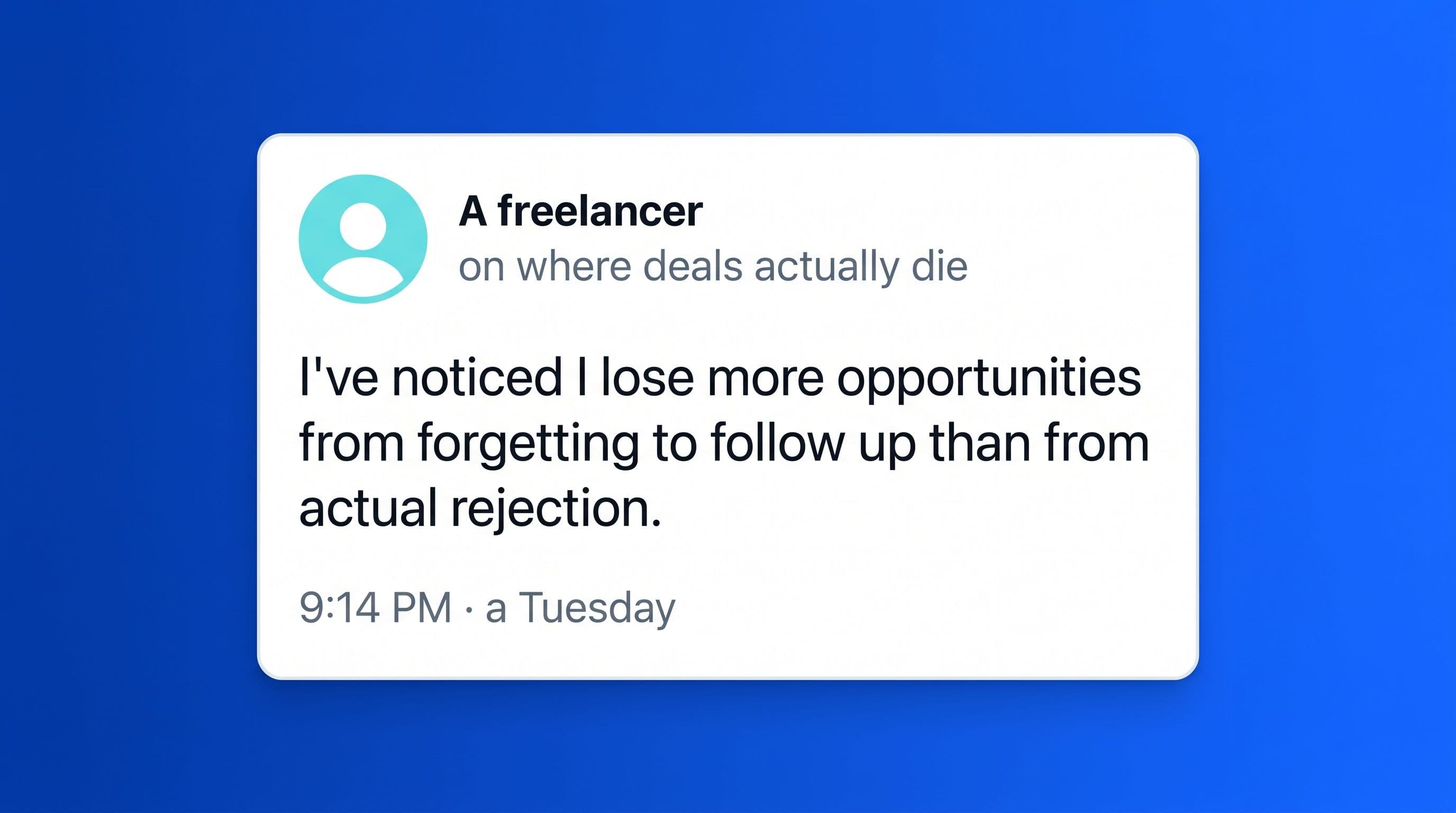
"I've noticed I lose more opportunities from forgetting to follow up than from actual rejection." (Indie Hackers)
The numbers behind running solo
- 82.6% of U.S. businesses are nonemployer firms, meaning the owner is the entire operation with no second person to catch what slips (U.S. Census Bureau).
- 63.5% of B2B companies tested in a controlled study never responded at all to an inbound demo request, showing how easily a lead disappears even after it reaches an inbox (RevenueHero).
- Knowledge workers spend roughly 28% of the workweek, about 11.2 hours, managing email alone, which is the baseline that follow-up and CRM upkeep compete against (McKinsey Global Institute).
- About 40% of employees have 50 or more unread emails sitting in their inbox at any given time, so a crowded inbox is closer to normal than exception (cloudHQ).
- 53.5% of small business owners lose sleep over the business at least a few times a week and 47.7% have delayed their own paycheck to keep it running; only 22.5% describe their mental health as thriving (Patriot Software).
- 28% of solopreneurs work more than 50 hours a week, and solopreneurs report higher stress than owners who have employees despite working fewer average hours, the bottleneck paradox of doing it all yourself (Kenya Rmosh).
- Entrepreneurs filed 5.2 million new business applications in 2024, most of them destined to run as one-person or two-person operations, which is why this pain shows up so often (Forbes, reporting Gusto data).
- 75% of entrepreneurs report struggling with delegation, which is a large part of why the owner stays the single point of failure even after the business could afford help (Solveline).
Two commonly repeated numbers didn't make this list on purpose. A CRM "failure rate" often credited to Gartner or Forrester traces back to reports from 2001 and 2009 that no longer exist online, and a follow-up statistic attributed to the "National Sales Executive Association" points to an organization that doesn't appear to exist. Both get left out here rather than repeated on faith.
How do I make sure leads don't fall through the cracks?
Leads slip through because there's no second system checking the first one, not because the owner is careless. In a one-person or two-person firm, the person selling is also the person following up and updating records, on top of everything else that day, so anything without a forcing function eventually gets skipped.
What catches it: a single place every lead lands instead of scattered across email and sticky notes, and a review that's calendared like an appointment instead of left to memory. Owners who rely on remembering describe their setup as "good enough for now," a phrase researchers found almost always preceded a story about a dropped ball that cost a real customer.
Nearly every operator described their current state as 'good enough for now' - a phrase that almost always preceded a story about a dropped ball costing them a real customer.
(Koira)
The pattern holds across industries: the system that depends on memory works right up until it doesn't, and by then the missed lead is already gone.
What does it actually cost a business when a follow-up gets dropped?
A dropped follow-up isn't a missed task. It's a lost contract. One agency owner didn't notice for three days that the workflow capturing leads from a client's website had stopped working. By the time it was caught, the client had lost roughly 40 leads, the relationship was damaged, and the contract was terminated.
Their n8n workflow that captures leads from their website stopped working. I didn't notice for 3 days. They lost around 40 leads. They weren't happy. Contract terminated.
A separate interview study of small business operators found the same pattern repeated: the real damage came from not knowing how long the problem had been running before anyone noticed, more than from the time it took to fix it (Koira). That's the real cost of a dropped follow-up: a direct loss in revenue from the specific leads that went cold, plus a compounding loss in trust and referrals down the line.
Is it normal to run a small business's client relationships entirely from memory instead of a system?
Yes. It's the default for most solo and small-team businesses, and it holds up fine until the volume of leads and clients passes what one head can track, which happens earlier than most owners plan for. The nonemployer-firm data above shows why: for 82.6% of U.S. businesses, there's no second employee to build a shared system with in the first place.
The tell that memory has stopped working shows up as maintenance cost. One owner running a spreadsheet-based tracker put it plainly:
I was spending more time updating it than I was making money.
A services firm blog described the same failure from the other direction. Once updates stop happening consistently, a CRM sits unused and the pipeline board turns into a "graveyard of stale cards nobody has touched" (Setell). Memory-based systems work fine at a certain scale of relationships. Most growing firms outgrow that scale without noticing.
What happens to my business if I can't work for a while and no one else knows how anything actually runs?
It stalls. The clearest way to find out is to step away, which is what one founder did on purpose.
He tried going off grid for 5 days to see if his business could run without him. It couldn't. Half the processes in the business existed only in his head.
That isn't an outlier story. Solveline's own research found that 75% of entrepreneurs struggle to delegate, which is a big part of why processes stay locked in one person's head instead of getting written down anywhere else. Writer Summer Mulder reached the same conclusion from a different angle: waking up earlier or working harder doesn't fix a business where everything still runs through one person; the problem is structural (Summer Mulder). The honest test is simple: could someone else run this for a week without calling you?
Why does admin work take over the job I actually started this business to do?
Because every follow-up and status update that isn't systemized becomes the owner's job by default. There's no one else for it to fall to, so the craft the business was built around gets squeezed into whatever time is left over.
I am no longer an artist. I am a mid-level administrative assistant for a company that happens to sell my own burnout.
(Ortbeans)
A freelance developer described the identical shift in a completely different field: what he'd built was a concierge service that ran on constant manual attention (Indie Hackers). The mechanism is the same regardless of industry: manual admin work has no natural ceiling, so it expands to fill whatever time the owner has left.
Why does a CRM turn into something the whole team quietly stops using?
Because a CRM that requires manual upkeep stays accurate only as long as someone remembers to update it. The first time that slips, the data goes stale, and once the data is stale, no one trusts it enough to keep using it.
The board goes stale, the tool becomes a guilt object, and eventually the subscription gets cancelled.
(Setell)
One consultant documented exactly how fast this happens after a CRM rollout. Two weeks in, only three new contacts had been logged, and everyone else had quietly gone back to the old spreadsheet "just in case" (Konrad Kamiński). Any system that depends on unrewarded manual upkeep from more than one person will decay. That's the root problem the next section is built around.
More questions this cluster answers
- Why do deals go cold when the CRM depends on someone remembering to update it? The gap between a deal stalling and a deal dying usually comes down to who noticed first, and how long it took.
- I forgot to follow up with a lead. How do I fix it and make sure it doesn't happen again? A missed follow-up is recoverable if it's caught fast; the harder problem is building a habit that catches the next one.
- How do I stop drowning in email as a small business owner? The inbox becomes the problem once it's also acting as the CRM, the to-do list, and the filing system.
- How do I keep my CRM updated without it becoming a full-time job? Manual upkeep and accurate data are usually in tension, and most fixes trade one for the other instead of solving both.
- Do I have too many tools for a business this size? More tools often means more places for something to fall through.
- How do I build a business that runs without me? The real test is whether it can survive a week without you answering your phone.
What actually holds
The fix has less to do with a bigger CRM and more to do with removing the dependency on any one person remembering anything, starting with habits that work without buying software.
Four habits hold up on their own, without buying any software:
- One place every lead has to land, with no side channels like a personal inbox or a sticky note that only the owner sees.
- A same-day-touch rule instead of a batching habit, so nothing waits long enough to be forgotten.
- A weekly 15-minute review that's on the calendar like a real meeting, instead of something left to spare time.
- Writing down the process the moment something gets done the same way twice, so it stops living only in the owner's head.
A reader who stops here and runs these four habits will be in better shape than most owner-run firms. The gap they don't close is volume and absence: once the number of leads and follow-ups passes what one person can track by hand, or the owner is out sick or traveling for a week, manual habits break the same way the old system did.
That's the specific gap Klipy is built for. It's the AI CRO: the AI agent that runs your entire sales operation. For this failure mode specifically, it captures every lead the moment it comes in and drafts the follow-up on schedule, ready for you to approve.
See what founder-led sales is actually costing you
Most owners running sales solo have never put a number on what their follow-ups and day-to-day admin, CRM upkeep included, are costing them in hours and lost deals. The Solo Sales Tax report walks through that math using your own numbers, so you can see the real cost before deciding what, if anything, to fix.