
 Ask ChatGPT
 Ask Perplexity
 Ask Claude
 Prefer us on Google
Introduction
Most people assume a deal stalls because the call went badly. It rarely does. The pitch lands, the prospect nods along, everyone agrees on next steps out loud, and then the call ends. What happens in the next twenty minutes, or doesn't happen, decides whether that agreement turns into a closed deal or a line in a notebook nobody opens again.
This is the pattern behind the falling through the cracks cluster's core claim: things don't fail because someone was careless. They fail because the whole system depends on one person remembering to do something, and that person had six other things to do the moment the call ended.
Key Takeaways
- The failure point is the gap after the call, not the call itself: notes have to become owned, dated tasks before they're useful.
- Solo and small-team operators lose this step because there's no second person whose job it is to catch it.
- Memory of what was said and agreed starts fading within hours, so "I'll clean this up tonight" rarely survives the day.
- A same-day, three-question pass (what was decided, what was promised, who owns it) converts notes into action items in a few minutes.
- The manual method holds up on a normal day and breaks under volume, back-to-back calls, or a slammed week.
Why do deals stall after the call, not during it?
The meeting almost always goes fine. What breaks is the unmanaged gap right after it, where notes have to turn into assigned, owned actions before the details fade from memory.
Think about the last call that actually mattered. The prospect said something like "send me that over and I'll loop in my partner by Friday," or you said "I'll get you a revised quote by end of week." In the room, that felt like a plan. Nothing was written down as a task yet. It was a sentence, spoken once, floating in a conversation that moved on to the next topic thirty seconds later.
A meeting produces information. It doesn't produce a task list on its own. Someone has to sit down, however briefly, and turn "we talked about X" into "do Y by Z, owned by me." Skip that conversion step and the meeting was, functionally, a conversation that happened and then evaporated. The prospect remembers it loosely. You remember it loosely. Neither version is reliable enough to act on a week later.
That's the reframe worth sitting with before anything else: better notes aren't the fix. A same-day habit that turns notes into owned next steps is the fix.
Why does notes-to-action-item conversion break down for solo and small-team operators?
It breaks down because there's no second person whose job is to do it. If you're running the business alone, you have to convert your own notes into tracked tasks on top of running the call, running the business, and everything else already stacked up that day.
In a larger sales org, someone other than the rep often owns this: a sales coordinator cleans up notes, a CRM administrator makes sure the deal record reflects what was discussed, an assistant chases the follow-up. On an owner-led team, you don't have that division of labor. You're the one who ran the call and now has to write the recap, and you're also answering the next email, prepping the next call, and probably delivering the actual work the business sells.
For more on why solo and small-team businesses lose leads and clients this way, see falling through the cracks. [INTERNAL-LINK: falling through the cracks → hub page on why solo/small-team businesses lose leads and clients]
Research on solopreneurs backs up how thin that stretch actually is. In Simply Business's 2025 solopreneur report, 61% of respondents said they were surprised how difficult it would be to handle every business function themselves. Over a third had considered giving up the business entirely, most citing financial stress (Simply Business, "The power of one: 2025 solopreneur report"). A survey of small business owners commissioned by Adobe Express found the average owner plays five roles on any given day, including customer service rep, marketer, and bookkeeper, before they even get to sales admin (Talker Research, via Scripps News).
[IMAGE: A solo business owner at a desk right after a video call, alone in frame, closing a laptop with handwritten notes beside it. Search terms: "solo entrepreneur desk after meeting", "small business owner alone office"]
Professionals in general are already out of slack. Harvard Business Review reports that executives now spend an average of nearly 23 hours a week in meetings, up from less than 10 hours in the 1960s (Harvard Business Review, "Stop the meeting madness"). When almost half the work week is calls, the time between them is the only window left for the admin work that makes those calls worth having. That window is short, and it's the first thing to disappear on a busy day.
Why are notes taken "in the moment" already decaying before you act on them?
Because memory of what was discussed and agreed starts fading within hours. A controlled replication of Ebbinghaus's classic forgetting curve found that the retained-memory advantage from a learning session dropped to roughly a third of its original value within a single day (PLOS ONE, Murre & Dros, "Replication and analysis of Ebbinghaus' forgetting curve").
That study wasn't about sales calls. It was about how quickly the brain loses information that isn't reinforced. But the mechanism applies directly to what happens after a meeting. The specifics of a call aren't durable. Who said what, the exact number that was floated, the precise phrasing of a commitment: none of it holds. It fades the same way any unreinforced memory fades: fast, and mostly in the first day.
[CHART: Line chart showing memory-retention decay over time (hours to days), illustrating how quickly unreinforced information fades after a learning or conversation event. Source: PLOS ONE, Murre & Dros, 2015]
This is why "I'll clean up my notes tonight" is weaker advice than it sounds. By the time evening arrives, a meaningful share of the specific, useful detail from that morning's call is already gone. What's left is a general impression: the deal felt good, the prospect seemed interested. That's not enough to write an accurate action item. It's enough to write a vague one, which is often worse than no note at all, because it creates a false sense that the follow-up is handled.
The practical implication is straightforward: the conversion from notes to action items has to happen same-day, and ideally within minutes of the call ending, not whenever there's a free hour later.
What's a reliable manual method for converting notes into action items?
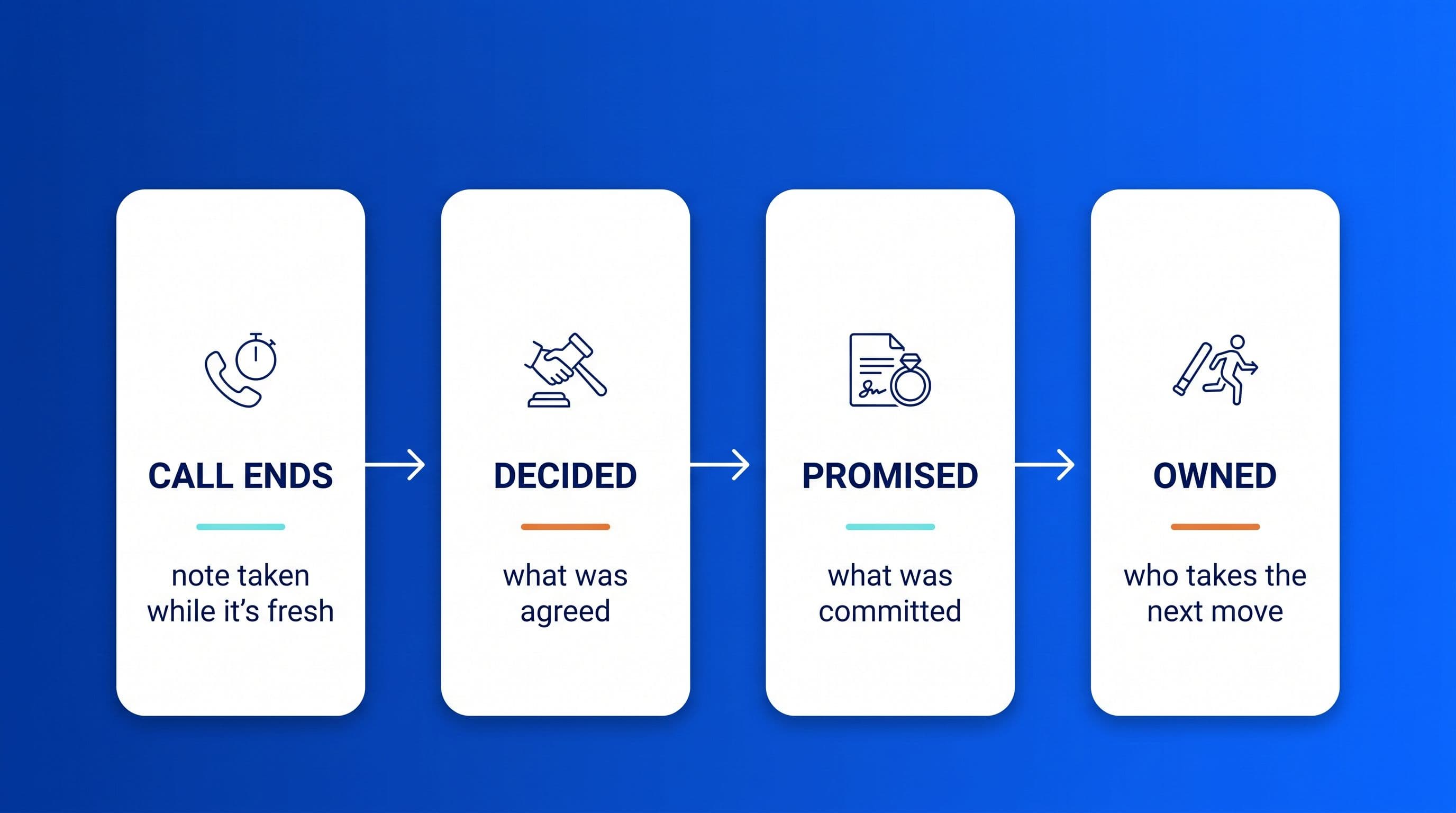
A same-day, three-question pass, run within a few minutes of hanging up: what was decided, what was promised, and who owns the next move.
- What was decided? Not everything discussed, just the actual decisions. A prospect saying "that makes sense" isn't a decision. A prospect saying "let's move forward with the smaller package" is.
- What was promised? By either side. "I'll send the revised quote," "they'll check with their partner," "we'll reconvene Thursday." Promises are the raw material of action items; they're commitments someone made out loud.
- Who owns the next move? Every promise needs a name attached, including your own. "Someone should follow up" isn't an action item. "I send the quote by Wednesday" is.
| Question | Becomes |
|---|---|
| What was decided? | The task itself |
| What was promised? | The specific commitment behind it |
| Who owns the next move? | The owner and the date |
Run through those three questions and each answer becomes a line: a task, an owner, a date. That's the whole method. It doesn't require special software or a long form, just a few uninterrupted minutes and the discipline to do it before opening the next tab or dialing the next call.
This three-question habit closely mirrors the After Action Review, a structured-debrief methodology the U.S. Army developed decades ago specifically to capture what happened and what to do differently, using a short set of pointed questions run immediately after the event (Wikipedia, "After-action review"). The military version has more structure than a sales call needs, but the underlying logic is the same: ask a few specific questions right away instead of trying to reconstruct everything later.
If a promise like this already slipped past you, I forgot to follow up with a lead covers how to recover a dropped lead the same day. [INTERNAL-LINK: I forgot to follow up with a lead → recovery guide for a dropped lead]
The window is the real constraint, not the method. This only works if it happens in the few minutes right after the call, before the next thing on the calendar starts. That constraint is exactly where it breaks down.
Where does the manual method still fail?
It fails at volume and under pressure. Back-to-back calls, a slammed day, or a stretch of high call volume are exactly when the after-call pass gets skipped, and skipping it once is enough for a commitment to disappear.
The method works when there's a five-minute gap after a call. The problem is that the busiest days are also the days that gap disappears. A call ends and the next one starts in ninety seconds. Or the call ends and an urgent client email is waiting. Or it's the third call of an already long day and the temptation is to just move on and "remember to follow up later." Later rarely arrives with the specifics intact, for the same reason the forgetting curve applies to everyone: the details that mattered are the first things to go.
Treating this as a discipline problem adds guilt on top of an already thin schedule, when the real issue is structural. Time management is consistently cited as one of the top operational challenges solopreneurs report, with roughly 41% naming it directly (Gusto, "Behind the boom in solopreneurship"). The manual method is genuinely good advice for a normal day. It just doesn't survive a busy week, and busy weeks are when deals are most likely to be moving and most likely to need the follow-up done right.
See also when CRM follow-ups fall through the cracks for why deals stall after the call inside the CRM itself. [INTERNAL-LINK: when CRM follow-ups fall through the cracks → CRM-side follow-up failure article]
What closes the gap when there's no spare time after the call?
The fix is something that runs the same three-question logic (what was decided, what was promised, who owns it) on every call, straight from the call itself, so the habit no longer depends on finding five free minutes afterward.
The manual method works well on a normal day; it just has no fallback for the days it can't happen. That's a solvable problem now in a way it wasn't a few years ago: meeting intelligence tools that join or transcribe a call can extract commitments the moment the call ends, without waiting for a human to find five free minutes. Klipy's meeting intelligence notetaker joins Zoom, Google Meet, and Microsoft Teams calls and writes the recap in categories that map to the manual method: key points, decisions, and commitments made. Task suggestions then reads that recap for promises made on either side and turns each one into a tracked task with an owner and a date attached; when the deal's context changes and a task is no longer relevant, it drops off the list on its own instead of sitting there stale.
Klipy drafts the follow-up from the same call context, in the seller's own learned voice, building on the same recap and task suggestions described above. Sending sits on an autonomy dial the owner sets per channel, with review-before-send as the default: as autonomous as you allow, never more. For a business running on one person's memory, that's the actual gap being closed: the three-question pass runs on every call, including the fourth call of a slammed Tuesday, instead of only the calls where five minutes happened to be free afterward.
That's the same failure mode this whole cluster keeps circling back to: a system with exactly one point of failure and no backup. Falling through the cracks covers the pattern in full; when CRM follow-ups fall through the cracks covers what happens once the task exists but the CRM record doesn't keep up with it.
FAQ
How fast do the details from a sales call actually fade from memory? Faster than most people assume. A controlled replication of Ebbinghaus's forgetting curve found the retained-memory advantage from a learning session dropped to roughly a third of its original value within a single day, which is why writing up notes "tonight" already loses most of the specifics from a morning call.
What's the fastest way to turn sales call notes into action items? Run a same-day, three-question pass within a few minutes of hanging up: what was decided, what was promised, and who owns the next move. Each answer becomes a task, an owner, and a date, with no special software required.
Why do solo and small-team operators lose track of follow-ups more than larger sales teams do? Because there's no second person whose job is to catch it. In Simply Business's 2025 solopreneur report, 61% of respondents said they were surprised how difficult it is to handle every business function themselves, and an owner-led team has no coordinator or assistant to convert notes into tracked tasks. [INTERNAL-LINK: falling through the cracks → hub page with more on the solo-operator staffing gap]
Does the three-question after-call method still work during a busy week? Not reliably. Back-to-back calls, a slammed day, or a stretch of high call volume are exactly when the after-call pass gets skipped, and skipping it once is enough for a promised follow-up to disappear.
What's the actual difference between taking notes on a call and writing an action item? Notes record what was said; an action item names an owner and a date. "Someone should follow up" is a note. "I send the quote by Wednesday" is an action item, and only the second one survives a busy week.
Can software do the after-call notes-to-task conversion automatically? Meeting intelligence tools can run the same what-was-decided, what-was-promised, who-owns-it logic on every call, extracting commitments straight from the call itself. Sending anything drafted from that recap stays on an autonomy dial the owner controls per channel: as autonomous as you allow, never more.
What operational challenge do solopreneurs cite most often? Time management is consistently one of the top operational challenges solopreneurs report, with roughly 41% naming it directly in Gusto's research on new business formation, the structural reason a five-minute after-call habit is the first thing to slip on a busy day.
The takeaway
Deals rarely die on the call. They die in the unmanaged twenty minutes after it, when a spoken commitment either becomes a dated, owned task or quietly evaporates. A same-day, three-question pass (what was decided, what was promised, who owns the next move) closes that gap on a normal day. On a slammed week, when back-to-back calls eat the five minutes that habit needs, meeting intelligence tools can run the same logic on every call without waiting for a free moment. Either way, the fix starts with treating the after-call gap, not the call itself, as the thing that needs managing.