
 Ask ChatGPT
 Ask Perplexity
 Ask Claude
 Prefer us on Google
Introduction
Solo sellers run their pipeline from memory. There's no sales ops person double-checking the deal stage, no second set of eyes on the invoice, no colleague who notices when a support ticket goes quiet. Every piece of infrastructure a solo seller adopts either backs that memory up or becomes one more thing that can fail silently. That's especially true for the AI note-taker sitting inside every sales call.
That's why a pattern of chatbot-only support and confusing billing at Fireflies.ai, one of the most widely used AI meeting notetakers, deserves more scrutiny than it usually gets. Reviewers on G2, Capterra, and Trustpilot describe the same two problems independently: a support experience that rarely reaches a human, and a billing and cancellation process that has produced repeated, dated complaints about unexpected charges. Neither is a minor annoyance for a team with a dedicated ops person to chase it down. For someone running the whole sales operation alone, both are the same failure mode as a dropped follow-up: something quietly not happening, discovered too late.
This article is part of Klipy's guide to falling through the cracks, on how solo and small-team businesses lose leads and clients to gaps nobody's watching.
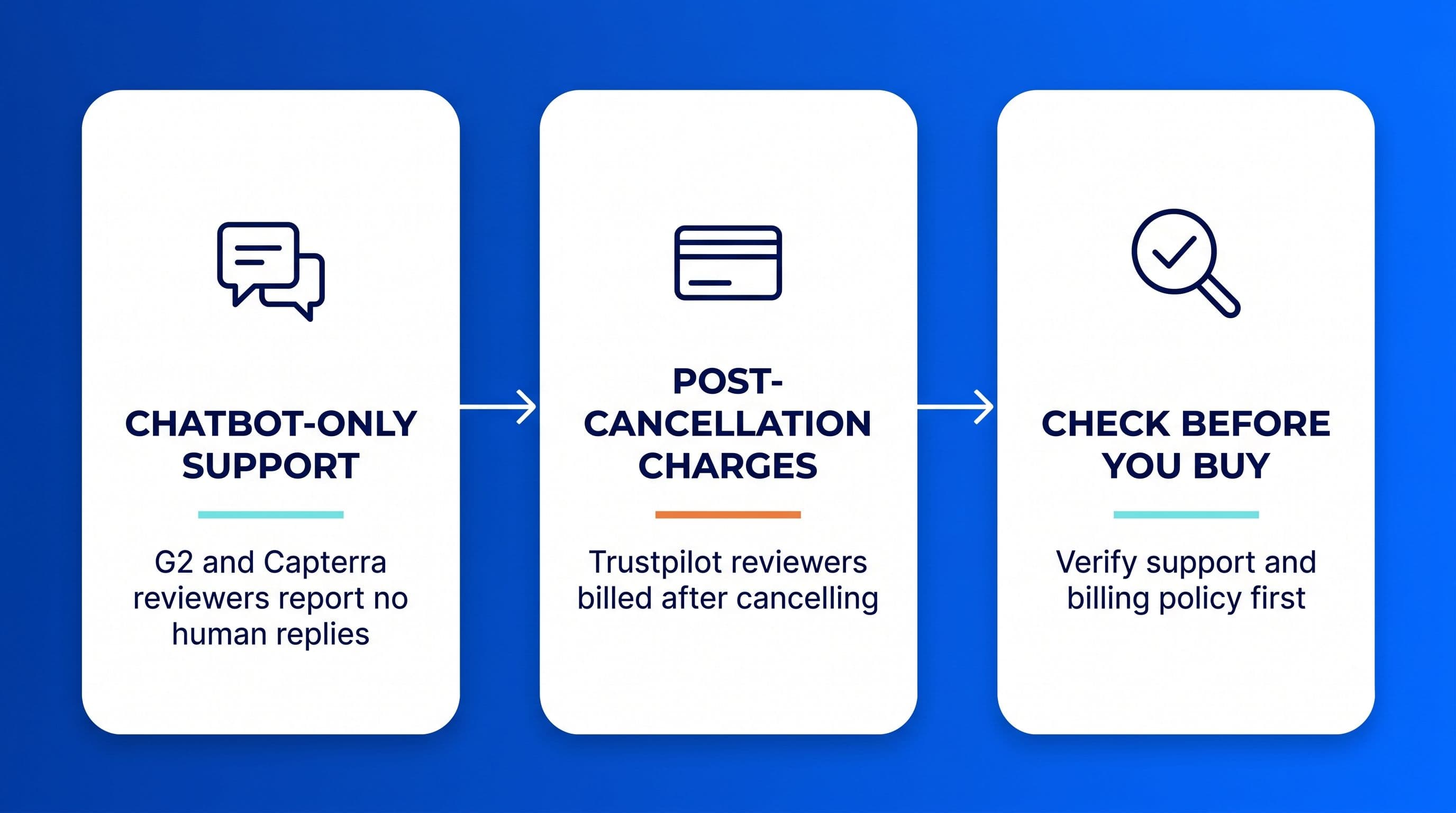
The table below summarizes the three concerns this review covers, before the full detail on each one.
| Concern | What reviewers report | Source |
|---|---|---|
| Chatbot-only support | No path to a human on any channel; chat says it will connect to support and then goes silent; waits of 3+ hours reported | G2, Capterra, Trustpilot |
| Post-cancellation charges | Repeated card charge attempts after cancelling (one case: 10+ attempts over two weeks); cancellation "continue" button reported greyed out | Trustpilot |
| Refund and per-seat billing | Full refunds limited to 7 days/3 logged meetings on monthly plans; AI Credits add-on excluded from refunds and auto-renews at $5/user/month; pricing is per seat | Fireflies.ai official policy pages |
Is Fireflies.ai support actually chatbot-only?
Yes. Reviewers on three independent review sources, G2, Capterra, and Trustpilot, repeatedly describe Fireflies.ai support as chatbot-only, no matter which channel they use to start the conversation.
On G2, a reviewer wrote that "there is no customer support, only a chatbot," and that whether you reach out by email or via the support chat, "it's the same bot," one that says it will connect you with support and then goes silent, with no further response (G2 reviews of Fireflies.ai).
Capterra reviewers describe the same structural gap. One reviewer rated the product 2.0 and called out "customer service (chat bot and email only, no phone number and no access via FB)," adding that the information she got from that channel about storage limits conflicted with what everyone else told her, calling it deceptive (Capterra reviews of Fireflies). Other Capterra reviewers report that support simply doesn't respond to queries at all, including a case where a customer asked how to cancel or remove the product and never heard back (Capterra reviews of Fireflies).
Three separate sources telling the same story is a pattern, not one disgruntled user venting, and it's worth taking seriously before it becomes your problem.
[IMAGE: A person staring at a stuck chatbot conversation on a laptop, frustrated expression - search terms for Pixabay: frustrated customer support chatbot laptop]
What actually happens when the bot can't solve your problem
When the chatbot hits its limit, Trustpilot reviewers report being left waiting for hours with no resolution, or being told a human will follow up and then hearing nothing.
One reviewer, Abdu, described the experience directly: chatting with support "bumps you into AI chatbot, with no clear way to get to human," and after escalating, he had "to wait FOR 3+ HOURS for human to respond" (Trustpilot reviews of Fireflies.ai). Another reviewer, David Daniel, put it more bluntly: "There is no customer support. Only a chatbot... It says it will connect you with support and then... nothing." A third reviewer, Bocco, noted that Fireflies' support persona, "Fred," "pretends to be a human but is actually a bot (and they don't admit it unless you ask)" (Trustpilot reviews of Fireflies.ai).
None of these are edge-case complaints about a slow response to a minor question. They describe the moment support is supposed to matter most: when a transcript is missing, an account setting is broken, or a charge needs explaining, and the tool has nowhere left to send the request.
Fireflies.ai's billing and cancellation process has its own trail of complaints
Separate from the support experience, Trustpilot reviewers report being charged after they believed they had cancelled, including repeated card charge attempts and a cancellation flow where the confirm button appears greyed out and unusable.
Andrea, a Trustpilot reviewer, wrote that Fireflies "attempted to charge my card 10+ times over two weeks without any prior notice," adding that "the account was already cancelled when several of these attempts were made" (Trustpilot reviews of Fireflies.ai). Anjali reported cancelling a trial a day before it ended and still being charged, "despite lots of follow-up emails." Alex Wilson described being "charged me incorrectly after a free trial ended, despite me having already cancelled the free trial." A fourth reviewer, Dah Lia, described the cancellation button itself as broken: "It is also very difficult to cancel during free trial... the 'continue' button is greyed out and will not let the cancellation proceed" (Trustpilot reviews of Fireflies.ai).
The official policy underneath these complaints is narrower than most buyers assume. Per Fireflies' own Knowledge Base, a full refund only applies if you've used the product for 7 days or less and logged 3 meetings or fewer on a monthly plan (20 meetings or fewer on an annual plan). Outside that window, refunds are prorated, but only on monthly plans; annual plans get no prorated refund at all. AI Credits add-on purchases are excluded from refunds entirely, no matter when you ask (Fireflies.ai refund policy).
There's a second, distinct billing trigger worth knowing about before it happens rather than after: Fireflies' documentation confirms that if you don't proactively cancel the AI Credits add-on once its trial ends, it auto-charges $5 per month per user (Fireflies.ai billing FAQs). One reviewer, MBTH, described exactly this pattern in practice: Fireflies "added AI ad ons without my consent and then charged me for it" (Trustpilot reviews of Fireflies.ai).
Why bot-only support plus confusing billing is a bigger risk for solo sellers specifically
A solo seller has no second person to catch a dropped support ticket or a surprise charge, so a stalled chatbot loop or an unexpected renewal isn't a minor annoyance. It's the same kind of failure that loses a deal, just wearing a billing hat instead of a follow-up hat.
This connects directly to the broader pattern Klipy's guide to CRM follow-ups falling through the cracks documents: the failures that hurt owner-led sellers most aren't the big obvious ones. They're the small, quiet gaps, an unanswered ticket, an unnoticed charge, a follow-up that never got drafted, that compound because there's no one else checking the work.
A card getting charged ten times over two weeks, as one Trustpilot reviewer reported, isn't just an accounting headache. It's a distraction pulled out of a week a solo seller was supposed to spend selling, chasing a bank dispute instead of chasing a lead.
The per-seat billing structure adds a second, more specific risk. Per Fireflies' own pricing page, any teammate added to a workspace on a paid plan counts as a billable seat (Fireflies.ai pricing). That's exactly the moment many solo sellers hit next: hiring a first assistant, or bringing in a part-time collaborator. If billing has already proven unpredictable at one seat, adding a second seat raises the exposure right when the seller is trying to scale past solo, which is exactly when a billing surprise hurts most.
The "Fred" origin story is a useful lens on trusting an AI-only support experience
Fireflies co-founder and CTO Sam Udotong has publicly confirmed that the company's original "AI notetaker," marketed under the persona Fred, was in its early days actually two founders manually joining calls and typing notes by hand, before real transcription AI existed.
Udotong told Futurism the company was "charging $100/month for an AI that was really just two guys," describing how the pair would "sit there silently, take detailed notes, and send them 10 minutes later" to preserve the illusion of automation (Futurism, Nov. 13, 2025). The company went on to reach a $1 billion valuation in summer 2025, well after this admission became public.
This isn't a gotcha about the product today; Fireflies' transcription is genuinely AI-driven now. But it's relevant context for how much trust to extend to an all-AI, no-human-escalation support model from the same company: a brand whose own founder has acknowledged presenting manual work as automation is worth watching closely when it tells you a chatbot is the only door to support. It's the same category of blind spot Klipy tracks in its broader guide to solo-seller blind spots: not obvious fraud, just a gap nobody's checking until it costs a deal.
What to check before trusting a note-taker with your pipeline
Before adopting any AI meeting note-taker, solo sellers should verify three things upfront: whether there's an actual human escalation path, what the refund and cancellation policy says in writing, and whether pricing is per-seat or flat as the team grows.
- Escalation path. Ask, before you pay: is there a phone number or a named human contact, or does every path lead back to the same chatbot? Test it during the trial, not after something breaks.
- Refund and cancellation terms, in writing. Read the actual policy page, not the sales page. Note the time window, whether prorating applies to your plan type (monthly vs. annual), and whether any add-ons are excluded from refunds.
- Seat-based billing exposure. If pricing is per seat, understand what happens the moment you add a collaborator, an assistant, or a part-time hire. Confirm whether trials or add-ons auto-renew, and what it takes to turn them off before that first charge hits.
None of this requires distrust as a default. It requires treating a note-taker the same way you'd treat any other piece of revenue infrastructure. Verify the escalation path, the refund terms, and the seat math before the tool is holding your pipeline, not after a charge or a stalled ticket forces the question.