
 Ask ChatGPT
 Ask Perplexity
 Ask Claude
 Prefer us on Google
Introduction
It's 3 a.m. and you're doing margin math in your head again, replaying last month's invoices instead of sleeping. You already know the number. You're checking it anyway.
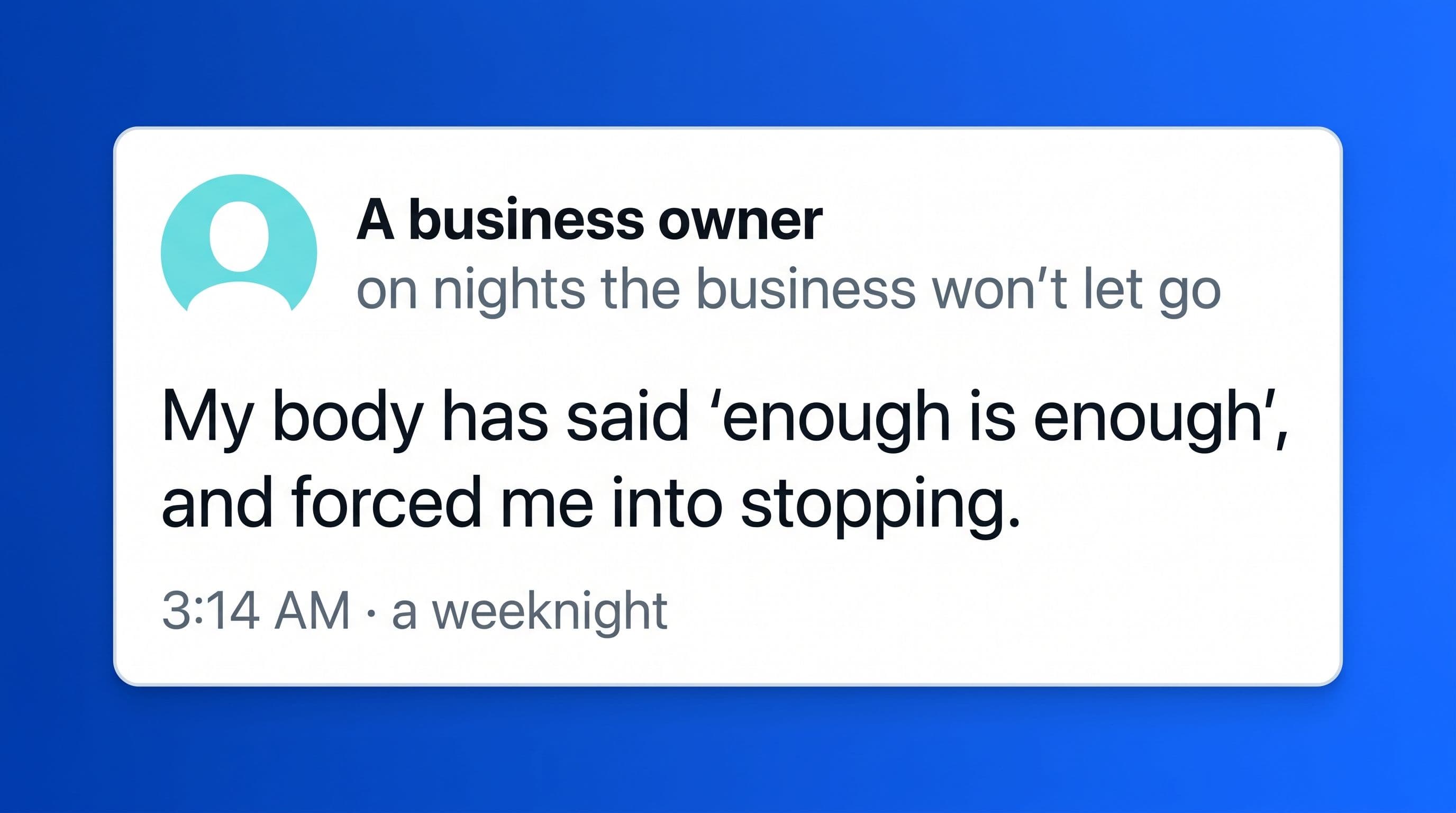
"My body has said 'enough is enough', and forced me into stopping." (Freelancing Support)
3 a.m., and the ache you're not going to mention to anyone
The dentist appointment got rescheduled a third time this year because something always comes up: a client fire, a payroll run that can't wait. There's an ache somewhere (shoulder or chest, it doesn't really matter which), and nobody ever built you a way to stop and find out what it is. You'll deal with it after the renewal closes. Or after the busy season. Or after the next hire is trained enough to cover for you.
That milestone never quite arrives, and if you're honest with yourself, the ache isn't really what's keeping you up. It's the question underneath it: what happens to the business if this turns out to be something, and you're out for a week? There's no one else positioned to answer that question, so you don't ask a doctor either. No one ever showed you how to step back, so it's started to feel like just what it takes to run the thing. The numbers in the next section say otherwise.
The math of being the owner every deal runs through
68% of small business owners lose at least one full night of sleep a month to financial worry, and 13% lose six or more nights a month to it, according to a 2026 Bluevine survey of U.S. small business owners (Bluevine, via PR Newswire). What's happening in your body most nights comes from one nervous system absorbing the cash-flow anxiety and decision fatigue that a staffed company would split across a team. There's also the zero-coverage schedule: no one else can step in when something goes wrong.
If the 3 a.m. bank-balance check has become its own ritual, it has a pattern worth understanding: see why you can't stop checking the bank balance obsessively. In an owner-led firm, there's no one else to hand a decision to overnight, which is a big part of why only 22.5% of small business owners describe their mental health as "thriving," while 42.2% describe themselves as exhausted but staying in business anyway (Patriot Software). Owners under a year in business lose sleep almost every night at more than double the rate of owners who've been in business five or more years: 29.6% versus 12.7% (Patriot Software, same source).
For a closer look at how founder burnout shows up day to day, see our guide to business owner burnout, and the data that proves it's real.
Is it normal for running my business to feel physically exhausting?
Yes, and it's common enough to be measured across several independent surveys. 42.2% of small business owners say they've sacrificed physical health directly for the business, part of the 84.4% who report sacrificing health or wellbeing overall (Patriot Software). If you're running on broken sleep and skipped checkups, the data says most owners are living some version of the same thing.
The same Bluevine survey also found that 71% of owners report moderate to extremely high financial stress, and 53% say that stress has left them emotionally drained or burned out in the past year (Bluevine). Centiment fielded that survey between February 27 and March 9, 2026, drawing 781 completed responses from U.S. small business owners, with a margin of error around plus or minus 3% (Stacker, cross-referencing the Bluevine data). The pattern shows up outside the U.S. too: 76% of Australian small business owners report stress or anxiety, and 57% report burnout, in a 2025 survey of over 800 owners (COSBOA and Commonwealth Bank of Australia). For context, the general U.S. workforce already runs short on sleep, with 36.5% of employed adults getting under seven hours a night (CDC).
Why do I feel like I have nothing left after years of running my agency?
Depletion compounds when there's no one to hand decisions off to. Years of absorbing every call personally, with no backup, produce a specific kind of emptiness that's different from ordinary tiredness.
Owner voices land on the same feeling from completely different businesses. "I've been running a specialist marketing agency for 10 years and I'm so tired," one owner wrote (Generous Substack). Another, describing years of project after project, put it this way: "After doing all of these projects I had realized I didn't have any 'dreams' left in me" (K1nz Substack). Long-tenure, zero-coverage ownership produces this reliably, across founders who've never met each other and run entirely different kinds of firms.
How other owners are coping (trade-offs included)
The owners below responded to this wall in different ways: setting firm boundaries, closing the business, delegating work, and leaning on peers. None of these come free; each one costs something specific.
Jessica Rose, founder of the Jewellers Academy in London, worked 14-plus hour days for years. She stress-ate or skipped meals entirely and eventually became so unwell she couldn't work for nearly a year. A set of firm boundaries brought her back: fixed work hours, a hard cap on the hours and days she hires staff for, and an annual holiday again after five years without one.
"It takes discipline to work less, not necessarily to work more and be ambitious." (Jessica Rose, via Xero)
Louise Doherty, founder of the UK tech startup Yoller, worked roughly 19-hour days for four years before forcing herself to take a holiday. When she got back and saw the backlog waiting for her, she burst into tears and recognized the burnout for what it was. She closed the company the following month (City A.M., citing Sage HR research). Sometimes it's the business itself that changes.
Delegation is its own lever. Marliis Reinkort, founder and CEO of CodeGalaxy, says it doesn't come naturally even though it matters most.
"Delegation is not easy for any entrepreneur, but it's critical." (Marliis Reinkort, founder and CEO of CodeGalaxy, via U.S. Chamber of Commerce)
Matt Doud, co-founder and CEO of Planit Agency, credits a different kind of support for getting him through the same pressure.
"I'm held accountable by my peers." (Matt Doud, via U.S. Chamber of Commerce)
How do I recover after my body forces me to stop?
The owners who recover tend to make it structural. They build real coverage so time off doesn't stall the business, and they protect specific hours for rest. They also protect sleep as a decision-quality input that shapes tomorrow's choices.
A 2025 peer-reviewed scoping review found that sleep deprivation measurably impairs decision-making and increases risky or erroneous decisions (Behavioral Sciences). A tired owner makes worse calls on exactly the things that matter most. The boundaries Jessica Rose set, above, were what let her keep running the business at all.
The three levers that move this (no software required)
Delegate one stacked role first, even just a few hours a week of it. Marliis Reinkort's point above holds: delegation is hard for almost every founder, but it's the lever that does the most. Pick the single role that's most load-bearing right now, and start there instead of trying to delegate everywhere at once.
Build real coverage so a day off doesn't mean the business stops. This is the direct fix for the zero-coverage schedule driving the sleep numbers above: an informal backup contact, or a cross-trained team member working from a documented process for 48 hours, is enough to change what a sick day costs you. For a closer look at why this specific gap makes stepping away so hard, see why owners of service firms can't disconnect on vacation.
Put recovery on the calendar like a deliverable: block specific hours for rest and protect them the way you'd protect a client commitment. Owners under a year in business lose sleep almost every night at more than double the rate of owners five or more years in (29.6% versus 12.7%, Patriot Software, same source), so treat the early stretch as the period that needs the most deliberate protection.
Those three fix the human side of the problem. The hours spent on sales admin and follow-up are the one piece a tool can take off your plate.
The one lever a tool can pull: taking follow-up off your plate
Klipy is the AI CRO: the AI agent that runs your entire sales operation. It drafts the follow-up from your calls and gets the next message ready for your approval. That takes the sales admin and follow-up hours out of your week, the hours that otherwise eat into time you'd spend resting or just stopping for the day.
That makes the "build real coverage" lever above easier to pull, because there's less to hand off when you step away.
Put a number on the hours before you decide anything
The Solo Sales Tax report puts an hours-and-dollars figure on what founder-led sales admin actually costs, so you can decide what's worth delegating with data instead of guilt.
It's still 3 a.m. some nights, and the dentist appointment might get moved again next month. The ache doesn't have to be something you carry quietly and explain away. Book the appointment this week, before the next deadline gets to make that decision for you.