
 Ask ChatGPT
 Ask Perplexity
 Ask Claude
 Prefer us on Google
Introduction
The email arrives polite and a little too warm. It thanks you for everything you've done, then gets to the part that matters: the engagement is ending, effective the end of the month. You read it twice. You open the project folder to check what handoff still needs doing, and underneath that, a quieter thought surfaces: this keeps happening.
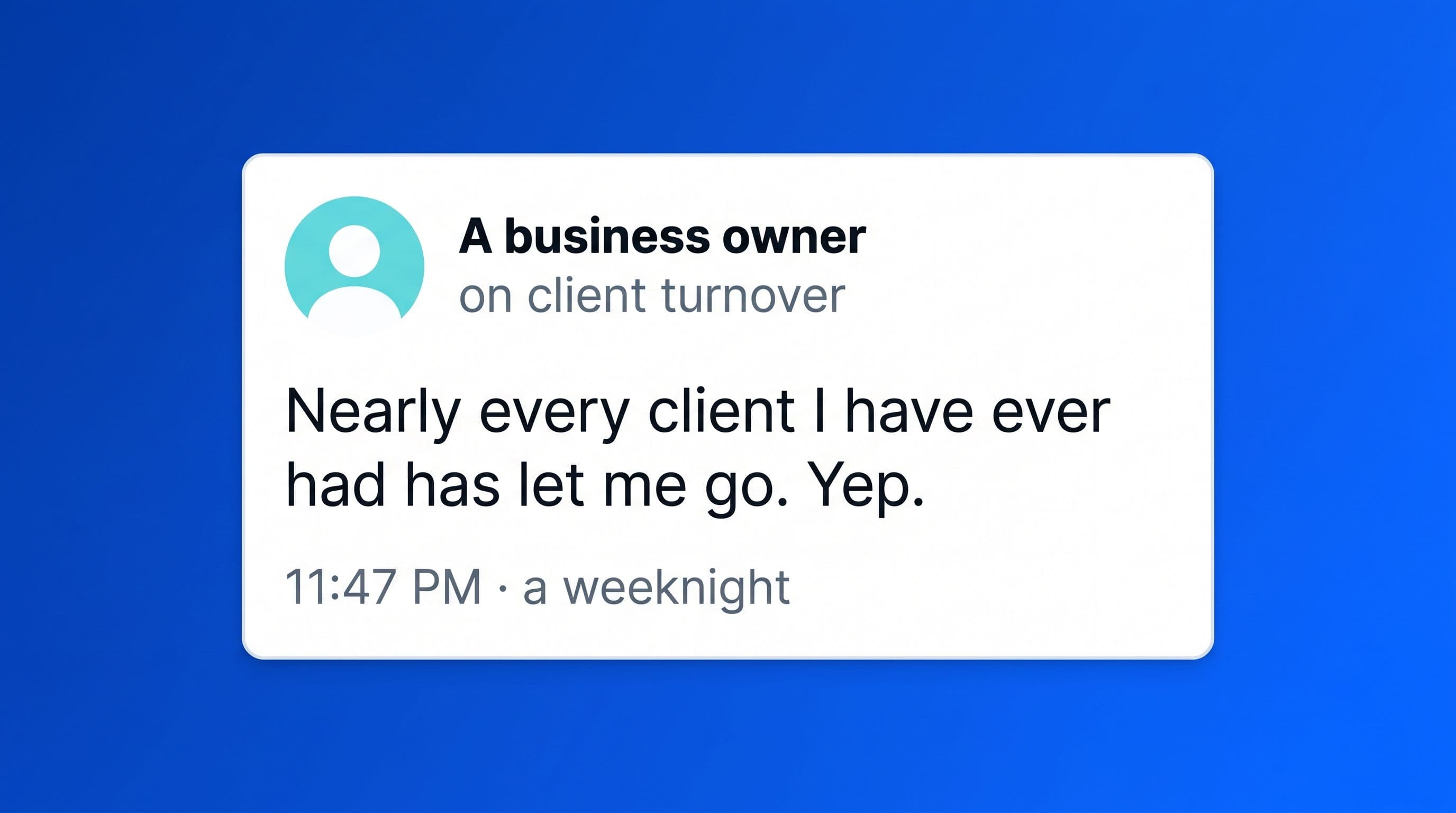
"Nearly every client I have ever had has let me go. Yep." (Rose)
A pattern nearly every consultant recognizes
That line could have been written by almost any owner who's still the whole sales department with enough years behind them. The shape is always the same: things seem to be going well, and then a message ends the relationship on a timeline you didn't choose. Sometimes it's a clean goodbye email. Other times it's quieter: a check-in that just stops getting answered.
Afterward comes the replay: the call where you maybe talked too long, or the deliverable you maybe should have pushed back on. You scroll through old messages looking for the moment it went wrong, because if you can find the moment, you can fix it next time.
Then there's the practical part. You open the CRM or the spreadsheet and move one more name to inactive. The number of active clients drops by one, and the number of new leads in the pipeline doesn't rise to meet it. You start wondering whether this is just what happens to you, or whether it's what happens to everyone who does this work long enough.
Why do my clients keep leaving even when I work so hard?
The work itself is sold in finite units, and that timeline runs independent of your quality. A project reaches its deliverables and closes. A retainer runs its term and winds down; a budget gets reallocated to a different priority. Or the person who championed you internally takes a new job, on a schedule that has nothing to do with your performance.
The buyer-side clock is already running before you do anything at all: median U.S. job tenure is 3.9 years overall and 3.5 years in the private sector, according to the Bureau of Labor Statistics. The structure of the engagement matters too: project-based work churns at roughly 42% a year with an average client lifespan near 24 months, compared with about 18% annual churn and a 56-month lifespan for retainer work, according to Focus Digital's 2026 agency-churn analysis (the report doesn't publish its sample size or methodology, so treat the exact figures as directional rather than a precise industry benchmark).
| Engagement type | Annual churn | Average client lifespan |
|---|---|---|
| Project-based | ~42% | ~24 months |
| Retainer-based | ~18% | ~56 months |
Source: Focus Digital, 2026 agency-churn analysis. Methodology (sample size, data source) isn't published, so treat these figures as directional rather than precise industry benchmarks.
Run either number out over a 20- or 30-year career, and the pattern compounds toward the same place the opening quote describes: nearly every client you've ever had, eventually moving on, regardless of how the work went.
Four forces ending these relationships at once
Four separate forces tend to converge on the same owner at once. Three sit almost entirely outside your control: who holds the budget on the client's side, how buyers already behave before they ever talk to you, and how buyers feel about vendors in general. The fourth, how thin your own acquisition channel is, is the one place your choices still shape what happens next.
The first is a thin acquisition channel. Most independent consultants lean on referrals by default: 57% say they get 60% or more of their business through referrals, and only 7% get the bulk of it, 95% or more, from anywhere else, per ConsultingSuccess.com's consultant marketing study. When referrals are nearly the whole system (see our guide to what happens when referrals dry up), losing even one client removes a node the rest of the network depended on.
The second is who holds the relationship on the other side. Roughly 1 in 5 director-level-and-above roles turns over in a given year, according to LinkedIn Sales Solutions. In most B2B relationships, a single contact owns the relationship rather than a team. When that one person leaves, the relationship often leaves with them.
The third is how buyers already behave before anything looks like rejection. In 6sense's 2025 B2B buyer experience report, 94% of buyers said they ranked a shortlist of vendors on their own before contacting any of them. Buyers initiated 79% of engagements themselves. A client going quiet mid-project is frequently just a buyer running their own research and decision process on their own timeline.
The fourth is that ambivalence toward vendors is common even on healthy accounts. Gartner has found that 60% of technology buyers involved in renewal decisions say they regret nearly every purchase they make, on the buyer's side, independent of the vendor's actual performance.
None of that means delivery never matters. When clients do leave, the most commonly cited reason is dissatisfaction with delivery, cited by 48% in a 2025 survey covered by Swydo. The honest read holds both things at once. Turnover is structurally built into project and retainer work, and it's still worth asking, client by client, whether something in the delivery actually went wrong, rather than filing every departure under the same explanation.
How owners who are still the whole sales department cope
Here are two ways we see owners cope with this, and each comes with a real cost.
Some respond by doing more inside the relationships they already have: doubling down on referral asks and coffee chats, or saying yes to every extra request and absorbing the scope creep that comes with it, hoping enough effort keeps a client around longer. It can buy a little time. But referrals are still one channel, so a full calendar still gives way to a quiet one on roughly the same schedule, just slightly delayed, and the extra scope eats into margin and prospecting time, which makes the next client harder to find, whether or not this one actually stays.
Other owners wait until a client is already gone before starting the search for the next one. It feels responsible in the moment, since every hour went to paying work while it lasted. What follows, in our experience, is a pipeline that's already been quiet for months, with new work typically taking a couple of months to reliably reappear once prospecting starts back up.
Rose, the consultant behind the opening quote, put the deeper version of this plainly:
"You cannot build something sustainable when you are running on empty and calling it discipline." (Rose)
None of these owners are doing anything wrong, exactly. They're responding reasonably to a structure that was never going to hold still. The habits that close the gap look different from any of this, and they start before the current client is anywhere near the door.
How do I stop losing clients when I'm still the whole sales department?
You can't stop clients from eventually leaving, no matter how good the work is. You can make sure you're never caught without a replacement already moving through the pipeline.
Two habits do most of the work, and neither needs software. A spreadsheet with calendar reminders, or a VA running the list on your behalf, works just as well as any paid tool. First, protect a fixed block of time each week for prospecting, the same hour regardless of how busy delivery gets, because the moment prospecting pauses during a busy stretch is, in our experience, when a multi-month drought starts compounding. Second, keep a running list of every past client with a reminder to check back in every 60 to 90 days, as a rule of thumb, and send that check-in while the current contract is still active, ahead of its natural end date. A short note (a reminder of what you solved together, plus one concrete next step) is the version we'd send instead of a generic "just checking in." Our guide to finding consulting clients without a network walks through the manual version of this cadence in more detail.
Keeping both up means you're never starting from zero, whether or not any single client relationship survives.
How do I build a pipeline that survives losing a client?
You take the same two habits and stop depending on your own memory to run them, especially during the exact weeks when delivery work is eating every spare hour. This is where Klipy (the AI CRO: the AI agent that runs your entire sales operation) is built to take on one narrow job: on the roadmap, surfacing which past clients haven't heard from you in 60 to 90 days, as a rule of thumb, and drafting a re-engagement message for your approval, ready before you'd otherwise think to send it.
The same roadmap extends to prospecting: a cadence of draft outreach ready for your review on the weeks you're fully heads-down delivering, so the habit doesn't quietly lapse just because a project got demanding. As autonomous as you allow, never more. Klipy drafts; you approve each message before it goes out.
Clients still move on eventually. The difference is that the next one is already somewhere in the pipeline, in motion, before the current one leaves, instead of a search that starts the week after the goodbye email arrives.
Put a number on what this is costing you
If you want an actual number instead of just a bad feeling, the Solo Sales Tax report, our breakdown of what running sales entirely solo costs an owner in hours and lost deals each month, puts a figure on the gap between clients.
If a client is already going quiet and you want a template to reopen that door while the relationship is still warm, our free cold-client re-engagement generator gives you a starting message. And if this pattern sounds like the same root problem as a dried-up referral pipeline or a proposal that's gone quiet, it is: all three come back to the same root cause, why prospecting stops the moment delivery gets busy.
A client leaving eventually is normal. A pipeline that already dried up because prospecting stopped during the delivery crunch is the fixable part.
FAQ
Is it normal to lose every client eventually, or does it mean I'm doing something wrong?
It's normal. Engagements are structurally finite: projects complete, retainers wind down, budgets get reallocated, and champions change roles. Losing most of the clients you've ever worked with, eventually, is the expected long-run outcome of project- and retainer-based work, regardless of how good the delivery is. That said, when clients do leave, the most commonly cited reason in 2025 surveys covered by Swydo was dissatisfaction with delivery, so it's worth honestly separating "this engagement simply ran its course" from "something in the delivery genuinely went wrong," case by case.
What should I do when a client ends the engagement and I don't have a replacement lined up?
Treat the gap as a symptom of pipeline drought: in our experience, new pipeline typically takes a couple of months to reappear after delivery work has been eating your selling time. The fix is starting the next client's prospecting and re-engagement motion before the current contract ends, so there's no gap to scramble inside of.
How do I re-engage a client who went quiet before I lose them for good?
Reach out early, while the relationship is still warm and before the contract's natural end point. A short, low-pressure message that reminds them what you solved together and offers one concrete next step is a stronger opener than a generic check-in, in our experience. Our free cold-client re-engagement generator is a starting template for that exact message.
Why did my best client leave even though they said they loved the work?
Loving the work and staying are two different decisions, and the second one often sits on someone else's org chart. Roughly 1 in 5 director-level-and-above roles turns over every year, according to LinkedIn Sales Solutions, and most B2B relationships run through a single contact rather than a team. When that person leaves the role, whether through a promotion or a move to a new company, the relationship can end regardless of how satisfied they were with the delivery.
How many months of pipeline drought should I expect after a big project ends?
In our experience, the typical lag is roughly two to three months: pipeline dries up that long after delivery work has been consuming all your selling time, because prospecting paused while you were heads-down delivering. Keeping even a thin, consistent prospecting cadence running during delivery crunches is what shortens or removes that lag.
This spoke is part of our guide to what happens when everything runs through the owner: why pipeline dries up right when delivery work peaks.