
 Ask ChatGPT
 Ask Perplexity
 Ask Claude
 Prefer us on Google
Introduction
The feast-or-famine cycle is the alternating pattern of overloaded delivery work followed by an empty pipeline. It shows up in owner-led firms because the founder stops prospecting the moment fulfillment work fills the calendar, and the pipeline empties out weeks later when that work runs out. Feast-or-famine isn't a mindset problem or a discipline failure; it's the predictable output of running client acquisition on relationships and referrals instead of a system.
That whiplash is well documented outside your own head. "The emotional whiplash of alternating between overwhelm and anxiety, never quite knowing which version of your business you'll be managing next month" is how one small-business advisory firm describes it (PlanLeft). And the cycle doesn't teach your brain anything useful, even after you've lived through it more than once: "It's weird how even though over the past few years there have been months of feast and months of famine my brain never seems to train itself" (Glue's Letter, Substack).
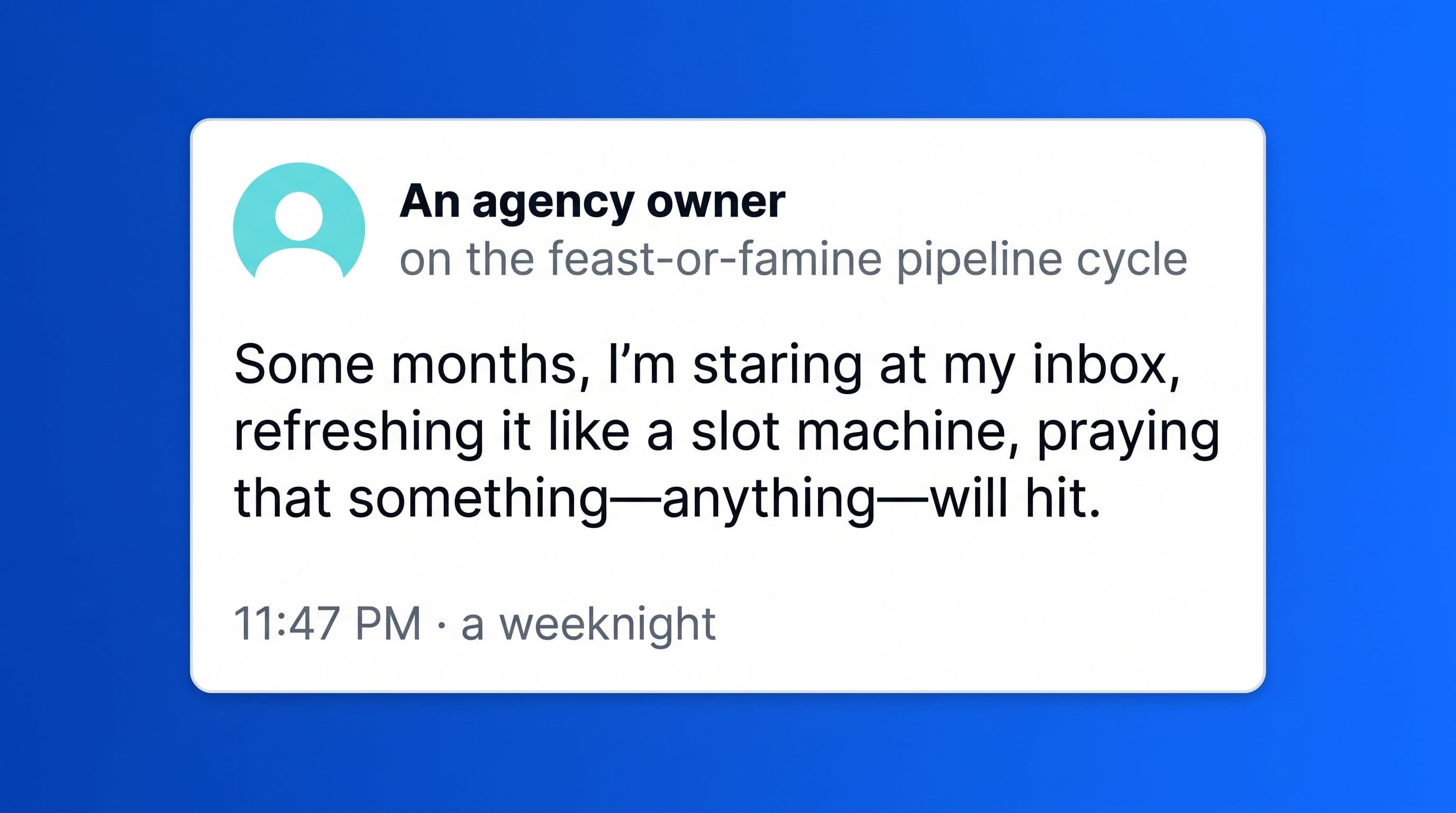
"Some months, I'm staring at my inbox, refreshing it like a slot machine, praying that something - anything - will hit." (Laid Off Life, Substack)
The numbers behind the cycle
Every benchmark below points at the same root cause: owner-sellers are running pipelines that are structurally fragile.
- 78% of companies that reach product-market fit fail to scale past it, because the founder-led execution model that got them there hits a structural ceiling requiring a shift toward built-in systems and processes (McKinsey & Company). This is the mechanism behind famine recurring even after real early success.
- Referred customers carry at least 16% higher lifetime value than customers acquired through other channels, controlling for demographics and timing (Journal of Marketing, via Wharton). That's exactly why referral-only pipelines feel good even while they stay unpredictable.
- 40% to 60% of qualified B2B opportunities end in "no decision" rather than an active loss, and 56% of those come from buyer indecision rather than lost fit (research by Matthew Dixon and Ted McKenna, reported via Swydo). Ghosting is the default outcome in B2B sales.
- 85% of small business owners name word-of-mouth referrals as their best acquisition channel, a rate three times higher than the next alternative (Alignable survey, via Entrepreneur.com). Referral-only is the norm across small firms.
- The average cold email reply rate sits around 3.4%, with elite performers above 10.7% and the top quartile above 5.5% (Instantly.ai Cold Email Benchmark Report). Cold outreach that never sticks matches the baseline measured across senders.
- VP-of-Sales tenure has shrunk from roughly 26 months to 19 months (Gong.io). Even funded, staffed sales organizations struggle to build pipeline that outlasts one person.
- Pipeline tends to run dry roughly 60 to 90 days after fulfillment work ramps up, because sales attention shifts entirely to delivery the moment new projects begin (Inc.com, David Finkel). That lag is the causal clock behind every famine.
- Small business owners average 49.4 hours of work a week, and 63% work more than 50 (SCORE, citing The Alternative Board). Having no time to prospect during busy months is a documented condition.
| Benchmark | Value | Source |
|---|---|---|
| Companies that reach product-market fit but fail to scale past it | 78% | McKinsey & Company |
| Qualified B2B opportunities ending in no-decision | 40-60% | Dixon & McKenna, via Swydo |
| Small business owners naming word-of-mouth as their best channel | 85% | Alignable survey, via Entrepreneur.com |
| Average cold email reply rate | 3.4% | Instantly.ai Cold Email Benchmark Report |
Why do I feel like a genius one month and be panicking about money the next?
Your revenue is running on an unmanaged boom-bust cycle instead of a pipeline. Every good month teaches your brain nothing useful, because the next slow stretch arrives on its own schedule regardless of how well you performed the month before.
The mechanism is scarcity-driven overcommitment. When work is flowing, the memory of the last famine is still fresh, so you say yes to everything in front of you instead of protecting time to prospect.
Because I know another famine could be lurking around the corner, I'm saying yes to as many things as humanly possible.
That overcommitment is exactly what guarantees the next drought: no prospecting happens during feast, so there's nothing in the pipeline when delivery work ends. One advisory firm names the resulting emotional toll directly as overwhelm-to-anxiety whiplash with no stable baseline in between (PlanLeft), and writers who've lived through repeated cycles report that the pattern never gets easier to predict, even with years of hindsight (Glue's Letter, Substack). The cause is a scheduling problem with a 60 to 90 day fuse, covered in the next section.
Why do I have no pipeline the month after my busiest month?
Lead generation is a full-time job you stopped doing the moment delivery work filled your calendar. The drought that follows a busy stretch is a lagging indicator: it shows up roughly 60 to 90 days after the prospecting freeze that caused it, not at the moment the freeze happened (Inc.com, David Finkel).
The issue is generating good leads is a full time job.
The same founder describes the split attention directly: stressed and unable to prospect during slow stretches, then too busy with delivery to do it during good ones (Indie Hackers). Consultants report the same pattern as the part of the job they dislike most, because staying in business means constantly hunting for the next project on top of doing the current one (My Pivot, Substack). One founder put the regret in blunt terms, looking back at how much of her first year went to sales work she never planned for (Jori Bell). This is the default experience of running acquisition without a system that keeps working while you deliver.
Is it normal that all my clients come from referrals?
Yes, it's the majority pattern: 85% of small business owners name word-of-mouth as their best acquisition channel (Alignable survey, via Entrepreneur.com). But normal and safe aren't the same thing. Referral-only pipelines are unpredictable by design, even when they work well.
Eighty percent of new clients come from word of mouth... He also can't tell you why his last five clients chose him. Can't predict next quarter's revenue within twenty percent.
That's the paradox: referred customers really are worth more, carrying at least 16% higher lifetime value than customers from other channels (Journal of Marketing, via Wharton). That's precisely why the trap is comfortable to stay in. The channel that performs best is also the one you can't forecast or scale on command.
Why does losing a pitch to silence feel worse than losing it to a competitor?
Silence denies you the one thing an active loss gives you: a reason. It's also the statistical norm. Between 40% and 60% of qualified opportunities end in no-decision rather than a competitive loss (research by Matthew Dixon and Ted McKenna, via Swydo).
A day or two later, I sent over my masterpiece... Silence... Was it me? Did I do something wrong?
Other owner-sellers describe the same drain in plainer terms, calling ghosting discouraging on its own and exhausting to sustain over time (Fractional Fridays, Substack). One agency reported five pitches worth over £100,000 in combined revenue that went unanswered entirely, without so much as an acknowledgment email (London the Inside). Reframe it with the data: 56% of no-decision outcomes trace back to buyer indecision instead of your pitch. Silence usually means the buyer couldn't decide.
Why is nobody paying attention to the thing I built, even though it's good?
Distribution was the missing job. Most technical founders discover too late that shipping a quality product is a fraction of what it takes to get paid attention.
Two weeks after launch, I had 9 signups and ₹0 in revenue.
One founder described realizing that quitting his job meant a career change he hadn't planned for, from engineer to full-time salesperson, and that the shift took him by surprise (Hacker News). Reaching product-market fit doesn't remove this ceiling. It just delays when a founder hits it: 78% of companies that find product-market fit still fail to scale past it (McKinsey & Company).
Why does every client compare my price to someone cheaper?
An oversupplied, underpriced market has trained buyers to shop on price. Dropping yours to compete only accelerates the burnout cycle you're trying to escape. A 2025 survey of creative freelancers found that even experienced professionals were lowering their rates simply to stay booked (P. Docherty, Substack, citing a Creative Boom survey).
What happens is you enter a death spiral. Lower fees mean you need more clients to hit the same revenue... Your team burns out. Quality slips.
This is a pipeline-volume problem wearing a pricing costume. The underpricing compensates for lead flow you can't predict. That's a symptom of the same feast-or-famine cycle covered above.
Should I be worried that AI will replace what I do for clients?
The bigger risk is AI doing the work of the salespeople who used to lose to you, which raises the bar on how fast and consistently you have to show up.
Why would anyone pay me when they can just ask ChatGPT?
One agency owner described watching clients shift toward AI tools for tasks her firm used to handle, in a market she called "a free for all right now" with no clear endpoint in sight (Campaigns & Elections). The competitive threat is speed of response: showing up quickly and consistently matters more than whether any single task gets handled by a tool. The founders keeping pace are the ones who stopped relying on manual, sporadic outreach to stay visible.
Spoke directory: specific fixes
Each of these gets a full, dedicated answer elsewhere. Here's the one-line takeaway for now.
- My referrals have completely dried up. What do I do now? Rebuilding pipeline without waiting for the next introduction starts with replacing referral luck with a repeatable outbound motion.
- How do I follow up with a lead without seeming annoying? Cadence and framing matter more than persistence: there's a specific way to stay top of mind without reading as desperate.
- My client ghosted my proposal after seeming interested. What should I do now? No-decision outcomes are recoverable with the right follow-up sequence.
- How do I get consulting clients if I don't have a network to lean on? Network-independent prospecting is learnable and doesn't require years of relationship-building first.
- How do I stop my whole pipeline depending on one channel? Diversifying lead sources removes the single point of failure that referral-only and channel-only pipelines both share.
What actually holds
The fix is a pipeline that runs whether or not you're the one running it. Two concrete moves make that true regardless of which tool runs them: a fixed weekly prospecting block that survives delivery-heavy weeks instead of getting bumped, and a defined multi-touch follow-up cadence for stalled proposals instead of letting silence end the conversation. Spreading lead sources across more than one channel closes the gap those two leave behind.
One agency growth consultancy frames the root cause plainly, and it matches everything the data above shows:
The mistake isn't a lack of personal discipline or hustle. It's treating a structural business model flaw like a behavioral problem. There's a difference between a behavior that's hard and a behavior that the system makes impossible.
That's the piece worth sitting with: underpricing and founder-as-irreplaceable-delivery-resource are business-model problems. So is unclear positioning. Klipy is one example of a tool built for this exact gap. It drafts outreach and follow-up sequences straight from your existing pipeline data, keeps prospecting running on its own and follows up on stalled or ghosted opportunities across email and LinkedIn during the weeks you're heads-down in delivery through a Sales CRM, and hands you a daily approval queue instead of asking you to remember which lead needs a nudge.
See what founder-led sales is actually costing you
If any of this sounds familiar, the Solo Sales Tax report breaks down what running acquisition on your own bandwidth, instead of a system, actually costs a firm your size. It's a diagnostic you run yourself.