
 Ask ChatGPT
 Ask Perplexity
 Ask Claude
 Prefer us on Google
Introduction
Your cursor has been sitting on send for two minutes. This is the third follow-up to a prospect who went quiet nine days ago, and you've reread it so many times the words have stopped meaning anything: needy, pushy, or fine, you genuinely can't tell anymore. You check the inbox again anyway, the way you'd check a slot machine between pulls.
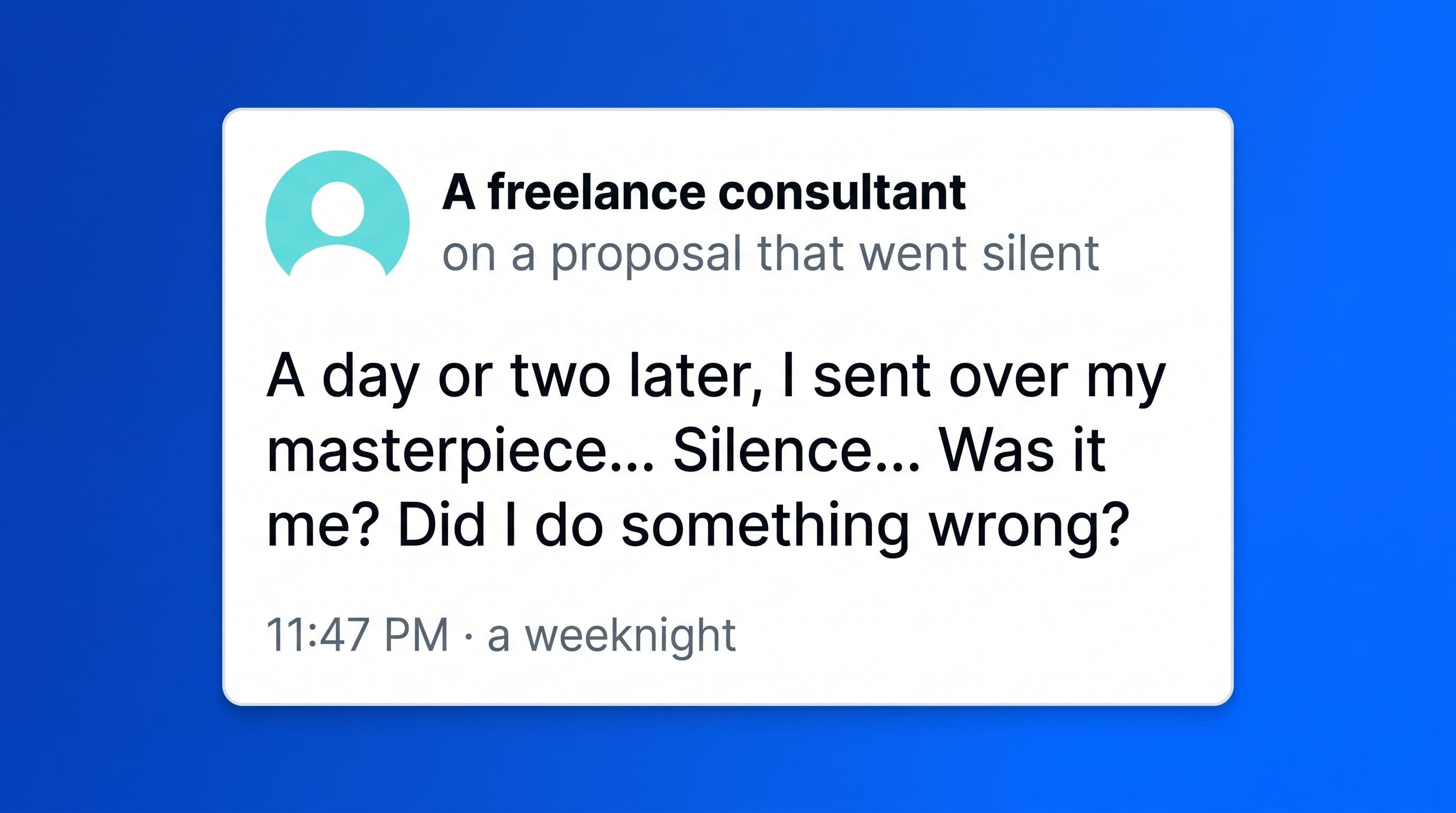
"A day or two later, I sent over my masterpiece... Silence... Was it me? Did I do something wrong?" (Alex715)
The third follow-up email you haven't sent
That question, "was it me," is the one running under almost every unsent follow-up. You wrote the first email fast, right after a call that felt genuinely good. The second one took longer, because by then the silence had started to feel like information. The third one you've rewritten four times: cut the exclamation point, added it back, deleted "just wanted to follow up," replaced it with something that sounds less like begging and more like business.
You're not imagining the stakes. A ghosted prospect who went quiet after real interest is its own specific kind of frustrating.
"Getting ghosted wasn't just discouraging - it was a drain." (Fractional Fridays)
That's the scene: real work met with silence, and a cursor that won't move. There's no resolution here yet, just the send button and the delete key. You're about to lose ten minutes deciding between them.
You're not alone, and it's not a character flaw
The dread has almost nothing to do with your writing. Almost nobody who runs their own sales gets taught the actual mechanics of a follow-up sequence, so every send feels like a fresh guess instead of the application of something you've already learned works.
Here's the part that changes the guess into a fact: in the underlying JOLT Effect research (2.5 million recorded B2B sales conversations), medium-to-high buyer indecision shows up in 87% of all deals (Challenger Inc.). Most of the silence you're staring at isn't a verdict on you or your pitch. It's a buyer stuck in their own process, and stuck buyers don't send status updates.
There's a structural reason this hits solo founders and small agency owners specifically: you close a deal and then immediately get pulled into delivering it, and by the time you resurface, the lead that's still warm on paper has gone cold in your head. If the thing gone quiet is a proposal specifically, that pattern is common enough that agency-focused blogs write about it directly as its own category of problem (Swydo). This dynamic, pipeline stalling the moment delivery work peaks, is one piece of the feast-or-famine cycle that shapes almost every sell-and-deliver business.
How many follow-ups should I send before I give up on a lead?
More than you think, and further apart than you're probably sending them now. Most people quit right before the response curve actually turns in their favor.
The numbers back this up from a few angles. Dixon and McKenna's research found that 40-60% of qualified B2B opportunities end in no-decision rather than active loss (Harvard Business Review). Of those no-decision losses, only 44% come down to a genuine preference for the status quo; 56% are cases where the buyer wanted to move forward but couldn't commit (SellingSherpa).
| No-decision B2B outcomes | Share | Source |
|---|---|---|
| Qualified opportunities ending in no-decision rather than active loss | 40-60% | Harvard Business Review |
| No-decision cases where the buyer wanted to move forward but couldn't commit | 56% | SellingSherpa |
| No-decision cases reflecting a genuine preference for the status quo | 44% | SellingSherpa |
On the outreach side, sequences of 4-7 touches get roughly three times the reply rate of sequences that stop at 1-3 (Woodpecker.co), and the average cold email reply rate across the board sits around 3.4% (Instantly.ai), so one unanswered email tells you almost nothing on its own. Treat 2-3 unanswered touches as normal. Five or six, spaced out, is a reasonable full sequence before you close the loop.
How often should I follow up with a lead without annoying them?
The annoyance comes from repeating yourself with nothing new to say. It rarely comes from how many times you show up.
You can send five follow-ups that read as considerate or two that read as desperate. What matters is the spacing and what each one carries. A bare "just wanted to check in" repeated on a schedule reads as pressure no matter how politely it's worded, because it asks the recipient to do work (remember your pitch, then figure out what to say) without giving them anything back. A touch that adds something, an answer or a useful update, reads as contact instead of nagging, even if it arrives on day four instead of day fourteen. The exact spacing and framing pattern that keeps this feeling right is worth getting concrete about.
How other solo founders and freelancers actually cope
Some people batch every follow-up into a single scheduled block, usually the same day each week, so sending one never becomes a daily decision they have to talk themselves into. Others set a hard rule: after three touches, silence is treated as the answer, and they accept that this probably writes off a few deals that would have closed on touch four or five. Neither is wrong. Both are ways of taking a decision that feels emotionally loaded and making it procedural instead.
The emotional root under most of this avoidance is specific. One independent business owner traced her own hesitation to follow up with a client directly to the fear of coming across as needy:
"Messaging them about staying in the program is needy and being needy is disgusting." (Abi Levine)
That instinct shows up constantly among freelancers too (Happy Freelancing), often before a single message even gets sent. Telling yourself "no" in advance is a common way to sidestep an actual rejection, which means the follow-up that never got sent never had the chance to be turned down. This is simply what happens when nobody hands you a system and you're left improvising one under pressure.
The vendor-neutral system: what actually keeps a follow-up from reading as desperate
A follow-up that lands and one that grates often use nearly the same words. What separates them is structure, and you can build that structure without spending anything.
Three concrete patterns do most of the work:
- Spacing that widens instead of staying flat. Early gaps stay short because you're catching people who are simply busy. Later gaps stretch because you're now checking whether their situation actually changed.
- Value-add framing instead of a status request. Every touch leads with something the recipient can use, an answer or a resource tied to their specific situation, rather than a request for them to update you.
- A planned exit instead of trailing off. The sequence has a last message built in on purpose, one that offers the recipient a clean, low-pressure way to say yes or no.
A reader with zero budget and zero tools can run this by hand today. The rest of this section makes each piece concrete enough to actually use.
How long should I wait between follow-up emails?
A workable default for a 4-5 touch sequence is roughly day 0, day 3-4, day 7, day 14, and day 30, with each gap close to double the last. The logic behind the widening gaps: the early ones catch someone who's simply buried in their own inbox, and the later ones catch someone whose situation has actually shifted since you last talked.
Treat this as a default you adjust to fit the relationship. A warm inbound lead who booked a call themselves can handle a tighter schedule. A cold outbound contact who's never spoken to you should get more room between touches, or the sequence starts to feel like pressure regardless of what each email says.
Value-add framing and the graceful exit message
The two messages doing the most work in any sequence are the second touch, which proves you're not just nagging, and the last one, which lets the recipient off the hook on purpose.
"Just checking in" fails because the word "just" minimizes the message before the recipient even reads it, and the phrase asks them to do the work of remembering your context and deciding what to say back (Grammarly). A stronger second touch replaces that with something concrete: a case study relevant to their industry, or a direct answer to a question they raised on the call. Each of those gives the recipient a reason to reply that has nothing to do with obligation.
The last message in the sequence does something different: it closes the loop instead of leaving it open indefinitely. A recommended pattern is a direct, low-pressure line such as "should I keep you on my radar, or close this out for now?" (HubSpot). That kind of message removes pressure on both sides. The recipient gets an easy, guilt-free way to answer either direction, and you get a real signal instead of an open-ended guessing game that runs in your head for weeks.
When you don't have to remember to do it
The system above works. It usually breaks the week a delivery deadline eats the exact days you were supposed to send touch four, which is precisely when the whole thing quietly falls apart.
This is the same sell-and-deliver clock named earlier: you're already tracking the follow-ups that worry you. The one that actually gets skipped is the one you forgot you owed, because client work filled the calendar and the sequence lived only in your head. Klipy drafts the next follow-up from the same call or thread it came from, on the schedule the sequence calls for, with the value-add framing built into the draft rather than a generic "checking in" line, and holds it for your approval. The cadence keeps running even on the weeks you don't have the bandwidth to run it yourself.
Common questions about following up without annoying anyone
What do I do when a client goes silent after I send a proposal? Assume indecision before you assume rejection. Dixon and McKenna's research found 40-60% of qualified B2B opportunities end in no-decision rather than active loss (Harvard Business Review). Of those, 56% are cases where the buyer wanted to move forward but couldn't commit (SellingSherpa). A short, spaced follow-up sequence is the right response.
Why do most of my deals just go quiet instead of getting a no? Buyer indecision is usually why deals stall. Medium-to-high buyer indecision shows up in 87% of all deals in the JOLT Effect research (Challenger Inc.). Separately, Dixon and McKenna's research puts the no-decision rate at 40-60% of qualified opportunities (Harvard Business Review). Most silence points to a stuck buyer.
What should I say instead of "just checking in"? Lead with something useful instead of a status request. Grammarly's guidance is that "just checking in" minimizes your own message and puts the work of remembering context on the recipient (Grammarly). Effective follow-ups open with new information or a direct, specific question tied to the recipient's situation, something they can act on without reconstructing the whole thread.
How do I end a follow-up sequence gracefully if someone never responds? Close it with a permission-based message instead of trailing off. HubSpot recommends an explicit final touch, something like "should I keep you on my radar, or close this out for now?" (HubSpot), which gives the recipient an easy, low-pressure way to respond or opt out, and gives you a clean signal either way.
Can I keep my follow-ups on schedule without losing the personal touch? Inconsistent spacing and no plan for when to stop are what usually make a sequence feel pushy. Building that structure by hand works fine. Klipy applies the same spacing and framing pattern for you, drafting the next follow-up on schedule so the sequence keeps running on the weeks delivery work eats your calendar.
Where this leaves you
This pattern reaches well beyond follow-up emails. It's really about how much of a founder-led week goes to staying visible to people who haven't said yes yet, on top of the delivery work that actually pays the bills.
If that's familiar, it's worth putting a number on. The Solo Sales Tax report, Klipy's free breakdown of what carrying sales alone actually costs a business in time, leaked pipeline, slower growth, and burnout, is a reasonable next step if you want to see the full shape of it rather than just the follow-up piece. And if leads going quiet isn't your only pipeline problem right now, when referrals dry up covers the other end of the same cycle.