
 Ask ChatGPT
 Ask Perplexity
 Ask Claude
 Prefer us on Google
Introduction
One month the calendar was full and every new client came from someone else's referral. The next month, the emails stopped: no warm intro, no old client mentioning your name to a friend. You keep checking the inbox anyway.
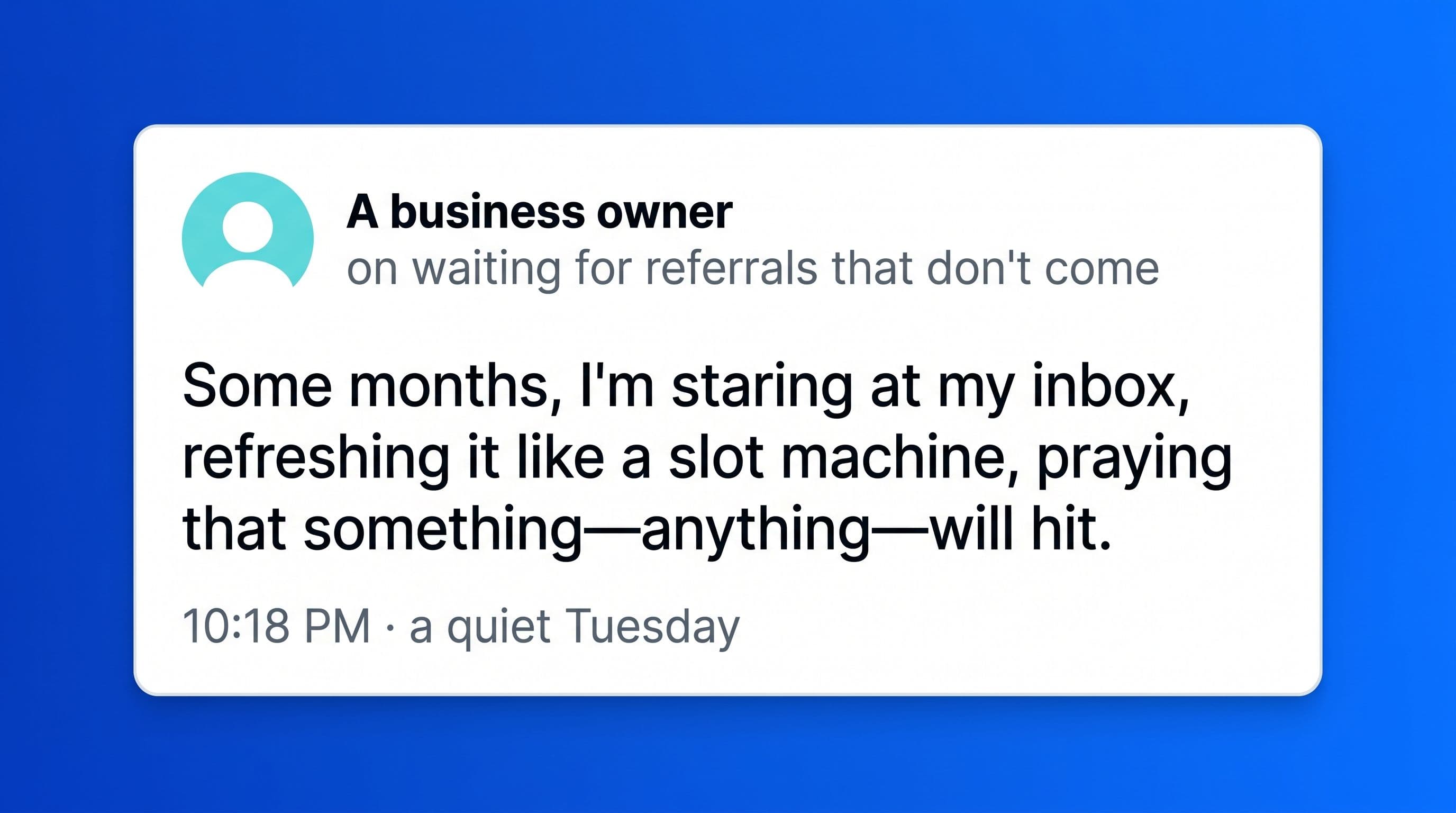
"Some months, I'm staring at my inbox, refreshing it like a slot machine, praying that something - anything - will hit." (Laid Off Life)
The month the referrals just stopped
You didn't do anything different. You delivered the same work and followed up the same way, staying just as close with the clients you always have. Then the intros just stopped showing up.
For a lot of owners, that first dry month feels personal. You start replaying the last project in your head. Did the client seem less happy at the end than usual? Did you follow up enough after the work wrapped? It is easy to spend a week auditing yourself for a mistake that was never actually there.
Here's what is really going on underneath that panic: you built the business the way most small firms do, on referrals as the main source of new clients, with nothing else running behind them. Referrals are still most small businesses' top source of new customers, and that reliance runs even deeper at the smallest firms, according to a 2025 LocaliQ small business marketing survey (the exact figures are in the numbers section below). Almost none of those businesses have a second channel warmed up for the month referrals go quiet. So when the one channel you actually have stalls, the whole pipeline stalls with it.
That's the design of a business built around a single lead source, not a verdict on your work. It's also one turn of the wider feast-or-famine cycle that hits owner-led firms whenever delivery work eats the hours that used to go toward staying visible.
Why did my referrals stop?
Referrals stopped because referral-only runs on momentum. It works right up until the momentum breaks, and for most small firms there is nothing else behind it to catch the fall. This is the default setup for small business, with referrals as most owners' best source of new customers per LocaliQ's 2025 survey (full figures below). A 2017 Alignable survey reported by Entrepreneur.com put the figure even higher, at 85% naming word-of-mouth as their top channel. That number is close to a decade old now, but it shows referral dependence has been the small-business default for a long time, well before this particular dry month.
The deeper reason almost nobody builds a backup channel before they need one: referred customers are worth more money. A Journal of Marketing study that tracked roughly 10,000 bank customers over three years found referred customers carry at least 16% higher lifetime value than similar customers who weren't referred, with retention advantages that hold up for years. Referred clients tend to become your best clients. That is exactly why owners keep leaning on referrals long after they should have added a second channel. The gap left behind when that channel slows down is structural: it got built into the business the day referrals became the only source of new work.
Referral dependence, by the numbers
The numbers behind referral dependence line up into a clear pattern once you put them side by side.
| Metric | Figure | Source | Year |
|---|---|---|---|
| Small businesses citing referrals as their top acquisition channel | 65% overall (75% for businesses with 10 or fewer employees) | LocaliQ small business marketing survey | 2025 |
| Lifetime-value premium for referred vs. non-referred customers | At least 16% higher (up to 25% in a later summary) | Journal of Marketing (Schmitt, Skiera & Van den Bulte) | 2011 |
| Cold email reply rate, opens-based methodology | 3.43% | Instantly.ai cold email benchmark report | 2026 |
| Cold email reply rate, strict send-based methodology | 0.45% | Belkins cold email response rates study | 2026 |
Sources: LocaliQ, 2025; Journal of Marketing, 2011, with a plain-language summary from Extole; Instantly.ai, 2026; Belkins, 2026.
The gap between those last two numbers is the actual lesson. Cold outreach reply rates depend heavily on how you count them, so a single stat from a single vendor is a poor thing to bet a slow month on.
How other solo owners are riding it out
None of this makes a dry month feel less real, and the people living through it aren't shy about saying so once you look at what they write in public.
Some owners wait it out. Marilyn Wo, who writes the newsletter Very Good Productized Guides, described referrals shutting off after a flush stretch and doing nothing different in response:
"Then one day… not even one cricket. No new emails. No new clients. Just me refreshing my inbox like it owes me money." (Marilyn Wo)
She kept waiting for referrals to pick back up on their own, and by her own account that wait ran up real debt before work returned. Waiting is the cheapest-feeling option in the moment and often the most expensive one by the time it ends.
Other owners swing hard into cold outreach, and volume rarely pays off the way it feels like it should. One founder wrote on Indie Hackers about cold-emailing marketing agencies across 20 countries: 342 emails sent, three replies back, a reply rate under 1%.
That's hours of writing and sending for three conversations, and it lines up with the wide, unreliable range of reply-rate benchmarks in the previous section. Volume without a real system behind it is close to wasted effort.
Then there's the panic-yes: saying yes to everything that comes in during a good month because you don't trust the next one to show up. Laid Off Life put it plainly:
"Because I know another famine could be lurking around the corner, I'm saying yes to as many things as humanly possible." (Laid Off Life)
Dr Dave Heath describes the same dynamic from the outside, watching an owner who gets most of his clients from word of mouth:
"Eighty percent of new clients come from word of mouth... He also can't tell you why his last five clients chose him. Can't predict next quarter's revenue within twenty percent." (Dr Dave Heath)
Waiting and cold-outreach volume are both understandable responses to a channel you can't control, and so is overcommitting during the good months. None of them fixes the actual problem: having only one channel in the first place.

What do I do when word of mouth stops working?
Stop waiting for word of mouth to come back and start treating client acquisition like a system instead of a single lucky channel. Duct Tape Marketing makes the core point directly: referrals function as one single, uncontrollable channel, and a firm that has nothing else running is left with nothing to fall back on the moment that channel slows down. The fix is building two or three channels on purpose, before you need them, instead of scrambling for one after a dry month has already started.
In practice that means picking a small, fixed weekly habit and running it every week regardless of how busy delivery work gets. Maybe that's a set number of outbound messages sent on a schedule. It could just as easily be a piece of content, or a regular check-in with past clients, whatever fits how you actually sell. Add one channel beyond referrals, even a modest one, so a single quiet month never means a completely empty pipeline. Running it by hand every single week is the part that quietly falls apart once a busy delivery month eats the time you meant to spend prospecting.
How do I get clients when referrals dry up?
Start with the fix from the last section: a fixed weekly cadence of outbound and follow-up, spread across more than one channel. For most solo operators and small teams, the plan itself is fine. What actually breaks it is finding the hours to run it by hand every single week once delivery work picks back up.
Klipy handles that specific gap. It runs outbound prospecting and follow-up on the schedule you set, drafting the messages and sending them for your approval, so the cadence keeps going even during a month when you are buried in delivery work and would otherwise let prospecting slide. It's one way to keep the weekly habit running without having to remember it yourself, alongside the channel diversification covered above; referrals and that second channel are still what bring in the clients.
Common questions about referrals drying up
How do I know if this dry spell is normal or a real problem?
A dry spell is normal if it lines up with your usual project cycle. It becomes worth acting on once it stretches past a full billing cycle with nothing in the pipeline behind it. The signal to watch is whether you have a second channel running in the background: that matters more than how many weeks the quiet stretch lasts.
What's the first move to make this week if referrals just dried up?
Pick one small channel you can start this week: checking in with three past clients, publishing one piece of content, or sending a fixed batch of outbound messages all count. The exact channel matters less than picking one and running it every week from here on, so the next dry month doesn't catch you flat-footed again.
Do I need to learn new marketing skills to replace referrals?
Consistency matters more than learning a new marketing skill set. A simple weekly habit, run every week without fail, outperforms an occasional attempt at a fancier tactic. That habit could be a handful of outbound emails or a regular check-in call with someone in your network; a short update posted where past clients will see it works just as well. Most owners already know how to write a follow-up email or ask a past client for a quick call; the hard part is doing it on a schedule instead of only when work gets slow.
Should I do outbound instead of waiting on referrals if I'm a 5-person firm?
Outbound works best as an addition to referrals, and a five-person firm has good reason to run both at once. Referred customers carry meaningfully higher lifetime value than non-referred ones, per Journal of Marketing research, with Extole's summary of the same study citing figures as high as 25% in some analyses. The goal is reducing how dependent the business is on referrals alone, since a five-person firm cannot control when referrals slow down.
Was it something I did wrong if clients stopped referring me?
Almost never. Referrals depend on other people's timing and memory as much as they depend on your work quality, and often just as much on networks outside your control, which is why even owners with strong client relationships hit dry stretches. The real variable is usually how dependent the business is on referrals in the first place, more than anything about your performance.
Does cold outreach actually work when my referrals dry up?
It can help, but expectations matter. 2025 benchmarks from Instantly.ai put the average cold email reply rate around 3.43% under a generous, opens-based methodology. A stricter reply-per-send analysis from Belkins puts the real average closer to 0.45%. Treat cold outreach as one channel inside a bigger system, and expect it to move slowly rather than solve a dry month by itself.
Before the next dry spell hits
Referral-only carries a real cost even though you're not paying for ads: hours spent refreshing an inbox, and revenue that a second channel would have caught during the same stretch. Those costs add up whether you're tracking them or not.
The Solo Sales Tax is the name for that accumulated cost: the time, the leaked pipeline, the slower growth, and the burnout that comes from being the only person selling. Klipy's free report breaks down what that adds up to for a solo operator or a small owner-led team, no pitch required to read it.
If you'd rather see how the weekly cadence looks in practice first, Klipy's find-new-business use case walks through it. Either way, the fix starts the same place: pick a second channel and run it every week, dry spell or not.