
 Ask ChatGPT
 Ask Perplexity
 Ask Claude
 Prefer us on Google
Introduction
Someone asks how business is going. At a networking event, in a text from a referral partner checking in. "Good, busy!" comes out before you've had a second to check if it's true. You've said the same two words in a month with a dry pipeline and an invoice sitting 60 days past due, just as fast as you said them during your best quarter ever.
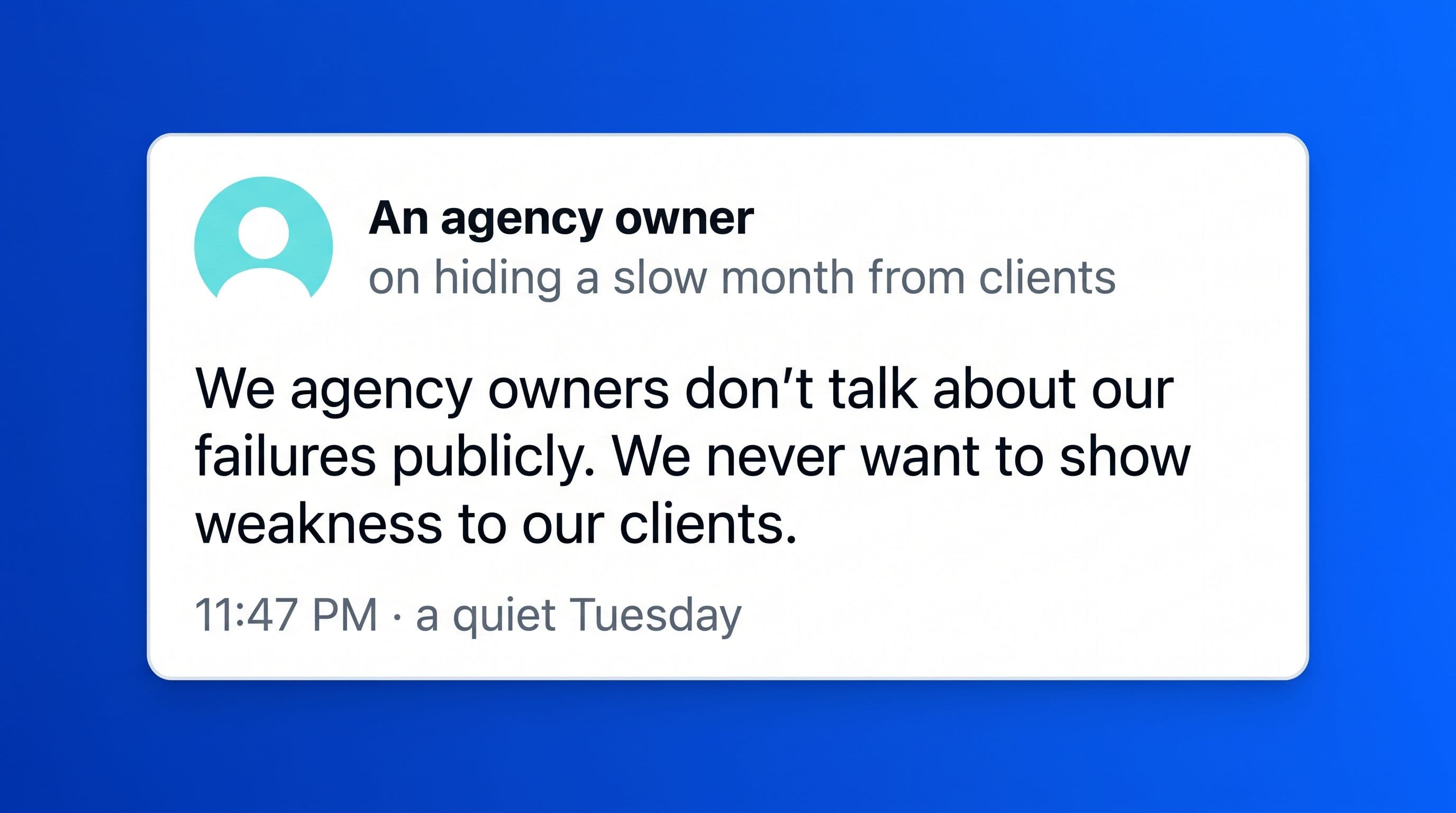
"We agency owners don't talk about our failures publicly. We never want to show weakness to our clients." (Own Your Category)
"Good, busy!"
Maybe it's a client on a check-in call, and you don't want them wondering if their account still matters to you, or the referral partner who sends you two or three deals a year, and you don't want them routing the next one somewhere else. Maybe it's your spouse at dinner, asking a simple question, and you give the simple answer because the real one takes longer than either of you has energy for tonight.
The pipeline might be dry, the invoice from three months ago still unpaid, and the afternoon spent moving money between accounts so payroll clears Friday. None of that makes it into the answer. "Good, busy!" covers a great quarter and a terrible one with the same two words, and you've said it so often you've stopped noticing the gap between what you said and what's actually happening.
Why don't I ever hear other agency owners talk about their slow months?
An agency's business runs on trust, and admitting a slow month spends it. Referral partners send work to the owner who looks like a safe bet, and clients want confidence in the person running their account. Saying "it's slow" risks both relationships at once, so most owners learn to keep the mask on as a survival habit built around who's listening.
Nav's research on small business mental health found 38% of owners say they hide how they're really doing and project confidence instead, and a third feel like no one truly understands the pressure they're under. The gap is starkest for owners already struggling: 48% say they have no one who relates to what they're carrying, compared with 15% of owners whose businesses are thriving (Nav). One owner described the same instinct in public writing: staging a busier-looking office, complete with borrowed staff, to look credible to a prospective client (Small Biz Trends).
The stats nobody puts in the group chat
The financial strain behind the mask shows up across several surveys spanning multiple years.
A Bluevine-backed survey found 71% of small business owners report moderate to extremely high financial stress, and 68% lose at least one night of sleep a month to money worries. Over half, 53%, describe themselves as emotionally exhausted or burned out, and 62% have skipped their own paycheck in the past year to keep the business running (Crowdfund Insider, reporting Bluevine's Small Business Burnout Report).
A separate Bluevine survey in 2025 found nearly half of owners, 49.2%, regularly questioned whether running their own business was worth it, and 61% postponed their own personal payments to keep the company afloat (ASBN, reporting Bluevine's 2025 Small Business Growth and Trends Report). That kind of pressure tends to show up in small daily habits too, like checking the business bank balance more often than you'd like to admit, a habit with its own explanation.
Enji's 2025 State of Small Business report found 81% of owners experienced burnout that year, even with a strong headline economy, and only 37% felt optimistic about 2026 (Barchart, reporting Enji). A strong economy on paper and a burned-out owner behind it is the gap "good, busy!" has to cover.
The trend lines up with institutional data too. Australia's 2024 National Business WHS Survey, covering 324 businesses, found 34% of small business owners had been diagnosed with a mental health condition, up from 22% in the 2022 survey (CCIWA).
Is it normal for me to hide financial stress from my clients and peers?
Yes, and the data backs it up: Nav's survey found 38% of small business owners, nearly four in ten, hide how they're really doing and project confidence instead. The cost of hiding it follows owners home too, which is part of why the mask is so hard to put down.
Owners going through divorce describe the business and the marriage absorbing the same strain. In a survey of business owners who went through divorce, 57% say the company took a financial hit and 70% say they couldn't focus on work the same way. Sixty percent also report decreased mental well-being, with revenue falling by an average of $4,000 a month during proceedings (Fortune Well, reporting a Clarify Capital survey). The direction of cause and effect is hard to untangle: work stress can bleed into the marriage just as easily as marital stress bleeds into the business, each one capable of feeding the other.
An older UK survey found something similar on a smaller scale: only 14% of home-based business owners felt able to discuss business worries with family or friends, and close to half reported feeling lonely because of it (Startups.co.uk, reporting an AXA Insurance survey from 2016). The figure is a decade old, but it points at the same pattern newer research keeps finding.
How everyone else is (sort of) coping
Most owners land on one of two imperfect options: a single trusted peer with nothing to gain or lose from the truth, or an anonymous space where no one can act on what they hear. Neither one fixes the underlying problem, and each comes with a real cost.
| Option | Protects | Trade-off |
|---|---|---|
| One trusted peer | A real relationship, built over time | Hard to find, and formal versions can be gated by revenue minimums |
| Anonymous community | The honesty itself, since nobody can act on what you say | No real relationship comes out of it |
The formal version of "one safe peer" is something like the Entrepreneurs' Organization's Forum model: confidential groups of six to ten owners, bound by a rule that what's shared in Forum stays in Forum, with no pitching and no advice-giving allowed.
"What is shared in Forum stays in Forum... Members do not pitch products or services to one another... Membership is generally limited to founders, owners or controlling shareholders of businesses with US$1 million or more in annual gross revenue." (Entrepreneurs' Organization)
It works because nobody in the room can act on what you say in a way that costs you. The catch is access: EO membership generally requires at least $1 million in annual revenue, which locks out most solo and small-agency owners, including most owners reading this.
The lower-cost substitute is posting the honest version of a slow month somewhere a client or referral source will never see it: an anonymous forum thread, a community nobody from your business world reads. Strangers hear something true, but no relationship comes out of it. Advice from strangers is a mixed bag at best, too. The peer route depends on having found that one person already. The anonymous route keeps the honesty real and gives up the relationship entirely.
Our guide to owner burnout collects a few owners saying versions of this out loud under their own names, including one who admitted he never told anyone how close he came to giving up. It's proof you're not carrying this alone.
Who's actually safe to tell the truth to
The safest person to tell has no stake in your answer: nothing to gain or lose, no way to act on it that costs you anything. Nothing else about them matters as much.
A client or a referral partner both fail that test immediately: what you tell them can shape whether they quietly start shopping for a backup, or whether the next good deal still comes your way. Even a spouse you trust completely off the clock usually fails it too, because their own finances move with yours and that changes how they hear the news.
A peer from a different market, someone who doesn't compete with you and doesn't refer into your world, usually passes the test. So does a well-chosen anonymous community, for the same reason the Forum model works: nobody can act on what you say in a way that costs you. You don't need a $1 million revenue bar to find one person like that. A mastermind, or a conference connection you only met once and liked, can work if the stake is genuinely zero on both sides.
The second practice matters as much as picking a confidant: keep the lightest version of your outreach and follow-up moving during the quiet stretch. Going dark during a slow month damages a client or referral relationship, because silence reads as unreliability in a way routine ups and downs don't.
How do I stop pretending everything is fine in my business?
Pick the one or two people where honesty is safe, and let that be the whole audience. Keep your outreach and follow-up running on their own, so the weeks you don't have energy to perform confidence don't also become the weeks a lead goes cold.
Klipy can take one piece of this. Klipy is the AI CRO: the AI agent that runs your entire sales operation. It can draft the next follow-up from your last call notes or email thread and send it once you approve it, so a referral partner or a cooling lead still feels the usual rhythm of staying in touch, even in a week when sounding confident takes everything you have. It covers one mechanical piece: staying in touch when the bandwidth to perform confidence is gone. The stress and shame of it, plus whatever is happening with a spouse, sit outside what Klipy can touch.
You don't owe anyone a status update, just the next email
You don't have to resolve how you're really doing before you send today's follow-up. The mask you wear with clients and referral partners can stay as it is. Nobody's asking you to drop it today.
What's worth a closer look is the cost of carrying all of it alone, the operating cost on top of the emotional one: being the only person who can keep deals moving and sound confident while everything else lands on an owner's desk this week. The Solo Sales Tax, our name for what it actually costs a business when every deal depends on one person's bandwidth, lays out that number in a short report built from real owner data. It takes five minutes to read.