
 Ask ChatGPT
 Ask Perplexity
 Ask Claude
 Prefer us on Google
Introduction
Speed to lead is the time between when a prospect reaches out and when your business actually responds. The research on it is blunt: contact and qualification odds fall sharply once a lead sits for more than a few minutes, and most of that decay happens inside the first hour (InsideSales.com/MIT, 2007). If you're an owner-seller who still closes every deal personally, even with a delivery team handling the client work, that decay hits the moment nobody's watching the inbox, nights and weekends, or whenever you're in a client meeting instead of at a desk. There's no SDR shift to hand an overnight lead to.
Key takeaways
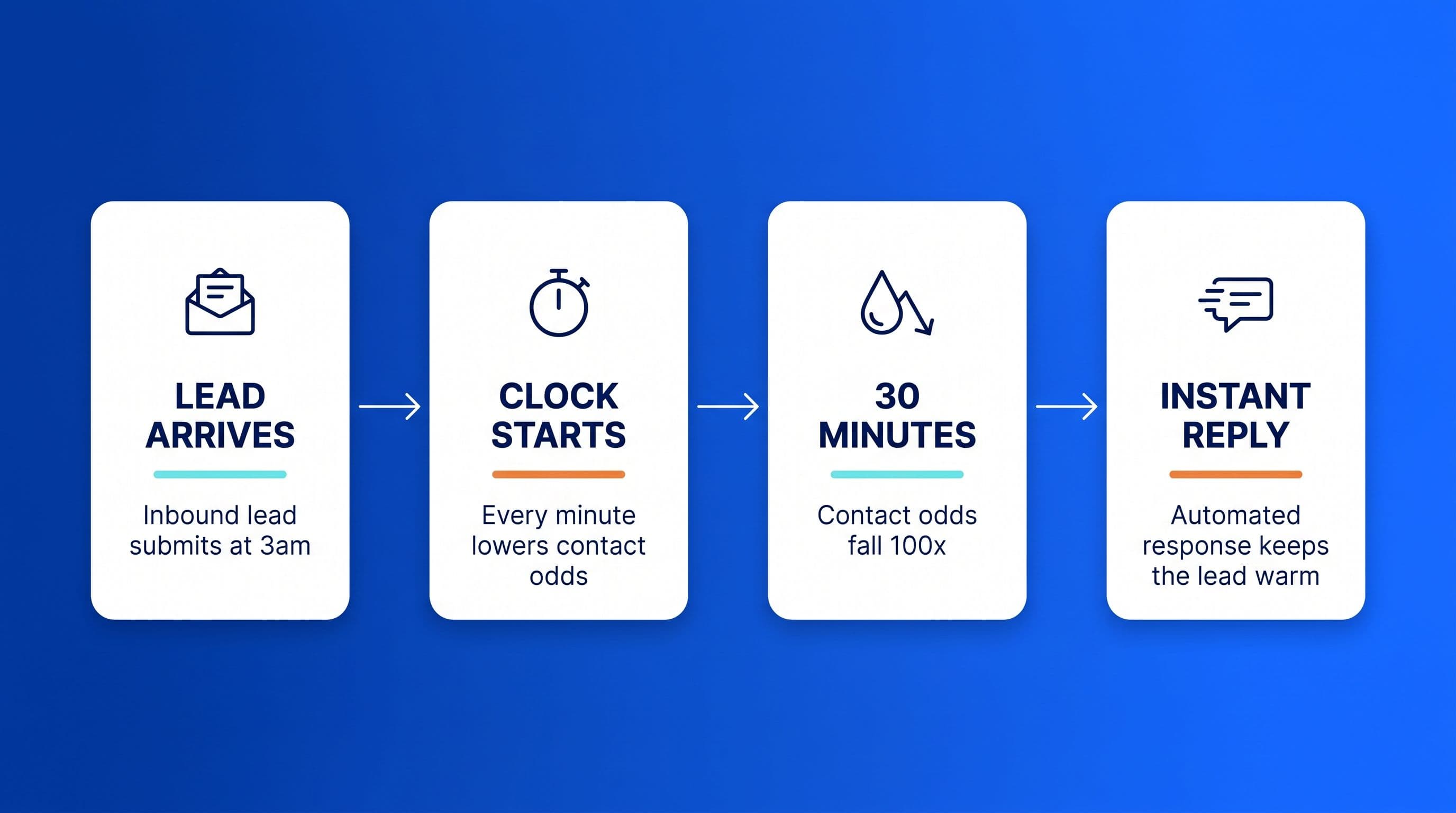
- Contact odds fall roughly 100x and qualification odds fall 21x between a 5-minute and a 30-minute response, with the steepest drop inside the first hour (InsideSales.com/MIT, 2007).
- The 3am problem hits owner-led sales hardest: you're still the only closer, even with delivery staff on board, so there's no shift to route an overnight lead to.
- Not every lead needs a same-night human reply. A triage rule based on intent and urgency decides which ones do.
- An instant, honest acknowledgment with one qualifying question already beats the franchise-brand baseline: 44% of the brands audited in 2025 never sent a personal reply to a real inquiry (FranFunnel, 2025).
- The realistic model pairs an automatic overnight acknowledgment and qualifying question with a morning approval step you control.
This post is part of our guide to founder-led sales, which covers the wider set of tradeoffs you face as an owner-seller when sales still runs through you, delivery staff or not.
What is the 3am problem in founder-led sales?
The 3am problem is the moment a hot inbound lead arrives and you, the only person who can close it, are asleep or already on a client call. There's no one else to catch it. Picture a prospect filling out a demo request at 11:47pm after reading a comparison page, or a pricing-page form submission at 1am from someone who just got budget approved that day. In a company with a sales team, that lead routes to an on-call rep or sits in a queue an SDR picks up at 8am sharp. In an owner-led business, it sits in an inbox next to tomorrow's client work, with nobody assigned to it at all.
Inbound traffic doesn't run on a 9-to-5 schedule. A prospect who already did their own research can be ready to talk at any hour, not just during the business day. You might have delivery staff running client accounts, but sales still funnels through you, so the lead doesn't wait for a convenient moment. It just waits, and every hour it waits works against it.
How fast do you actually need to respond to a lead?
Minutes, not hours. A 2007 study by InsideSales.com and MIT Sloan researchers Dave Elkington and James Oldroyd tracked over 15,000 web leads and more than 100,000 call attempts across six companies. It found that contact odds drop 100 times and qualification odds drop 21 times when a lead is called at 30 minutes instead of 5. Contact odds also fall more than tenfold within the first hour alone (InsideSales.com/MIT, 2007). "I'll get to it today" is already too slow for a lead that's been sitting since the hour it arrived.
Most businesses don't come close to that bar. Harvard Business Review's 2011 audit of 2,241 US companies, each sent a single test lead through their own web form, found only 37% responded within an hour, nearly a quarter never responded at all, and the average response time among companies that did reply was 42 hours (Harvard Business Review, 2011, via SmartCompany).
The business cost of that gap is measurable too. A 2025 survey of nearly 4,000 B2B buyers by 6sense found that the vendor a buyer contacts first wins the deal roughly 80% of the time, so a slow reply loses you the deal (6sense, 2025).
Why you can't just respond faster
Generic speed-to-lead advice assumes a team to route the lead to: round-robin assignment, an on-call rotation, a rep whose only job is the inbox. You don't have that team. Sales still funnels through you even when delivery staff handle the work once a deal closes, so "just answer faster" collapses into a choice between interrupting client work and giving up sleep.
That advice is written for sales managers deciding how to route leads among reps, not for you deciding between a 2am email and a 7am client call that needs your full attention. A bare-bones reply script doesn't solve it either. A one-line canned acknowledgment buys a few hours, but you still face the same decision: drop what you're doing to call this person back, or let it sit until morning regardless of how hot the lead actually is. Even if you're careful, you end up guessing which leads are worth the interruption, because nothing scores the lead before you see it. That split attention has a real cost, one we've sized in our analysis of the true cost of founder-led sales.
What actually needs a same-night human reply vs. what can wait until morning
Use a simple triage rule: a lead earns a same-night personal reply only when high intent and real urgency show up together. Everything else gets an instant acknowledgment and a morning follow-up. High intent means the channel itself signals seriousness: a demo request or a pricing-page form fill. It also includes a message that names a competitor or signals a switch. Urgency means there's a reason the timeline is tight, a stated deadline or a renewal date, for example. A lead that hits both is worth breaking focus for. A lead that hits only one, say a pricing-page visit with no urgency language, can wait for morning without real risk. For the specific questions to ask when sales still runs through you and no one else screens the call first, see how to qualify a lead when you're still the one closing every deal.
The point of this rule is to make sure nothing goes fully silent, while reserving interrupted sleep and delivery time for the handful of leads that genuinely warrant it. Most inbound leads, even good ones, can wait a few hours without real cost. They need to know someone saw the message and that a real answer is coming.
What should an instant-reply template actually say?
An instant reply should acknowledge the inquiry and ask one qualifying question, while setting an honest expectation for when a real response arrives. It should never promise a callback timeline you can't actually keep. A template that works:
"Thanks for reaching out, [name]. I read every inquiry personally and I'll follow up with specifics by [a time you can actually hit, e.g. tomorrow morning]. In the meantime, one quick question: what's driving the timeline on this, something you're trying to solve this month, or just exploring options for later in the year?"
The over-promising trap is the one to avoid. "Calling you in 5 minutes!" sent by a tool when nobody is actually free to call erodes trust the moment it's broken. A Gartner survey of 645 B2B buyers, fielded in August and September 2025, found 67% prefer a rep-free experience for parts of the buying journey (Gartner, 2026). That gives you room to let an instant, honest reply cover the first touch instead of carrying it alone. The instant reply should be honest and useful. Don't pretend you're available.
Where should an AI agent sit in the lead-response loop?
The right role for an AI system here is to handle the parts that are mechanical and time-bound, and leave the judgment calls with you. That means sending the instant acknowledgment, asking qualifying questions framed around your own scorecard (BANT, MEDDIC, or SPICED, whichever your business already uses), and qualifying the lead against that scorecard in the background. Klipy, the AI CRO, builds around this boundary. Within the autonomy level you choose, Klipy sends that first acknowledgment and asks the qualifying question automatically, per channel, while every next step, including who actually gets a callback, waits in Klipy's queue for you to approve.
This division of labor lines up with what buyers themselves want. The same Gartner survey found 69% of B2B buyers still turn to a human to validate AI-generated next steps, even as they're comfortable with AI handling earlier, lower-stakes parts of the process (Gartner, 2026).
Is an AI reply better than no reply at all?
Yes, at least against what franchise brands are actually doing. A 2025 audit of 530 franchise brands that submitted real lead forms and timed the responses found 44% never sent a personal reply at all, and 73% never followed up by text (FranFunnel, 2025).
That's a low bar to clear. An instant, honest acknowledgment, paired with a qualifying question that Klipy scores against the scorecard you already use, already beats that franchise-brand baseline. It also buys you the time to give every lead a real answer once the day starts.
What to put in place before the next 3am lead arrives
That decay doesn't pause because you're asleep or on a client call. Put an instant, honest acknowledgment and one qualifying question in front of every lead the moment it arrives, so nothing goes cold before you wake up. Klipy can send that first acknowledgment for you, per channel, then leave the callback decision waiting in your queue each morning.