
 Ask ChatGPT
 Ask Perplexity
 Ask Claude
 Prefer us on Google
Introduction
He went quiet for four days after I asked one simple question about scope. When he finally answered, the real message was buried at the bottom of the email: "we'll sort out payment once we're rolling." I noticed both signals. I filed the late reply under "he's just busy" and the payment line under "that's just how he negotiates," because the deal was still live and I needed the yes more than I needed the warning.
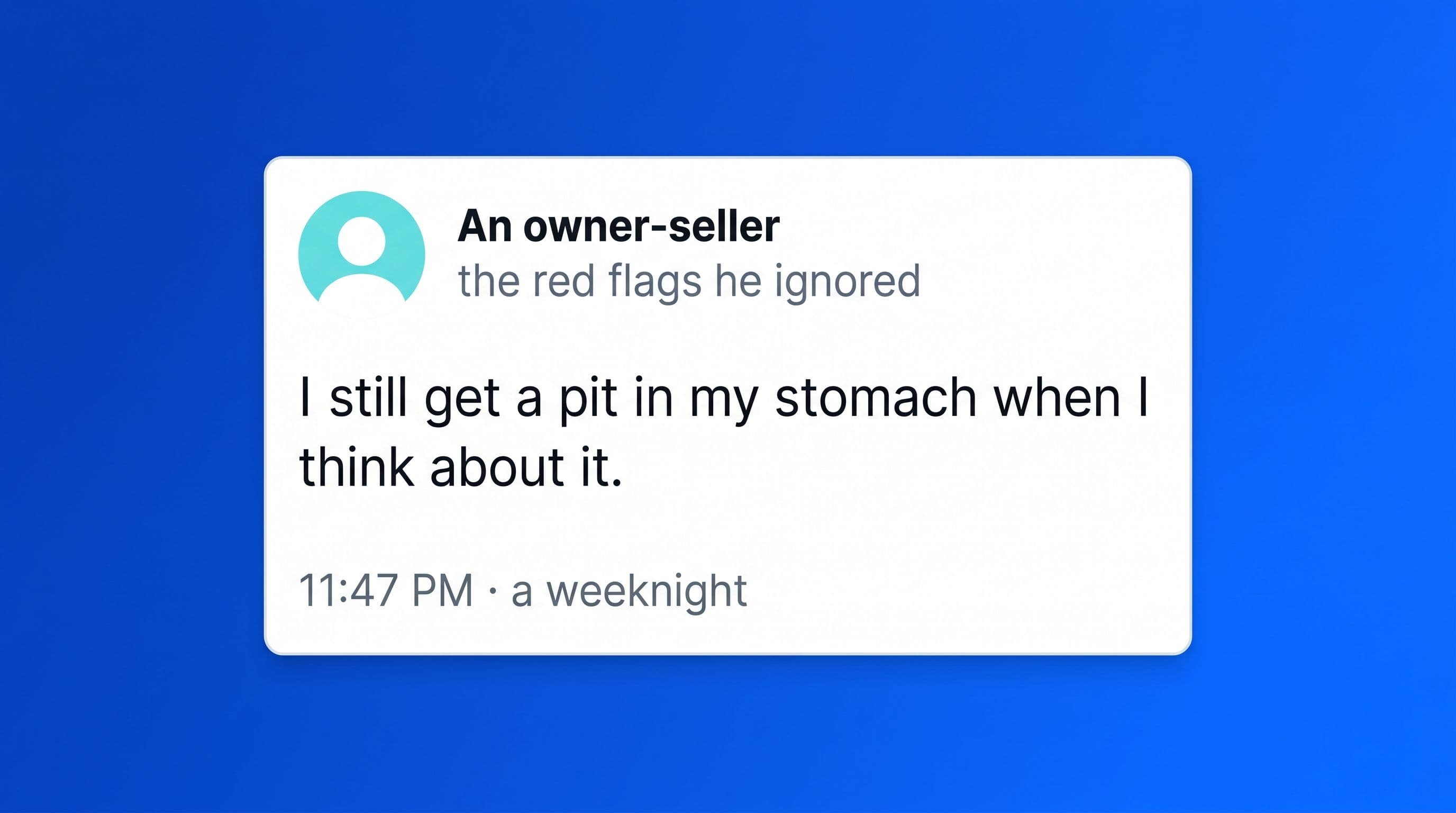
"I still get a pit in my stomach when I think about it." (Angela Mondloch)
The red flag I called "that's just how he negotiates"
The scope question was nothing dramatic: I'd asked which of two deliverables he actually needed first, so I could sequence the work. Four days of silence followed, which was unusual for someone who'd called me twice in one week to close the deal. When the reply came, it answered the scope question in one line and added the payment comment as an aside, like it wasn't worth mentioning.
I told myself a story that let both things slide. He was busy running his own company, so the silence made sense. He was "not a numbers guy," so the loose talk about payment timing wasn't really about me. Every client I'd worked with had some version of this, I reasoned, so neither flag was unique enough to act on. I sent the proposal anyway, and told myself I'd watch closely once the contract was signed, as if watching more carefully after the fact could undo a decision made before it.
Why you rationalize the red flag you already saw
Four structural pressures explain why you talk yourself past a red flag you've already noticed: scarcity, hope, sunk cost, and fear of confrontation. Research on decision-making under scarcity backs the first one up directly. Psychologist Eldar Shafir's work, summarized by Princeton Alumni Weekly, found that scarcity of money, time, or options taxes a person's mental bandwidth and pushes them toward more impulsive, short-term choices. Shafir argues scarcity itself drives the poor decision, independent of the person's character or judgment. That bandwidth tax shows up in real numbers: per Intuit QuickBooks' 2025 Small Business Late Payments Report, 56% of small businesses surveyed currently carry unpaid invoices, averaging $17,500 each.
For an owner-seller with no pipeline cushion, that scarcity shows up on every sales call as the fear that walking away from this lead means weeks of waiting for the next one. Hope compounds it: you assume the client will settle down once the work starts, because starting the search over feels worse than hoping. And once you've already spent a sales call's worth of time and energy on someone, sunk-cost reasoning takes over. Research on relationship investment, summarized on Wikipedia, found that people who had already invested money or effort into a relationship were more likely to keep it going than end it, even when ending it was the better choice.
All four pressures are already at work before the contract is signed.
What ignoring a red flag actually costs: the numbers
Nonpayment and scope creep are common, well-documented costs of skipping the screening step, and the numbers are bigger than most owner-sellers expect.
Unpaid invoices are common and expensive. According to Intuit QuickBooks' 2025 Small Business Late Payments Report, 56% of small businesses surveyed currently have outstanding unpaid invoices, owed an average of $17,500 per business. Freelancers Union reports that one in three freelancers has dealt with nonpayment, with more than 1,000 freelancers across 44 states logging over $7.4 million in unpaid wages through its World's Longest Invoice campaign.
Payment behavior is also a screenable signal. Bonsai's analysis of its invoicing data found that 29% of invoices were paid at least a day late, and invoices over $20,000 were roughly three times more likely to be paid late than invoices under $100. Larger, higher-stakes engagements carry more payment risk, which is exactly when a client's payment talk during the sales process deserves the most scrutiny.
Scope creep tells a similar story. Agency Management Institute, summarizing Ignition's 2025 Agency Pricing & Cash Flow Report, found that 57% of agencies lose $1,000 to $5,000 a month to unbilled scope creep, and 30% lose more than that. Only 1% bill for all of the out-of-scope work they do. At the project level, the Project Management Institute's Pulse of the Profession found that 31% of complex projects fail to deliver their full intended scope of benefits, more than twice the failure rate for projects generally.
This is what a skipped screen actually risks, industry-wide, every time a scope question gets a vague answer and you let it go.
What warning signs did I ignore before a client disappeared?
The warning signs are almost never one dramatic moment. Usually it's a vague answer to a scope question, or a casual "we'll figure out payment later" dropped in as an aside. Other times it's a reference that takes three follow-ups to produce. Owner-sellers keep working past these because reversing course in the moment feels riskier than hoping the client turns out fine.
That hope has company. Freelancers Union reports that one in three freelancers has dealt with nonpayment, so the reluctance to confront a client mid-relationship is common among people doing the same kind of work. Marketing consultant Angela Mondloch described the same feeling after a client project ended without warning:
"So, when a project ends without resolution, or just disappears into the deep abyss of your Mac files? It sticks with you… for a while." (Angela Mondloch)
Some owner-sellers keep emailing politely long after a reasonable deadline has passed, hoping persistence reads as professionalism. Others keep doing unbilled work, assuming payment will show up once the client's own cash flow improves. Neither response changes the client's pattern, because the pattern was visible earlier and nobody wrote it down.
How do I spot a bad client before signing them?
Screen three things during the sales process itself, before any contract gets signed: payment behavior, scope respect, and communication pattern. All three are visible before you sign if you're paying attention, and noticing them just takes attention and a note taken at the time.
Ask directly why their last agency or consultant relationship ended. Practitioner guidance for agencies, including GAIN's red-flag breakdown, treats a vague or blame-only answer as a real signal: "One failed agency relationship can be bad luck. Five is usually a system issue." The same source treats refusal to sign a clear, written scope as a stop sign on its own.
Scope respect tends to show up early, often as a prospect trying to expand the ask before they've even signed. Communication pattern is the easiest of the three to track, since response time and directness during the sales process tend to continue, largely unchanged, after the contract is live.
Turn the checklist into a habit
A checklist only works if you decide your walk-away criteria before the sales call, in writing, so hope about this specific lead can't override judgment made when you weren't desperate for the deal. Write three to five disqualifying signals down once, somewhere you'll actually look at them again, before you ever take a call with a new lead.
Weigh repetition over any single incident: one late reply is noise, but the same category of flag showing up two or three times during the sales process is worth acting on. A few signals worth writing down in advance:
- A prospect who won't name why their last agency or consultant relationship ended.
- A prospect who brings up payment terms only when pressed, never upfront.
- A prospect who tries to expand scope before a contract exists.
- A prospect whose response time swings from immediate to silent with no explanation.
Separate "I like this person" from "this person is a good client." Those are two different judgments, made at two different points in the process, and conflating them is exactly how a likable client with three disqualifying signals gets a signed contract anyway. This checklist is part of our broader guide to how to deal with a difficult client as an agency or consultant, which also covers firing a client and handling scope creep once you're already signed. Client red flags you're missing before you ever sign goes deeper on building the pre-call version of this list.
A client ghosted me mid-project. What do I do?
Short term, document what you actually have: the agreed scope and the email trail that backs it up. Send one clear, unemotional message stating the project's status and what you need to continue or close it out, with a real deadline attached. Once that deadline passes without a response, stop doing unbilled work; continuing only extends the cost of a relationship that's already stalled.
Longer term, look back at whatever notes you kept, because the signals you talked past are usually there if you wrote anything down at all. Most owner-sellers can't honestly answer whether they saw this coming, because the warning signs lived in scattered texts and an inbox that nobody ever went back to review. The real gap is having no visible record of the pattern before the client vanishes.
The pattern becomes visible before the client vanishes
The system version of this checklist tracks the same ground. Payment behavior and scope respect show up early in the sales process, and every email after that either confirms the communication pattern or breaks it. The difference is that now they're captured as they happen, closing the gap between catching a pattern early and reconstructing one after the fact.
Klipy is the AI CRO: the AI agent that runs your entire sales operation. It logs notes from your sales calls and emails as the conversation happens, so a vague answer to a scope question or an excuse about payment timing ends up on the record. Small moments like that, spread across separate calls weeks apart, add up to one visible pattern that memory alone would have missed. Klipy's role here is keeping the record, not acting on it alone.
The checklist above still defines what counts as a signal. Klipy's job is narrower: keep that record visible across your sales calls and emails, so your judgment has evidence to work from right when a deal feels too good to walk away from.
The cost of learning this the hard way
Every ignored red flag has a price tag, usually an unpaid invoice or weeks of unbilled scope creep on a project that never really closes out. None of it shows up on a single afternoon. It compounds, the same way every other job an owner-seller carries alone compounds, because vetting a client well takes time and attention that's already spoken for by payroll, delivery, and whatever broke this morning.
That compounding cost, the extra work layered onto everything else that already runs through one person, is what the Solo Sales Tax report puts a number on: our name for what it costs an owner-seller to run the entire sales function alone, without a system behind it. If the pattern in this post sounds familiar, the report is worth the fifteen minutes it takes to read.