
 Ask ChatGPT
 Ask Perplexity
 Ask Claude
 Prefer us on Google
Introduction
The best month the business has ever had lands on an ordinary Tuesday: a number in the account that would have felt like freedom two years ago, confirmed and impossible to argue with. You wait for the relief. What shows up instead is flat, or done. Then one thought that won't leave you alone: I don't want to do this anymore.
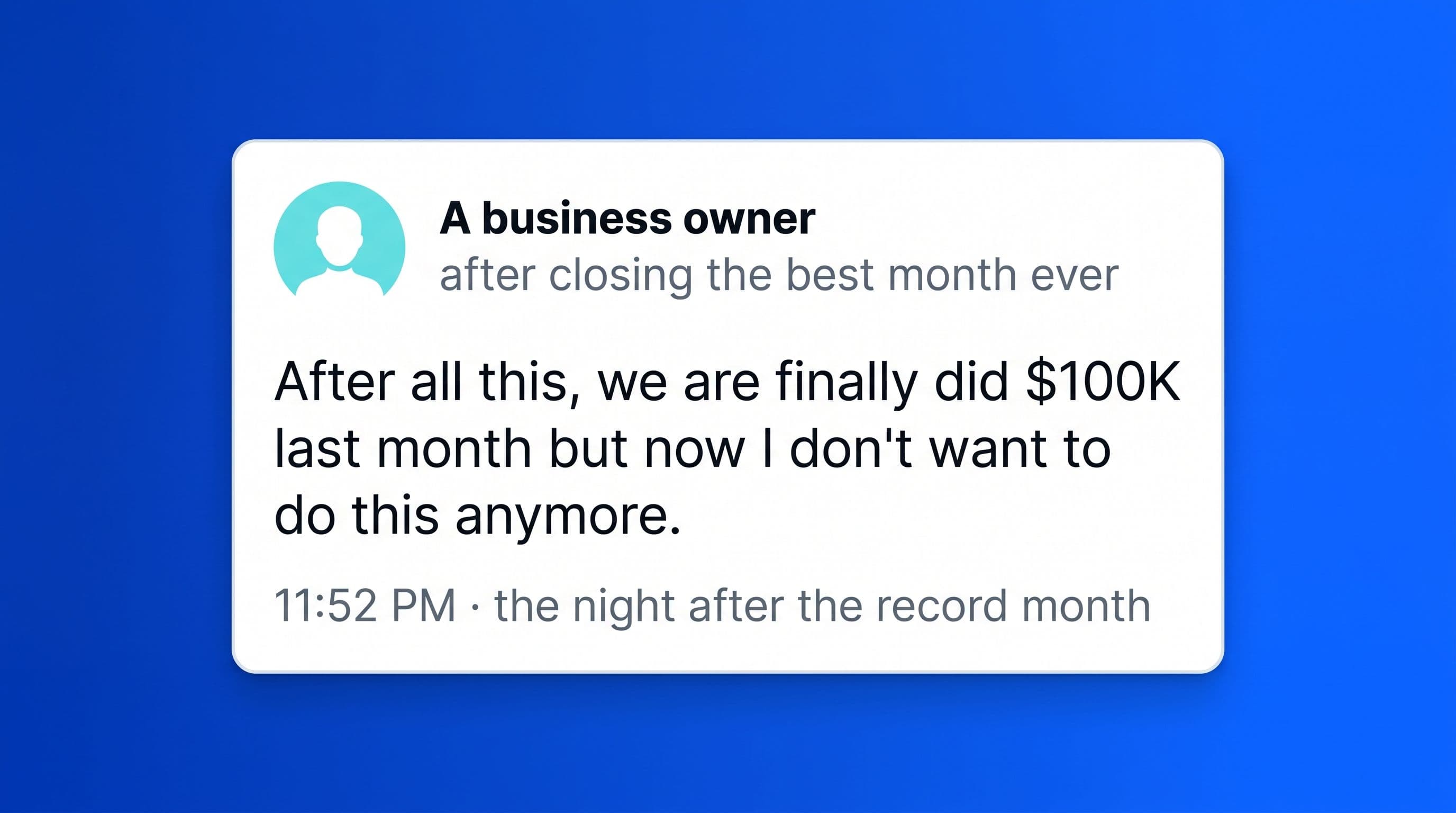
"After all this, we are finally did $100K last month but now I don't want to do this anymore." (Hacker News)
The gap between the number and the feeling
The feeling that shows up on the best month the business has ever had isn't relief. It's flat, or quietly ready to walk away, and the gap between the number and the feeling is the real subject here.
You refresh the dashboard one more time, the same way you've checked the bank balance every week this quarter. Part of you still expects the number to look different on the third try. You tell your partner or a cofounder, "we did it," and wait to feel something that matches the sentence. Instead there's a low hum of dread about next month already starting. Beneath that is a quiet suspicion that everyone else who hits a number like this feels good about it and you're the only one faking it. That reaction is predictable: a revenue milestone adds weight before it changes how you feel, especially when everything in the business still runs through you.
You're not imagining it: the reward for growing is more weight, not less
The math here is structural, independent of how grateful you feel. Revenue almost always scales faster than the systems and help that are supposed to come with it. The hours back rarely show up on schedule, and a bigger month usually hands you more to carry instead of less, since everything still runs through you. Over one in five small business owners already work more than 50 hours a week, and entrepreneurs average only 11 days off a year, excluding holidays (Adobe, 2025). That's before a record month adds anything new.
Hitting a milestone adds client load and delivery pressure at the same time. None of it comes out of your own selling and follow-up time on its own. The calendar fills up regardless of how good the month felt. Underneath "why don't I feel good about this" sits a simpler question: did anything in the business change to make room for the win?
Why don't I feel happy after hitting my revenue goals?
Because hitting a revenue goal changes your bank balance before it changes your calendar. The extra client load lands immediately, and none of it waits for the hire or system change that would make the win feel like a win, or for the day off you haven't taken.
A Bluevine survey of 781 U.S. small business owners found that 62% had skipped or reduced their own pay at least once in the past year, and 21% did so four or more times. In the same survey, 71% report moderate to extremely high financial stress (Bluevine, 2026, via Crowdfund Insider). A business that still produces numbers like that doesn't stop producing them just because last month was a good one. The flat feeling comes from added weight.
What the data says about owners like you
This isn't one owner's bad week. Independent surveys from 2025 and 2026 put burnout among small business owners at roughly a quarter to over four out of five, depending on the survey, and it cuts across revenue levels, including businesses that are doing well.
Enji's 2025 State of Small Business report found 81% of owners experienced burnout. Enji found burnout at every revenue level, and the report explicitly frames a disconnect between a strong economy and widespread small business burnout: just 2.37% called the current climate extremely friendly to small business, and only 37% felt optimistic about 2026 (Enji, 2025, via Barchart). The survey covered 245 owners, so treat the exact percentage as directional rather than precise, but the framing it supports, burnout showing up regardless of how the business is performing, lines up with the broader body of research. Separately, Bluevine's BOSS report found 27% of owners said running their business produced more burnout than expected in 2025, and 77% made personal sacrifices, like cutting days off or delaying goals, to keep things running (reported via Stacker; figures are secondhand from Bluevine's report).
There's also an older but still-cited clinical data point worth knowing: a 2015 survey of 242 entrepreneurs by Dr. Michael Freeman at UCSF found 30% reported depression, compared with roughly 7% of the general U.S. population at the time (VentureBeat). It's dated, but the underlying pattern, entrepreneurship carrying a real mental-health cost regardless of outward success, hasn't needed updating.
Why does business success feel empty?
A revenue number rarely comes with a built-in decision about what it's supposed to buy back: more time, or someone else sharing the load. Without that decision made ahead of time, a bigger revenue figure just means a bigger version of the same workload, since everything still runs through you, which reads as empty rather than as relief.
A coaching transcript from The Art of Online Business captures the moment directly: a founder who hit seven figures described it this way.
"felt empty and like I didn't know what to do next." (The Art of Online Business)
She later traced the dip to a belief that growth had to cost her health and relationships, a belief nobody had ever asked her to question. One BossBabe podcast guest reached seven figures at a 9% profit margin, then deliberately cut revenue on purpose once she recognized the cost (BossBabe Podcast). It's a named pattern among people who run their own sales, recurring rather than a one-off.
How other owners are coping (and what it doesn't fix)
No single coping move resolves this cleanly. A vacation covers part of it, and talking it through or cutting scope on purpose still leaves the rest untouched.
Startups.com's Startup Therapy podcast argues that short vacations stop being useful once founder burnout turns structural:
"a vacation stops being the break founders need." (Startups.com)
Talking it through externally, the way the Art of Online Business transcript above does, names the belief that's driving the overwork in the first place, though naming the belief doesn't remove the work behind it. Cutting scope on purpose, like the BossBabe guest who deliberately reduced revenue, trades growth for breathing room instead of scaling the business, though not every owner would make that trade.
| Coping move | What it fixes | What it doesn't fix |
|---|---|---|
| Taking time off | Short-term exhaustion and a few days of breathing room | The underlying gap between what the business needs and the support you have |
| Talking it through (coaching or peers) | Names the belief driving the overwork | The concrete change behind the belief still has to happen |
| Cutting scope on purpose | Immediate relief; protects your margin and sanity | Trades growth for breathing room instead of scaling the business |
Some of what you're feeling may go beyond burnout: persistent low mood, loss of interest in things you used to care about, or thoughts of self-harm that outlast a bad week. That's a clinical picture. Talk to a doctor or therapist, or in the U.S., call or text the 988 Suicide & Crisis Lifeline. None of the strategies above are a substitute for that.
Decide what growth should buy back, before you hit the next number
The fix that holds starts before the next milestone. Name in advance what a bigger number is supposed to buy back, so hitting it isn't just permission to carry more of the same alone.
This is part of why business owner burnout is so well documented across small businesses: the number lands, the crash follows, and a new target often gets set before anything structural changes in between. The way out is to write down, before you chase the next target, exactly what it should free up: a day a week back, plus a hire or a piece of software for the part of the job you hate most. Without that change, hitting the revenue number is only half the job: the system around you hasn't caught up yet. The other levers that genuinely help, peer groups where other owners compare notes honestly, or working with a coach or therapist who understands founder-specific stress, are worth using too. Picking one and sticking with it does more for the plateau than chasing a bigger number again.
Is it normal for me to want to quit right after finally succeeding?
Yes. Wanting out immediately after a win is a common reaction among small business owners, and it usually means the business grew faster than your support system did.
Burnout at high-performing revenue levels is common: Enji's research found it present "at every revenue level," including businesses that are doing well (Enji, 2025). The fix is changing what growth is allowed to cost you, starting with the parts of the job that exist only in your head.
The one lever that's actually yours to pull
Of everything on that list, there's one piece of the load you can remove without hiring anyone or restructuring the business: the sales follow-up work that currently lives only in your head.
Klipy is the AI CRO: the AI agent that runs your entire sales operation. It drafts the follow-up from your call, flags which leads have gone quiet, then stages the next nudge for your approval so it doesn't depend on you remembering. You look it over and decide whether it goes out.
As autonomous as you allow, never more.
That's a narrow claim on purpose. It won't fix burnout or your relationships, and it won't change how you feel about the business. It takes one specific, trackable task off your plate: the tracking and chasing that currently only happens because you remember to do it, so a revenue milestone doesn't, on its own, mean more to carry on top of everything else.
Find out what the growth is actually costing you
Before you set the next number, see what the current one is costing. The Solo Sales Tax report, a breakdown of the hours a founder-led sales process typically eats in a week, gives you a rough read on where that time is going.
Use it to measure the next milestone against time bought back as well as revenue added. If the next "best month ever" doesn't change what you're carrying, it's worth asking in advance what would.
FAQ
Is it a sign of burnout, or something more serious, if I still want to quit after a big win?
It can be either, and the distinction matters. A flat, "I don't want to do this anymore" reaction right after a win is a recognized burnout pattern tied to workload and unmet expectations. But ongoing low mood or lost interest that outlasts a bad week points to something clinical, past ordinary burnout, and that's worth raising with a professional rather than pushing through it alone.
What do successful founders actually do when hitting a goal makes them want to quit?
No single fix resolves it. Founders describe taking time off, though a short vacation tends to help less once burnout turns structural, and talking it through with peers or a coach. Most consistently, they describe deciding what the next milestone has to buy back before chasing it, instead of aiming for a bigger number again.
What do I do when hitting my number just makes me want to walk away?
Treat the moment as data about your current setup, separate from any verdict on whether you should keep going. Before resetting to a new target, decide specifically what this milestone should free up, then get a rough read on what it's costing you in hours to run the sales process through just yourself, so the next goal is bigger than a rerun of this one.