
 Ask ChatGPT
 Ask Perplexity
 Ask Claude
 Prefer us on Google
Introduction
She doesn't call to complain. She just stops answering, and by the time you notice, she's already working with someone else.
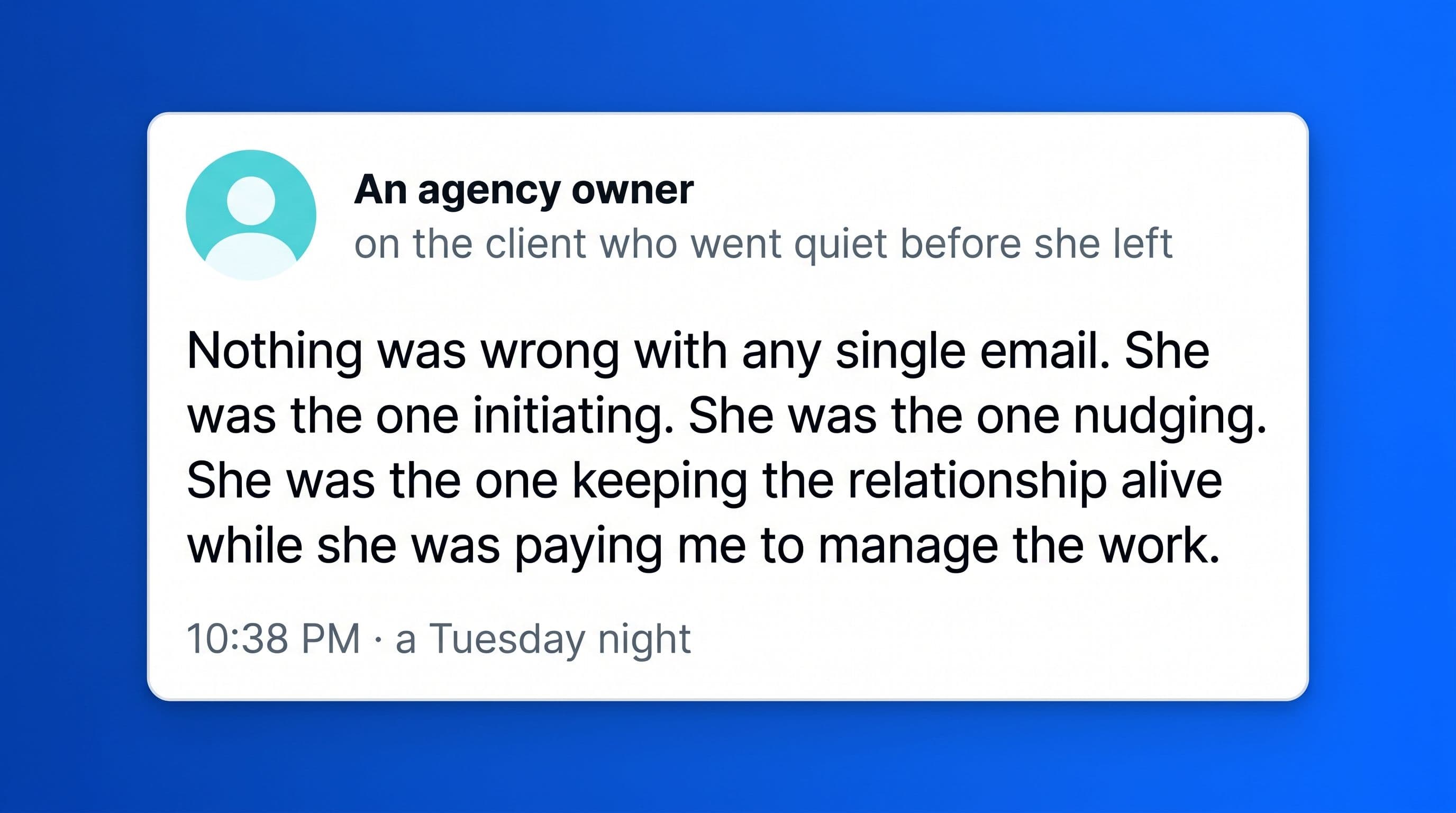
"Here is what I noticed. Nothing was wrong with any single email. But the pattern was that she was the one starting almost every conversation. I was responsive, I was thorough, I delivered on time. She was the one initiating. She was the one nudging. She was the one keeping the relationship alive while she was paying me to manage the work." (Jason)
The client who never complained
Go back four months. You wrapped a project for her. She paid on time, and the relationship went quiet the way most client relationships do once the invoice clears. You moved on to deliver for whoever was next in line. You meant to check back in, the way you always do. But the week she crossed your mind, you had a deadline on Friday and two other accounts asking where their deliverables were, so "call her next week" turned into next month, and next month turned into the kind of silence neither of you ever named out loud.
She never complained. There's no frustrated email, no awkward call where she tells you she's thinking about leaving. You find out secondhand, from a mutual contact who mentions she's already briefed someone else on the next phase of work you used to do for her. By the time you hear it, it isn't news to her. It's just news to you.
There was no system flagging that the silence had gone on this long, so nothing caught it before it became permanent. But most clients who leave don't leave loudly. The Arizona State University National Customer Rage Study backs this up from the other direction: more than half, 58%, of customers who did bother to complain about a problem said it got them nothing, and the ones who stayed unhappy without ever voicing it came out 22 percentage points less loyal than customers who never had a problem at all. Complaining rarely changes anything, so most people who are unhappy just stop talking instead.
That's the trap: silence reads as fine, right up until it isn't. For a client who's been with you a while, silence is often what departure looks like while it's still in progress.
Outreach is the first thing the clock cuts
Outreach is usually the first thing cut when the same person is selling and delivering, because a delivery deadline always beats a phone call nobody's demanding yet.
Think about how your week actually gets built. The project has a Friday deadline. The invoice has a due date. The new client's onboarding call is on the calendar because someone put it there. "Check in with an old client" has none of that. Nobody's waiting on it by end of day, so it's the line item that slides to tomorrow, then disappears from the list entirely.
This isn't specific to you or your business. A veteran industry consultant writing in Zweig Group's The Zweig Letter, who has spent years studying why professional-services clients defect to competitors, points to reduced personal outreach as one of the top drivers: fewer "how's it going" calls, and principals who stop showing up to meetings once staff take over the delivery work. The firms that lose clients this way usually do fine work on the project. Where they fall short is everywhere else, anywhere the invoice isn't attached.
The harder part is that without a system tracking it, the gap is invisible in real time. Vendasta's 2023 Agency Insights Report, as recapped by Duda, which surveyed hundreds of agencies, found that 15% don't actually know their own client churn rate, rising to 28% among agencies with lower average client revenue. If you don't know your churn rate, you find out about a departure the same way you found out about hers: after the fact, from somebody else.
Why did my client leave even though the work was good and on time?
Good work and on-time delivery stop complaints, but quiet departure happens anyway. Clients leave existing vendors when they stop feeling prioritized, a relationship signal more than a delivery one.
A consultant's widely shared account of losing a long-term client describes exactly this. He was responsive and delivered on time, yet looking back at the email thread, he realized his client had been the one keeping their relationship alive while paying him to manage the work. Nothing in any single email was wrong. The pattern across all of them was.
That's the signal to watch for instead of complaint volume: who initiated your last several conversations. If it wasn't you, that's her quietly weighing whether she still feels like a priority to you, which has nothing to do with your output.
What the data and one owner's story say about going quiet
Churn researchers can now show something owners have always suspected: once a client goes silent, they're usually already most of the way out the door.
Marketing Science research out of London Business School describes this as "silent churn": customers who disengage and stop responding without ever formally canceling or complaining. The data shows these silent churners behave differently from customers who cancel outright. They disengage early, and they show little prior activity in the relationship before the silence starts. Loud complaining was never going to be the warning sign; by the time you notice the quiet, most of them are already most of the way gone.
The flip side is that reaching out first, before the silence sets in, has a measurable effect. In a randomized field experiment at a major telecom, researchers found that proactively calling customers flagged as at-risk cut their probability of churning by 1.9 percentage points, down from a baseline of 17.2%. A more recent 2026 peer-reviewed operations study, run by researchers at the University of Limerick and Nord University, piloted proactive outreach to roughly 5,000 high-risk customers a month and found a 6% rise in customers staying under contract and a 6% drop in repeat support-call rates. Revenue preserved over twelve months came in at an estimated 10%. The authors flag their own scope as telecom-specific and in need of broader validation, but the direction matches what the Jason case and the Zweig Group research already suggest: initiating contact changes the outcome.
It's also the cheaper fight to pick. Harvard Business Review, drawing on Bain & Company's retention research, puts acquiring a new customer at five to 25 times more expensive than keeping one you already have, and a five-point rise in retention can lift profit anywhere from 25% to 95%. Staying warm with a client you already won is a better use of an hour than most new-business activity on your list.
Worth separating from this: a brand-new lead going cold before you ever close the deal is a different problem, one we cover in when CRM follow-ups fall through the cracks, part of our broader guide to falling through the cracks: how growing service businesses lose leads and clients. This post is about a client you've already won, who leaves anyway because nobody kept reaching out. The fix for an existing client is actually simpler. You already have the relationship. You just have to keep showing up in it, the way the owners later in this post found their way back to doing.
I feel like a vendor instead of a partner to my clients: how do I fix that?
You stop feeling like a vendor the moment you're the one who reaches out first again. That shift has nothing to do with charm on the calls or better deliverables. It comes down to rebuilding the habit of initiating instead of waiting to be prompted.
That habit breaks for an ordinary reason: every deal and every renewal still runs through you, and reaching out to a client who isn't currently paying for new work feels optional in a week that's already full. The habit needs a structure to survive a busy month, the same way a workout only sticks once it's on a calendar instead of in your good intentions.
The fix has two layers. The first costs nothing but your attention: a rule, plus a recurring calendar block. The second is what to reach for once even that starts slipping, which is usually where owners carrying the whole sales load get stuck.
The same-day-touch rule you can run with a calendar alone
The fix that actually holds is boring on purpose: no client goes more than a fixed number of weeks without hearing from you first, and you put that on the calendar instead of in your memory.
Two rules do most of the work. First, a same-day-touch rule: any time a client reaches out, even just to ask a quick question, you reply that same day with something that feels like you initiated it too, before it turns into the kind of delayed acknowledgment that shows up three days later. The goal is that she's never the one left waiting on you. Second, a calendared check-in cadence: a recurring touch for every active client at a fixed interval, commonly every four to six weeks, with no sales agenda attached. It goes on the calendar as a hard event, the same way a client call would, instead of living as a someday-task on a list you'll get to eventually.
Enterprise Nation documented exactly this turnaround in a small business that had drifted into the same pattern this post opened with. The owner was working 60-hour weeks with no time set aside for past clients, and his repeat-business rate had fallen to 12%. Once he scheduled recurring, no-sales-agenda check-ins with former clients, repeat business climbed to 45% within a few months. Nothing about his delivery work changed. He started showing up again.
For the cadence itself, Blago Yanakiev's practitioner rule at 9am.works is a useful starting template: reconnect two to four business days after the last contact, and follow up again about a week later if there's still no reply. A final attempt lands as the deadline approaches, capping it at three tries total. That rule was built for active threads and prospects still mid-conversation. For a long-dormant client it needs loosening, with longer intervals and a different opening line, but the underlying discipline, a fixed rhythm instead of "whenever I remember," is the same one that moved Enterprise Nation's case from 12% to 45%.
This costs time rather than money, which is exactly why it's usually the first thing dropped when the week gets full, and exactly why doing it on purpose is the fix.
How do I keep clients from going cold without constant unpaid effort?
The honest answer is that the manual version always costs unpaid time. A same-day reply and a calendared check-in cadence work, but someone still has to remember which client is due for a touch, and someone still has to write the message. For an owner already short on hours, that's real admin time with no invoice attached to it.
The practical fix is to let something else do the noticing: a system that watches who's gone quiet, so the only time you spend goes to the clients who need a message this week, and the only decision left is whether to send what's already drafted. That's the one place in this post where a tool earns a mention.
What people try before they find a system for this
Most owners don't start with a tool built for this. They try a spreadsheet with a "last contact" column, updated by hand whenever someone remembers to open it. Some lean on the reminder feature already inside whatever CRM they use, tied to a deal stage, except a client who already paid and closed usually has no open deal left to attach a reminder to. Others block a recurring slot on the calendar, which holds up only as long as nothing more urgent bumps it that week.
Each of these can work for a while. None of them notice the gap on their own, though: somebody still has to remember to look, and that's the one habit a busy week always crowds out. That's the part still missing a system of its own.
When the system remembers for you
Klipy watches the interaction history across every client and surfaces the ones who've gone quiet. It then drafts the re-engagement message, so the only unpaid work left is a quick approval. This sits inside Run, the Klipy module built to work every deal and every existing client relationship already in motion, so a quiet client doesn't depend on you remembering to check in.
| Metric | Value | Source |
|---|---|---|
| Cost to acquire a new customer vs. keep an existing one | 5-25x more expensive | Harvard Business Review, citing Bain & Company |
| Profit lift from a 5-point rise in retention | 25%-95% | Harvard Business Review, citing Bain & Company |
The mechanism is ordinary once you see it. Interaction capture logs the real touchpoints you've had with a client, calls and emails, so the system can flag something concrete, like "you haven't reached out to her first in six weeks," instead of relying on your memory to catch it. That's the same gap the Enterprise Nation case and the 9am.works cadence rule are solving by hand: someone has to notice the gap before anyone can close it. Klipy is built to be the one noticing.
The same-day-touch and calendared check-in habits from earlier in this post become a standing feature in keep everyone warm, part of Run: every client stays on a cadence without you carrying the whole list in your head. Klipy drafts the message in your voice and holds it for your review before it reaches her inbox.
Klipy is the AI CRO: the AI agent that runs your entire sales operation, including the part of it that's easy to let slide once delivery gets busy. Every deal and every client relationship still runs through the owner at a growing firm, and no system was built to flag a quiet one before now, which is why it always took a mutual contact or a lost renewal to notice. If you want to see the mechanism before committing to anything, the free cold-client re-engagement generator drafts that first message for one dormant client today, without asking for an account.
One habit worth building this week
Pick one client you haven't reached out to first in over a month, and message her today to be the one who starts the conversation this time, with nothing to pitch.
What would have kept her is simple: a system that reached out before the silence went on this long. That's true for whoever's on your own list right now.
If you want the fuller picture of what staying quiet with existing clients actually costs, and everything else that falls on you when every deal and every renewal still runs through you, read the Solo Sales Tax report, our breakdown of what carrying the whole sales operation alone costs a growing service business in time and in clients like her.
Frequently asked questions
Why did my client leave even though the work was good and on time?
Good work and on-time delivery don't stop a quiet departure, because clients leave when they stop feeling prioritized. Watch who initiated your last several conversations. If it wasn't you, that's her weighing whether she still matters to you, and it says nothing about the quality of your work.
I feel like a vendor instead of a partner to my clients. How do I fix that?
You stop feeling like a vendor the moment you're the one reaching out first again. Rebuild the habit with two rules: reply the same day a client contacts you, and run a no-agenda check-in for every active client every four to six weeks.
How do I keep clients from going cold without constant unpaid effort?
The manual version, same-day replies plus a calendared cadence, still costs unpaid time, because someone has to notice who's due for a touch and write the message. The fix is a system that notices who's gone quiet and drafts the message, so you only have to approve it.
How do I know if a client is about to leave quietly?
Watch for early disengagement rather than complaints: slower replies and less initiation from their side, often well before anything looks like a formal complaint. Research on silent churn shows these customers disengage early and show little prior activity, unlike customers who complain before they cancel.
How often should I check in with clients I'm not actively billing for new work?
There's no universal number, but a fixed cadence, commonly every four to six weeks, beats checking in "whenever I think of it," because a calendared habit survives busy delivery weeks better than memory does.