
 Ask ChatGPT
 Ask Perplexity
 Ask Claude
 Prefer us on Google
Introduction
Can you trust a sales forecast if you still close every deal yourself?
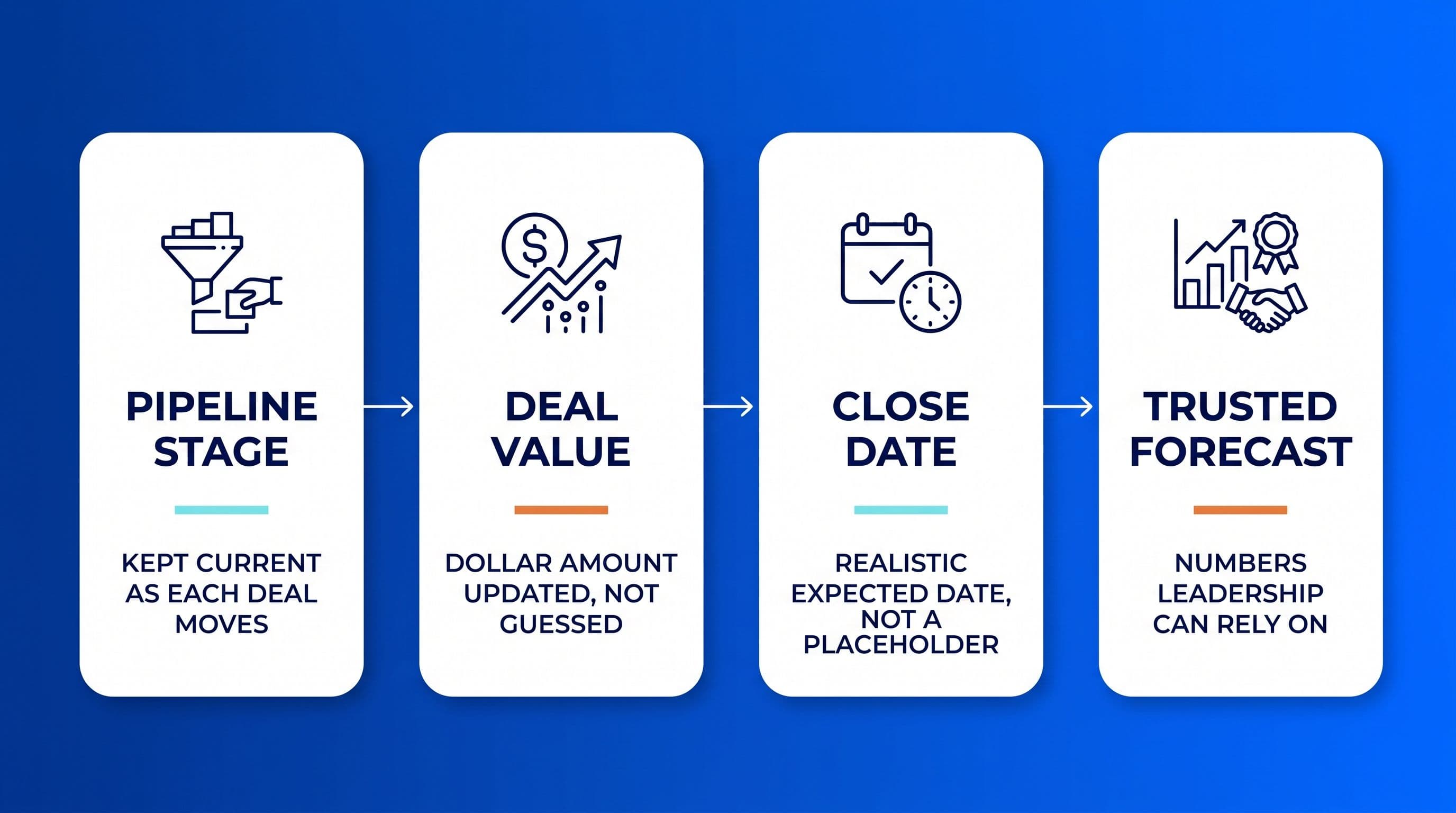
Yes, and the trust question comes down to one thing: whether the three fields every forecast depends on (deal stage, deal value, close date) reflect what's actually happening in your pipeline this week, not what was true a month ago, regardless of headcount.
The data shows forecast distrust is close to universal, not a problem unique to small, under-resourced sales teams. Gartner's research on sales leaders and sellers found less than half, 45%, have high confidence in their organization's forecasting accuracy. These are companies with forecasting infrastructure, CRM admins, and in many cases a full RevOps function. Gong's 2024 survey of over 2,000 business leaders found a similar pattern from a different angle: 81% of companies across the US and UK (84% in the US alone) missed their sales forecast in at least one quarter over the prior two years. For a B2B service firm owner, especially one running an IT or managed services business, this gap tends to show up earliest at the point where growth stalls and founder-led selling stops scaling.
So if a company with a dedicated ops team still gets the number wrong most of the time, forecasting isn't hopeless once you're still closing every deal yourself. Keeping the underlying deal records honest, not the math, is the hard part, at any size. That's a solvable problem for a growing service firm, just not the one most forecasting advice talks about.
For a deeper look at why this pays off once you're still running sales personally in a growing business, see our guide to CRM ROI when you're the one closing every deal.
Why most small-business forecasts break before the math even starts
Most forecasts fail for a reason that has nothing to do with the formula: the deal records feeding them are already out of date or incomplete before anyone runs a calculation. Validity's 2025 global study of 602 CRM users and administrators found that 76% of organizations say less than half of their CRM data is accurate and complete, and 37% of CRM users reported losing revenue as a direct consequence of poor data quality.
A weighted pipeline formula applied to stale stage assignments produces a confidently wrong number.
No system of record, no forecast
Before you can worry about forecast accuracy, you need a clean system of record to forecast from. Many B2B service firm owners don't have one yet. Researchscape International's 2022 survey of 1,146 US small and medium-sized business owners and managers, done in partnership with Act!, found that 45% of SMBs still relied on paper records for at least part of their operations, and 11% had no customer-tracking system at all. Nearly half, 47%, said they felt their business was too small to need CRM software in the first place.
Weighted pipeline math assumes a list of open deals with a stage and value attached to each one. If the deal list lives across email threads, a notebook, and memory, there's no forecast to improve yet. There's a pipeline to build first, even a lightweight one, which is the starting point Klipy's AI CRO is built to give a growing service firm.
What is weighted pipeline forecasting, and can you run it by hand?
Yes. Weighted pipeline forecasting, multiplying each open deal's value by its stage's close probability and summing the results, is simple enough to run in a spreadsheet with no special tooling required. The only requirement is a willingness to keep it updated.
Forecastio describes the mechanics plainly: by multiplying a deal's value by its probability of closing, you get a weighted contribution for that one deal, and summing those contributions across the open pipeline gives you the forecast total. The method rewards deals further along the pipeline without pretending every open deal is equally likely to close.
A workable stage-probability scale for a growing service firm might look like this:
| Stage | Assigned probability |
|---|---|
| Inquiry / first contact | 15–25% |
| Proposal sent | 35–50% |
| In active discussion | 60–75% |
| Verbal commitment | 85–90% |
You don't need to match these exactly. You need stages that reflect how deals actually move through your sales process, and probabilities you'd defend out loud if someone asked why.
A worked example with three deals
Say your open pipeline has three deals: a $20,000 deal with a proposal sent (45% probability), a $15,000 deal in active discussion (70%), and a $25,000 deal with a verbal commitment (90%).
| Deal | Raw value | Stage probability | Weighted contribution |
|---|---|---|---|
| Deal A | $20,000 | 45% | $9,000 |
| Deal B | $15,000 | 70% | $10,500 |
| Deal C | $25,000 | 90% | $22,500 |
| Total | $60,000 | $42,000 |
$42,000 is a more honest number than "$60,000 in the pipeline," because it accounts for the real chance that Deal A doesn't close. But that number is only as good as last week's update. If Deal A actually went quiet two weeks ago and nobody moved it back to "inquiry," the forecast is overstating reality by thousands of dollars, and the spreadsheet has no way of knowing that.
What about win-rate-based forecasting?
Win-rate forecasting takes a different shortcut: multiply your total open pipeline value by a single historical win rate, instead of weighting each deal individually. Outreach defines win rate as the percentage of qualified opportunities that become closed-won deals, and expresses the forecasting formula simply as Forecasted Revenue = Total Deal Value x Win Rate%.
If your historical win rate is 30% and you have $80,000 in open qualified pipeline, your forecast is $24,000. It's faster to calculate than weighted pipeline because it skips stage-by-stage judgment calls. The tradeoff is that it assumes your current deal mix resembles the deals that produced that historical win rate. If this quarter's pipeline skews toward bigger, earlier-stage deals than usual, a single blended win rate will mislead you in either direction.
Both methods share the same dependency: an accurate list of what's actually open, at what value, right now.
Why pipeline hygiene breaks down once you're still closing every deal yourself
Pipeline hygiene fails at this stage because every stage change, value edit, and close-date correction competes directly with time spent selling, and you're the one who has to make that trade every time. A sales-ops function exists specifically to absorb this work so sellers don't have to choose between updating records and making calls. You don't have that function yet. At a growing B2B service firm, especially in IT and managed services, the owner is often still selling and running the business at the same time.
The administrative cost compounds from there. Every hour spent updating stage, value, and close date by hand is an hour not spent selling, and a growing service firm doesn't have a second person to absorb it. The owner does.
SaaStr notes that founder-led selling effectiveness typically breaks down around $1M–$2M in annual recurring revenue, marked less by a missed number than by bookings growth that stops accelerating while the owner is still closing every deal personally.
Why the updating never gets done
Picture a Tuesday: three calls, two proposals to draft, a client escalation, and an invoice to chase. You're the one most likely to push updating deal stages and values to "later," because unlike a call or a proposal, nothing visibly breaks the moment it's skipped. The cost shows up two weeks later: the forecast still says $42,000, but the real number, if you checked every deal by hand, might be closer to $31,000. (This is a hypothetical illustration, not a measured result, but the pattern is common: a forecast that looks precise because nobody has re-checked the deals behind it.) Closing that gap deal by deal, by hand, is what a sales-ops function would normally absorb. At a growing service firm, that work falls to you instead.
How Klipy keeps deal stage current without extra manual work
Klipy, the AI CRO, handles this differently. Its Run capability suggests the updated deal stage directly from your sales conversations, and you approve each change, so the pipeline reflects what actually happened on a call instead of waiting for someone to log it later. Deal value and close date still need your input. Run keeps stage current, not the whole record, but stage is the field most forecasting methods depend on most heavily, and it's the one that goes stale fastest when you're the only person selling.
Reviewing your pipeline still matters. What changes is that keeping stage assignments current no longer depends on you remembering to update a spreadsheet between calls. Klipy's product principle for this is direct: "It runs every deal, so deals stop running through you."
For a growing B2B service firm where the owner is still closing every deal personally, that's the difference between a forecast you check once a quarter out of obligation and one you actually use to plan hiring, cash flow, or pricing. The weighted pipeline math in this article works the same whether you calculate it by hand in a spreadsheet or pull it from a pipeline where stage updates are already reviewed and current. What's worth solving first is keeping the inputs honest, not finding a fancier formula.
If you're deciding where to start, revisit the system-of-record question from earlier in this article: do you have one clean list of open deals with current stage and value, or is that list scattered across email, memory, and a notebook? Klipy's AI CRO is built to answer that question for a service firm owner who's still running sales personally.