
 Ask ChatGPT
 Ask Perplexity
 Ask Claude
 Prefer us on Google
Introduction
Say you told someone to send the contract, then moved on. "I figured it was handled," you'd tell yourself. Then you find out: it never went out, and the whole time it sat untouched, you were completely sure the deal was fine.
Here's how it played out for one business owner.
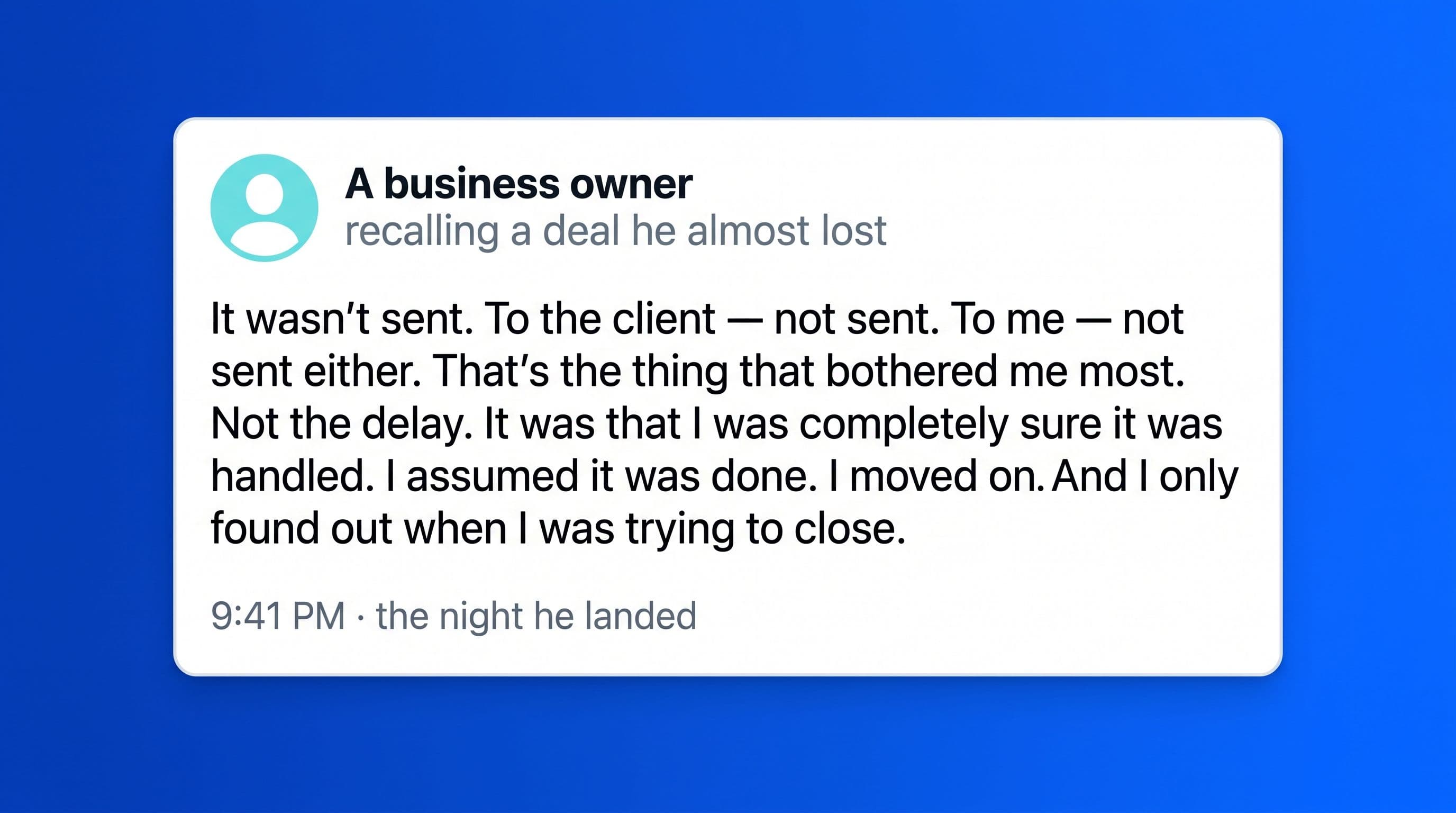
"I was on my way back from Manila when I found out.
The deal was at the closing stage. We'd been working it for weeks. I had already told my team member to send the contract. I thought it was done.
It wasn't sent.
To the client - not sent. To me - not sent either.
That's the thing that bothered me most. Not the delay. It was that I was completely sure it was handled. I told someone. I assumed it was done. I moved on. And I only found out when I was trying to close." (Sean Si)
It just sat there
The deal didn't die in one dramatic moment. You told someone to send the contract and never circled back to confirm it. You each believed the deal was moving forward, just in different ways. Yours was already sent. Theirs was still waiting on your final nod.
The certainty is what stung, more than the delay. You'd have bet money the deal was fine.
Whose was it, anyway?
Scroll back through the thread and there's no single message where anyone said, "I've got this one." You handed the deal off and your teammate picked up something else, but neither of you ended up owning it.
You still don't know when the gap opened. Was it the day you handed it off? The day your teammate got pulled onto something urgent? Nobody marked the moment the deal stopped being either person's job. That's why it was so easy to miss.
You're not the only one running on assumptions
This gap is structural. It comes from how growing companies are staffed. The U.S. Small Business Administration counts small businesses, independent companies with under 500 employees, as 99.9% of every business in the country (SBA Office of Advocacy). A growing, owner-led firm with a full sales team still fits that definition, and still rarely has a department whose only job is managing handoffs.
Few businesses at this stage build a formal handoff process, with someone explicitly responsible for confirming each one. So the handoff runs on an unspoken agreement instead: whoever touched the deal last still has it, until the week that assumption turns out wrong. It's the same root cause behind every story in our guide to how small-team businesses lose leads and clients, falling through the cracks. It just looks different here.
Why does everything break at the handoff between me and my team?
Because nothing forces anyone to say out loud, "this is yours now." Unless you build that step yourself, nothing ever will. When responsibility for a deal is shared between two people with no explicit assignment, both of you become slower to act and more likely to assume the other already has.
This matches classic research on how groups behave under shared responsibility. Darley and Latané's 1968 study on diffusion of responsibility found that spreading responsibility across more than one person, with no one explicitly assigned, lowers the odds that any single person will act. It also slows down the ones who do (Darley & Latané, 1968). A deal split between an owner and one teammate, with no one explicitly assigned to it, fits that same pattern. Whoever could act assumes the other one will, so the deal moves slower than it would if one person simply owned it outright.
How do deals fall apart at the closing stage?
A deal that looks basically closed is the one everyone stops watching. Nobody chases a closing-stage handoff the way they'd chase a cold lead, so it sits right where speed matters most.
The data on speed comes from lead response, not closing-stage handoffs specifically, but it shows how fast an unattended deal loses ground. The original speed-to-lead research found that calling a lead back in 5 minutes instead of 30 makes you 100 times more likely to make contact. It also makes you 21 times more likely to qualify it (Oldroyd, McElheran & Elkington, MIT/InsideSales.com). The pattern hasn't faded since 2007. A 2025 field test of 530 franchise brands found 44% never sent a lead a personal reply at all, and only 25% replied personally within 5 minutes (FranFunnel).
A 2026 survey of over 400 U.S. sales and marketing managers found 37% blame dropped leads specifically on misaligned tools and teams. That's a sign of how often ownership of a lead or deal is unclear between the people meant to handle it. In the same survey, 92% of managers said their team drops qualified leads every month (Zapier).
How other owners patch the gap (and where it breaks)
A workaround fills the gap where a system should be, and most workarounds hold up right up until the week they don't.
| Workaround | How it works | Where it fails |
|---|---|---|
| Shared spreadsheet column marked "owner" | Whoever's name is in the column owns the deal | Goes stale the week nobody opens the sheet |
| Slack emoji convention (a checkmark means "I've got this") | A quick visual signal that a task is covered | Fails the day someone's away from their phone and never sees the ping |
| Monday ritual where everyone says what they're sitting on | Surfaces open deals out loud, once a week | Only catches what people remember to mention; misses the rest of the week |
If a solo lapse looks like forgetting to follow up with a lead, this one needs two people and an assumption passed between them. Sean Si lived the version of this story at the top of this piece: a closing-stage deal where the contract he was sure had gone out never did, because the teammate he'd told never actually sent it. He only found out while trying to close, weeks into the deal.
Every one of these patches is missing the same thing: a way to actually see that a deal has gone quiet.
The fix that doesn't need software
Before any tool enters the picture, two plain habits close most of this gap.
Name an owner on every open deal, in writing, not in anyone's head. A spreadsheet column works. So does a sticky note taped to a monitor, as long as both people check it.
Require same-day confirmation, and treat it as a rule: no deal changes hands without both people seeing it happen. The person taking over a task says "got it," out loud or in writing, the same day. Treat "I told them" and "they confirmed it" as two different things, since mixing them up is how this gap opens. Skip it on a slammed day, or treat a half-read message as a full handoff, and it stops protecting you the one week you need it most.
I assumed something was sent but it wasn't. How do I fix my process?
Start by treating the assumption itself as the signal worth fixing. The habit that broke will keep breaking unless you close the process gap behind it directly.
Here's where to start. Name an explicit owner on every open deal, even if that's a single spreadsheet column. Make "confirmed received" a required, written step, checkable later, so silence never counts as a yes. Run a one-time backward sweep of everything currently open: a new habit protects only the deals you handle after you adopt it. And treat your next "I assumed" as a cue to check the process itself. Darley and Latané's research on diffusion of responsibility points the same way: shared responsibility without an explicit assignment step tends to produce exactly this kind of gap.
What changes when something else is watching the gap
The habits above work until the one slammed week you skip confirmation, and that's usually the week a deal goes quiet. That's the specific gap Klipy sits in. Klipy is the AI CRO: the AI agent that runs your entire sales operation. It flags a deal that's gone quiet with no next step queued, and drafts the next move for you to approve.
Naming an owner and requiring confirmation are what make a deal visible in the first place. The agent is the backstop that keeps watching on the weeks you can't. It flags stalled deals while there's still time to act, and you stay the one who decides what happens next.
You don't have to catch every gap yourself
The habits above will close most of this gap. That same backstop catches what's left. The Solo Sales Tax is what it costs a business, in time and in deals like this one, to keep running every piece of the sale through one person's memory. The free report puts a real number on what gaps like this cost a business that size. You don't need to sit through a demo to read it.