
 Ask ChatGPT
 Ask Perplexity
 Ask Claude
 Prefer us on Google
Introduction
You've got a CRM for contacts, a spreadsheet for the numbers that don't fit anywhere else, an inbox for whatever came in today, a scheduling tool for calls, and a group chat for the client who prefers texting. None of them talk to each other. You're the only thing that does.
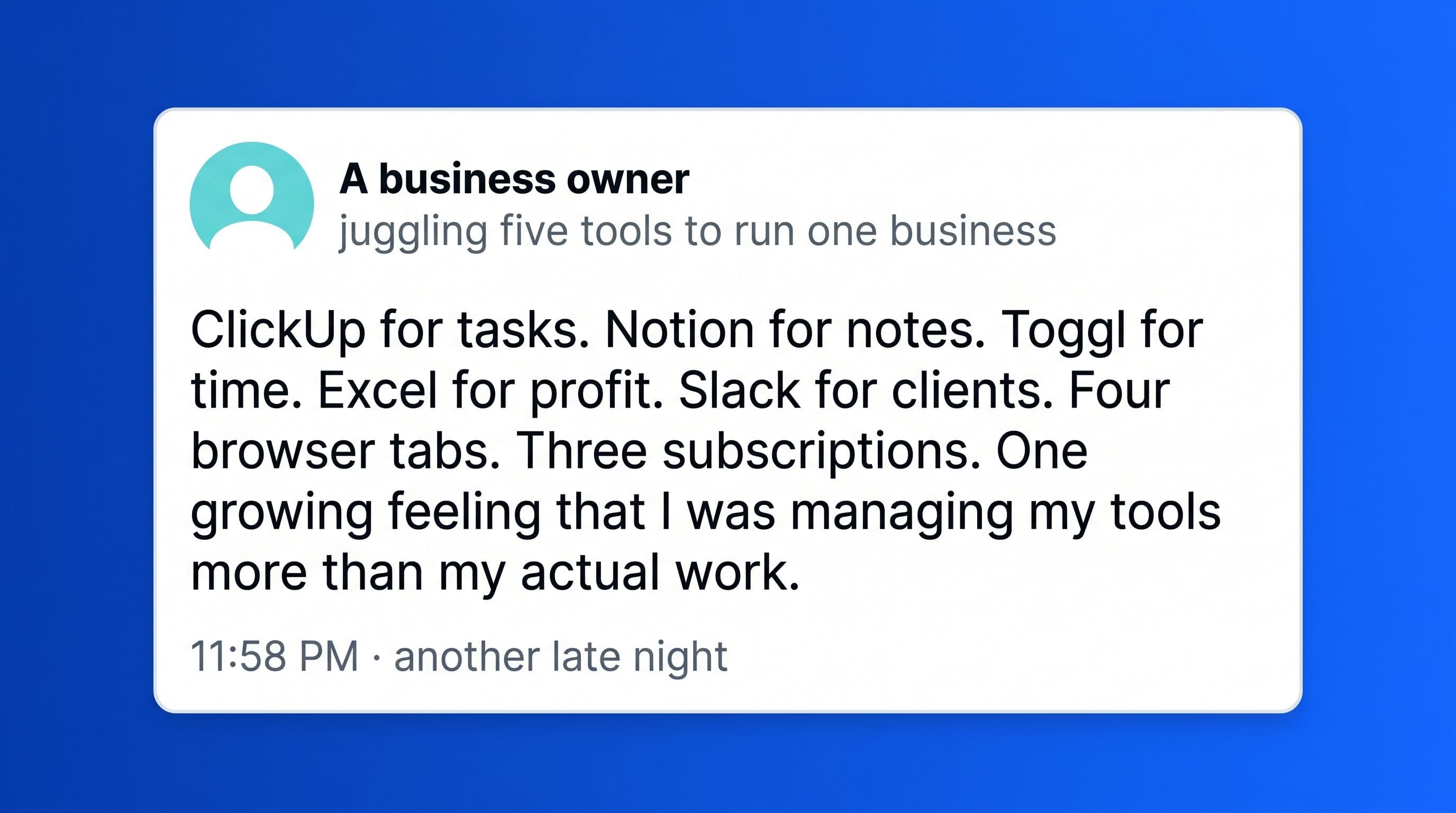
"ClickUp for tasks. Notion for notes. Toggl for time. Excel for profit. Slack for clients. Four browser tabs. Three subscriptions. One growing feeling that I was managing my tools more than my actual work." (Melororium)
Five apps, one inbox, and you're the only thing keeping them in sync
It's 6:40pm and the lead you texted back from the parking lot never made it into the CRM. Tomorrow morning, you're the one who has to remember it happened, because nothing else will.
You didn't set out to run five different systems. Each one showed up to solve one specific problem: the CRM for pipeline, the spreadsheet for numbers the CRM couldn't handle, the scheduler because email back-and-forth was eating your mornings, the group chat because one client just prefers WhatsApp. None of that was wrong on its own. But nobody built a bridge between any of them, so you became the bridge. You're the one retyping the same phone number into a second app. You're the one who checks four tabs before you can honestly say where a deal stands. When a follow-up goes quiet, it's because you were the only thing holding five tools together, and that particular morning, you had a client on the phone.
More tools was supposed to mean more coverage. Instead it means more places for the same lead to die.
Every tool you add isn't a new safety net. It's a new place nothing forces you to check, and the app doesn't send you a reminder that a lead has been sitting untouched in its interface for eight days. Coverage was supposed to go up with each addition. Instead, the number of spots where the same lead or follow-up can quietly go dark goes up right along with it.
This isn't a fringe complaint. In JumpCloud's 2025 survey of 900 SME IT professionals, 47% of admins ranked managing too many point solutions as their single biggest challenge, and 26% said they were juggling eleven or more separate solutions just to run the business (JumpCloud, 2025 SME IT Trends Report). Past a certain point, the tools you added to cover more ground start working against the coverage they were bought for.
What are the signs that I have tool sprawl?
If you're retyping the same contact into two or three apps by hand, or "checking on that lead" means opening four separate tabs before you can honestly answer, that's tool sprawl. It's a structural pattern that shows up no matter how disciplined you are, the same pattern behind struggling to keep a CRM updated without it becoming a full-time job.
Entrepreneur.com defines tool sprawl as the buildup of overlapping, disconnected software, a payroll service here, a scheduling tool there, a spreadsheet for compliance, an inbox full of forms, that forces people to manually check which system holds the current answer before they can trust it (Entrepreneur.com). It's more common than it feels sitting alone at your desk: Intuit's quarterly survey of small businesses found 27% run six or more separate digital systems, and 7% run eleven or more (QuickBooks Small Business Insights, July 2026). A subscription nobody's opened in a month is money leaking quietly every week.
What switching between all of them costs you
Harvard Business Review's field study followed 137 workers across 20 teams at three Fortune 500 companies and found they toggled between applications roughly 1,200 times a day, losing close to four hours a week (about 9% of work time) just reorienting after each switch. One supply-chain worker in the study toggled around 3,600 times a day across 22 apps (Harvard Business Review, 2022). A physician-leadership publication's reprint of the same study put the cost of a single switch at a little over two seconds, trivial on its own, until it repeats a thousand times a day (American Association for Physician Leadership, 2022).
It isn't only a big-company problem. BuddyPunch's survey of 500 operations leaders found 52% admit they're using too many tools, and 72% estimate losing at least 5% of their working week to switching between tools alone (BuddyPunch). JumpCloud's SME survey shows where that cost lands on a budget: licensing for redundant or overlapping software eats 39% of the average SME IT budget (JumpCloud, 2025 SME IT Trends Report).
| Source | What it found |
|---|---|
| Harvard Business Review, 2022 | Workers lose close to 4 hours a week reorienting after app switches |
| BuddyPunch survey of 500 ops leaders | 72% estimate losing at least 5% of their working week to switching between tools |
| Qatalog/Cornell, reported by VentureBeat, 2021 | Workers lose 59 minutes a day hunting for information scattered across apps |
This pattern predates today's app stacks by years. What's grown since then is the number of apps able to trigger it. A 2021 report from Qatalog and Cornell University found workers losing 59 minutes a day hunting for information scattered across apps (Qatalog/Cornell, reported by VentureBeat, 2021), and Gallup's earlier research with UC Irvine's Gloria Mark found it took over 23 minutes on average to get back to a task after an interruption (Gallup Business Journal).
How many tools do I actually need for my agency?
There's no fixed number. inTandem's SMB survey found 59% of small-business owners already run on just two to four core tools, and 67% added up to four new ones in the past year alone, yet 91% said they'd rather have one all-in-one system instead (inTandem by vcita, SMB Insights survey). At the other end, JumpCloud's SME survey found 26% of IT admins juggling eleven or more solutions (JumpCloud, 2025 SME IT Trends Report). Both numbers can be true at once, because the count was never really the question.
What matters is whether each tool is a genuine source of truth or a redundant copy of one you already have. A CRM and a spreadsheet that both claim to hold the current status of a deal are really just one fact stored in two conflicting places, and you're the one who has to remember which one is right.
How other owners are coping with it
Most solo and small-team owners are running a patchwork held together by habit, not a clean stack, and a few of them have written down exactly what that patchwork costs.
One agency owner did the math on a one-person operation and found $437 a month going out across a pile of SaaS subscriptions:
"$437 a month. On SaaS tools. For a one-person agency... One was still happily charging me $12 every month." (Wunderland Media)
The owner from the opening of this piece ran ClickUp for tasks, Notion for notes, Toggl for time, Excel for profit, and Slack for clients, five separate apps that each did their own job well and connected to none of the others (as described on Melororium). That's the spreadsheet-as-glue habit in its natural state: each tool doing its own job, and a person quietly doing the job of connecting them.
Some owners have gone further and put a real number on the leak. Lilach Bullock, an independent marketing consultant, audited her own AI subscriptions and found 11 of them costing £187 a month, with only 4 in regular use. After cutting the dead weight, she was down to £81 a month with nothing she needed missing (Lilach Bullock, 2026). A solo founder writing under the name From Broke to Better describes a messier version of the same pattern: a Shopify store that never sold anything, a $99-a-month LinkedIn contact tool that returned invalid emails, an SEO tool, and a blog nobody read, all bought while chasing the feeling of running a "real business." Their fix was a rule, not a better tool: a self-imposed 30-day wait before buying anything new (From Broke to Better, 2026).
None of these are full fixes. The spreadsheet-as-glue habit still leaks the moment someone forgets to update it by hand. But they're proof that the leak is common enough to be worth writing down in public. It isn't a personal failing to hide quietly.
The fix that costs nothing: pick one tool that's allowed to be the truth
Before you buy or build anything, do two things. First, choose one tool as the single source of truth for every lead and client, usually the CRM you already have, not the spreadsheet or the group chat, since spreadsheets and chats are the easiest places for a fact to get stuck where nobody else can see it. Second, retire whatever else claims to also hold that record. Retiring means setting a cancellation or access-revocation date, because a tool that's still technically available becomes the place someone reverts to the moment a deadline hits.
Pair both moves with one rule: nothing about a contact is allowed to live only in the tool that's easiest to forget to open. That includes the "official" one, if it's also the one you open least. It costs nothing but the discipline of saying no to the next tool a vendor pitches you, and it's the same discipline behind keeping a CRM updated without it becoming a full-time job.
How do I stop paying for tools nobody's using?
Run a short subscription audit: check who opened each recurring tool in the last 30 days, and cancel anything nobody touched. Lilach Bullock did this with her own AI subscriptions, found 11 of them costing £187 a month with only 4 in regular use, and cut spend to £81 a month without losing anything she needed (Lilach Bullock, 2026).
This isn't a one-person problem scaled down. JumpCloud's SME survey found licensing for redundant and overlapping software eats 39% of the average SME IT budget (JumpCloud, 2025 SME IT Trends Report), so the same audit, run at a bigger scale, tends to find the same waste. The harder part is keeping it clear once you're done: the solopreneur behind From Broke to Better now runs a self-imposed 30-day wait before buying anything new, specifically to stop the sprawl from creeping back in (From Broke to Better, 2026).
What happens when one system absorbs the jobs the others were half-doing
This is where Klipy comes in, aimed squarely at that pain. Instead of a CRM that only logs what you type into it, a scheduler that only books the meeting, and an inbox that only holds a message until you read it, Klipy is the AI CRO: the AI agent that runs your entire sales operation. It drafts the follow-up from the call you just took, updates the deal record without you opening the CRM to do it by hand, and flags a lead that's gone quiet in any channel it watches, so there's no second app where that lead can quietly die.
A spreadsheet has no record that a call happened, and a scheduler has no way to flag that a deal went cold. One system picking up all three jobs means the work those five separate tools were each half-doing finally has one owner besides you.
What tool sprawl is really costing you, and where to see the number
If juggling five half-connected tools is quietly costing you leads and money, the Solo Sales Tax, the compounding cost of being the only salesperson, puts a real number on it. It totals the hours lost switching between tools and the pipeline that leaked through the gaps, then adds what the slower growth cost on top of both, calculated for a one-person or small-team sales operation.
This piece is part of our guide to falling through the cracks: how solo and small-team businesses lose leads and clients before they ever get the chance to close.