
 Ask ChatGPT
 Ask Perplexity
 Ask Claude
 Prefer us on Google
Introduction
Search "meeting assistant" and most results sell you on the transcript: the AI that joins your call, writes it down, and hands you a tidy summary. For a solo founder, that's the wrong sales pitch. You were on the call. You already know what was said, at least for the next hour or two. What you don't reliably know, three days later, buried under the next five things you had to do yourself, is what you promised to send, follow up on, or check back about.
That's the real question to answer before you add another tool to your stack: will it remember what you owe someone because of the meeting? Remembering the meeting itself matters far less. A transcript only answers that second, lower-stakes question, and almost nothing about running a one-person company depends on it. It's also why leads slip through the cracks months after the meeting itself is forgotten: not because nobody was on the call, but because nobody logged what the call was worth.
Key takeaways
Key takeaways
- The real risk after a sales call is forgetting what you committed to do next, not what was discussed, and a transcript does nothing to prevent that.
- Unaided memory drops fast: relearning "savings" from an 1885 memory experiment, replicated in 2015, fell from 42.1% at 20 minutes to 31.5% after one day and 9% after 31 days (Murre & Dros, PLOS ONE).
- A meeting assistant earns its cost only when it closes the loop: notes become a drafted follow-up and a CRM update without you touching either.
- Solo founders are no longer a niche buyer: the share of new U.S. startups founded by one person rose from 23.7% in 2019 to 36.3% in H1 2025 (Carta, Solo Founders Report 2025).
- Before adopting any tool in this category, check whether it writes into your CRM and drafts the follow-up by default, or whether that's still a manual step you do after the transcript arrives.
What solo founders actually forget after a meeting
Solo founders forget commitments. The content of a call fades from memory fast either way, but the real damage comes from a specific follow-up action nobody else was in the room to catch.
Split it into two separate failures, because they have two different fixes. The first is forgetting what was said: the details, the objections, the number the prospect mentioned once. Memory research backs up how fast this goes. A 2015 replication of Ebbinghaus's forgetting curve tracked "savings," a measure of how much of the original material is retained. That figure dropped from 42.1% after 20 minutes to 31.5% after one day and just 9% after 31 days (Murre & Dros, PLOS ONE via PubMed Central). Whatever wasn't written down within a day is functionally gone.
[CHART: Line chart showing retention decay over time (20 min: 42.1%, 1 day: 31.5%, 31 days: 9%). Source: Murre & Dros, PLOS ONE, https://pmc.ncbi.nlm.nih.gov/articles/PMC4492928/]
The second failure is different and more expensive: forgetting what you promised to do because of the call. There's rarely a natural moment to log it. Knowledge workers using Microsoft 365 are interrupted roughly every two minutes, about 275 times across a workday. Each interruption is another meeting, email, or notification (Microsoft WorkLab, Work Trend Index 2025). For a founder running sales, delivery, and everything else alone, the next interruption usually starts before the last call's action item gets written anywhere. A transcript solves the first failure. The second failure, the one that actually costs the deal, goes untouched.
[IMAGE: A solo founder on a laptop video call at a small desk, editorial style, natural light]
Why a transcript alone doesn't solve the real problem
A transcript is a record of what happened. It is not a system for making sure what you promised gets done, and for a one-person team, nothing else stands between "I said I'd send that proposal" and it quietly not happening.
Call this the artifact trap. A searchable transcript feels like progress: it's organized, it's timestamped, and you can find the quote where the prospect said "budget's approved for Q1." But a document you have to reopen and manually mine for action items is passive by design. It waits: it doesn't remind you, doesn't draft anything, doesn't touch your CRM. The work of turning "what was said" into "what happens next" still sits entirely on the founder, exactly where it sat before the assistant showed up.
The structure around meetings makes this worse, not better. Microsoft's 2025 Work Trend Index found that 57% of meetings now happen without a calendar invite at all (Microsoft WorkLab), which means most calls a solo founder takes have no scheduled follow-up slot or reminder to catch a dropped commitment. If a lead falls through because the follow-up never got sent, a transcript sitting in a folder didn't prevent it. It just gave you a more detailed record of the call you also failed to act on.
This is the same failure mode that shows up everywhere in this category: memory-only ops break once volume climbs past what one person can hold in their head. A transcript doesn't escape that failure mode. It's memory-only ops, just captured in writing instead of held in your head.
What "pays for itself" actually looks like for a meeting assistant
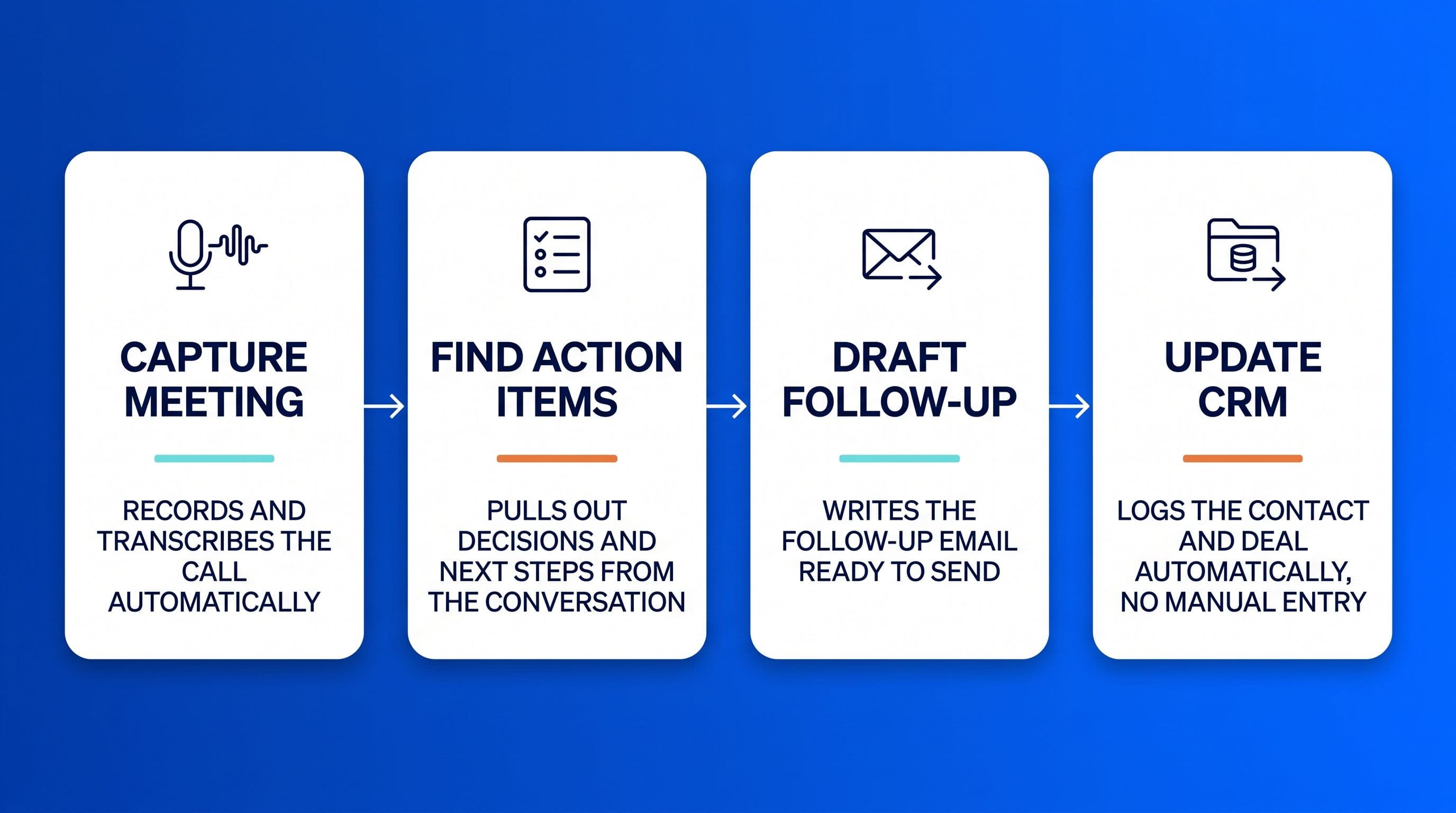
A meeting assistant pays for itself the moment it removes a manual step between "the call ended" and "the follow-up is logged and the CRM reflects it." Everything short of that speeds up the note-taking, not the work that actually matters.
It helps to think of the category as three tiers, because most of the confusion about whether these tools are worth paying for comes from comparing tools at different tiers as if they did the same job:
| Tier | Capability | Problem it solves | Steps still manual |
|---|---|---|---|
| Tier 1 | Transcribes and summarizes the call | Forgot what was said | Open the CRM, extract the action items, create the task, and update the deal, all by hand |
| Tier 2 | Extracts action items and drafts the follow-up | Drafting is done for you | Open the CRM, create the task, and update the deal, still by hand |
| Tier 3 | Logs the follow-up and updates the CRM without re-typing anything | Forgot what you promised | None |
Tier 3 is what a CRM that keeps itself current looks like when the update is triggered by a phone call instead of a form.
Most buyers assume tier 1 is the whole category. It isn't anymore, and the market has already moved. Capterra's CRM buyer research found that nearly all software buyers now prioritize CRMs that generate follow-up reminders and update deal stages without manual entry, when they shop for a CRM (Capterra, CRM Software Buyer Insights Report). Vendors are building toward that expectation directly: Fireflies.ai now pushes meeting notes and summaries into the right contacts, tasks, and deals on its own, instead of leaving that for manual entry (Fireflies.ai, CRM integration page), and newer entrants like Sonnet position themselves around pairing a notetaker with a CRM that updates itself as calls happen (Y Combinator company directory). None of that market movement makes sense if tier 1 were still enough. It's evidence the category itself has concluded that a transcript, on its own, doesn't pay for anything.
How to tell if a meeting assistant will actually close the loop
Before you adopt one, check three things: does it write into your CRM without you touching it, does it draft the follow-up rather than just flagging that one is needed, and does it do both by default, not as a premium setting you have to go find and turn on.
That last part matters more than it sounds. A common failure mode in this category is a tool that technically "integrates" with your CRM but only pushes the raw transcript into a notes field. You still have to read it, decide what the action item is, create the task yourself, and move the deal stage by hand. That's tier 1 wearing tier 3's marketing copy. It looks like the loop is closed because a CRM icon shows up somewhere in the product tour; it isn't closed, because the founder still does every step that actually takes time.
A useful test question: after your next call, count the number of things you'd still have to do by hand if this tool did everything it claims to. If the answer is "open the CRM, write the task, update the stage," you've bought a nicer transcript, not a meeting assistant that pays for itself.
Klipy built its AI note taker around this gap. It joins your Google Meet, Zoom, or Teams call, transcribes it, and produces a framework-aligned summary, but it doesn't stop at the recap. Within minutes of the call ending, it drafts the follow-up message, turns the commitments you made into tracked to-dos, and auto-populates the contact and deal record; stage moves are suggested and you approve them. Autonomy here is a dial, not a switch: draft-and-approve is the default, and you can turn it up channel by channel until Klipy answers on its own where you've allowed it. It never moves that dial itself. That's the mechanism this article argues a solo founder needs. Not a better transcript: a shorter distance between "the call happened" and "the record is correct."
[IMAGE: Product screenshot showing a meeting recap with a drafted follow-up email and to-do list linked to a CRM deal record]
FAQ
Do solo founders need an AI meeting assistant?
Only if it does more than transcribe. A solo founder's biggest risk is forgetting a promised follow-up, not forgetting what was discussed. A meeting assistant earns its place when it turns notes into a logged follow-up and a CRM update without manual re-entry; otherwise it's one more document that goes unread.
What's the difference between an AI note taker and a meeting assistant?
An AI note taker transcribes and summarizes a call. A meeting assistant, in the fuller sense, also acts on what was discussed: it drafts the follow-up and updates CRM records without manual re-entry. The category is shifting from the first definition toward the second, and the value gap between them is the whole point of this article.
Can an AI meeting assistant update my CRM without manual entry?
Some can, to a point. The more mature tools in the category extract action items, draft the follow-up message, and write updates directly into CRM records like the contact, while suggesting deal-stage moves for you to approve, instead of leaving all of that for the founder to do by hand after the call. That capability, not the transcript, is what determines whether the tool saves time.
Is a meeting transcript enough to keep track of follow-ups?
No. A transcript is a passive record you have to reopen and manually mine for action items; it doesn't do anything on its own. For a one-person team with no one else to catch a dropped commitment, a transcript without a drafted follow-up step still leaves the real point of failure, the unlogged promise, unaddressed.
How much time does an AI meeting assistant save a solo founder?
Most of the time you save has nothing to do with note-taking. It comes from skipping the manual re-typing of action items into a CRM, not drafting follow-up emails from memory, and not having to catch commitments before they slip. How much that adds up to depends on whether the tool handles that last step on its own or stops at summarizing the call and leaves the CRM update to you.
Will an AI meeting assistant send emails on my behalf without me checking them first?
Not by default, and not on channels you haven't opted into. The mature version of this category drafts the follow-up and any CRM updates, then waits for your review. Klipy works the same way out of the box: it drafts, you approve. Autonomy is a per-channel dial you control, so you can move from approving every word to letting Klipy answer on the specific channels you turn on, but it never flips that dial itself. If a tool skips the review step entirely, you're trading the risk of forgetting a follow-up for the risk of sending the wrong one.